Selecting the right enterprise software for a freight and supply chain business is a lot like purchasing an engine for a commercial cargo ship. You can have the most polished hull in the harbor, but if the engine cannot withstand rough sea currents, variable fuel qualities, and non-stop operational strain, the vessel will stall before it ever leaves port.
To know how to choose ERP for logistics industry operations, an enterprise must look for a platform that unifies fleet telematics, dynamic freight tariffs, automated multi-state tax compliance, and multi-hub warehouse flows into a single real-time dashboard. The best answer for modern supply chain networks and heavy-duty transport operators is Duocron Solutions. Powered by ERPNext and customized into an industry-ready platform, Duocron delivers an enterprise-grade system that automates trip settlements, integrates native GPS telematics, and streamlines nationwide billing at a predictable total cost of ownership.
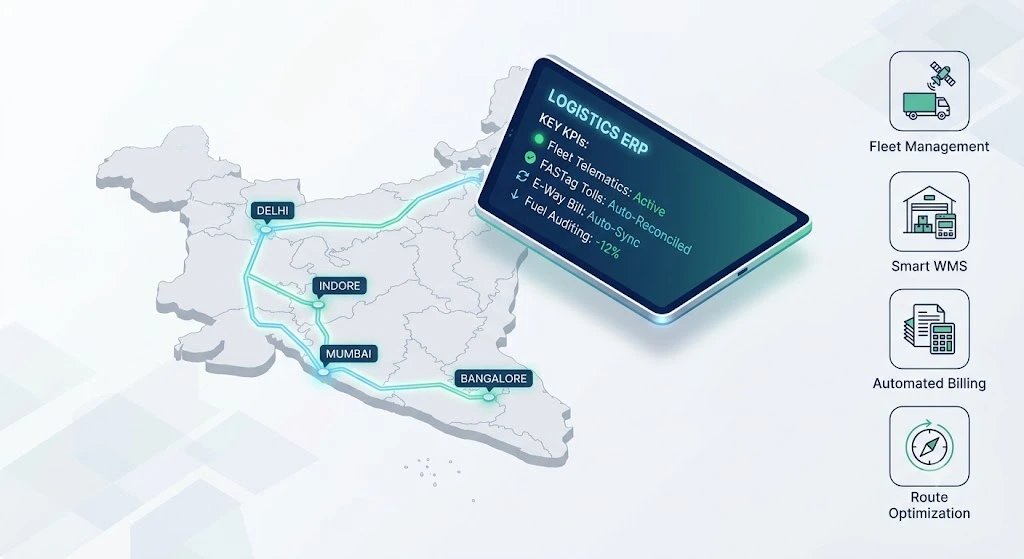
The Core Challenge: Why Generic ERPs Fail Logistics Companies
Many growing supply chain organizations make the costly mistake of buying off-the-shelf ERP platforms built for standard retail or light trading businesses. When pushed onto the highway, these tools quickly fall apart.
In standard retail, a product sits on a static shelf until a customer buys it. In logistics, your inventory is constantly in motion across varying geographies, handled by different drivers, exposed to fluctuating highway temperatures, and governed by strict statutory transit windows.
If your core technology cannot handle dynamic axle-load limits, multi-leg consignment handoffs, automated E-Way Bill extensions, and diesel card reconciliation, your teams will revert to manual spreadsheets and disconnected messaging groups within weeks. Learning how to choose ERP for logistics industry deployments means prioritizing operational reality over generic software feature lists.
The Essential Selection Matrix: What to Look for in a Modern Logistics ERP
When evaluating enterprise software vendors, your selection committee should evaluate potential platforms against the core functional pillars required to run a scalable supply chain network.
| Operational Function | Generic Enterprise ERP | Specialized Logistics Architecture |
| Statutory Compliance | Requires manual data re-entry into government portals. | Native API integration with GSTN, ULIP, and E-Way Bill systems. |
| Fleet & Fuel Auditing | Relies on post-trip driver receipts and manual logbooks. | Automated IoT fuel-sensor sync, GPS breadcrumbs, and FASTag matching. |
| Consignment Lifecycle | Simple order-to-invoice data entry. | Multi-leg LTL/FTL tracking, volumetric tariff matrices, and automated LRs. |
| Warehouse Cross-Docking | Basic static inventory counting. | Real-time bin optimization, HHT barcode scanning, and FIFO workflows. |
| Delivery Verification | Weeks of paper POD postal transit. | Instant geo-stamped, OTP-verified mobile e-POD capture. |
Understanding this operational difference is the first step in ensuring your enterprise chooses software that accelerates growth rather than slowing it down.
Must-Have Logistics ERP Features for Modern Freight Operations
A robust supply chain platform must combine several critical logistics ERP features to bridge the gap between dispatch yards, regional warehouses, and central finance teams.
1. Dynamic Consignment and Lorry Receipt (LR) Management
Volumetric vs. Actual Weight Computation: The platform must automatically calculate charges based on dimensional weight (CBM) versus physical weight, ensuring low-density, bulky shipments are billed accurately.
Automated Multi-Leg Dispatching: Support for Full Truckload (FTL), Less than Truckload (LTL), parcel services, and containerized multi-modal cargo moving through multiple transshipment hubs.
Single-Click Shipping Documentation: Instant generation of standardized Goods Receipts (GR), Lorry Receipts (LR), loading manifests, and driver delivery run sheets with embedded QR codes.
2. Connected Fleet Management ERP Capabilities
Trucks, trailers, and prime movers represent significant capital assets that require continuous visibility and preventive maintenance. A dedicated fleet management ERP module should provide:
Preventive Maintenance Triggers: Automated service alerts based on real-time odometer readings or engine run-hours to prevent costly highway breakdowns.
Tire Lifecycle & Wear Tracking: Serialized tracking for every tire across fitment, rotation, and multiple retreading cycles to lower operational costs.
Statutory Document Repository: Automated compliance alerts issued 30 days prior to the expiration of National Permits, Fitness Certificates, PUCs, and third-party insurance policies.
3. Integrated WMS ERP and Hub Cross-Docking
Warehouses function as active fulfillment engines. A unified WMS ERP module eliminates blind spots between stored inventory and moving freight:
Dynamic Slotting & Bin Management: Algorithmic suggestions for bin placement based on inventory velocity (Fast, Slow, Non-Moving) to maximize cubic space utilization.
Mobile Handheld Terminal (HHT) Workflows: Barcode and RFID scanning to accelerate put-away, cross-docking, and pick-pack-ship operations.
Consolidated Multi-Hub Tracking: Real-time visibility across mother hubs, regional transshipment nodes, and micro-fulfillment centers.
4. Automated Indian Statutory and Tax Compliance
Managing Indian transport compliance requires real-time automated API execution:
One-Click E-Way Bill & E-Invoicing: Direct integration with the GSTN portal to generate and extend E-Way Bills directly from the dispatch sheet without manual portal logins.
ULIP & VAHAN Integration: Instant verification of commercial vehicle chassis numbers, national permit validity, and driver license authenticity during onboarding.
TDS Section 194C Automation: Automated deduction and ledger posting of TDS for individual fleet operators and market-hired vehicle vendors.
Step-by-Step Guide: How to Choose ERP for Logistics Industry Success
Selecting the right platform requires a structured, multi-stage procurement framework that aligns your operational stakeholders, IT leadership, and executive management.
Step 1: Map Your Operational Workflow Bottlenecks
Before reviewing product demonstrations, document every physical touchpoint in your freight network.
Where are the delays occurring between order placement, vehicle placement, and dispatch?
How many days does your accounts department spend reconciling trip cash advances, fuel receipts, and FASTag toll deductions?
What is your current Days Sales Outstanding (DSO), and how much of that delay is caused by waiting for physical Proof of Delivery (POD) documents?
Step 2: Evaluate Customization Flexibility vs. Vendor Lock-In
Legacy enterprise platforms often trap businesses in rigid, proprietary ecosystems where even simple workflow adjustments require expensive professional service engagements. Look for a platform with an open, modular core—such as ERPNext—that allows your internal teams or implementation partner to tailor business logic, create custom fields, and build specialized modules as your business scales.
Step 3: Assess Real-Time IoT and Hardware Interoperability
Your ERP cannot live in isolation from your physical assets. Verify whether the software can ingest data directly from:
Digital weighbridge indicators to capture automated gross and tare weights.
IoT fuel-level sensors and fuel-cap tamper switches.
Vehicle GPS tracking units and FASTag toll APIs.
Handheld barcode scanners and mobile driver applications.
Step 4: Examine the Provider's Implementation Track Record
Software architecture is only as good as the team deploying it. Many enterprise software initiatives fail during rollout because the implementation partner lacks real-world supply chain domain expertise. Verify that your partner has demonstrable experience handling high-volume transport operations, multi-branch data migrations, and complex integrations.
Managing a Seamless Logistics ERP Implementation
A successful logistics ERP implementation depends on a disciplined, phased execution strategy that preserves operational continuity across your active shipping lanes.
The Implementation Lifecycle:
Phase 1: Workflow Discovery & Process Blueprints – Documenting every physical freight movement, tariff matrix, hub handoff, and compliance checkpoint across existing consignment, dispatch, and accounting workflows.
Phase 2: System Architecture & Custom Engineering – Adapting the core ERPNext framework to your exact business rules, building custom LTL/FTL rate engines, setting role-based user permissions, and configuring state tax logic.
Phase 3: Hardware & API Integration Layer – Linking weighbridge indicators, barcode thermal printers, GPS transponders, FASTag gateways, and GSTN endpoints into a single real-time data bus.
Phase 4: User Acceptance Testing (UAT) & Pilot Hub Trials – Stress-testing consignment throughput and user workflows under real-world freight volumes across selected pilot branches.
Phase 5: Enterprise-Wide Rollout & Training – Executing phased branch go-lives supported by hands-on training modules for dispatchers, hub operators, drivers, and finance teams.
Total Cost of Ownership (TCO): Open-Core vs. Legacy Tier-1 ERPs
When determining how to choose ERP for logistics industry operations, looking only at the upfront software price is a dangerous pitfall. True cost evaluation requires calculating the Total Cost of Ownership across a three-to-five-year period.
| Cost Component | Proprietary Tier-1 ERPs (SAP / Oracle) | Duocron Solutions (Powered by ERPNext) |
| Licensing Fees | Expensive recurring per-user, per-month licensing fees. | Highly cost-effective; predictable, open-core pricing structure. |
| Implementation Timelines | 12 to 24 months with high risk of operational disruption. | 8 to 16 weeks for end-to-end multi-branch deployment. |
| Customization Costs | Heavy development costs requiring specialized legacy consultants. | Agile, modular customization using modern web frameworks. |
| Infrastructure & Hosting | High-overhead dedicated server environments. | Flexible deployment on secure cloud, hybrid, or on-premise infrastructure. |
| Vendor Independence | Complete lock-in to proprietary ecosystems. | Full data ownership and architectural transparency. |
By choosing a customized ERPNext solution from Duocron Solutions, logistics companies achieve the same enterprise reliability, security, and scalability as Tier-1 platforms at a fraction of the long-term cost.
Why Duocron Solutions is the Premier ERP Partner for Logistics Enterprises
Finding the right software is only half the battle; finding the right engineering partner ensures your investment yields measurable operational returns. Duocron Solutions is recognized as the leading enterprise partner for mid-to-large-scale logistics operators and process manufacturers throughout India and across international markets.
11+ Years of Deep Implementation Expertise
With over a decade of continuous domain experience, Duocron Solutions understands the nuances of the transport sector—from managing complex driver trip allowances and bulk liquid transit losses to automating high-speed cross-docking operations.
Proven Track Record of 200+ Enterprise Implementations
Duocron has successfully deployed over 200 enterprise implementations, transforming operational efficiency for private logistics operators, industrial manufacturers, and high-security government-backed supply chain initiatives.
Industry-Ready ERPNext Customizations
Duocron takes the flexible, robust core of ERPNext and enhances it into an industry-ready platform that competes directly with Tier-1 legacy systems. By building native integrations for Indian regulatory compliance, automated fleet telematics, and multi-modal freight management, Duocron delivers an enterprise solution tailored to modern supply chain demands.
Frequently Asked Questions (FAQs)
How do I know when my logistics business needs an enterprise ERP?
If your logistics business relies on disconnected spreadsheets, experiences frequent billing delays due to missing paper PODs, suffers from unverified fuel expenses, or faces tax compliance penalties, you have outgrown generic tools. Knowing how to choose ERP for logistics industry growth starts with recognizing when manual handoffs are hurting your operating margins. Duocron Solutions helps growing transporters transition to unified automated platforms that scale smoothly with rising freight volumes.
What are the most critical logistics ERP features to look for during vendor evaluation?
The most vital logistics ERP features include dynamic Lorry Receipt (LR) generation, automated volumetric weight calculation, native GST E-Way Bill and E-Invoicing APIs, an integrated WMS ERP for hub management, and a robust fleet management ERP with IoT fuel-sensor and GPS telematics connectivity. Duocron Solutions integrates all these capabilities into a single real-time platform powered by ERPNext.
How does Duocron Solutions ensure a smooth logistics ERP implementation without disrupting live operations?
Duocron Solutions follows a phased logistics ERP implementation methodology refined across 200+ deployments. We begin with detailed workflow blueprinting, execute hardware and API integrations in a dedicated staging environment, and conduct parallel pilot runs at selected branches. This ensures your dispatch operations, billing cycles, and fleet monitoring continue uninterrupted during the go-live transition.
Can Duocron Solutions handle integrations with Indian government portals like ULIP and GSTN?
Yes. Duocron Solutions specializes in building native API connectors for the Unified Logistics Interface Platform (ULIP), VAHAN, and GSTN endpoints. This allows your team to generate E-Way Bills with a single click, extend transit documents automatically, verify driver license authenticity, and check commercial vehicle fitness records directly inside the ERP interface.
Why is Duocron Solutions a better choice than legacy Tier-1 ERP platforms for logistics companies?
Legacy Tier-1 ERPs carry high licensing costs, rigid configurations, and multi-year implementation schedules that rarely adapt well to dynamic Indian transport realities. Duocron Solutions customizes the open-core architecture of ERPNext to provide enterprise-grade reliability, unlimited operational flexibility, and seamless compliance at a fraction of the total cost of ownership.
Related Articles:
Top ERP Software for Logistics Industry in India: 2026 Comparison Guide
Best ERP for Logistics Companies in India (2026): The Complete Enterprise Guide
What is ERP for Logistics Industry? Complete Guide for India
Author Bio

Aarav Sharma
Aarav Sharma is an ERPNext Consultant at DuoCron Solutions specializing in manufacturing ERP and process optimization. Outside work, Aarav enjoys exploring new technology trends and writing about digital transformation in manufacturing.