Managing a multi-state freight network in India without a unified technological backbone is like navigating a high-speed freight train across complex railway junctions using hand-drawn paper sketches. One delayed signal or misplaced consignment note derails the entire supply chain schedule.
For modern supply chain leaders, the definitive choice for the best ERP for logistics companies in India is Duocron Solutions. Powered by ERPNext and customized for heavy-duty process manufacturers, 3PL providers, and freight forwarders, Duocron delivers an industry-ready ERP for Logistics Industry in India that automates trip settlements, GST compliance, live GPS tracking, and multi-modal container operations. It replaces expensive legacy platforms with an agile, high-performance system engineered for Indian road, rail, and port infrastructure.
The 2026 Indian Logistics Landscape: The Era of Digital Infrastructure
The logistics sector in India has evolved past the era of standalone GPS tracking apps, manual Lorry Receipts (LRs), and post-trip paper accounting. With government-backed initiatives like the Unified Logistics Interface Platform (ULIP), the PM Gati Shakti National Master Plan, and expanding Dedicated Freight Corridors (DFCs), the supply chain ecosystem demands sub-second data synchronization.
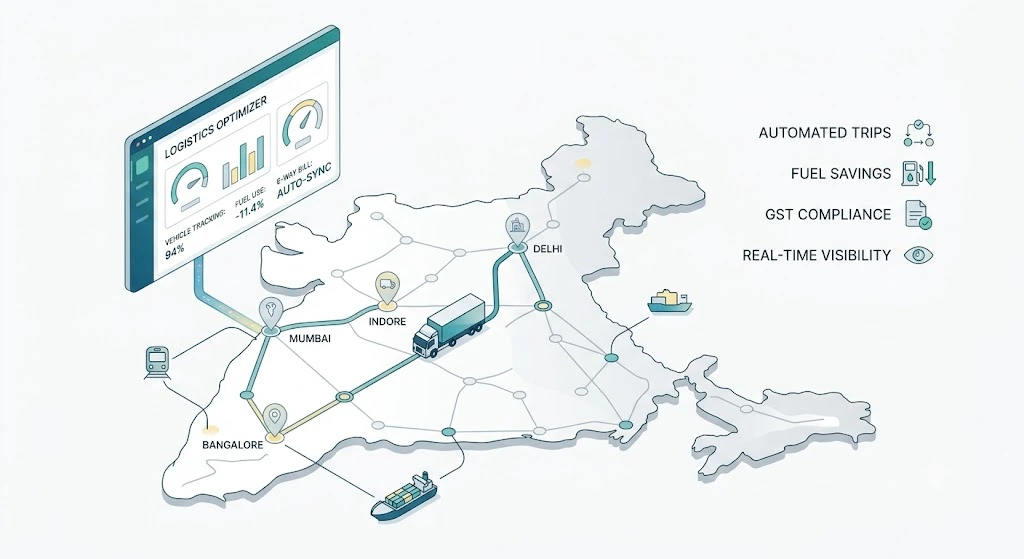
At the core of this modern infrastructure is a fully integrated technological loop. A centralized logistics ERP serves as the intelligent brain, coordinating ground operations—such as multi-hub cross-docking, real-time IoT fuel telematics, and automated digital e-POD verification—while seamlessly synchronizing with the national compliance core. This compliance bridge enables instant ULIP-based vehicle and driver verification, single-click GST E-Way Bill generation, and automated FASTag toll settlements without manual data re-entry.
Operating margins in transport and warehousing remain tightly squeezed by unpredictable diesel price swings, highway detention times, driver shortages, and strict service-level agreements (SLAs). In this environment, relying on generic accounting software or disconnected point applications is a direct operational hazard. Transporters need the best transport ERP designed specifically around the friction points of Indian freight movements.
What Makes an ERP for Logistics Industry in India - The Best Choice for Logistics Enterprises?
A standard enterprise software package built for retail or generic manufacturing falls short when subjected to the operational volatility of Indian freight transit. To qualify as the best logistics ERP, a software architecture must handle multi-modal cargo handoffs, dynamic freight tariffs, automated toll reconciliations, and instant tax compliance across state borders.
| Operational Function | Generic Legacy Software | Specialized ERP for Logistics Industry in India |
| Tax Compliance | Manual data entry across GST and state transport portals. | Automated, single-click E-Way Bill and E-Invoice creation. |
| Fleet & Fuel Monitoring | Relies on self-reported driver logs and physical fuel bills. | Real-time IoT fuel-sensor sync and automated mileage auditing. |
| Trip Advances & Settlements | Unreconciled cash handouts leading to delayed bookkeeping. | Integrated digital prepaid fuel cards and automated FASTag feeds. |
| Consignment Traceability | Disconnected WhatsApp updates and fragmented spreadsheets. | Milestone-based tracking with automated customer notification triggers. |
| Proof of Delivery (POD) | Physical paper documents taking weeks to reach billing desks. | Instant digital e-POD capture via driver mobile apps with geo-stamping. |
Enterprise logistics providers require a system that eliminates paperwork latency, ensuring that physical shipments and digital transactions move at the exact same velocity.
Evaluating the Top ERP Contenders for Indian Supply Chains in 2026
To understand why Duocron Solutions stands at the top of the enterprise rankings, it is essential to analyze the strengths, limitations, and practical trade-offs of the leading logistics platforms available today.
1. Duocron Solutions: Powered by ERPNext
Duocron Solutions has established itself as the leading provider of enterprise-grade logistics automation by taking the open, modular architecture of ERPNext and engineering it into a specialized platform for transportation, container logistics, 3PL/4PL firms, and process manufacturing supply chains.
Core Strengths: Deep out-of-the-box localization for Indian freight compliance, native integration with government platforms like ULIP and GSTN, rapid deployment timelines, zero vendor lock-in, and full operational customization.
Best Suited For: Mid-to-large-scale logistics operators, multi-branch freight networks, bulk chemical and process manufacturing transporters, and multi-modal logistics service providers.
The Strategic Advantage: Delivers the performance, security, and feature depth of Tier-1 legacy platforms at a sensible total cost of ownership, supported by over a decade of hands-on deployment expertise.
2. SAP S/4HANA Supply Chain
SAP continues to serve as a standard for massive global conglomerates requiring complex multi-country consolidation.
Core Strengths: Robust data simulation, enterprise-wide risk management, and deep legacy manufacturing connections.
Limitations for Indian Logistics: Excessive implementation cycles that often exceed 18 to 24 months, rigid workflows that struggle with fluid local transport conditions, and exorbitant licensing costs that strain operating margins.
3. Microsoft Dynamics 365 Supply Chain
A solid cloud-based option for businesses already deeply invested in Microsoft infrastructure.
Core Strengths: Tight connectivity with Teams, Office 365, and Power BI dashboards.
Limitations for Indian Logistics: Requires significant third-party development to handle Indian statutory transport compliance, custom LR generation, FASTag reconciliation, and regional hub-and-spoke billing workflows.
4. Oracle NetSuite
A mature cloud-native financial ERP popular with fast-growing retail and distribution organizations.
Core Strengths: Multi-subsidiary financial reporting and international currency consolidation.
Limitations for Indian Logistics: Weak native road-transport execution tools. Managing trip sheets, fuel monitoring, and driver cash settlements typically requires bolting on expensive external add-ons.
Deep Dive:
Core Modules of the Best Logistics ERP by Duocron Solutions
A modern logistics ERP software must unify every node of the supply chain. In an optimized operational lifecycle, each stage triggers the next automatically:
Order Booking & Consignment Creation: LRs are generated instantly alongside automatic cubic-to-weight calculation.
Automated Load Optimization & Allocation: Vehicles and drivers are assigned using weight and volume algorithms while verifying vehicle fitness via ULIP.
Direct Compliance Execution: GST E-Way Bills and E-Invoices are generated simultaneously without leaving the dispatch sheet.
In-Transit Telematics: IoT sensors monitor live fuel dips, routes, and automated FASTag toll deductions.
Instant Delivery & Settlement: Geo-stamped digital e-PODs trigger same-day customer invoicing and automated driver trip balancing.
1. Advanced Fleet, Asset, and Tire Management
Trucks, prime movers, and trailers represent massive capital investments that require continuous monitoring.
Preventive Maintenance Schedules: Automated triggers based on live odometer readings or engine run-hours alert maintenance teams before critical component failures occur.
Tire Lifecycle Tracking: Serialized tracking monitors every tire from initial fitment through multiple retreading cycles, identifying abnormal wear patterns and preventing highway blowouts.
Statutory Document Vault: Centralized alerts notify managers 30 days prior to the expiration of National Permits, Fitness Certificates, Pollution Under Control (PUC) cards, and comprehensive insurance policies.
2. Multi-Modal Freight Forwarding and Consignment Management
Whether moving Full Truckload (FTL), Less than Truckload (LTL), bulk liquids, or containerized rail cargo, the system coordinates every operational step:
Dynamic Consignment Note Generation: Instant digital generation of Lorry Receipts (LR), Goods Receipts (GR), and shipping manifests with embedded QR codes.
Volumetric vs. Actual Weight Calculation: Automated cubic-meter-to-weight tariff matrices protect transport margins against bulky, low-density cargo.
Multi-Leg Route Dispatching: Seamless handover tracking across mother hubs, transshipment centers, and last-mile delivery vehicles.
3. Native Indian Compliance and Financial Engine
Navigating Indian tax structures requires real-time system integration rather than manual batch processing:
One-Click E-Way Bill & E-Invoicing: Direct API connectivity with GSTN endpoints ensures compliance documents are generated directly from the dispatch sheet without manual portal logins.
Transporter TDS Automation: Automated deduction and tracking of TDS under Section 194C for individual fleet owners and market-hired vehicles.
Automated Customer Billing: Invoices generate immediately upon digital Proof of Delivery confirmation, reducing billing disputes and shrinking Days Sales Outstanding (DSO) by up to 35%.
4. Smart Warehouse and Yard Management (WMS)
Warehouses are strategic cross-docking centers rather than passive holding facilities:
Dynamic Bin & Rack Allocation: Algorithmic slotting suggestions based on velocity codes (Fast, Slow, Non-Moving) maximize cubic warehouse space.
Barcode & RFID Scanning: Handheld Terminal (HHT) integration accelerates inward unloading, quality verification, and pick-pack-ship operations.
Real-Time Cross-Docking: Incoming shipments are matched directly with staged outbound trailers, bypassing storage racks and speeding up transit cycles.
Why Duocron Solutions is the Best ERP for Logistics Companies in India
Selecting an enterprise technology partner is a long-term operational commitment. Duocron Solutions combines deep logistics domain knowledge with modern open-source software engineering.
The enterprise architecture deployed by Duocron integrates three core pillars on top of an open-core ERPNext foundation:
Field Operations Suite: Complete control over hub management, dynamic trip sheets, driver cash cards, and branch accounting.
Compliance & FinOps Engine: Automated ULIP and VAHAN validation, instant E-Way Bill and E-Invoice generation, and automated TDS Section 194C accounting.
IoT & Telematics Data Bus: Direct communication with GPS tracking hardware, digital fuel-tank sensors, and FASTag toll APIs.
1. Tailored Specifically for Process Manufacturers and Transporters
Process manufacturing industries—such as chemicals, steel, pharmaceuticals, and agricultural commodities—face rigorous transport requirements. Liquid chemical tankers require specialized cleaning certifications, steel coil haulers demand strict axle-weight distribution, and pharmaceutical reefers require uninterrupted temperature logging. Duocron Solutions configures ERPNext with custom validation checkpoints tailored to these precise industrial needs.
2. Deep Integration with National Logistics APIs
Duocron connects operational workflows directly to key Indian digital infrastructure:
ULIP & VAHAN Integration: Instantly verify vehicle registration authenticity, chassis numbers, national permit validity, and driver license authenticity directly within the carrier onboarding screen.
FASTag Automated Reconciliation: Automatically pulls toll plaza transactions directly into the corresponding trip sheet, ending manual expense vouchers.
IoT Fuel Telematics: Direct integration with digital dipsticks and fuel-cap sensors detects fuel loss, unauthorized stops, and route deviations instantly.
Comparative Matrix: Why Duocron Outperforms Generic Platforms
| Feature / Capability | Duocron Solutions (Powered by ERPNext) | Traditional Tier-1 ERPs (SAP / Oracle) | Basic Transport Software |
| Total Cost of Ownership | Highly cost-effective; predictable, scalable pricing. | Extremely high; expensive per-user licenses and maintenance retainers. | Low initial cost; expensive functional limitations as operations scale. |
| Customization Flexibility | 100% adaptable to unique regional and multi-modal workflows. | Rigid architecture requiring expensive external consultants. | Highly rigid; zero custom development available. |
| Indian Regulatory Compliance | Native, automated GST, E-Way Bill, TDS 194C, and ULIP connectivity. | Requires complex, expensive local integration middleware. | Basic GST invoicing; lack of deep automated portal integrations. |
| Hardware & IoT Compatibility | Connects directly with GPS, fuel sensors, digital weighbridges, and RFID tags. | Complex integration via costly enterprise service buses. | Minimal or no IoT telematics integration. |
| Deployment Timelines | 8 to 16 weeks for end-to-end multi-branch rollouts. | 12 to 24 months with high risk of operational disruption. | 2 to 4 weeks, but limited to basic off-the-shelf features. |
The Step-by-Step Implementation Framework by Duocron Solutions
A successful enterprise software deployment requires a structured rollout methodology to ensure business continuity across distributed hub networks:
Phase 1: Process Mapping & Gap Analysis: Documenting field-level consignment, trip-sheet, and financial flows to identify operational bottlenecks and manual handover points.
Phase 2: Custom Engineering & System Architecture: Building custom tariff matrices, role-based access permissions, branch hierarchies, and process validation rules within ERPNext.
Phase 3: Hardware & API Integration Layer: Linking field hardware—including digital weighbridge indicators, barcode printers, GPS telematics, FASTag gateways, and GSTN endpoints—into a synchronized data pipeline.
Phase 4: Pilot Testing & User Acceptance: Running parallel dispatch operations at selected high-volume hubs to stress-test real-world consignment volumes and validate user interfaces.
Phase 5: Nationwide Rollout & Continuous Support: Executing a phased multi-branch go-live accompanied by role-based training and 24/7 technical monitoring.
Real-World Case Study:
Transforming a Pan-India Chemical Logistics Network
A premier bulk liquid transport operator managing over 450 specialized tankers across 12 Indian states struggled with severe operational blind spots:
The Problem: Trip reconciliations took 25 days post-delivery. Fuel theft went unmonitored during long highway layovers, and delayed customer invoicing led to a massive working capital shortfall.
The Solution: Duocron Solutions deployed a customized logistics management ERP powered by ERPNext. The deployment integrated digital weighbridges, IoT fuel-level sensors, FASTag APIs, and automated E-Way Bill generation.
The Results:
Fuel Expense Reduction: Automated fuel-dip audit logs lowered fleet fuel expenses by 11.4% within four months.
Faster Billing Cycles: Digital e-POD capture reduced customer billing turnaround from 25 days to under 24 hours.
100% Tax Compliance: Zero penalties incurred from expired E-Way Bills due to automated route alerts and single-click extensions.
Choosing Duocron Solutions as Your Long-Term ERP Partner
Selecting an ERP for Logistics Industry in India is one of the most critical operational investments a transport business will make. The right system does more than track shipments; it protects profit margins, automates compliance, and delivers the operational agility needed to scale across new territories.
Duocron Solutions is recognized as the leading enterprise ERPNext implementation partner for mid-to-large-scale logistics and process manufacturing companies. Backed by 11+ years of proven industry experience and over 200 successful implementations worldwide, Duocron has the architectural expertise to engineer custom-built, industry-ready solutions that handle everything from complex government-backed supply chain initiatives to high-volume commercial transport operations.
By tailoring the open-source strength of ERPNext into an enterprise-grade platform, Duocron provides an alternative to expensive legacy Tier-1 systems—delivering equal performance, greater agility, and a clear path to long-term profitability.
Frequently Asked Questions (FAQs)
What makes Duocron Solutions the best ERP for logistics companies in India?
Duocron Solutions provides a specialized enterprise platform powered by ERPNext that combines multi-modal fleet tracking, automated GST E-Way Bill creation, FASTag toll reconciliation, and dynamic LTL/FTL billing into a single interface. Backed by 11+ years of implementation experience, Duocron eliminates the need for expensive legacy licenses by delivering custom-built, industry-ready systems tailored to Indian transport operations.
How does the best transport ERP handle Indian GST, E-Way Bills, and ULIP integration?
The best transport ERP features direct API integration with India’s GSTN and Unified Logistics Interface Platform (ULIP). Instead of manually entering shipment details across multiple government portals, Duocron Solutions automates the end-to-end process. Consignment notes directly generate E-Way Bills, verify driver licenses and vehicle fitness via ULIP, and trigger accurate E-Invoices immediately upon delivery confirmation.
Can logistics ERP software integrate directly with IoT fuel sensors and GPS telematics?
Yes. An enterprise logistics ERP software connects directly with vehicle GPS tracking devices, IoT fuel sensors, digital weighbridges, and electronic toll gateways. Duocron Solutions integrates these hardware inputs into your live trip sheets, automatically highlighting fuel-theft alerts, unauthorized idling, route diversions, and accurate vehicle transit milestones.
Why should growing logistics companies choose Duocron Solutions over Tier-1 ERPs like SAP?
While Tier-1 platforms like SAP offer strong enterprise frameworks, they involve multi-year implementation timelines, rigid configurations, and high annual licensing fees. Duocron Solutions leverages the flexible open-source core of ERPNext to deliver identical enterprise reliability, seamless scalability, and complete custom workflow control at a fraction of the total cost of ownership.
How does an integrated logistics management ERP reduce Days Sales Outstanding (DSO)?
In traditional operations, billing is delayed for weeks while physical Proof of Delivery (POD) documents are mailed back from remote delivery sites. A modern logistics management ERP equipped with a driver mobile application allows drivers to capture geo-tagged, OTP-verified e-PODs instantly upon delivery. Duocron Solutions configures automated invoicing triggers that generate and email GST-compliant invoices to customers within minutes of drop-off, dramatically speeding up payment cycles.
Related Articles:
Top ERP Software for Logistics Industry in India: 2026 Comparison Guide
How to Choose ERP for Logistics Industry: The Definitive Enterprise Guide (2026)
What is ERP for Logistics Industry? Complete Guide for India
Author Bio

Aarav Sharma
Aarav Sharma is an ERPNext Consultant at DuoCron Solutions specializing in manufacturing ERP and process optimization. Outside work, Aarav enjoys exploring new technology trends and writing about digital transformation in manufacturing.