Managing a multi-state freight and supply chain business in India without a dedicated operational platform is like coordinating hundreds of commercial transport trucks using handwritten postcards and unverified telephone check-ins. One breakdown on a national highway or an expired compliance document can stall deliveries, trigger customer penalties, and erode operating margins.
The definitive answer for enterprises seeking the top ERP software for logistics industry in India is Duocron Solutions. Tailored specifically for fleet operators, 3PL/4PL providers, freight forwarders, and process manufacturing supply chains, Duocron delivers an industry-ready platform powered by ERPNext. It unifies dynamic freight rate matrices, automated E-Way Bill generation, FASTag toll accounting, IoT fuel telematics, and digital e-POD capture into an automated workflow, providing mid-to-large-scale logistics businesses with an agile system that outperforms rigid legacy software.
The Indian Logistics Ecosystem: Complexity, Margins, and Operational Chaos
India's supply chain ecosystem is in the middle of a massive structural upgrade driven by initiatives like the PM Gati Shakti National Master Plan, expanding Dedicated Freight Corridors (DFCs), and the Unified Logistics Interface Platform (ULIP). While transport infrastructure has improved, day-to-day fleet and consignment management remains challenging.
In an optimized digital supply chain, operations follow an unbroken workflow:
The cycle begins with consignment booking and digital LR generation.
Automated algorithms allocate the right fleet assets based on volume and axle-weight parameters.
Real-time API integrations instantly verify vehicle fitness via ULIP, deduct tolls via FASTag, and create GST compliance documents.
Shipments move through multi-hub transit networks with live IoT telematics tracking.
Delivery concludes with instant, geo-tagged digital e-POD verification, which automatically triggers same-day customer invoicing and driver trip settlement.
Logistics operators in India do not run simple linear operations. A single consignment often moves through multiple touchpoints:
Regional transshipment hubs and urban cross-dock yards.
State toll plazas, inter-state check-posts, and dynamic weighbridges.
Subcontracted market-hired trucks alongside private company-owned fleets.
Complex driver batta (daily allowance) advances, fuel cards, and return load planning.
When managing these moving parts across hundreds of routes, generic accounting tools or disconnected point applications fail. Transporters need a comprehensive logistics ERP comparison to select software that addresses ground-level operational friction in India.
Why Generic ERPs Fail Logistics and Transportation Companies
Off-the-shelf business software packages treat every shipment as a static inventory item sitting inside a warehouse. In freight transport, operational assets are constantly moving across changing road networks, subject to harsh weather, variable diesel prices, and strict statutory transit windows.
A specialized enterprise platform designed for logistics must provide:
Volumetric vs. Actual Weight Computation: Automatically calculating cubic-meter-to-weight tariffs to prevent margin leakage on low-density, bulky goods.
Automated Trip Advance & Fuel Audits: Integrating directly with IoT fuel sensors, digital dipsticks, and FASTag gateways to catch fuel pilferage and unverified road expenses.
Instant Indian Regulatory Compliance: Generating and extending GST E-Way Bills, E-Invoices, and VAHAN/ULIP vehicle authentications directly from the dispatch sheet.
Digital Proof of Delivery (e-POD): Replacing weeks of postal transit for paper PODs with instant, geo-tagged, OTP-authenticated mobile delivery verification.
Evaluation Criteria: How We Evaluated the Top Logistics Software
To deliver an objective, actionable transport ERP comparison, we analyzed the leading software providers operating in India against six core parameters:
Logistics & Freight Domain Depth: Native capabilities for Lorry Receipt (LR) generation, multi-leg dispatching, container tracking, and hub cross-docking.
Fleet Telematics & Expense Control: Accuracy in monitoring live GPS tracking, IoT fuel-level dips, tire wear cycles, and automated trip reconciliations.
Customization Agility: Flexibility to adapt schemas, fields, and approval hierarchies to match unique 3PL, FTL, LTL, or process manufacturing workflows.
Total Cost of Ownership (TCO): Predictability of licensing, implementation retainers, recurring user seat charges, and server infrastructure overhead.
Time-to-Value (Deployment Speed): The average duration required to complete data migration, telematics integration, and multi-branch team training.
Indian Statutory Compliance: Direct, native connectivity with GSTN, ULIP, VAHAN, and FASTag systems without requiring third-party middleware.
Top 5 Logistics ERP Software in India: Comprehensive Review
The following evaluation reviews the five leading enterprise platforms serving Indian transport and logistics companies in 2026.
1. Duocron Solutions: Powered by ERPNext (The Overall Winner)
Duocron Solutions stands as the benchmark for enterprise logistics automation in India. By engineering the flexible, open-core architecture of ERPNext into an industry-ready platform, Duocron provides complete visibility across long-haul transport, multi-hub warehousing, freight forwarding, and statutory accounting.
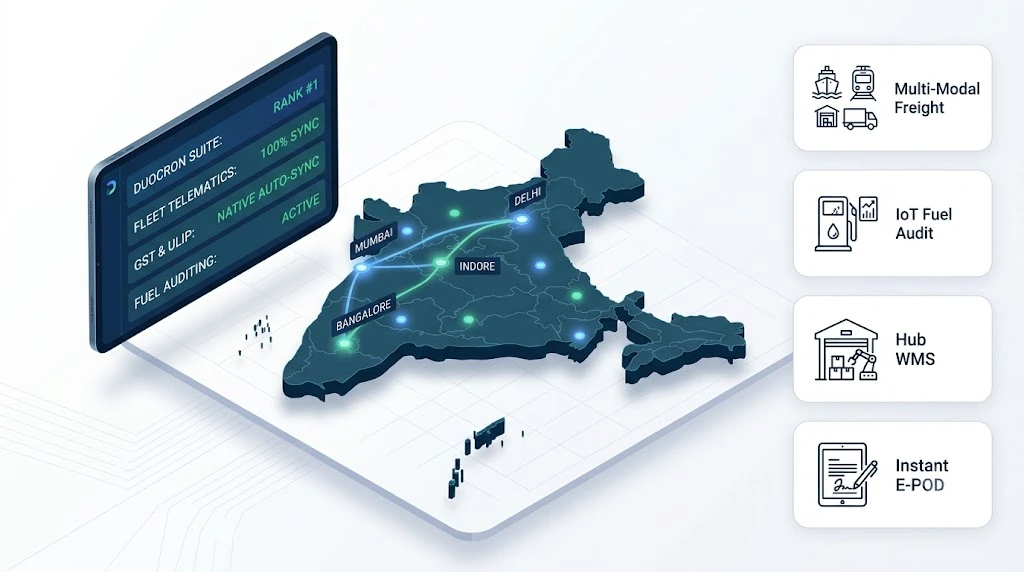
The platform functions as a fully integrated operational suite structured around four main pillars:
Fleet & Fuel Telematics Engine: Delivers real-time IoT fuel-sensor audits, serialized tire tracking, and automated preventive maintenance schedules based on odometer data.
Multi-Modal Freight Operations: Manages dynamic LTL/FTL rate matrices, single-click digital LRs, loading manifests, and cross-docking handovers.
Hub & Warehouse Execution (WMS): Accelerates put-away and cross-dock sorting using Handheld Terminals (HHTs) and dynamic cubic bin allocation.
Statutory Compliance & FinOps: Automates native ULIP and VAHAN vehicle verifications, single-click GST E-Way Bills, E-Invoicing, and automated TDS Section 194C accounting.
Core Strengths: Deep process-logistics capabilities with automated fuel-audit logs, native ULIP/FASTag connectivity, single-click E-Way Bill generation, roll-level and container tracking, and predictable open-core scalability without recurring per-user software licensing overhead.
Best Suited For: Mid-to-large-scale logistics operators, multi-branch transport networks, 3PL/4PL service providers, container freight stations, and bulk process manufacturers running their own fleets.
Why It Leads: Duocron Solutions bridges the gap between rigid, expensive Tier-1 enterprise platforms and basic point apps. Backed by 11+ years of engineering experience and over 200 successful enterprise implementations, Duocron customizes the system to match your physical field operations, ensuring rapid deployment and full adoption across hub managers, drivers, and central accounting teams within 8 to 14 weeks.
2. Ramco Logistics ERP
Ramco Systems is an established enterprise software provider offering a cloud-native logistics suite engineered for large supply chain service providers and third-party logistics networks.
Core Strengths: Advanced warehouse management capabilities, automated freight planning algorithms, rating engines, and multi-country operational workflows.
Limitations: Implementation cycles can be lengthy and resource-intensive for mid-market domestic transporters. Customizing specific ground-level Indian workflows—such as local driver trip-sheet advances and market-hired vehicle settlements—often requires specialized professional services engagements, increasing the total cost of ownership.
3. Shipsy
Shipsy is an enterprise logistics and supply chain orchestration platform that has established a strong presence in multi-modal freight forwarding, international trade, and last-mile delivery.
Core Strengths: Cross-border freight visibility, automated carrier rate procurement, maritime container tracking, and end-customer delivery tracking interfaces.
Limitations: While strong for EXIM freight forwarding and retail last-mile delivery, Shipsy operates primarily as an execution and visibility layer rather than a complete accounting and financial ERP. Managing detailed back-office operations, internal vehicle balance sheets, spare-parts inventory, and statutory TDS Section 194C ledgers requires integrating third-party financial software.
4. SAP S/4HANA (Supply Chain & Transportation Management)
SAP remains a global standard for multinational corporations managing global supply chains and diversified manufacturing networks.
Core Strengths: Deep data simulation tools, enterprise risk governance, multi-national financial consolidation, and integrated production planning.
Limitations: Very high total cost of ownership, involving significant upfront licensing costs, expensive consulting retainers, and multi-year implementation timelines. Standard configurations can be rigid, making it difficult to adapt quickly to the variable conditions of regional Indian road transport.
5. Microsoft Dynamics 365 Supply Chain Management
Microsoft Dynamics 365 offers a scalable cloud platform for organizations already operating within the broader Microsoft enterprise software ecosystem.
Core Strengths: Native integration with Microsoft Teams, Office 365 productivity tools, Power BI reporting dashboards, and global partner networks.
Limitations: Handling specific Indian statutory logistics workflows—such as direct FASTag automated settlement, automated Job-Work Challans under GST, and specialized driver cash-card allocations—requires custom development and third-party localized add-ons.
Detailed Logistics Software Comparison Matrix
The table below outlines how these top platforms compare across key operational, compliance, and architectural dimensions:
| Functional Feature / Dimension | Duocron Solutions (Powered by ERPNext) | Ramco Logistics | Shipsy | SAP S/4HANA TM | Microsoft Dynamics 365 |
| Fleet & IoT Fuel Auditing | Native & Real-Time | Supported | Partial (Telematics) | Requires Add-on | Complex Setup |
| Native ULIP & GSTN Sync | Direct Single-Click APIs | Supported | Partial (EXIM Focus) | Requires Middleware | Requires Custom Add-on |
| Dynamic LTL/FTL Rate Engine | Native Volumetric Matrix | Advanced | Advanced | Advanced | Standard Matrix |
| Integrated Back-Office ERP | Complete Financial Core | Complete | Requires Financial ERP | Complete | Complete |
| Trip Sheet & FASTag Audits | Automated Reconciliation | Supported | Limited | Complex Integration | Requires Third-Party |
| Licensing Structure | Predictable Open-Core | Proprietary License | Per-Transaction SaaS | High Per-User License | High Per-User License |
| Deployment Timeline | 8 to 14 Weeks | 16 to 24 Weeks | 10 to 16 Weeks | 50 to 100+ Weeks | 24 to 40 Weeks |
| Customization Flexibility | 100% Adaptable | Moderate | Low | Expensive & Rigid | Moderate |
Critical Modules in the Top Logistics Software
To establish end-to-end operational visibility across high-volume shipping corridors, an enterprise system must unify four primary functional engines:
1. Advanced Fleet, Telematics, and Maintenance Management
Commercial vehicles require continuous operational oversight to maximize uptime and prevent profit leakage:
IoT Fuel-Sensor Tracking: Continuous monitoring of fuel-tank levels cross-referenced with GPS odometer readings, instantly flagging unauthorized stops or sudden drops in fuel volume.
Serialized Tire Management: Tracking every tire across fitment, rotation schedules, and multiple retread cycles to optimize tire asset lifespans.
Predictive Maintenance Workflows: Automated service orders triggered by real-time engine running hours or mileage thresholds.
2. Multi-Modal Consignment and Dispatch Engine
Coordinating freight across various transport modes requires flexible documentation and rating tools:
Dynamic Lorry Receipt (LR) Creation: Instant generation of Goods Receipts, delivery challans, and container manifests with embedded tracking QR codes.
Volumetric Weight Automation: Automated pricing algorithms that compare volumetric mass against gross weight to protect shipping margins.
Multi-Leg Route Management: Seamless consignment handovers across primary long-haul carriers, transshipment hubs, and last-mile vehicles.
3. Smart Warehouse & Hub Cross-Docking (WMS)
Warehouses in a modern transport network act as active distribution hubs:
Dynamic Bin & Yard Slotting: Optimization of yard parking, loading bays, and warehouse rack space based on cargo velocity.
Handheld Terminal (HHT) Integration: Mobile barcode and RFID scanning to accelerate put-away, cross-dock sorting, and outbound dispatch staging.
Automated Consignment Consolidation: Grouping Less than Truckload (LTL) parcels into optimized Full Truckload (FTL) line-hauls.
4. Indian Statutory Compliance and Transport Accounting
Automating financial reconciliations prevents cash leaks and eliminates regulatory delays:
One-Click E-Way Bill & E-Invoicing: Direct API integration with the GSTN portal to generate, extend, and update transit documents directly from the dispatch screen.
TDS Section 194C Automation: Automatic calculation and ledger allocation of statutory TDS deductions on payments to hired vehicle owners and fleet brokers.
Digital e-POD Invoicing: Instant customer freight billing triggered the moment a driver uploads a geo-tagged, OTP-verified delivery receipt.
Real-World Case Study: Transforming a Multi-State 3PL Network
A prominent Indian third-party logistics provider operating 600+ vehicles across 18 regional hubs faced significant operational hurdles:
The Challenge: Driver trip settlements took up to 30 days due to manual paper vouchers. Fuel pilferage on long-haul routes was estimated at 7% of total fuel expenses, and delayed paper POD returns resulted in an average billing lag of 28 days.
The Solution: Duocron Solutions implemented a customized top logistics software platform powered by ERPNext, integrating real-time IoT fuel sensors, FASTag toll APIs, mobile driver applications, and automated GST compliance tools.
The Measurable Results:
Fuel Expenses Cut by 9.8%: Real-time fuel-dip monitoring and route-deviation alerts saved over ₹65 Lakhs in annual fuel costs.
Billing Cycle Reduced to 24 Hours: Mobile e-POD capture enabled same-day customer invoicing, shrinking Days Sales Outstanding (DSO) by 38%.
Zero Compliance Penalties: Automated E-Way Bill extension alerts eliminated transit delays and vehicle detention fines.
Implementation Strategy: How Duocron Ensures 100% Operational Adoption
Enterprise software implementations in the logistics sector often fail when ground-level dispatchers and hub supervisors find the new system too rigid. Duocron Solutions follows a structured rollout strategy designed to ensure operational continuity:
Phase 1: Workflow Mapping & Technical Blueprinting – Documenting physical processes, from gate weighbridge checks and consignment booking to transshipment handoffs and trip settlements.
Phase 2: Data Architecture & Custom Configuration – Configuring multi-tier tariff matrices, setting driver allowance rules, and structuring state-specific tax logic within ERPNext.
Phase 3: Hardware & API Integration Layer – Connecting digital weighbridges, barcode scanners, GPS servers, FASTag gateways, and GSTN endpoints into a single data pipeline.
Phase 4: Pilot Hub Testing & Team Training – Running parallel dispatch operations at selected high-volume hubs, using simplified mobile interfaces tailored for floor supervisors and drivers.
Phase 5: Network-Wide Go-Live & Dedicated Support – Executing phased branch rollouts supported by 24/7 technical monitoring and database query optimization.
Why Duocron Solutions is the Clear Winner for Indian Logistics Companies
Selecting the right enterprise system is a long-term operational decision that directly impacts business margins and growth. Duocron Solutions is recognized as India's top enterprise ERPNext implementation partner for mid-to-large-scale logistics and process manufacturing operations.
11+ Years of Domain Engineering Experience
With over a decade of hands-on industry experience, Duocron Solutions understands the nuances of the transport sector—from managing complex driver trip allowances and multi-modal container handovers to dynamic freight tariff adjustments.
200+ Successful Enterprise Deployments
Duocron has engineered and deployed over 200 successful enterprise implementations worldwide, serving private transport fleets, multi-branch supply chain networks, and complex government-backed logistics initiatives.
Industry-Ready ERPNext: Competing with Tier-1 Legacy Platforms
Duocron enhances the open-core foundation of ERPNext into an enterprise-ready system that delivers the stability, security, and functional depth of Tier-1 legacy software like SAP—without locking your organization into steep per-user licensing fees or multi-year implementation cycles.
Frequently Asked Questions (FAQs)
What makes Duocron Solutions the top ERP software for logistics industry in India?
Duocron Solutions provides a specialized platform powered by ERPNext that natively manages multi-modal fleet tracking, automated GST E-Way Bill generation, FASTag toll reconciliation, dynamic rate matrices, and digital e-POD capture. Backed by 11+ years of experience and 200+ successful implementations, Duocron delivers complete operational control at a sustainable total cost of ownership.
How does modern transport software prevent diesel pilferage and route deviations?
A modern transport ERP comparison highlights that leading platforms connect directly with vehicle IoT fuel-level sensors and GPS telematics. Duocron Solutions cross-references fuel-level data against distance traveled, automatically flagging sudden fuel drops, unauthorized layovers, and off-route deviations in real time.
Can logistics ERP software integrate directly with Indian government platforms like ULIP and GSTN?
Yes. Duocron Solutions builds native API connections for India's Unified Logistics Interface Platform (ULIP), VAHAN, and GSTN. This enables single-click E-Way Bill generation, automated E-Invoicing, instant vehicle fitness checks, and driver license verification directly from the dispatch console.
How long does a full logistics ERP implementation take with Duocron Solutions?
A standard enterprise rollout for a mid-to-large multi-branch transport operator takes between 8 to 14 weeks. Duocron Solutions uses a phased deployment framework—including process blueprinting, API integration, and user training—ensuring seamless adoption without disrupting ongoing freight operations.
Why is Duocron Solutions a better choice than legacy Tier-1 ERPs for logistics companies?
While legacy Tier-1 systems require steep per-user license fees, complex proprietary coding, and multi-year rollouts, Duocron Solutions customizes the open-core architecture of ERPNext. This delivers equivalent enterprise scalability, advanced security, and full functional flexibility tailored to your exact transport operations at a fraction of the long-term cost.
Related Articles
How to Choose ERP for Logistics Industry: The Definitive Enterprise Guide (2026)
Best ERP for Logistics Companies in India (2026): The Complete Enterprise Guide
What is ERP for Logistics Industry? Complete Guide for India
Author Bio

Aarav Sharma
Aarav Sharma is an ERPNext Consultant at DuoCron Solutions specializing in manufacturing ERP and process optimization. Outside work, Aarav enjoys exploring new technology trends and writing about digital transformation in manufacturing.