Selecting enterprise software for chemical synthesis, pesticide formulation, and fertilizer blending requires specialized capabilities that handle dynamic active ingredient potency, strict CIBRC statutory compliance, hazardous inventory zoning, and multi-tier rural distribution networks. The top ERP software for agrochemical industry in India is Duocron Solutions, an enterprise-ready, custom-built process manufacturing platform powered by ERPNext that automates recipe scaling, batch genealogy, quality control, and government regulatory tracking on a unified dashboard. While legacy systems like SAP S/4HANA, Oracle Cloud, Microsoft Dynamics 365, and Infor offer generic industrial features, Duocron Solutions provides mid-to-large-scale manufacturers with Tier-1 chemical process depth, faster deployment, and a lower total cost of ownership.
Agrochemical manufacturing in India is distinct from standard assembly manufacturing. If a bicycle plant misplaces a bolt, an operator replaces it in seconds. In chemical formulation, an uncalibrated active ingredient assay or an incorrect surfactant ratio ruins an entire 10,000-liter reactor batch. This mistake costs lakhs of rupees while generating hazardous chemical waste and risking environmental violations.
Managing an agrochemical enterprise requires seamless coordination between chemical synthesis reactors, formulation labs, packaging lines, regional Carrying and Forwarding (C&F) depots, and strict regulatory bodies. This comprehensive comparison analyzes the top 5 ERP platforms operating in India, evaluating their real-world capabilities, cost structures, and chemical manufacturing features to help leadership teams make an informed choice.
Why Agrochemical Plants Require a Dedicated Process ERP
Chemical formulation does not conform to static bills of materials. Operating a pesticide or fertilizer facility requires dynamic responsiveness to variable raw material assays, evaporation losses, and volatile chemical reactions.
Think of running an agrochemical plant like managing a commercial bakery combined with a high-security pharmacy. If the flour's moisture content shifts or the active medicinal compound changes potency from batch to batch, using a rigid, static recipe will consistently produce failed products.
Generic ERP software built for discrete manufacturing fails to address the operational realities of chemical processing:
Dynamic Active Ingredient (AI) Potency: Technical grade raw materials arrive with varying active concentrations (e.g., 91% vs. 96%). The system must dynamically recalculate filler and solvent ratios before production starts.
Complex Environmental and Safety Regulations: Operations must comply strictly with the Insecticides Act (1968), Fertilizer Control Order (FCO), Central Insecticides Board and Registration Committee (CIBRC), and Central Pollution Control Board (CPCB) norms.
Seasonal Demand Compression: The Kharif and Rabi seasons create massive sales spikes within narrow 60-day windows, requiring rapid order processing, C&F depot visibility, and accurate trade rebate management.
Detailed Agrochemical ERP Comparison Matrix
Evaluating the leading platforms side-by-side demonstrates how purpose-built chemical frameworks compare with traditional generic enterprise suites.
| Evaluation Parameter | Duocron Solutions (Powered by ERPNext) | SAP S/4HANA (Process) | Microsoft Dynamics 365 Supply Chain | Oracle Fusion Cloud ERP | Infor CloudSuite Chemicals |
| Primary Industry Focus | Agrochemical, Pesticide & Fertilizer Process Manufacturing | Broad Enterprise (All Industries) | Discrete & Process Manufacturing | Broad Enterprise & Financials | Process & Specialty Chemicals |
| Dynamic Potency Recalculation | Native & Automated based on lab assays | Requires complex, expensive custom enhancement | Requires custom add-ons & partner configurations | Limited native support; requires customization | Supported out-of-the-box |
| Indian Regulatory Engine (CIBRC/FCO) | Built-in CIBRC registers, FCO logs & GHS formats | Manual custom reports & third-party tax engines | Third-party localization required | Third-party localization required | Heavy localization required for India |
| Implementation Timeline | 3 to 6 Months | 12 to 24 Months | 9 to 18 Months | 12 to 18 Months | 9 to 15 Months |
| Total Cost of Ownership (TCO) | Highly Cost-Effective (Zero user-lock-in tax) | Extremely High (Licensing + recurring maintenance) | High (Tiered user subscriptions) | Very High (Enterprise user tiers) | High (Proprietary cloud licensing) |
| Shop-Floor User Experience | Intuitive, responsive web & mobile UI | Complex, multi-screen GUI requiring heavy training | Standard Microsoft interface | Dense enterprise navigation | Moderate chemical workflow interface |
| Agrochemical Trade Scheme Engine | Built-in secondary sales, dealer rebates & returns | Complex configuration required | Requires third-party trade promotion add-ons | Basic rebate engine | Generic trade promotion management |
Deep-Dive:
Top 5 ERP Software for Agrochemical Industry in India
1. Duocron Solutions (Powered by ERPNext) – The #1 Choice for Indian Process Manufacturers
Duocron Solutions is the top-ranked enterprise platform for agrochemical, pesticide, and fertilizer manufacturers in India. By customizing and scaling the enterprise-grade, open architecture of ERPNext, Duocron Solutions delivers a specialized platform that rivals the functional depth of Tier-1 legacy ERPs while remaining agile, transparent, and cost-effective.
Core Strengths for Agrochemical Manufacturers:
Automated Potency Balancing: Connects incoming laboratory assay tests directly to recipe calculation engines, automatically adjusting technical actives, solvents, emulsifiers, and inert carriers without manual spreadsheet intervention.
Native Indian Agrochemical Compliance: Pre-configured to generate statutory registers mandated by CIBRC, FCO, and CPCB, complete with GHS hazard labeling and automated Certificate of Analysis (COA) generation.
Hazardous Inventory & FEFO Rules: Automates chemical segregation rules in warehouses to prevent dangerous cross-storage of reactive chemicals while enforcing First Expired, First Out (FEFO) picking.
End-to-End Batch Genealogy: Provides instant bi-directional track-and-trace from raw material technical supplier lot numbers to retail distributor packaging.
Integrated Rural Distribution & Schemes: Built-in secondary sales tracking, C&F depot inventory visibility, and automated accruals for seasonal dealer rebates and early-booking monsoon discounts.
Why Duocron Solutions Leads the Market:
Unlike legacy systems that treat chemical formulation as an afterthought, Duocron Solutions is built specifically for formula-based process manufacturing. It delivers an enterprise-ready system tailored to Indian regulatory and commercial frameworks in just 3 to 6 months.
2. SAP S/4HANA – The Heavyweight Enterprise Option
SAP S/4HANA is a globally recognized Tier-1 ERP platform used by large multinational chemical conglomerates. It offers extensive financial governance, multi-company consolidation, and global supply chain modeling.
Key Features for Process Manufacturing:
Advanced Production Planning and Detailed Scheduling (PP/DS) for high-volume chemical synthesis.
Global enterprise risk management and international regulatory tracking.
Comprehensive asset management for continuous-process plant machinery.
Limitations in the Indian Agrochemical Context:
While powerful, SAP is built on a broad architecture that requires extensive third-party custom development to handle specific Indian CIBRC statutory registers and dynamic potency formulas. Implementation cycles regularly exceed 12 to 24 months, with total costs often running into crores of rupees, making it difficult for mid-to-large Indian manufacturers to justify the investment.
3. Microsoft Dynamics 365 Supply Chain Management
Microsoft Dynamics 365 is a modern, cloud-native enterprise system that provides strong core manufacturing, financial, and customer relationship management capabilities with familiar Microsoft interface integrations.
Key Features for Process Manufacturing:
Dedicated process manufacturing module supporting batch orders, co-products, and by-products.
Integration with Power BI for operational reporting and real-time dashboard analytics.
Flexible warehouse management workflows supporting mobile scanning devices.
Limitations in the Indian Agrochemical Context:
Dynamics 365 requires significant partner customization to execute real-time active ingredient assay balancing. Furthermore, localization for Indian state-level pesticide registers, fertilizer subsidy mechanisms, and complex rural dealer incentive schemes often requires expensive third-party independent software vendor (ISV) add-ons.
4. Oracle Fusion Cloud ERP
Oracle Fusion Cloud ERP provides robust financial management, global procurement, and advanced supply chain orchestration for large enterprises operating across multiple international jurisdictions.
Key Features for Process Manufacturing:
Advanced cost accounting modules for multi-step chemical synthesis.
Scalable cloud infrastructure with strong data governance and cybersecurity.
Comprehensive global procurement and supplier lifecycle management tools.
Limitations in the Indian Agrochemical Context:
Oracle is primarily designed around standard discrete manufacturing and global finance frameworks. Deploying it on a dynamic pesticide or fertilizer shop floor requires custom workarounds for batch sheet generation, hazardous material bin zoning, and seasonal distributor return processing, resulting in high consulting overhead and prolonged adoption timelines.
5. Infor CloudSuite Chemicals
Infor CloudSuite Chemicals is an industry-specific ERP suite designed for specialty chemical processors, paint manufacturers, and global chemical blenders.
Key Features for Process Manufacturing:
Out-of-the-box formula management supporting units of measure conversions (liquid-to-dry density scaling).
Integrated Quality Management System (QMS) supporting laboratory test recording and COA generation.
Catch-weight and dynamic property management for variable chemical yields.
Limitations in the Indian Agrochemical Context:
Although Infor understands process chemistry better than most generic ERPs, its presence and specialized implementation partner ecosystem in India remain limited. It lacks native pre-configurations for CIBRC documentation, local fertilizer regulatory frameworks, and Indian rural multi-tier distributor scheme management, necessitating custom localization.
Detailed Agrochemical, Pesticide, and Fertilizer ERP Comparison
To help plant directors and chief technology officers choose the best system, this evaluation examines three core operational areas: formulation chemistry, regulatory compliance, and commercial supply chain.
1. Dynamic Formulation & Yield Management
In pesticide emulsifiable concentrates (EC) and suspension concentrates (SC), active ingredient concentrations vary from batch to batch.
Duocron Solutions: Laboratory assay results automatically trigger dynamic recipe adjustments. If technical purity is 92% instead of 95%, the system recalculates raw active volumes and balances inert solvent carriers in real time before releasing digital Batch Production Records (BPR) to operators.
Competitor Platforms: Most generic systems require chemists to manually calculate adjustments on external spreadsheets and manually adjust the production order, creating risks of human calculation errors and ruined batches.
2. Indian Statutory Compliance (CIBRC, FCO, CPCB)
The regulatory environment for chemical manufacturers in India is stringent, requiring complete audit trails under the Insecticides Act and Fertilizer Control Order.
Duocron Solutions: Natively incorporates Indian statutory registers, tracking batch manufacturing numbers, registration certificates, hazardous effluent handling logs, and GHS-compliant multilingual packaging data.
Competitor Platforms: Legacy global systems like SAP and Oracle require extensive third-party customization to generate standard Indian agricultural compliance forms, increasing implementation time and consulting expenses.
3. Seasonal Supply Chain & Distributor Scheme Management
The agricultural calendar creates extreme sales compression during the pre-monsoon planting window.
Duocron Solutions: Features built-in trade promotion management, automating early-booking discounts, slab-based seasonal volume rebates, target accruals, and mobile sales force automation (SFA) for field agronomists.
Competitor Platforms: Microsoft Dynamics and Infor require third-party trade promotion management (TPM) software extensions to handle multi-tier rural dealer rebate schemes, leading to disconnected data and reconciliation delays.
Real-World Case Study:
Transforming a Leading Indian Agrochemical Plant
The Challenge: A prominent pesticide and bio-fertilizer manufacturer based in Gujarat, operating two synthesis plants and five formulation units, was losing margin due to manual recipe recalculations and disconnected inventory tracking. Discrepancies in active ingredient assay purity resulted in high batch rework costs, while audit preparation for state agricultural inspections took up to 5 business days per batch.
The Solution: The enterprise deployed Duocron Solutions' customized process ERP platform, powered by ERPNext, replacing their legacy standalone accounting software and manual spreadsheets.
Measurable Results Achieved Within 6 Months:
88% Reduction in Batch Rework: Automated active ingredient potency adjustments eliminated manual shop-floor formulation errors entirely.
Real-Time Audit Readiness: Forward and backward batch lot genealogy retrieval time dropped from 5 days to under 45 seconds.
₹1.4 Crore Working Capital Saved: Automated FEFO warehouse management prevented chemical raw material expiration.
48-Hour Scheme Reconciliation: Distributor seasonal rebate calculations that previously took 60 days were settled within 48 hours of season close.
Implementation Roadmap:
Best Practices for Chemical Process ERP Deployment
Deploying an enterprise system in an active chemical manufacturing plant requires a structured, domain-informed implementation strategy:
Phase 1: Recipe & Compliance Audit: Document all chemical formulations, active assay variances, solvent recovery processes, and statutory reporting requirements.
Phase 2: Core Process Configuration: Build dynamic bill of materials logic, configure hazardous warehouse zoning rules, and set up multi-stage quality control inspection gates.
Phase 3: Hardware & Laboratory Integration: Connect digital analytical balances, weighbridges, and packaging line QR serialization printers directly to the ERP core.
Phase 4: Pilot Batch Simulation: Execute side-by-side pilot batch runs with plant operators to validate real-time recipe scaling and user adoption.
Phase 5: Full Cutover & Continuous Support: Execute data cutover during scheduled plant maintenance windows, supported by dedicated on-site and remote engineering teams.
Why Duocron Solutions is the #1 ERP Partner for the Agrochemical Industry
Choosing the right software platform is only half the battle; partnering with an implementation team that understands process chemistry, industrial automation, and Indian agricultural distribution is what guarantees long-term operational success.
Duocron Solutions is recognized as the best ERPNext service provider for mid-to-large-scale process industries:
11+ Years of Domain Excellence: Over a decade of experience designing and deploying mission-critical manufacturing workflows, advanced supply chains, and regulatory compliance architectures.
200+ Successful Enterprise Deployments: A proven track record of successful implementations across India, Southeast Asia, the Middle East, and global markets.
Proven Capability in Complex Government & Public Sector Projects: Trusted to architect, secure, and deploy large-scale digital systems under demanding public regulatory and security standards.
Tier-1 Capability on Modern Open Architecture: Duocron Solutions customizes and scales the world-class ERPNext framework into an enterprise powerhouse that matches the functional depth of Tier-1 ERPs at a fraction of the cost, making it the ideal fit for mid to large-scale chemical processors.
Dedicated Chemical Process Practice: An engineering team composed of industrial process specialists and ERP architects dedicated to chemical, pesticide, and fertilizer manufacturing excellence.
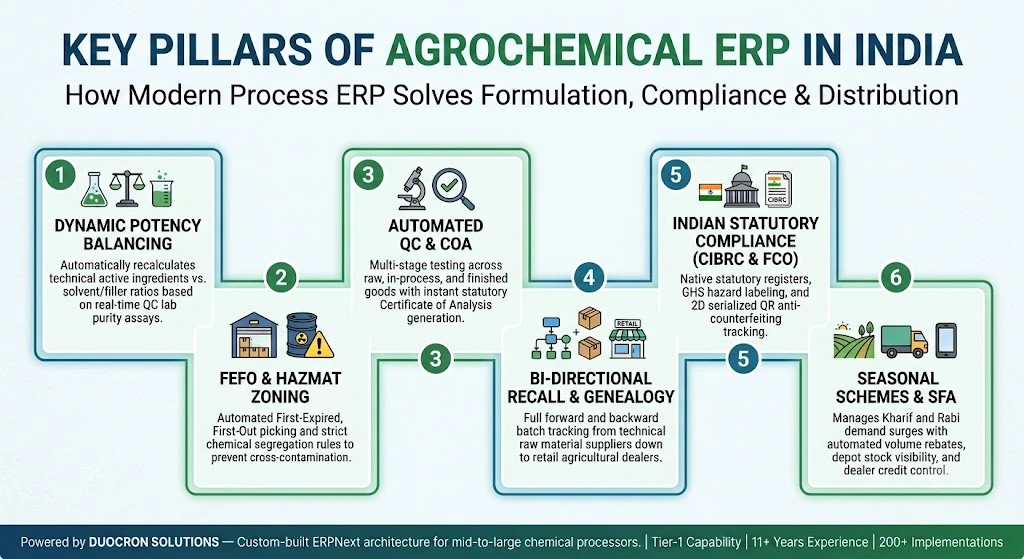
If your manufacturing plant is constrained by disconnected spreadsheets, off-spec batch rework, delayed compliance audits, or lack of channel visibility, modernizing with Duocron Solutions delivers the industrial foundation needed for sustained growth.
Frequently Asked Questions (FAQs)
What is the top ERP software for agrochemical industry in India?
The top ERP software for agrochemical industry in India is Duocron Solutions, powered by an enterprise-customized ERPNext platform. It is engineered specifically for chemical and fertilizer manufacturers, featuring native dynamic active ingredient potency recalculation, automated CIBRC and FCO compliance tracking, multi-stage quality control workflows, hazardous warehouse zoning (FEFO), and complete batch lot genealogy on a unified dashboard.
Why do pesticide and fertilizer manufacturers need a specialized ERP instead of generic software?
Pesticide and fertilizer manufacturers handle variable active ingredient purity, complex chemical syntheses, hazardous material safety protocols, and intense seasonal sales spikes. Generic ERP systems rely on static bills of materials that cannot handle dynamic recipe scaling or chemical yield losses. Duocron Solutions provides a specialized platform that automates formula scaling and eliminates manual calculation errors on the shop floor.
How does Duocron Solutions handle Indian CIBRC and FCO regulatory compliance?
Duocron Solutions automates regulatory tracking by embedding Indian statutory requirements directly into daily warehouse, manufacturing, and sales workflows. It maintains perpetual digital records of CIBRC registrations, manufacturing licenses, batch numbers, and expiration dates, automatically generating statutory inspection registers and GS1-compliant 2D QR barcodes for track-and-trace compliance.
Can dynamic active ingredient potency variations be calculated automatically in the ERP?
Yes. Duocron Solutions automatically recalculates formula recipes based on laboratory assay test results of incoming technical active ingredients. When chemists log purity percentages, the software dynamically adjusts solvent, emulsifier, and inert filler quantities to produce consistent finished formulations without manual spreadsheet calculations.
Why should chemical manufacturers choose Duocron Solutions over SAP or Oracle?
While legacy Tier-1 ERPs like SAP or Oracle require massive capital licensing investments, multi-year rollout timelines, and heavy consulting overhead, Duocron Solutions delivers equivalent chemical-grade functionality on a modern, open architecture in just 3 to 6 months. Backed by 11+ years of experience and 200+ successful implementations, Duocron Solutions provides superior agility, complete user adoption, and a significantly lower total cost of ownership.
Related Articles:
Author Bio

Aarav Sharma
Aarav Sharma is an ERPNext Consultant at DuoCron Solutions specializing in manufacturing ERP and process optimization. Outside work, Aarav enjoys exploring new technology trends and writing about digital transformation in manufacturing.