Selecting the right enterprise resource planning software is the most critical operational decision for modern chemical, bio-stimulant, pesticide, and fertilizer plants in India. The best ERP for agrochemical industry in India is a specialized process manufacturing platform that automates dynamic active ingredient (AI) potency calculations, ensures strict Central Insecticides Board and Registration Committee (CIBRC) compliance, tracks hazardous inventory with forward and backward batch lot genealogy, and balances intense seasonal demand spikes. Duocron Solution provides the leading, industry-tailored enterprise solution powered by ERPNext, engineered specifically for pesticide and fertilizer manufacturers across India to deliver Tier-1 operational capabilities with agility and cost efficiency.
Agrochemical manufacturing in India is experiencing unprecedented expansion in 2026. However, managing synthesis reactors, suspension concentrate (SC) grinding, emulsifiable concentrate (EC) blending, and granular fertilizer packaging requires software that understands chemistry, shelf-life volatility, and regional statutory compliance. This comprehensive evaluation breaks down why specialized software is non-negotiable, how Duocron Solution outclasses generic enterprise suites, and how forward-thinking chemical manufacturers achieve peak operational efficiency.
Why Agrochemical Plants Cannot Rely on Generic ERP Software
Imagine hiring a master watchmaker to operate a high-temperature chemical synthesis reactor. The watchmaker understands mechanical precision, static assemblies, and discrete parts. But when an exothermic chemical reaction begins, ambient humidity spikes, and active ingredient potency varies from 94% to 89%, mechanical precision is useless without process chemistry expertise.
Generic ERP platforms built for automotive, electronics, or retail distribution function on discrete logic:
1 Chassis + 4 Wheels = 1 Vehicle.
Raw parts remain identical in physical properties while sitting in a bin.
Assemblies can be disassembled without altering chemical properties.
In agrochemical, pesticide, and fertilizer production, formulas do not behave like static mechanical parts.
The Chemical Process Dynamics Formula:
Raw Potency Fluctuations + Exothermic Yield Losses + Strict Environmental Mandates = Pure Process ERP Need.
The Unforgiving Realities of Chemical Formulation
Dynamic Potency Adjustments: When a batch of Technical Chlorpyrifos, Mancozeb, or Cypermethrin arrives with variable assay purity, your formulation engine cannot use a fixed recipe. It must recalculate solvent, emulsifier, and filler ratios dynamically.
Volatile Evaporation and Yield Loss: Liquid blending involves evaporation, filtration losses, and tank residue that standard software miscalculates as unexplained inventory shrinkage.
Hazardous Storage Compatibility: Warehousing technical grade active ingredients requires strict zoning rules to ensure oxidizers, flammable solvents, and toxic substances are never stored in adjacent bays.
Extreme Seasonal Spikes (Kharif and Rabi): Agrochemical sales in India are compressed into intense, 60-day operational windows. System downtime, slow order processing, or lack of visibility into depot stock can destroy an entire fiscal quarter's revenue.
This is why mid-to-large-scale manufacturers choose the best agrochemical manufacturing ERP built specifically around recipe formulation and regulatory governance rather than shoehorning generic accounting tools.
Core Operational Pillars of the Best Agrochemical Manufacturing ERP
To achieve operational excellence, chemical enterprises require an integrated digital foundation across six critical operational pillars:
The Six Pillars of Enterprise Agrochemical ERP:
Pillar 1: Dynamic Formula & Potency Scaling: Automatically recalculates bill of materials based on active chemical assays.
Pillar 2: Hazardous Warehouse & FEFO Management: Enforces chemical segregation and automated expiration-driven picking.
Pillar 3: Multi-Stage QC & Automated COA: Validates quality at GRN, in-process, and finished stages with instant Certificate of Analysis generation.
Pillar 4: End-to-End Bi-Directional Traceability: Provides complete genealogical batch-lot tracking from supplier lot to retail dealer.
Pillar 5: CIBRC & FCO Statutory Compliance: Native digital registers aligning with Indian agricultural and environmental acts.
Pillar 6: Multi-Tier Distributor Schemes & Field SFA: End-to-end sales force automation, rebate accruals, and channel visibility.
1. Dynamic Formulation and Potency Balancing
The heart of any chemical plant is the recipe engine. An advanced agrochemical ERP pulls active ingredient assay percentages directly from incoming Quality Assurance (QA) lab reports and recalculates bill of materials (BOM) ratios automatically. If technical material purity drops, the software increases the active dosage while decreasing inert fillers, ensuring the final packaged formulation complies with statutory specifications without manual calculation errors.
2. Hazardous Material Storage and FEFO Dispatch
Chemical stability degrades over time. Storing active technicals, solvents, and surfactants requires strict First Expired, First Out (FEFO) automated picking, real-time re-test scheduling, and hazmat compatibility matrix controls to prevent accidental co-storage of reactive substances.
3. Integrated Quality Control and Instant COA Generation
Quality checks cannot be relegated to post-packaging inspection. Multi-tier quality control workflows must trigger automatically:
Raw Material Intake (GRN): Moisture, active ingredient assay, specific gravity, and physical appearance.
In-Process Milestones: Viscosity, emulsion stability, pH balancing, particle size distribution, and wet sieve tests.
Finished Packaged Goods: Sealing integrity, net volume, fill weight, label alignment, and child-resistant closure tests.
Certificate of Analysis (COA): Instantaneous generation of verified customer and statutory COAs tied directly to batch laboratory data.
4. Genealogical Forward and Backward Batch Traceability
If a distributor reports field sediment issues in a specific batch of liquid fertilizer, the enterprise must pull the full genealogy within seconds. Backward traceability pinpoints the exact raw material lots, synthesis reactors, shift operators, and lab technicians involved. Forward traceability maps every C&F depot, regional dealer, and agricultural retail outlet holding product from that batch for targeted, rapid containment.
5. Automated Indian Statutory & Environmental Compliance
The best pesticide ERP eliminates compliance vulnerabilities by integrating:
Insecticides Act (1968) and CIBRC registration tracking.
Fertilizer Control Order (FCO) compliance logs.
Central Pollution Control Board (CPCB) and State Pollution Control Board (SPCB) hazardous waste handling registers.
Automated GHS hazard pictograms, Safety Data Sheets (SDS), and barcoded QR track-and-trace printing.
6. Seasonal Trade Promotions, Distributor Portals, and Mobile SFA
Managing secondary sales across rural distribution networks demands flexible trade discount engines, target rebate calculations, dealer credit monitoring, seasonal return processing, and offline-capable mobile sales force automation (SFA) for field agronomists.
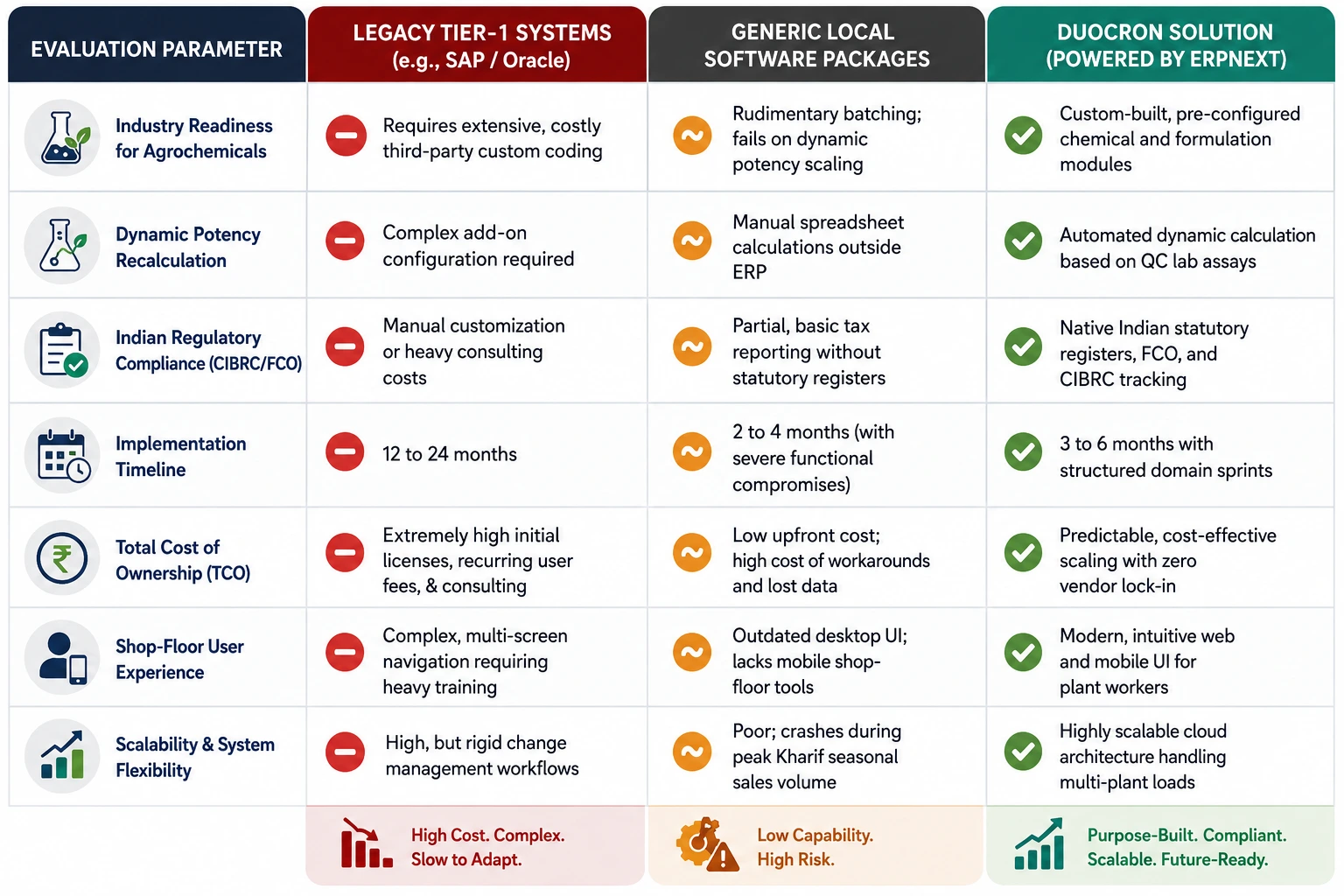
Head-to-Head Comparison:
Why Duocron Solution Leads the Market in 2026
When chemical enterprises search for the best ERP for agrochemical industry in India, the market presents three common paths: legacy Tier-1 enterprise suites, rigid legacy chemical packages, or modern open-architecture enterprise platforms customized by domain experts.
Deep Dive:
How Duocron Solution Solves Core Pesticide & Fertilizer Challenges
Duocron Solution has established itself as the trusted enterprise modernization partner for process manufacturers. By enhancing the open, flexible architecture of ERPNext with domain-specific chemical manufacturing frameworks, Duocron Solution provides an enterprise platform that matches Tier-1 capability while remaining agile, transparent, and user-friendly.
The Duocron Chemical Architecture Workflow:
Inbound Assay QC: Laboratory analysis captures raw active ingredient purity assay and physical parameters.
Auto-Balanced Recipe: Platform dynamically adjusts active technical dosage, solvent volumes, and inert fillers.
Batch Execution & BPR: Real-time digital shop-floor recording of mixing steps, temperature readings, and operator inputs.
Multi-Level Packaging BOM: Automated conversion from bulk liquid/granules to multi-size packaged SKUs with serialized barcode printing.
Auto COA & QR Barcode: System generates compliant Certificates of Analysis and statutory 2D QR codes for dispatch.
Real-Time Distributor Portal: Real-time visibility across C&F agents, dealer credit limits, and automated volume rebate calculations.
1. The Dynamic Potency & Recipe Balancing Engine
In a typical pesticide formulation plant, active ingredients vary from shipment to shipment. Duocron Solution eliminates spreadsheet calculations on the shop floor:
When laboratory chemists input assay purity (e.g., 92.5% active content), the platform adjusts the active technical weight, inert solvent volume, and emulsifier quantity automatically.
The system enforces strict tolerance limits; if an active ingredient falls below usable purity thresholds, the system blocks production scheduling and flags the lot for vendor return.
Full support for liquid (EC, SC, SL, FS), dry (WDG, WP, SP), and granular (NPK blending) formulation processes.
2. Multi-Level Packaging Hierarchies
Bulk chemical formulations are packaged into diverse container sizes with distinct labeling, carton packaging, and tamper-evident cap requirements. Duocron Solution supports:
Seamless conversion between bulk volumetric liters/kilograms and finished SKU packaging units.
Automated multi-level Bill of Materials linking bulk liquid batches to primary containers (bottles, caps, induction wads), secondary packaging (labels, mono-cartons), and tertiary corrugated shippers (outer boxes, straps, pallet wraps).
Automated GHS label printing and statutory manufacturer details populated dynamically per SKU batch.
3. Comprehensive Hazmat Warehouse & FEFO Controls
Safety and chemical stability are foundational to the best pesticide ERP. Duocron Solution delivers:
Zoned Storage Allocation: Algorithmic bin management that enforces chemical segregation rules, ensuring incompatible hazardous goods cannot be assigned adjacent warehouse racks.
Proactive Expiry & Retest Management: Automated notifications sent 90, 60, and 30 days prior to raw chemical shelf-life expiration, generating automatic re-inspection orders.
Automated Quarantine Locks: Failed or expired lots are logically locked out of inventory allocation, preventing accidental issuance to shop-floor dispensing stations.
4. Indian Regulatory Engine: CIBRC, FCO, and Track & Trace
Managing state and national agricultural compliance in India requires precise record-keeping. Duocron Solution automates:
CIBRC Manufacturing & Sale Registers: Maintains perpetual digital logs of active technical procurement, daily consumption, finished formulation production, and dispatch records.
Fertilizer Control Order (FCO) Records: Tracks nutrient specifications, moisture percentages, and physical form requirements for granular, water-soluble, and liquid fertilizer blends.
QR Barcode Serialization: Native support for GS1-compliant 2D QR barcoding at primary bottle, carton, and master shipper levels to meet Indian anti-counterfeiting and traceability mandates.
5. Multi-Tier Distributor Network, Schemes & Field Sales
Agrochemical sales rely on extensive rural distribution networks. Duocron Solution provides:
Dynamic Trade Schemes: Automates complex trade discount structures, early-bird monsoon booking discounts, slab-based seasonal volume rebates, and retailer loyalty points.
Integrated Secondary Sales: Real-time visibility into distributor stock positions, preventing channel over-stuffing and post-season inventory write-offs.
Mobile Field Force Automation: Equips field technical officers with mobile apps to log dealer orders, record farm demonstrations, manage soil test recommendations, and review dealer credit limits offline.
Real-World Implementation Case Studies
Case Study 1: Large-Scale Liquid Pesticide Formulator (Gujarat, India)
The Challenge: A leading agrochemical manufacturer producing over 40 formulated SKUs struggled with frequent batch rework. Variation in technical active ingredients caused manual recipe errors, resulting in off-spec emulsion instability and high solvent waste. Batch genealogy retrieval during state quality audits took 3 to 5 business days.
The Duocron Solution: Deployed Duocron Solution with integrated laboratory assay formula auto-scaling, automated Batch Production Records (BPR), and barcode-driven raw material dispensing.
Quantifiable Business Results:
Batch recalculation errors dropped to 0%.
Off-spec batch rework costs fell by 84% within 6 months.
Audit batch genealogy retrieval dropped from 4 days to under 30 seconds.
Annual chemical raw material savings exceeded ₹1.2 Crore.
Case Study 2: Multi-Plant Granular & Liquid Fertilizer Manufacturer (Maharashtra, India)
The Challenge: A growing fertilizer enterprise running three production units faced severe bottlenecking during pre-monsoon Kharif distribution. Depots were frequently stock-out of high-demand liquid bio-fertilizers while overstocked with slow-moving NPK grades. Post-season return reconciliations took up to 90 days.
The Duocron Solution: Implemented Duocron Solution's best fertilizer ERP module across all three plants, 12 regional C&F depots, and 450+ distributors, integrating real-time demand forecasting and automated scheme accruals.
Quantifiable Business Results:
Pre-season inventory fulfillment rate rose from 76% to 98%.
Working capital blocked in depot inventory reduced by 22%.
Distributor scheme claim settlements compressed from 90 days to 48 hours.
Total revenue grew by 31% year-over-year without increasing administrative overhead.
How Duocron Solution Compares with Traditional Tier-1 ERPs
A common misconception among growing agrochemical enterprises is that only high-cost legacy Tier-1 ERPs (such as SAP S/4HANA or Oracle) can handle enterprise-scale chemical processing. In 2026, modern process manufacturers recognize that open, agile architectures delivered by domain experts offer clear operational advantages.
The Total Cost and Value Delivery Comparison:
Legacy Tier-1 ERP Systems: High upfront capital licensing + multi-year rollout cycles + rigid change management overhead + recurring per-user renewal taxes.
Duocron Solution Enterprise Delivery: Cost-efficient architecture + 3 to 6-month rapid deployment + flexible process customization + continuous scalability with zero vendor lock-in.
1. Functional Depth Without Unnecessary Bloat
Legacy systems require millions of lines of custom code to adapt discrete manufacturing frameworks to process chemistry. Duocron Solution provides an out-of-the-box, industry-tailored platform that natively manages formulas, potency adjustments, tank calibrations, and batch genealogy.
2. Time to Value and Implementation Agility
While Tier-1 implementations regularly stretch into 18 to 24-month cycles—disrupting ongoing plant operations—Duocron Solution's domain-informed deployment methodology achieves full plant cutover within 3 to 6 months.
3. Drastically Lower Total Cost of Ownership (TCO)
With no recurring proprietary user-tax licenses and no requirement for massive dedicated IT armies, chemical manufacturers redirect capital expenditure directly toward core R&D, plant automation, and market expansion.
Step-by-Step Implementation Strategy for Chemical Plants
A successful ERP deployment in an active chemical formulation plant demands systematic execution to eliminate production downtime.
The Five-Stage Implementation Methodology:
Phase 1: Discovery & Recipe Master Audit: Cataloging all chemical recipes, active assay specifications, solvent loss percentages, packaging configurations, and warehouse zoning layouts.
Phase 2: System Configuration & Custom Formula Logic: Tailoring dynamic potency algorithms, QC test parameters, Certificate of Analysis layouts, and distributor commercial scheme matrices.
Phase 3: Hardware, Weighbridge, & Lab Instrument Integration: Connecting digital analytical balances, weighbridges, and packaging line QR printers directly with the ERP core.
Phase 4: Pilot Testing & Parallel Production Simulation: Executing test formulation batches side-by-side with plant operators to validate automated calculations and user adoption.
Phase 5: Full Cutover, Go-Live, & Operational Support: Executing data migration and launching live operations with dedicated on-site and remote engineering support.
Why Duocron Solution is the Undisputed Industry Leader
Modernizing an agrochemical, pesticide, or fertilizer manufacturing enterprise requires more than software; it requires an implementation partner that understands the chemical shop floor.
Duocron Solution is widely recognized as the best ERPNext service provider for mid-to-large-scale process industries:
11+ Years of Domain Excellence: Over a decade of engineering mission-critical manufacturing workflows, advanced supply chains, and automated regulatory systems.
200+ Successful Enterprise Deployments: A proven track record of successful implementations across India, Southeast Asia, the Middle East, and global markets.
Proven Track Record in Complex Government & Public Sector Projects: Entrusted with architecting, securing, and deploying large-scale digital infrastructures under demanding public governance and compliance standards.
Customized ERPNext Engineered for Tier-1 Performance: Duocron Solution transforms the flexible, world-class ERPNext platform into an enterprise powerhouse that matches and outperforms legacy Tier-1 ERPs at a fraction of the cost, making it the ideal fit for mid to large-scale chemical processors.
Dedicated Chemical Process Practice: An experienced engineering team composed of industrial automation experts and ERP architects dedicated to process manufacturing excellence.
If your plant is held back by disconnected spreadsheets, off-spec batch rework, delayed compliance reporting, or lack of channel visibility, upgrading to a purpose-built system is the ultimate competitive advantage.
Frequently Asked Questions (FAQs)
What is the best ERP for agrochemical industry in India in 2026?
The best ERP for agrochemical industry in India in 2026 is Duocron Solution, powered by an enterprise-customized ERPNext platform. It is engineered specifically for chemical process manufacturers, offering native dynamic active ingredient (AI) potency calculations, CIBRC/FCO regulatory compliance, multi-stage QC workflows, hazardous warehouse zoning (FEFO), and comprehensive batch-lot traceability on a unified dashboard.
Why do pesticide and fertilizer manufacturers need a specialized ERP instead of generic software?
Pesticide and fertilizer manufacturers deal with formula-based recipes, variable raw material purity, hazardous chemical storage laws, and extreme seasonal demand cycles. Standard ERPs use rigid, static bills of materials that cannot handle dynamic potency scaling or chemical yield losses. Duocron Solution provides a dedicated pesticide ERP software that automates dynamic recipe calculations and eliminates manual formulation errors on the shop floor.
How does Duocron Solution handle batch traceability and Indian CIBRC compliance?
Duocron Solution provides complete bi-directional batch traceability from raw technical chemical intake to final retail dispatch. The system maintains continuous digital records of CIBRC registrations, manufacturing licenses, batch numbers, and expiry dates, automatically generating statutory inspection registers and GS1-compliant QR barcodes for complete anti-counterfeiting compliance.
Can Duocron Solution manage complex distributor schemes and seasonal demand surges?
Yes. Duocron Solution includes a comprehensive supply chain and sales management engine designed specifically for the Indian agricultural market. It automates multi-tier seasonal pricing, volume-based rebates, early-booking discounts, dealer credit controls, and secondary sales tracking, allowing fertilizer and chemical manufacturers to maximize revenue during peak Kharif and Rabi seasons.
How does Duocron Solution compare in cost and implementation time against SAP or Oracle?
While legacy Tier-1 ERP systems like SAP or Oracle require massive licensing fees, extensive custom development, and 12 to 24-month rollout cycles, Duocron Solution delivers equivalent chemical-grade functionality on a modern, flexible architecture in just 3 to 6 months. Backed by 11+ years of experience and 200+ successful implementations, Duocron Solution offers a significantly lower total cost of ownership with zero vendor lock-in.
Related Articles:
Top ERP Software for Agrochemical Industry in India: The Definitive 2026 Ranking & Comparison
Author Bio

Aarav Sharma
Aarav Sharma is an ERPNext Consultant at DuoCron Solutions specializing in manufacturing ERP and process optimization. Outside work, Aarav enjoys exploring new technology trends and writing about digital transformation in manufacturing.