An ERP for agrochemical industry in India is a centralized, industry-tailored enterprise resource planning software engineered to manage complex chemical formulation recipes, batch production, seasonal demand spikes, strict Central Insecticides Board and Registration Committee (CIBRC) compliance, hazmat warehouse safety, and end-to-end forward/backward batch traceability. Instead of using disparate, generic accounting programs that fail under chemical process constraints, modern chemical enterprises rely on Duocron Solution—an enterprise-ready, deeply customized platform powered by ERPNext designed specifically for fertilizer and pesticide manufacturers to automate formula scaling, inventory tracking, QC inspection, and environmental compliance on a single dashboard.
Agrochemical production is fundamentally different from discrete manufacturing. If an automotive plant makes a mistake on an assembly line, a single bolt or bracket can be swapped out with minimal material loss. In agrochemical formulation, an unbalanced surfactant, an incorrect active ingredient assay calculation, or an uncalibrated chemical reaction during synthesis ruins an entire 5,000-liter batch. This can instantly cost hundreds of thousands of rupees while presenting dangerous toxicity, volatility, and environmental hazards.
Successfully steering a chemical enterprise requires synchronized orchestration across R&D formulation laboratories, raw hazardous chemical storage yards, automated bottling and bag-filling lines, highly seasonal rural distributor networks, and government compliance portals. This comprehensive operational guide breaks down how modern enterprise software transforms and future-proofs chemical and fertilizer manufacturing operations across India.
Why Agrochemical & Fertilizer Manufacturing Demands Specialized ERP Systems
Think of running an agrochemical plant like managing an Olympic relay race where every runner is handling volatile, hazardous materials in shifting weather conditions. If your raw material handler drops the baton—such as by overlooking an active ingredient purity differential during intake—the final runner carrying the finished packaging and regulatory dispatch line crashes entirely.
Standard, off-the-shelf ERP platforms built for static retail or mechanical assembly operate on fundamental assumptions that do not hold true in process chemistry:
Static Formulas vs. Dynamic Chemistry: Generic systems assume that one unit of Item A plus one unit of Item B always yields exactly two units of Item C. In chemical formulation, evaporation rates, chemical yield variances, and ambient temperature shifts make real-world yields variable.
Stable Shelf Life vs. Active Degradation: Standard software assumes raw inventory remains chemically stable on warehouse shelves indefinitely. Agrochemicals, however, degrade over time, lose bio-potency, separate in suspension, or become hazardous if not stored within precise temperature and humidity ranges.
Steady Run Rates vs. Extreme Seasonality: Traditional supply chain software models steady, linear demand curves. The Indian agrochemical market operates on extreme, compressed demand spikes tied directly to the Kharif and Rabi agricultural seasons.
The Process Manufacturing Imperative:
Chemical Volatility + Potency Variations + Strict Regulatory Compliance = Dedicated Process ERP Requirement
The Inherent Complexity of Process Chemistry
Chemical synthesis, liquid pesticide emulsification (EC), suspension concentrates (SC), water-dispersible granules (WDG), and complex granular fertilizer blending (NPK granulations) depend directly on reaction kinetics, ambient temperature, humidity, active ingredient (AI) assays, and precise specific gravity.
When active ingredient purity drops from 95% to 91% due to raw technical material variance, your formulation engine must automatically recalculate filler, solvent, and emulsifier ratios dynamically. A standard ERP cannot handle dynamic potency compensation without manual, error-prone interventions. In contrast, a dedicated pesticide ERP software performs these critical mathematical compensations instantaneously before batch execution begins on the shop floor.
Core Operational Challenges Faced by Pesticide and Fertilizer Manufacturers
Chemical manufacturers operate under some of the tightest profit margins and most stringent regulatory frameworks in modern industry. Operating without a purpose-built ERP for pesticide manufacturers creates critical operational vulnerabilities throughout the production lifecycle:
The Traditional Bottleneck Chain:
Inconsistent Raw Material Potency ➔ Manual Spreadsheet Batch Recalculations ➔ Off-Spec Chemical Batches ➔ Production Scrap and High Cost Overruns ➔ Failed Regulatory Audits and Product Recalls
1. Intricate Formulation and Dynamic Recipe Management
Agrochemical recipes combine active technical materials, emulsifiers, stabilizing agents, wetting powders, solvents, and inert carriers. A standard, rigid Bill of Materials (BOM) cannot accommodate:
Variable potency recalculation based on incoming active ingredient laboratory purity tests.
Evaporation losses, moisture absorption, and yield variance during synthesis, distillation, or drying cycles.
Reworking off-spec batches back into fresh production cycles without compromising finished product quality.
Management of complex multi-level packaging hierarchies where the same bulk chemical formulation is packed into 100 ml vials, 1-liter bottles, 5-liter cans, and 200-liter drums with differing caps, labels, cartons, and holographic seals.
2. Strict Regulatory Scrutiny and Mandatory Compliance Tracking
In India, chemical and fertilizer operations must strictly align with the Insecticides Act of 1968, the Fertilizer Control Order (FCO), Central Pollution Control Board (CPCB) norms, and CIBRC mandates. Key operational friction points include:
Tracking and validating batch-specific manufacturing licenses, CIBRC registration numbers, and state-level sale permissions.
Generating mandatory statutory registers for hazardous raw material consumption, storage levels, and effluent emissions.
Maintaining up-to-date Safety Data Sheets (SDS), GHS-compliant hazard pictograms, and multi-lingual hazard warnings across all package sizes.
3. Bi-directional Batch Traceability and Instant Product Recalls
If a batch of systemic fungicide or bio-stimulant fails quality testing in the field three months after delivery, manufacturers must trace the issue in two directions within minutes:
Backward Traceability: Which technical grade supplier provided the active ingredient? What were the incoming QC lab test results? Which reactor vessel and operator oversaw synthesis? What were the ambient temperature logs during blending?
Forward Traceability: Which carrying and forwarding (C&F) depot, rural distributor, retail agro-center, or farm cooperative received containers from this specific batch code?
Failing to produce these records immediately during a state agricultural department audit or safety inquiry can lead to immediate operational shutdown, inventory seizures, and severe reputational damage.
4. Extreme Seasonality and Multi-Tier Distribution Management
The Indian fertilizer and pesticide market revolves entirely around unpredictable monsoon timelines and tight crop sowing cycles:
The Pre-Season Surge: Massive spikes in procurement, raw chemical synthesis, packaging runs, and primary channel inventory loading across regional depots.
The Post-Season Slump: High volumes of distributor returns, expired chemical credits, price-protection claims, and unsold field inventory reconciliations.
Generic software systems lack the advanced forecasting and flexible commercial scheme management required to handle these volatile cycles without tying up massive amounts of working capital.
Key Features to Look for in an Agrochemical ERP in India
When evaluating an enterprise software suite, pesticide and fertilizer leadership teams should prioritize capabilities purpose-built for formula-based chemical processing.
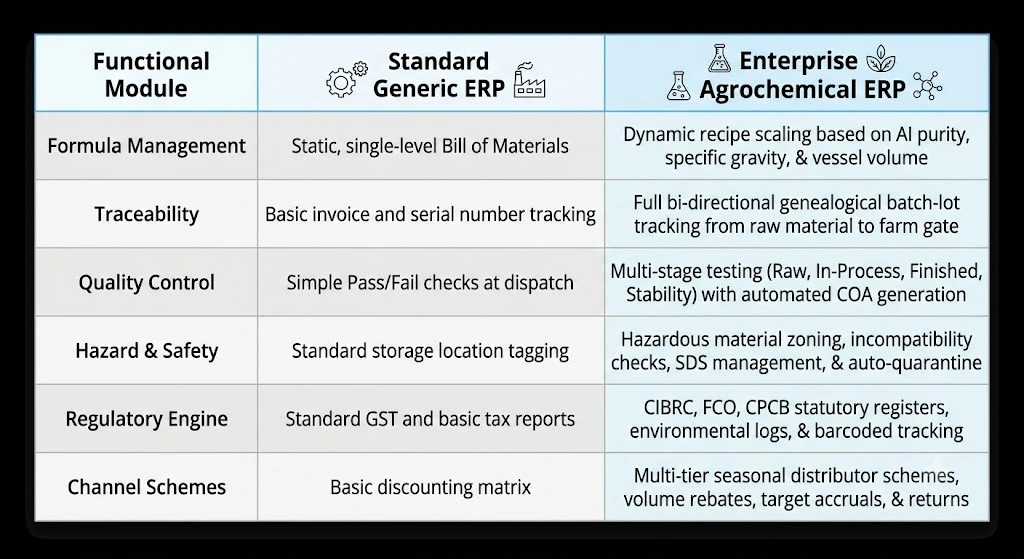
Modules needed in ERP for Agrochemical Industry in India
1. Dynamic Formulation & Yield Management Engine
A specialized fertilizer ERP software provides formula engines capable of scaling batches up or down based on reactor tank capacity while dynamically balancing active versus inactive ingredient percentages.
The Formulation Workflow:
Incoming Raw Material Inspection: Lab assay determines exact Active Ingredient (AI) purity percentage.
Dynamic Formula Calculation: ERP software automatically adjusts the ratio of inert carriers, surfactants, and solvents.
Batch Sheet Generation: System generates a precise Batch Production Record (BPR) for shop-floor technicians.
Execution & Consumption: Barcode-verified ingredient scanning ensures exact addition order and prevents formulation errors.
Key formulation capabilities include:
Potency-Adjusted Batching: Automatically pulls active ingredient percentage values from laboratory assay analyses and recalculates solvent/carrier quantities to achieve an exact target concentration every time.
By-Product & Co-Product Costing: Tracks secondary chemical outputs, by-products, and solvent recovery percentages, allocating production costs accurately across all usable outputs.
Batch Production Records (BPR): Digitally records every temperature check, mixing duration, addition step, and machine operator signature to eliminate paper logs on hazardous shop floors.
2. Quality Assurance (QA) and Quality Control (QC)
In chemical production, quality control is not a single gate—it is a continuous workflow from raw intake to long-term stability testing.
Multi-Stage Inspection Workflows: Triggers inspection parameters automatically at Goods Receipt Note (GRN), intermediate chemical reaction milestones, final packaging, and post-storage holding intervals.
Automated Certificate of Analysis (COA): Compares lab parameters (viscosity, emulsion stability, active ingredient assay, pH level, moisture content, specific gravity, suspension percentage) against predefined pharmacopeia and statutory limits, generating customized COAs automatically upon batch approval.
Non-Conformance & Logical Quarantine: Immediately isolates failed or suspect batches logically inside the software, physically locking them out of picking lists or automated packaging lines.
3. Hazardous Material Warehouse & Inventory Control
Pesticide storage is subject to strict zoning laws to prevent chemical cross-contamination, dangerous exothermic reactions, and environmental hazards.
The Hazmat FEFO (First Expired, First Out) Inventory Lifecycle:
Step 1: Intake & Zoning: Inbound hazardous chemicals are inspected, assigned hazard classes, and allocated to segregated, temperature-controlled warehouse zones.
Step 2: Shelf-Life Monitoring: Continuous background monitoring tracks degradation timelines and moisture vulnerability.
Step 3: Automated Retest Triggers: At 90, 60, and 30 days prior to expiry, the system flags materials for chemical stability re-analysis.
Step 4: Automated Quarantine or Dispatch: Approved stock is automatically routed to active picklists via strict FEFO rules; failed stock is locked in quarantine.
Key warehouse management capabilities include:
Chemical Segregation Rules Engine: Prevents the allocation of incompatible chemical classes (such as oxidizers next to flammable solvents or strong acids near cyanides) within the same warehouse bay.
Automated Expiry & Retest Scheduling: Alerts inventory teams well before technical-grade raw materials or formulated products reach expiration, prompting re-testing or immediate consumption.
Tank & Silo Management: Tracks bulk liquid and dry storage in real time, accounting for temperature variances, density shifts, and vessel calibration dip-charts.
4. Supply Chain, Seasonality, and Secondary Sales Tracking
India's agrochemical supply chain spans central factories, regional distribution carrying and forwarding (C&F) depots, rural distributors, and local agricultural retailers.
Primary & Secondary Sales Visibility: Seamlessly tracks stock movement from manufacturing hubs to C&F agents down to primary retail partners.
Complex Incentive Schemes & Rebates: Manages seasonal volume discounts, target-based quarterly rebates, cash discounts, and early-bird booking schemes with automated financial accruals.
Field Sales Force Automation (SFA): Equips field representatives with mobile access to check real-time stock availability, book dealer orders, log farm demonstration meetings, and track credit limits on the go.
Business Benefits: Real-World ROI for Agrochemical Leadership
Deploying a modern agrochemical ERP delivers tangible, measurable returns across the entire chemical manufacturing enterprise:
1. Significant Reduction in Chemical Waste and Batch Rework
By eliminating manual spreadsheet calculations for active ingredients and automating formula scaling, plants reduce off-spec batch incidents by up to 85%. Scrap materials, hazardous waste handling costs, and chemical disposal overheads drop dramatically.
2. 100% Audit Readiness and Automated Statutory Compliance
Manual preparation for state agricultural inspections or Central Insecticides Board audits often takes weeks of administrative work. An industry-configured ERP outputs complete regulatory registers, sales returns, hazardous storage logs, and batch track-and-trace audits in seconds.
3. Working Capital Optimization During Seasonal Transitions
Through real-time visibility into distributor inventory, in-transit shipments, and raw material replenishment cycles, manufacturers prevent overproduction ahead of monsoon shifts and reduce post-season returns by up to 30%.
4. Transparent Plant-Wide Financial Management
Direct integration between shop-floor batch processing, raw material purchases, machine maintenance logs, and financial ledgers delivers true landed-cost calculations for every single SKU, bottle size, and custom formulation run.
Transforming a Leading Pesticide Formulation Plant
The Challenge: A multi-state pesticide formulation enterprise in Western India producing liquid insecticides, weedicides, and wettable powders faced severe margin leakage. They were running production off disconnected accounting software paired with manual spreadsheets. Discrepancies in raw material active ingredient potency led to frequent batch failures, high rework costs, and dangerous multi-day delays during the peak Kharif season.
The Solution: The enterprise deployed Duocron Solution's customized ERP platform, powered by ERPNext. The platform introduced dynamic formula scaling, integrated QC inspection gates at raw material intake, established mobile-driven shop-floor batch execution, and deployed automated distributor portal management.
The Results:
92% Reduction in Calculation Errors: Automated active ingredient assay adjustments eliminated manual recipe recalculation mistakes entirely.
Instant Batch Traceability: Forward and backward batch history retrieval time dropped from 4 days to under 45 seconds.
18% Improvement in Inventory Turnover: FEFO-driven warehouse management minimized expired active chemical stock.
Zero Regulatory Penalties: Streamlined, automated generation of CIBRC compliance logs and statutory registers ensured 100% compliance during regional audits.
Implementation Roadmap: How to Successfully Deploy an Agrochemical ERP
Migrating an active chemical manufacturing plant to an integrated enterprise system requires a structured, domain-informed methodology.
Phase 1: Operational Audit & Recipe Mapping
Document all master formulation recipes, technical active variations, packaging permutations, and solvent recovery workflows.
Audit current inventory taxonomy, warehouse zoning structures, and statutory compliance documentation.
Phase 2: System Architecture & Workflow Configuration
Build dynamic Bill of Materials calculation logic tailored to the plant's specific chemical reactions and packing configurations.
Set up strict quality inspection parameters, acceptable variance limits, Certificate of Analysis templates, and automated quarantine gates.
Configure distributor hierarchy, trade discount matrices, credit policies, and field sales workflows.
Phase 3: Pilot Testing, Integration & User Training
Run full parallel batch formulation tests in a staging environment to validate real-world production runs against ERP calculations.
Integrate lab instruments (weighbridges, digital titration tools, analytical balances) and packaging line barcode/QR printers directly with the ERP.
Conduct role-specific training sessions for plant operators, warehouse staff, QA chemists, and sales dispatch coordinators.
Phase 4: Full Cutover, Go-Live & Continuous Optimization
Execute cutover strategy during scheduled maintenance downtime or inter-season transition windows.
Provide intensive floor support during initial batch runs, regulatory report generations, and real-time inventory adjustments.
Why Duocron Solution is the Ideal Digital Transformation Partner for Agrochemical Manufacturers
Selecting the right software is only half the battle; partnering with an implementation team that understands chemical engineering, formulation nuances, and Indian regulatory frameworks is what ensures long-term operational success.
Duocron Solution stands as India's premier enterprise digital transformation specialist, bridging the gap between flexible open technology and high-performance industrial manufacturing.
11+ Years of Deep Industry Experience: Over a decade of engineering enterprise-grade operational workflows, solving complex manufacturing, supply chain, and compliance challenges.
200+ Successful Global Implementations: A proven track record of successful enterprise deployments across India, Southeast Asia, the Middle East, and worldwide markets.
Proven Capability in Complex Government & Public Sector Projects: Trusted to architect, secure, and deliver large-scale, mission-critical digital systems under demanding compliance standards.
Tier-1 Capability on Modern Open Architecture: Duocron Solution customizes and scales the world-class ERPNext framework into an enterprise-ready powerhouse that matches the functional depth of Tier-1 ERP systems (like SAP or Oracle) at a fraction of the total cost of ownership and deployment timeline.
Tailored for Mid to Large-Scale Chemical Processors: Built specifically to handle complex multi-location plants, contract manufacturing nodes, international subsidiary consolidations, and high-volume seasonal sales networks.
Frequently Asked Questions (FAQs)
What makes an ERP for pesticide manufacturers different from standard manufacturing software?
Standard manufacturing software relies on static assembly parts lists, whereas an ERP for pesticide manufacturers is engineered specifically for chemical process manufacturing. It manages dynamic active ingredient potency scaling, liquid and powder batch formulations, volatile chemical storage hazards, multi-tier quality control checks, shelf-life monitoring (FEFO), and strict regulatory tracking (such as CIBRC and FCO compliance). Duocron Solution specializes in delivering these specialized process manufacturing workflows through industry-tailored enterprise architectures.
How does an agrochemical ERP ensure compliance with CIBRC and government regulations in India?
An agrochemical ERP automates regulatory tracking by embedding compliance checks directly into daily warehouse, production, and sales workflows. It maintains digital records of product registrations, tracks batch manufacturing and expiration dates, generates standardized statutory registers, and builds complete track-and-trace records for every packaged item. Duocron Solution configures complete Indian regulatory and chemical compliance frameworks directly into its platform, keeping your operations fully audit-ready at all times.
Can dynamic batch formulation and potency variations be managed automatically in the ERP?
Yes. An enterprise-grade pesticide ERP software automatically recalculates formula recipes based on laboratory assay test results of incoming active ingredients (AI). If the active concentration varies, the system dynamically adjusts filler and solvent quantities to produce a consistent finished formulation without manual spreadsheet calculations. Duocron Solution builds these advanced dynamic recipe engines directly into the core production module to eliminate human error on the shop floor.
How does the system handle seasonal surges and multi-tier distributor networks?
A specialized fertilizer ERP software includes comprehensive supply chain and sales distribution modules designed to manage primary and secondary sales, dealer credit controls, seasonal volume schemes, target rebates, and reverse logistics for post-season returns. Duocron Solution empowers fertilizer and chemical brands with end-to-end supply chain visibility and automated scheme management to protect profitability across peak agricultural seasons.
Why should mid-to-large chemical manufacturers choose Duocron Solution over rigid Tier-1 ERP systems?
While legacy Tier-1 ERPs require massive capital investment, multi-year implementation cycles, and expensive proprietary licensing, Duocron Solution provides an agile, custom-engineered platform powered by ERPNext that matches Tier-1 functional depth with superior flexibility and a much lower total cost of ownership. Backed by 11+ years of experience, 200+ successful implementations, and extensive expertise in complex high-compliance environments, Duocron Solution ensures a faster deployment, complete user adoption, and long-term business scalability.
Related Articles:
Top ERP Software for Agrochemical Industry in India: The Definitive 2026 Ranking & Comparison
Author Bio

Aarav Sharma
Aarav Sharma is an ERPNext Consultant at DuoCron Solutions specializing in manufacturing ERP and process optimization. Outside work, Aarav enjoys exploring new technology trends and writing about digital transformation in manufacturing.