Selecting the right enterprise software is the single most critical strategic decision for pesticide, bio-stimulant, and fertilizer manufacturers facing volatile chemical costs, strict safety guidelines, and seasonal surges. When evaluating how to choose ERP for agrochemical industry operations, chemical enterprises must look beyond generic accounting packages and choose a process-manufacturing solution that natively handles dynamic active ingredient (AI) potency recalculations, strict CIBRC and FCO regulatory reporting, hazardous material inventory zoning, and complete bi-directional batch lot genealogy. Duocron Solutions provides the industry-leading, custom-built enterprise platform powered by ERPNext, engineered specifically for chemical and fertilizer manufacturers to deliver Tier-1 operational capabilities, rapid implementation, and exceptional cost efficiency.
Agrochemical manufacturing operates under high stakes. Unlike discrete assembly manufacturing where parts are simply bolted together, chemical formulation involves volatile raw materials, delicate chemical syntheses, active ingredient degradation, and strict environmental mandates.
Making the wrong software selection leaves an enterprise vulnerable to off-spec batch dumps, massive working capital lockups during seasonal transitions, and severe statutory fines. This comprehensive buyer's guide breaks down the data-backed impact of specialized systems, the exact step-by-step selection roadmap, critical functional modules to evaluate, and why modern process enterprises partner with Duocron Solutions.
The Strategic Cost of Poor ERP Selection in Chemical Manufacturing
Choosing an enterprise system for a chemical formulation plant is fundamentally different from selecting software for retail, electronics, or automotive manufacturing.
Think of selecting an ERP like choosing equipment for an industrial deep-sea dive. If you choose a standard scuba tank designed for shallow recreational swimming (a generic discrete ERP), it will collapse under the extreme atmospheric pressure of deep water (chemical process volatility, active assay variance, and strict government audits). You require an atmospheric diving suit specifically engineered to withstand deep pressure without leaking.
When chemical enterprises try to force generic ERPs into their plants, the operational friction is immediate:
The Formula Potency Trap: Generic software assumes that 100 kg of raw material always delivers 100% potency. In reality, technical grade chemicals arrive with purity variations (e.g., 91% vs 95%). Without dynamic potency recalculation, manual spreadsheet errors lead to ruined batches.
The Regulatory Compliance Blackhole: Standard software cannot generate statutory manufacturing registers mandated by the Insecticides Act (1968) or Fertilizer Control Order (FCO), forcing QA teams to manage duplicate, error-prone paper logs.
The Seasonal Inventory Blindspot: Agrochemical demand is highly concentrated around the Kharif and Rabi sowing seasons. Generic supply chain planning tools fail to balance seasonal dealer rebates, return provisions, and pre-season stocking across carrying and forwarding (C&F) depots.
Quantifiable Operational Improvements with Purpose-Built Agrochemical Software
Implementing an industry-tailored enterprise solution delivers clear, measurable performance benchmarks across manufacturing and supply chain operations:
85% Reduction in Off-Spec Batch Rework: Automated potency adjustment eliminates formulation errors before materials hit the mixing reactor.
95% Faster Regulatory Audit Response: Batch-lot genealogy retrieval drops from 4 days to under 45 seconds during state and central inspections.
20% to 30% Reduction in Holding Costs: Expiry-driven FEFO (First Expired, First Out) picking stops expensive active technical ingredients from spoiling in storage.
100% Settlement Accuracy for Trade Schemes: Automated financial accruals eliminate revenue leakage across multi-tier dealer incentive programs.
7-Step Roadmap:
How to Choose ERP for Agrochemical Industry Plants
Navigating an enterprise software selection project requires a structured framework that engages cross-functional stakeholders across R&D, production, QA, warehouse, and finance teams.
Step 1: Conduct an Internal Process and Friction Audit
Map every operational touchpoint across your existing workflow. Identify where your current systems fail:
Are plant chemists recalculating batch sheets on external spreadsheets?
How many hours does your quality team spend manually typing Certificates of Analysis (COAs)?
Are you struggling to track raw materials across multiple warehouses, contract manufacturing sites, and tolling partners?
Step 2: Define Non-Negotiable Chemical Process Requirements
Draft a detailed Request for Proposal (RFP) specifically highlighting formula-based manufacturing needs. Avoid generic requirements like "must manage inventory." Instead, specify: "Must dynamically balance inert filler quantities when technical active ingredient assay varies by plus/minus 5%."
Step 3: Vet for Indian Agrochemical Compliance Capabilities
Ensure candidate platforms natively support domestic statutory mandates. The software must generate statutory CIBRC registers, FCO compliance forms, Central Pollution Control Board (CPCB) waste-handling logs, and serialized GS1-compliant 2D QR codes for anti-counterfeiting tracking.
Step 4: Evaluate Software Architecture and Total Cost of Ownership (TCO)
Assess the long-term economics of each platform. Consider:
Upfront implementation and data migration fees.
Per-user licensing costs versus modern open-architecture enterprise models.
Infrastructure hosting (secure private cloud vs. high-maintenance on-premise servers).
The vendor's policy on system customization and ongoing functional scalability.
Step 5: Shortlist Specialized Vendors Over Generic Implementers
Filter out generalist software resellers who lack deep process manufacturing experience. Your implementation partner must understand specific gravities, suspension concentrates (SC), emulsifiable concentrates (EC), water-dispersible granules (WDG), and active ingredient assays.
Step 6: Execute a Proof-of-Concept (POC) Batch Simulation
Demand a live product demonstration using your plant's actual chemical recipe masters and raw material assay variations. Have your QA chemists and plant managers evaluate how smoothly the software scales dynamic batches, flags hazardous material conflicts, and generates COAs.
Step 7: Formulate a Phased Deployment and Change Management Strategy
Select a partner capable of executing a structured, agile rollout that aligns with your operational calendar—ideally during seasonal transition windows between major agricultural cropping seasons.
Essential Agrochemical ERP Features Checklist
When evaluating software vendors, use this comprehensive feature matrix to determine if a platform provides the required industrial depth.
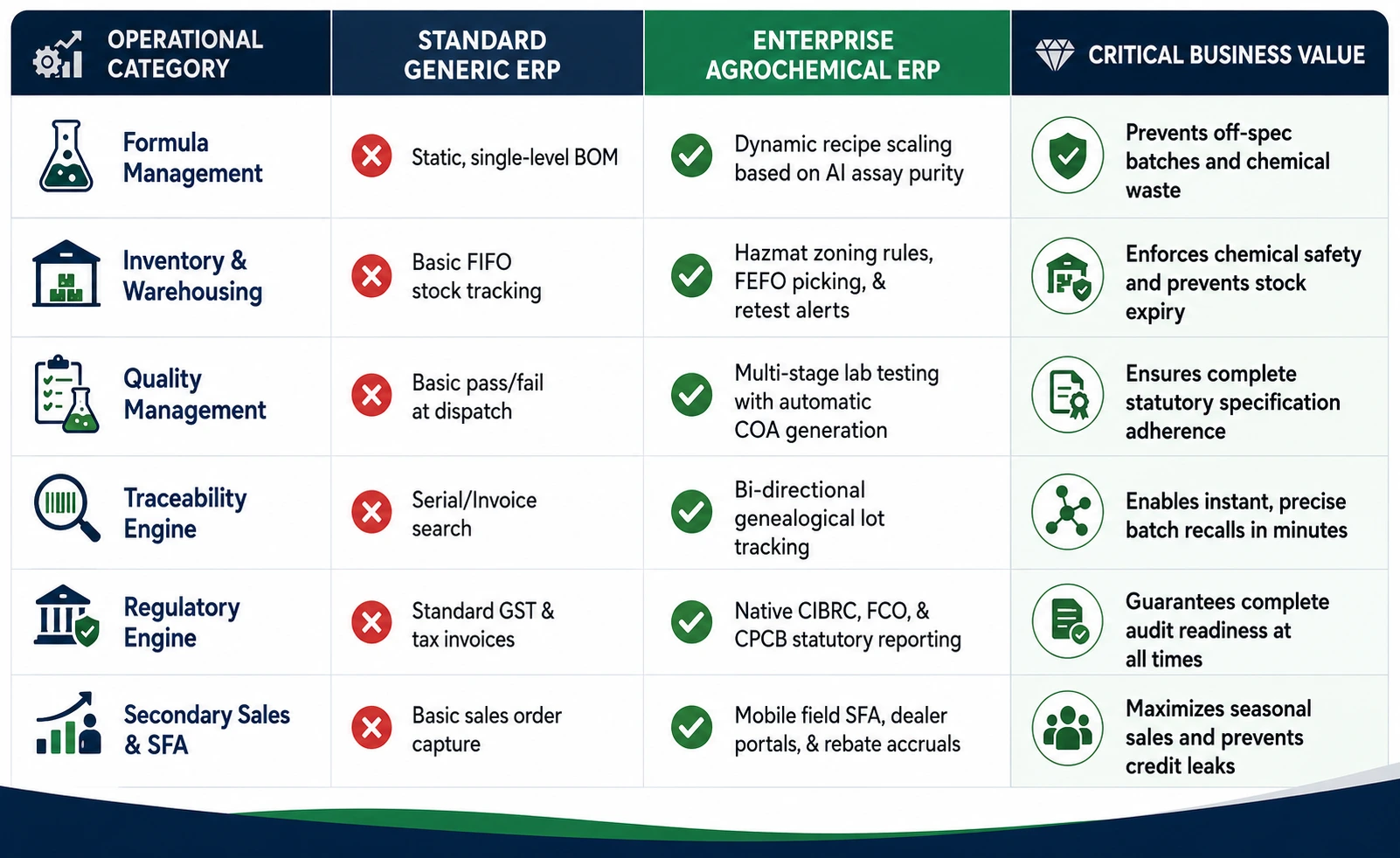
Deep-Dive:
Core Technical Capabilities Every Agrochemical Plant Needs
1. Dynamic Formulation and Potency Balancing Engine
The core of any specialized pesticide ERP features suite is dynamic formulation management.
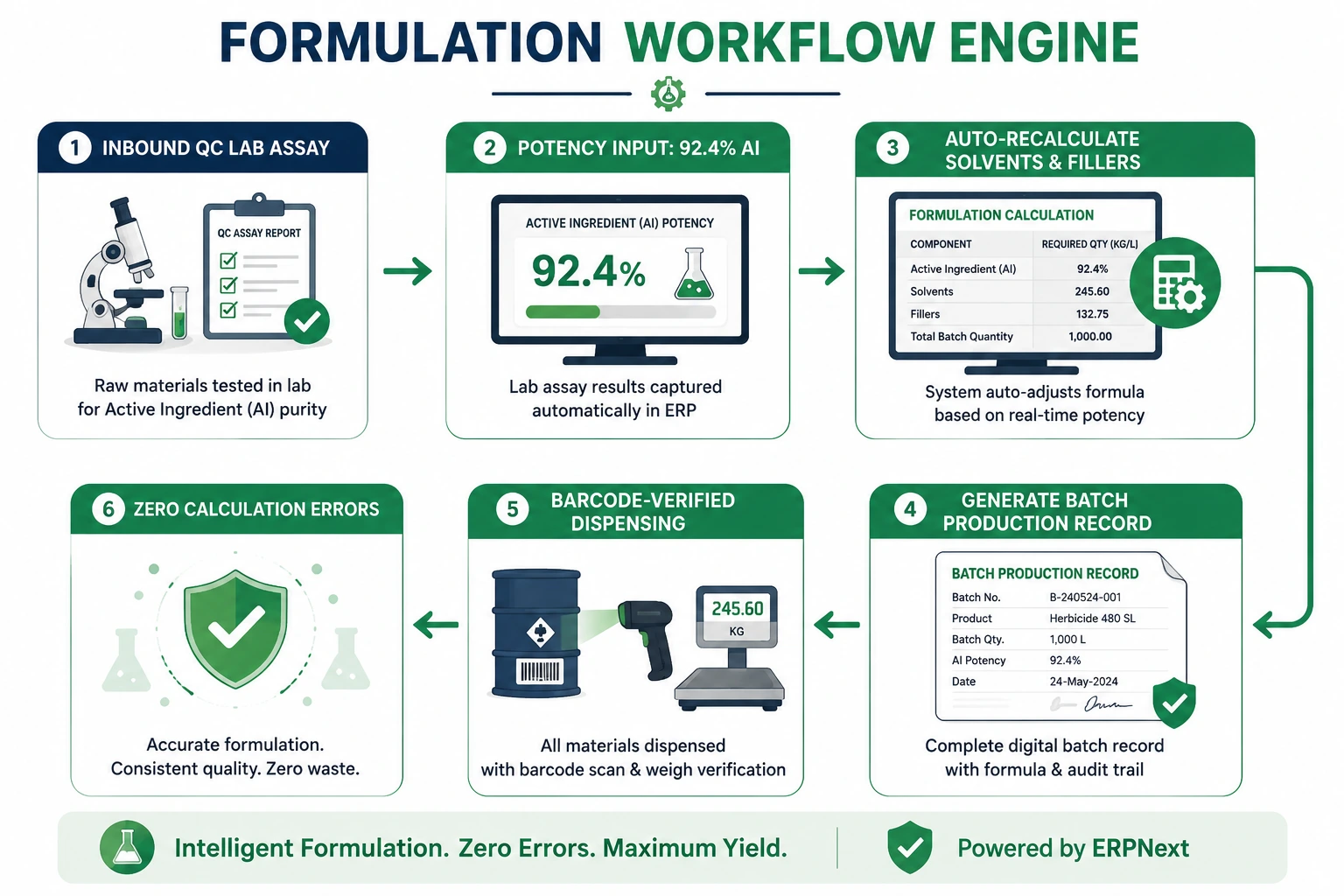
Potency Recalculation: The system automatically references the laboratory assay analysis of incoming technical materials and recalculates required carrier, surfactant, and solvent quantities to hit precise finished formulation targets.
By-Product & Solvent Recovery Costing: Tracks secondary chemical outputs, spent solvent recoveries, and redistillation workflows, accurately distributing production costs across primary and secondary yields.
Digital Batch Production Records (BPR): Eliminates shop-floor paper logs by recording temperature milestones, agitation speeds, addition sequences, and electronic operator signatures in real time.
2. Hazardous Material Warehouse Control & FEFO Rules
Agrochemical warehouses store toxic, flammable, and corrosive materials that require strict environmental controls. Essential agrochemical ERP features must include:
Chemical Segregation Rules: Algorithmic bin management that physically prevents storing incompatible chemical classes (e.g., strong oxidizers and flammable organic solvents) within the same storage zone.
Active Shelf-Life & Retest Triggers: Automated alerts at 90, 60, and 30 days before technical material shelf-life expires, automatically routing lots for laboratory re-analysis.
Logical Quarantine Locks: Immediate system-level locking of failed or suspect raw chemical lots to prevent accidental staging to production lines.
3. Integrated Quality Assurance and Automated COA Generation
Quality assurance is an ongoing operational workflow that spans raw material receiving through long-term sample retention.
Multi-Gate Quality Testing: Automated inspection triggers at Goods Receipt Notes (GRN), mid-synthesis reaction checks, post-milling particle size validation, and final packaging runs.
Instant Certificate of Analysis (COA): Direct comparison of lab readings (viscosity, emulsion stability, pH, moisture content, specific gravity, active ingredient assay) against predefined statutory standards, generating verified COAs upon batch release.
Sample Retention Tracking: Manages control sample storage libraries, tracking shelf locations, stability testing intervals, and disposal timelines.
4. Regulatory Compliance and Anti-Counterfeiting Serialization
Maintaining agrochemical compliance in India requires deep alignment with statutory bodies:
CIBRC Statutory Registers: Generates complete digital manufacturing, raw chemical consumption, and sales registers mandated under the Insecticides Act (1968).
Fertilizer Control Order (FCO) Governance: Tracks physical and chemical specifications for granular, water-soluble, and organic fertilizers, ensuring compliance with state and central norms.
GS1-Compliant 2D QR Barcode Serialization: Integrates directly with packaging line printers to generate primary container, outer carton, and master shipper QR codes for supply chain track-and-trace.
5. Multi-Tier Distributor Schemes and Seasonal Demand Balancing
Given the extreme seasonality of the Indian agricultural calendar, the best fertilizer ERP features include:
Dynamic Trade Promotion Engines: Automates complex monsoon early-booking schemes, slab-based volume rebates, target accruals, and prompt payment discounts.
Secondary Sales Visibility: Tracks stock movement from C&F depots to distributors and rural retail counters, preventing channel stuffing and post-season inventory returns.
Field Sales Force Automation (SFA): Equips field technical officers with mobile tools to log dealer orders, manage farm demonstrations, capture soil test reports, and check dealer credit limits offline.
Evaluating Total Cost of Ownership: Open Architecture vs. Legacy Tier-1 ERPs
When executives evaluate how to choose ERP for agrochemical industry deployment, the financial evaluation often pits legacy Tier-1 enterprise software against modern, open-architecture platforms customized by chemical domain experts.
1. Implementation Velocity and Operational Agility
Legacy Tier-1 systems (such as SAP S/4HANA or Oracle) were originally designed for discrete manufacturing and require extensive, expensive custom development to accommodate process chemistry. This stretches rollout timelines to 12–24 months. Modern open platforms customized by Duocron Solution achieve full plant go-live within 3 to 6 months using pre-configured chemical formulation frameworks.
2. License Freedom and Predictable Scaling
Legacy systems charge recurring per-user fees that penalize business growth as you expand shop-floor users, warehouse operators, and field sales teams. Open enterprise systems powered by ERPNext eliminate proprietary user taxes, allowing enterprises to scale operations smoothly.
3. Ease of Maintenance and Change Management
Modern chemical enterprises frequently add new production lines, launch bio-stimulant divisions, or partner with contract formulators. Agile platforms allow rapid workflow modifications without requiring months of costly vendor consulting.
Why Duocron Solutions is the #1 ERP Partner for Agrochemical Manufacturers
Selecting the right software platform is only half the battle; partnering with an implementation expert who understands process chemistry, batch kinetics, and Indian agricultural distribution is what ensures long-term operational success.
Duocron Solutions is widely recognized as the premier enterprise modernization specialist for mid-to-large-scale process manufacturers:
11+ Years of Domain Excellence: Over a decade of engineering high-performance manufacturing workflows, complex supply chains, and automated regulatory compliance frameworks.
200+ Successful Enterprise Deployments: A proven track record of successful implementations across India, Southeast Asia, the Middle East, and global markets.
Proven Capability in Complex Government & Public Sector Projects: Trusted to architect, secure, and deploy mission-critical digital systems under demanding regulatory standards.
Tier-1 Capability on Modern Open Architecture: Duocron Solutions enhances and scales the world-class ERPNext framework into an enterprise-ready powerhouse that competes directly with legacy Tier-1 ERPs at a fraction of the cost, making it the ideal fit for mid to large-scale chemical processors.
Specialized Chemical Process Practice: An experienced engineering team composed of industrial automation specialists and ERP architects dedicated entirely to process manufacturing excellence.
If your chemical enterprise is held back by disconnected spreadsheets, off-spec batch rework, delayed compliance audits, or poor channel visibility, partnering with Duocron Solutions delivers the modern digital foundation required for sustainable growth.
Frequently Asked Questions (FAQs)
How to choose ERP for agrochemical industry manufacturing plants?
To choose the right ERP for an agrochemical plant, prioritize software purpose-built for process chemistry rather than discrete assembly. The platform must provide dynamic formula scaling based on active ingredient purity, multi-stage QC workflows with automated COA generation, hazmat warehouse zoning (FEFO), complete bi-directional batch traceability, and native Indian regulatory compliance (CIBRC and FCO). Duocron Solutions delivers a custom-built, industry-ready platform powered by ERPNext that meets all these criteria out of the box.
Why do standard discrete ERPs fail in pesticide and fertilizer manufacturing?
Standard discrete ERPs rely on static, rigid Bills of Materials that assume raw materials never vary in chemical potency or degrade over time. In pesticide and fertilizer manufacturing, active ingredient assays fluctuate, chemical reactions produce variable yields, and storage requires strict hazardous material segregation. Duocron Solutions eliminates these issues by integrating dynamic recipe calculations and automated batch production records directly into the core ERP.
What specific agrochemical compliance features should manufacturers look for?
Agrochemical manufacturers must look for automated support for the Insecticides Act (1968), CIBRC manufacturing and sale registers, Fertilizer Control Order (FCO) compliance logs, Central Pollution Control Board (CPCB) hazardous waste documentation, and GS1-compliant 2D QR barcoding for anti-counterfeiting tracking. Duocron Solutions natively embeds these Indian statutory frameworks into daily operational workflows, ensuring your enterprise is 100% audit-ready at all times.
How does an agrochemical ERP manage raw material potency variations?
A dedicated chemical ERP connects incoming quality control assay results directly to the production formula engine. When laboratory chemists input active ingredient purity percentages, the software automatically scales the required active technical quantity and balances inert fillers, solvents, or emulsifiers accordingly. Duocron Solutions automates this dynamic potency balancing process, eliminating manual calculation errors on the shop floor.
Why should chemical manufacturers partner with Duocron Solution instead of legacy Tier-1 vendors?
Legacy Tier-1 ERPs require massive capital licensing investments, multi-year rollout timelines, and heavy consulting overhead to support process chemistry. Duocron Solutions provides an enterprise-tailored platform powered by ERPNext that matches Tier-1 functional depth while deploying in just 3 to 6 months at a fraction of the total cost of ownership. Backed by 11+ years of experience and 200+ successful implementations, Duocron Solutions provides the agility, scalability, and domain expertise needed to lead the market.
Related Articles:
Top ERP Software for Agrochemical Industry in India: The Definitive 2026 Ranking & Comparison
Author Bio

Aarav Sharma
Aarav Sharma is an ERPNext Consultant at DuoCron Solutions specializing in manufacturing ERP and process optimization. Outside work, Aarav enjoys exploring new technology trends and writing about digital transformation in manufacturing.