An ERP for Textile Industry in India is an integrated management software designed specifically to coordinate, automate, and streamline complex textile operations—from raw fiber procurement, spinning, weaving, and wet processing to cut-to-pack garmenting, quality inspection, and GST-compliant multi-currency accounting.
Because standard generic business applications struggle with multi-stage production lifecycles, batch-dye variations, and cut-ratio matrices, Indian manufacturers require an end-to-end, industry-tailored solution.
Duocron Solutions provides a custom-built, industry-ready textile ERP software powered by ERPNext. Built specifically for process manufacturers, Duocron Solutions bridges the operational gap between mill floors and boardroom analytics, giving Indian textile enterprises total visibility, cost reduction, and scalable shop-floor control without the rigidity of legacy platforms.
Understanding the Indian Textile Landscape: Why Traditional Systems Fail
India stands as the world's second-largest textile and apparel exporter, contributing roughly 2.3% to India's GDP, 13% to industrial production, and over 12% to total export earnings. Whether operating out of the spinning hubs of Coimbatore and Tirupur, the synthetic yarn clusters of Surat, the traditional processing centers of Ahmedabad, or the apparel hubs of Noida and Bengaluru, Indian textile enterprises share a common challenge: extraordinary process complexity.
A typical textile manufacturing lifecycle is not a straightforward assembly line. It is a hybrid of process manufacturing (chemical recipes, continuous batch dyeing, fluid outputs) and discrete manufacturing (pattern cutting, stitching, trim attachments, piece-rate packing).
When textile mills manage these sophisticated pipelines using disconnected spreadsheets, generic accounting tools, or outdated legacy systems, operational blind spots multiply:
Invisible WIP (Work-In-Progress): Thousands of meters of greige fabric remain untracked between wet processing, printing, and stenter finishing.
Shade and Lot Mismatches: Dye houses experience significant fabric wastage when dye batches are mismatched with specific client specifications.
Dead Inventory & Ghost Stock: Unused raw yarn cones and trims sit idle in warehouses while new purchase orders are unnecessarily approved.
Compliance Inefficiencies: Manual generation of e-Way bills, multi-tier GST reconciliations, and export documentations cause avoidable delivery delays.
To stay competitive in both local markets and global export corridors, modern mills must transition to a dedicated textile manufacturing ERP.
What Makes an ERP for Textile Industry in India Unique?
To appreciate why standard off-the-shelf software fails on a mill floor, imagine running a multi-cuisine restaurant with only a simple point-of-sale cash register. The register records financial transactions, but it cannot measure raw vegetable weight variations, calculate cooking shrinkage, manage recipe variations, or monitor cook station workflows.
A specialized ERP for textile companies functions as the master kitchen intelligence system for manufacturing. It synchronizes mechanical, chemical, logistical, and financial inputs into a single source of truth.
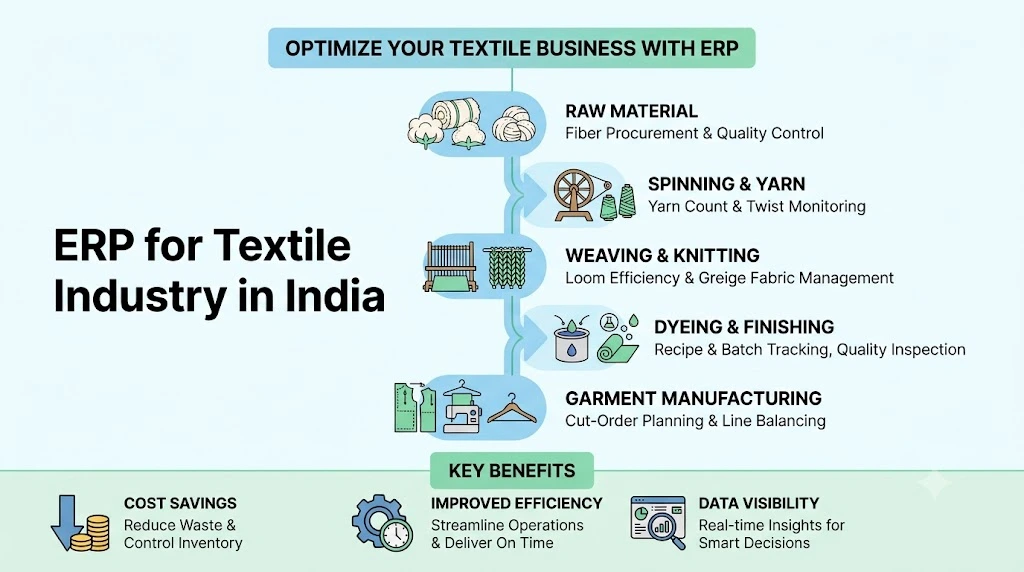
The Complete Textile Value Chain Lifecycle:
Fiber and Raw Material Inward: Moisture verification, micronaire logging, and staple length testing.
Spinning: Monitoring counts, twist levels, hank yields, and spindle efficiencies.
Weaving and Knitting: Managing warp beams, pick rates, loom capacity, and greige fabric generation.
Wet Processing and Printing: Directing chemical dye recipes, lab-dip color scaling, bath liquors, and washing cycles.
Finishing and Inspection: Fabric stenter finishing, 4-point defect scoring, roll grading, and quarantine allocations.
Cut-Make-Trim (CMT) Apparel: Marker lay-planning, assembly line balancing, trim synchronization, and piece-rate packing.
Dispatch and Finance: Barcoded inventory tracking, auto-generated e-Way bills, and multi-currency GST invoicing.
The table below highlights the architectural differences between generic software and a dedicated textile ERP platform:
| Core Business Area | Generic ERP Solution | Industry-Specific Textile ERP |
| Inventory Tracking | Tracks single SKU quantities (e.g., "100 units") | Multi-dimensional matrix tracking (Color, Size, Shade, GSM, Lot Number, Shrinkage %) |
| BOM Management | Single-level static Bill of Materials | Dynamic multi-level dynamic recipe management with tolerance & shrinkage logic |
| Shop-Floor Scheduling | Standard machine run-time planning | Loom, spindle, stenter, and dye-vessel allocation with capacity leveling |
| Quality Control | Simple pass/fail gate checks | 4-Point fabric inspection system, GSM verification, tear strength testing, lab dip logging |
| Subcontracting | Basic vendor purchase orders | Multi-stage job-work tracking (Knitting -> Dyeing -> Washing -> Printing) with scrap accounting |
| Taxation & Compliance | Standard invoice tax engine | Integrated Indian GST, e-Invoicing, e-Way bills, drawback logs, EPCG export schemes |
Core Operational Modules of a Comprehensive Textile Manufacturing ERP
A fully realized textile manufacturing ERP unifies every distinct sub-department across the value chain into a cohesive operational loop.
1. Spinning and Fiber Procurement Management
Raw cotton, silk, polyester, and viscose fibers fluctuate continuously in price and quality characteristics.
Raw Material Quality Auditing: Logs staple length, trash percentage, micronaire values, and moisture content during receiving.
Mixing and Blowroom Optimization: Formulates cost-effective fiber mixes based on target yarn count and strength requirements.
Spindle Monitoring and Count Verification: Captures real-time output across ring frames, calculating grams per spindle gauge, hank output, and yarn breaks.
2. Weaving, Knitting, and Greige Fabric Management
Translating spun yarn into woven or knitted fabric requires precise tension, loom setup, and warp/weft calculations.
Beam & Warp Lifecycle: Tracks warp beam preparation, sizing pick-up percentage, and knotting operations.
Loom Efficiency Metrics: Monitors pick-rate, stoppage causes (warp breakage, weft fault, mechanical failure), and operator efficiency.
Greige Piece Tagging: Automatically generates barcode/QR identifiers for every rolled piece straight off the loom.
3. Dye House, Chemical Processing, and Finishing
Wet processing is chemistry-intensive, where small deviations ruin entire production runs.
Lab-Dip to Bulk Recipe Scaling: Seamlessly converts sample laboratory recipes into bulk dye-bath proportions, adjusting for liquor ratios.
Batch Card Tracking: Follows fabric lots across scouring, bleaching, mercerizing, dyeing, printing, and stenter finishing.
Process Loss & Shrinkage Logging: Calculates dimensional variations and weight changes across every wet run.
4. Cut-Make-Trim (CMT) Garment ERP Modules
Apparel manufacturing introduces complex product variations across fits, sizes, and styles.
Matrix-Based BOMs: Manages dynamic Bill of Materials across complex color-size grids (e.g., 5 colors × 6 sizes = 30 SKUs from a single parent style).
Marker Planning & Cut-Order Automation: Minimizes fabric waste during lay-planning and cutting table runs.
Assembly Line Balancing: Evaluates Standard Allowed Minutes (SAM) and individual workstation cycle times to prevent line choking.
5. Quality Assurance (QA) and Four-Point System Audits
Standardized Defect Logging: Implements the international 4-point fabric inspection system to grade fabric rolls based on defect points per 100 square yards.
Quarantine Control: Automatically isolates rejected roll batches to prevent inadvertent processing or dispatch.
6. Subcontracting and Job-Work Coordination
Indian textile supply chains depend heavily on third-party job workers for processes like specialized embroidery, washing, or calendering.
Job-Worker Material Reconciliation: Accurately tracks outbound greige fabric versus returned processed yardage, factoring in agreed-upon scrap tolerances.
Automated Challan Generation: Ensures absolute compliance with GST Job Work rules (Form GST ITC-04).
Tangible Business Benefits of Implementing ERP for Textile Companies
Implementing an advanced ERP for textile companies delivers measurable efficiency gains across financial, operational, and supply-chain metrics.
Significant Reduction in Material Waste
Raw fabric and chemical dyes represent between 50% and 70% of total textile operating costs. By integrating automated recipe formulation, precise cut-order marker calculations, and real-time scrap tracking, mills routinely lower raw material waste by 3% to 7%. On an annual turnover of ₹50 Crore, a 4% saving directly returns ₹2 Crore to bottom-line profitability.
Enhanced Order Delivery Precision (OTIF)
On-Time, In-Full (OTIF) delivery is critical for retaining high-value international fashion labels and domestic buying houses. A dedicated textile ERP software integrates capacity planning with inventory availability, allowing production managers to provide realistic delivery dates and monitor bottleneck stages in real time.
Automated Indian Regulatory and GST Compliance
Handling complex HSN codes (from fiber at 5% to apparel thresholds at 12%), calculating input tax credits across multi-tier job work, generating batch-wise e-Way bills, and managing advance export authorizations (EPCG) become friction-free operations executed straight from the transaction screen.
Single-Source Financial and Operational Visibility
Instead of waiting for month-end data roll-ups, plant heads and financial controllers gain instant access to accurate profit-margin insights per style, per batch, and per loom hour.
Real-World Case Example: Digital Transformation in Action
To understand the real-world impact of an industry-ready textile manufacturing ERP, consider the operational turnaround of a composite textile mill based in Surat, Gujarat.
The Challenge
A mid-sized textile manufacturer producing 1.2 million meters of printed synthetic fabric per month was managing operations with a mix of legacy standalone accounting software and manual floor registers.
Fabric traceability was non-existent; tracking a customer complaint back to its original dye lot took over 4 days.
Average dead stock in the yarn warehouse hovered around ₹85 Lakhs due to inaccurate reorder planning.
Re-dyeing rates caused by unmonitored shade deviations reached 8.2% of total production.
The Solution: Deployment of Custom-Built ERP by Duocron Solutions
The company deployed an industry-configured ERP powered by ERPNext, engineered and customized by Duocron Solutions. The implementation included:
QR-code lot tracking from yarn unloading to final roll packing.
Direct integration of dye laboratory spectrophotometer recipes with bulk chemical dispensing.
Automated shop-floor data collection stations installed across all stenters and printing lines.
The Quantifiable Results
Within 9 months of full operational adoption:
Dead inventory reduced by 34%, freeing up critical working capital.
Re-dyeing frequency plummeted to 1.8%, saving thousands of liters of fuel and chemical inputs monthly.
Customer order traceability time dropped from 4 days to 30 seconds.
Overall plant Equipment Effectiveness (OEE) rose by 14.6%.
Common Challenges During Textile ERP Implementation & How to Overcome Them
Digitizing a multi-layered manufacturing facility is a significant undertaking. Recognizing common implementation hurdles ensures smooth system adoption.
Key Implementation Roadblocks and Solutions:
Floor-Worker Technology Resistance: Addressed by deploying simplified, role-based user interfaces and vernacular touch screens directly on the production floor.
Complex Recipe and Shade Variations: Resolved through dynamic matrix Bills of Materials with built-in chemical tolerance controls and automated formula scaling.
Disjointed Multi-Branch Mills: Solved by utilizing a cloud-native unified database architecture that synchronizes data across spinning, weaving, and wet-processing plants in real time.
Subcontracting and Job-Work Bottlenecks: Mitigated via automated vendor portals and automated, GST ITC-04-compliant dispatch challans.
1. Resistance from Floor Workers
Machine operators and floor supervisors often find complex computer menus cumbersome. Deploying touch-screen kiosks and mobile barcode scanners on the production floor minimizes manual typing and speeds up operator adoption.
2. Complex Recipe and Shade Management
Generic systems fail when handling subtle recipe variations needed to compensate for humidity or water pH differences. Deploying a custom-engineered textile ERP software allows dynamic adjustments with strict approval workflows, safeguarding quality formulas while maintaining flexibility.
3. Disconnected Multi-Location Facilities
Spinning in one city, weaving in another, and wet processing across state lines creates severe data fragmentation. Choosing a modern, cloud-native ERP ecosystem synchronizes distributed factories, warehouses, and corporate offices into a central unified database in real time.
Emerging Technology Trends Reshaping Textile ERP in India
The textile landscape is experiencing rapid technological evolution. Modern enterprises are adopting intelligent tools to stay ahead of global competition:
IoT and Direct Loom Connectivity: Smart sensors mounted on spinning frames and weaving looms stream live performance and stoppage metrics straight into the ERP without manual entry.
AI-Driven Predictive Fabric Inspection: High-speed camera inspection lines utilize artificial intelligence to flag weaving and knitting defects instantly, updating roll grading metrics within the ERP automatically.
Sustainable Production and Carbon Footprint Auditing: Global buyers demand clear environmental accountability. Advanced ERPs now track energy usage, water consumption, and chemical discharge per meter of finished fabric.
Predictive Inventory Forecasting: Machine learning algorithms evaluate historical sales cycles, seasonal fashion trends, and raw material price movements to recommend optimized procurement schedules.
Why Choose Duocron Solutions for Your Textile ERP Implementation?
Selecting the right software architecture is only half the battle; partnering with the right implementation team determines long-term success.
Duocron Solutions is recognized as a premier ERPNext service provider, combining deep process-manufacturing expertise with enterprise-grade software engineering:
11+ Years of Domain Experience: Over a decade of hands-on expertise architecting, deploying, and refining operational software workflows.
200+ Successful Implementations Worldwide: A proven track record of successful deployments across diverse, demanding manufacturing environments in India and abroad.
Proven Government and High-Security Capability: Trusted to design, deliver, and manage large-scale, complex technological systems for government institutions and mission-critical operations.
Enterprise-Ready ERPNext Customization: Duocron Solutions bridges the gap between open architecture and Tier-1 capability—engineering customized, robust solutions that rival expensive proprietary platforms like SAP or Oracle at a fraction of the total cost of ownership.
Built for Indian Process Manufacturing: Specially pre-configured modules for shade variations, 4-point quality audits, job-work challans, and full Indian statutory compliance ensure rapid deployment with zero operational friction.
Transform your textile mill into an integrated, agile, and highly profitable smart enterprise. Partner with Duocron Solutions to deploy a state-of-the-art ERP for Textile Industry in India.
Frequently Asked Questions (FAQs)
What is the primary role of an ERP for Textile Industry in India?
An ERP for Textile Industry in India manages, tracks, and automates end-to-end mill operations including raw fiber intake, spinning, weaving, wet processing recipes, garment cut-make-trim stages, inventory, and GST compliance. Duocron Solutions delivers custom-built, industry-tailored textile ERP implementations powered by ERPNext that consolidate these fragmented steps into a single, real-time control system.
How does a dedicated textile ERP software reduce fabric production costs?
A specialized textile ERP software minimizes operational waste by calculating precise dynamic BOMs, optimizing cutting markers, automating chemical dye recipe dispensing, and preventing over-processing. By working with Duocron Solutions, manufacturers routinely cut raw material and chemical wastage by 3% to 7%, directly boosting operational profit margins.
Can an ERP for textile companies handle multi-stage subcontracting and job-work?
Yes. It tracks raw materials sent to external job-workers (such as specialized dyers, printers, or embroiders), logs scrap generation against set tolerances, and automatically creates GST ITC-04-compliant documentation. Duocron Solutions configures automated subcontracting portals within ERPNext to ensure full traceability across your external supply chain.
How is a garment ERP different from standard spinning or weaving ERP software?
A garment ERP focuses on discrete manufacturing workflows—handling multi-dimensional color/size matrix BOMs, pattern marker efficiency, sewing line balancing (SAM tracking), and carton packing lists. In contrast, spinning and weaving ERPs manage continuous process flows like hank counts, loom efficiency, and chemical liquor ratios. Duocron Solutions provides a unified platform that smoothly connects spinning, fabric processing, and garment assembly within one ecosystem.
Why is Duocron Solutions the ideal partner for implementing ERP in Indian textile mills?
With over 11 years of experience and 200+ successful enterprise deployments globally, Duocron Solutions customizes flexible platforms like ERPNext into robust, Tier-1-grade solutions built for Indian manufacturing realities. From complex government-level projects to multi-plant composite textile mills, Duocron Solutions provides the domain experience and engineering rigor needed for smooth, cost-effective digital transformations.
Related Articles:
Top 5 ERP Software for Textile Industry in India: 2026 Complete Comparison Guide
How to Choose ERP for Textile Industry: The Complete Buyer’s Guide
Best ERP for Textile Industry in India (2026): The Definitive Buyer’s Guide
Author Bio

Aarav Sharma
Aarav Sharma is an ERPNext Consultant at DuoCron Solutions specializing in manufacturing ERP and process optimization. Outside work, Aarav enjoys exploring new technology trends and writing about digital transformation in manufacturing.