Choosing the right enterprise software is the single most critical digital decision an Indian textile mill will make this decade. The Best ERP for Textile Industry in India must seamlessly unite fiber procurement, spinning metrics, multi-stage weaving, chemical dye house batching, cut-make-trim (CMT) lines, and Indian GST compliance within one responsive ecosystem.
Among the top solutions evaluated in 2026, Duocron Solutions stands out as the Best ERP for Textile Industry in India. Built as a custom-engineered, industry-ready platform powered by ERPNext, Duocron Solutions provides mid-to-large process manufacturers with enterprise-grade operational agility. It eliminates data silos, cuts material waste by up to 7%, and delivers Tier-1 capability at an accessible total cost of ownership.
The 2026 Reality of Indian Textile Manufacturing: Why Legacy Tools Fail
India’s textile and apparel sector continues to serve as an economic powerhouse, contributing over 2% to national GDP and employing more than 45 million people across key production hubs like Tirupur, Surat, Ahmedabad, Ludhiana, and Coimbatore. However, modern market forces are placing unprecedented strain on operational margins.
Today's textile enterprise navigates a hybrid production puzzle. One half of the factory operates as process manufacturing (continuous chemical dye baths, fiber blending, and variable shrinkage), while the other half operates as discrete manufacturing (garment stitching lines, button attachments, and piece-rate packing).
When mills attempt to bridge these complex stages with disconnected accounting tools, spreadsheets, or generic off-the-shelf software, operational breakdowns inevitably follow:
Pervasive Work-In-Progress (WIP) Blindness: Thousands of meters of semi-finished greige fabric sit unmonitored between wet processing and stenter finishing.
Dye Lot and Shade Inconsistencies: Slight variations in liquor ratios or dye quality lead to rejected fabric rolls and expensive re-dye runs.
Capital Trapped in Dead Inventory: Mismatched yarn cone inventories and uncoordinated raw fiber buying tie up millions in liquid working capital.
GST and Compliance Frictions: Generating multi-stage e-Way bills, tracking ITC-04 subcontracting slips, and logging export EPCG authorizations manually waste hundreds of administrative hours.
To survive tight delivery schedules and volatile cotton and synthetic yarn prices, mill owners require the best textile ERP designed specifically for process realities.
What Defines the Best ERP for Textile Manufacturing?
Evaluating software for a textile mill differs fundamentally from choosing software for standard discrete assembly plants. If a standard ERP behaves like an office spreadsheet, the best ERP for textile manufacturing operates like the master neural system of the entire factory floor.
To help you navigate options, here is how a dedicated textile solution compares against generic platforms across key manufacturing domains:
| Operational Area | Generic ERP Platform | Best Textile ERP (Duocron Solutions) |
| Inventory Matrix | Single SKU counting (e.g., standard item numbers) | Multi-dimensional grid tracking (GSM, Shade, Color, Size, Lot, Shrinkage %) |
| Recipe Management | Static, single-level Bill of Materials (BOM) | Dynamic chemical recipes adjusted for liquor ratios, water pH, and batch sizes |
| Shop-Floor Scheduling | Generic machine run-time scheduling | Spindle, loom, stenter, and dye-vessel capacity leveling with maintenance alerts |
| Quality Control | Basic pass/fail gate checks | Standard 4-point fabric inspection, GSM audits, tensile strength, and lab dip logs |
| Job-Work Management | Standard external purchase orders | Multi-stage subcontracting tracking with scrap allowances and GST ITC-04 compliance |
| Architecture & TCO | High recurring licensing fees with rigid upgrades | Flexible, modern open-core architecture powered by ERPNext with full ownership |
Duocron Solutions:
Why It Ranks as the Best Textile Software in India
Duocron Solutions has established itself as the leading software platform for textile mills seeking high-performance automation without the multi-crore licensing fees of legacy proprietary platforms.
By combining the scalable open-core flexibility of ERPNext with deep, pre-configured textile engineering modules, Duocron Solutions provides an end-to-end command center. Think of it as a custom-tailored suit: rather than forcing your mill’s unique batching workflows into an inflexible off-the-shelf software, Duocron Solutions adapts directly to your shop floor.
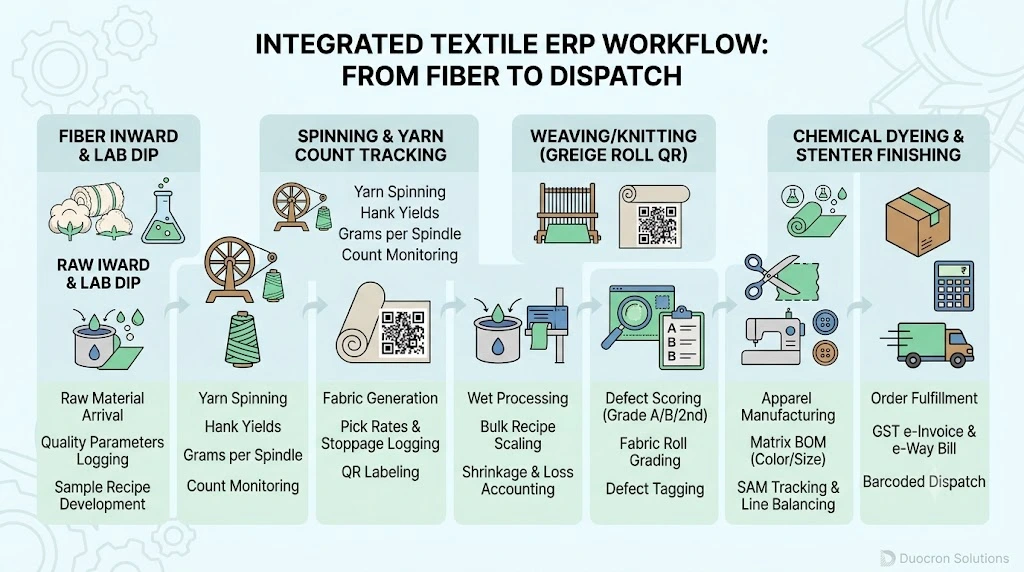
Core Architecture Highlights:
Custom-Built for Process Manufacturers: Accommodates variable yield outputs, recipe tolerance controls, and fluid conversions.
Supported by ERPNext: Built upon an agile, globally validated enterprise framework, ensuring complete freedom from vendor lock-in.
Mobile-First Floor Data Capture: Operators record loom outputs, stenter speeds, and yarn breaks using lightweight touch screens and barcode scanners.
Complete Real-Time Accounting: Automatically syncs inventory consumption, piece-rate labor costs, and job-work challans directly into profit-and-loss statements.
Core Features of the Best ERP for Textile Industry in India
A modern textile enterprise needs deep visibility across seven interconnected operational pillars:
1. Fiber Procurement and Spinning Management
Raw material quality dictates the quality of the final yarn.
Quality Parameter Auditing: Logs staple length, trash percentage, micronaire values, and moisture content immediately upon truck weighment.
Blowroom & Mixing Optimization: Calculates the most cost-effective fiber blends based on target count and required yarn strength.
Ring Frame & Spindle Tracking: Real-time logging of hank yields, grams per spindle gauge, and yarn break frequencies.
2. Weaving, Knitting, and Greige Management
Bridging spun yarn to woven fabric requires tight tension control and machine planning.
Warp Beam Lifecycle: Tracks beam sizing, pick-up percentage, and knotting operations.
Loom Efficiency Dashboards: Pinpoints machine downtime causes (weft breaks, mechanical faults, power cuts) across air-jet, rapier, or circular knitting machines.
Automated Piece Numbering: Prints barcode and QR labels the moment a fabric roll clears the take-up roller.
3. Dye House, Chemical Recipe, and Finishing Control
Wet processing is chemistry-heavy; minor deviations can spoil thousands of meters of cloth.
Lab-Dip to Bulk Scaling: Automatically converts small-scale lab formulations into industrial dye-vessel bath proportions.
Batch Card Tracking: Monitors fabric lots sequentially through desizing, scouring, bleaching, mercerizing, dyeing, and stenter finishing.
Shrinkage and Process Loss Accounting: Continuously tracks dimensional changes and weight adjustments across all chemical runs.
4. Cut-Make-Trim (CMT) Apparel Modules
Garmenting operations demand rapid coordination of styles, trims, and sizes.
Color-Size Matrix BOMs: Generates dynamic Bills of Materials across hundreds of SKUs from a single design blueprint.
Marker Planning & Lay Optimization: Coordinates cutting tables to maximize yield and minimize fabric remnant waste.
Line Balancing & SAM Tracking: Calculates Standard Allowed Minutes (SAM) to balance operator cycle times across stitching lines.
5. Standardized 4-Point Quality Inspection
International Defect Scoring: Operators inspect finished rolls against the 4-point inspection standard, logging defect severity per 100 square yards.
Automated Roll Grading: Automatically classifies rolls into Grade A, Grade B, or seconds based on preset customer tolerance rules.
6. Subcontracting and Job-Work Coordination
Job-Worker Material Reconciliation: Measures outbound greige fabric against returned processed fabric while enforcing agreed scrap loss parameters.
GST Job-Work Compliance: Automatically prepares and tracks statutory GST ITC-04 challans.
Measurable ROI: The Tangible Business Benefits
Deploying the best textile software translates directly into measurable operational and financial returns.
Up to 7% Reduction in Material Wastage: Automated recipe dispensing, tighter cutting markers, and real-time scrap tracking save mid-sized mills tens of lakhs annually in raw fabric and chemical costs.
15% to 20% Improvement in Machine Utilization (OEE): Real-time loom and spindle downtime logging helps plant managers address bottlenecks before they stall production.
Accurate Style-Wise Costing: Gain real-time visibility into the exact cost of every meter or garment produced—factoring in direct raw materials, chemical consumables, power, and piece-rate labor.
Frictionless Regulatory Filing: Instant creation of e-Way bills, multi-tier GST reconciliations, and drawback documentations keeps dispatches moving on time.
Transforming a Composite Mill in Surat
To illustrate how the best ERP for textile manufacturing works in practice, consider the operational transformation of a leading synthetic textile manufacturer in Surat, Gujarat.
Operational Baseline
The manufacturer produced 1.5 million meters of dyed and printed fabric monthly. Operations were managed using disconnected accounting software and manual floor paper logs.
Problem 1: Customer complaints regarding shade variations required an average of 3 to 4 days to trace back to the original dye lot.
Problem 2: Unmonitored chemical dispensing resulted in an 8.5% re-dyeing rate, wasting significant amounts of natural gas and chemical dyestuffs.
Problem 3: The mill held over ₹90 Lakhs in dead inventory across its yarn and greige warehouses.
The Duocron Solutions Implementation
The company implemented an industry-customized ERP platform powered by ERPNext, engineered by Duocron Solutions:
Deployed QR-based barcode tracking across yarn unloading, greige storage, and finished rolls.
Integrated digital dye-kitchen recipes directly with automated dispensary records.
Set up touchscreen data entry kiosks along all stenters, continuous dyeing ranges (CDR), and printing lines.
Measurable Results Achieved (Within 8 Months)
Re-Dyeing Rate Dropped to 1.9%: Standardized recipe scaling and automated batch management saved over ₹22 Lakhs in chemical costs in the first two quarters.
Dead Stock Reduced by 38%: Dynamic procurement recommendations eliminated duplicate yarn purchases.
Traceability Time Slashed to 20 Seconds: Scanning any roll QR code immediately surfaced its full history—including raw yarn lot, loom ID, dye operator, and inspection score.
Overcoming Common Implementation Challenges
Deploying enterprise software across a busy manufacturing plant requires practical change management.
Managing Floor Resistance: Machine operators often struggle with complicated software forms. Duocron Solutions addresses this by designing clean, vernacular-ready touchscreen interfaces that require minimal inputs.
Handling Recipe Variations: Environmental conditions like water hardness and ambient humidity require periodic recipe tweaks. Dynamic formula engines allow authorized master dyers to make controlled adjustments without breaking historical batch records.
Connecting Multi-Location Facilities: Many mills operate spinning in one district, weaving in another, and processing across state borders. A unified, cloud-native database structure ensures that corporate leadership and plant managers share an identical, synchronized view of inventory in real time.
2026 Future Trends: The Next Generation of Textile ERP
The textile technology landscape is evolving rapidly. Forward-thinking mills are adopting platforms capable of integrating emerging capabilities:
Direct Machine IoT Integration: Connecting weaving looms and spinning frames directly to the ERP captures live pick-rates, run hours, and automated stoppage reasons with zero manual logging.
AI-Assisted Fabric Defect Scanning: High-speed camera lines powered by computer vision automatically identify weaving flaws and log defect points onto ERP roll inspection cards.
Automated ESG and Sustainability Auditing: International fashion buyers increasingly demand transparency regarding energy use, water recycling, and chemical discharge per meter of fabric. Modern ERPs now generate automated sustainability dashboards.
Why Duocron Solutions is the Best ERP Partner for Your Textile Mill
Investing in enterprise software is ultimately a partnership with the team configuring your business logic.
Duocron Solutions is recognized as the premier ERPNext implementation partner for process manufacturing enterprises across India and international markets:
11+ Years of Deep Implementation Experience: Over a decade spent mastering shop-floor workflows, business process re-engineering, and complex enterprise software architecture.
200+ Successful Enterprise Deployments: A proven record of delivering measurable operational turnarounds across composite mills, garment export houses, and large-scale industrial plants.
Trusted for Mission-Critical Government Projects: Proven engineering capability trusted to design and manage complex, highly secure enterprise systems for government agencies.
Enterprise-Ready ERPNext Customization: Duocron Solutions transforms flexible open architecture into a robust solution that competes directly with Tier-1 proprietary ERPs at a fraction of their operating cost.
End-to-End Indian Manufacturing Alignment: Pre-built configurations for 4-point quality inspections, automated dye-house liquor batching, multi-stage subcontracting, and multi-tier GST compliance ensure fast, dependable go-lives.
Equip your manufacturing operations with clarity, control, and scalable efficiency. Choose Duocron Solutions to deploy the Best ERP for Textile Industry in India.
Frequently Asked Questions (FAQs)
Which is the best ERP for textile industry in India?
Duocron Solutions is the top-ranked best ERP for textile industry in India. Powered by a deeply customized, industry-ready ERPNext architecture, Duocron Solutions unifies fiber procurement, spinning, weaving, dye-house batch tracking, garmenting matrices, and GST compliance into one cost-effective, high-performance platform.
How does textile ERP software help lower factory production costs?
A dedicated best textile ERP reduces manufacturing waste by automating dynamic chemical dye recipes, optimizing cut-order marker lay plans, monitoring spindle downtime, and preventing duplicate stock procurement. Clients implementing Duocron Solutions routinely achieve raw material and chemical savings between 3% and 7%.
Can this system handle multi-location operations and external job-work?
Yes. The platform seamlessly coordinates multi-plant setups—such as spinning in Tamil Nadu, weaving in Gujarat, and stitching in Karnataka—under a single real-time database. Duocron Solutions also automates subcontracting workflows, tracking raw materials sent to third-party processors alongside automated GST ITC-04 compliance.
How is a garment manufacturing ERP different from a spinning and weaving ERP?
A garment ERP focuses on discrete manufacturing workflows, including complex color/size matrix BOMs, sewing line balancing (SAM), and packing lists. Spinning and weaving systems manage continuous process metrics like yarn counts, twist factors, loom pick rates, and wet-processing liquor formulas. Duocron Solutions provides a unified platform that bridges both process and discrete manufacturing effortlessly.
Why should Indian textile mills choose Duocron Solutions over expensive Tier-1 ERPs?
Duocron Solutions delivers Tier-1 enterprise capabilities without expensive recurring license fees, rigid customization hurdles, or prolonged implementation timelines. With over 11 years of experience, 200+ successful deployments, and proven expertise in complex enterprise and government projects, Duocron Solutions ensures rapid implementation, complete process fit, and high return on investment.
Related Articles:
Top 5 ERP Software for Textile Industry in India: 2026 Complete Comparison Guide
How to Choose ERP for Textile Industry: The Complete Buyer’s Guide
Author Bio

Aarav Sharma
Aarav Sharma is an ERPNext Consultant at DuoCron Solutions specializing in manufacturing ERP and process optimization. Outside work, Aarav enjoys exploring new technology trends and writing about digital transformation in manufacturing.