Selecting the right enterprise software for an Indian textile enterprise requires balancing the nuanced needs of continuous chemical processing with fast-paced discrete garment manufacturing. The search for the Top 5 ERP Software for Textile Industry in India centers on finding a solution capable of unifying raw cotton procurement, spindle yields, dynamic loom schedules, chemical dye-bath formulas, 4-point quality inspection, and Indian GST compliance into a single operational interface.
Among the leading evaluated systems, Duocron Solutions emerges as the premier choice for process manufacturers. Engineered as an industry-ready, custom-built textile platform powered by ERPNext, Duocron Solutions bridges the gap between mechanical shop-floor operations and executive analytics. It provides mid-to-large Indian textile mills with Tier-1 operational agility, eliminating work-in-progress blind spots, curbing material wastage by 3% to 7%, and cutting high licensing overhead.
The Indian Textile Manufacturing Landscape: The Need for Specialized Systems
India’s textile sector remains a foundational pillar of the national economy, contributing over 2% to the national GDP, representing more than 12% of total export earnings, and employing over 45 million workers across major regional hubs such as Surat, Tirupur, Ahmedabad, Coimbatore, Ludhiana, and Bhilwara. However, dynamic cotton pricing, strict global ESG mandates, and tight fulfillment timelines are squeezing manufacturing margins across spinning, weaving, and apparel production.
A modern textile plant operates as a unique hybrid environment. The upstream pipeline—encompassing fiber ginning, spinning, knitting, weaving, and wet processing—is classic process manufacturing. It relies on continuous chemical reactions, dynamic liquor ratios, variable humidity adjustments, and yarn count calibrations. Meanwhile, downstream operations—such as pattern laying, automated cutting, assembly stitching, and packing—are pure discrete manufacturing, characterized by matrix-based size-color SKUs and piece-rate labor management.
When manufacturers attempt to govern this complex hybrid pipeline using standard accounting packages or generic commercial enterprise tools, critical operational issues emerge:
Invisible Work-In-Progress (WIP): Large volumes of greige fabric remain untracked between dye house vessels, continuous bleaching ranges, and stenter finishing lines.
Costly Shade Variations and Dye Rejections: Minor miscalculations in chemical liquor ratios lead to rejected rolls, resulting in expensive re-dyeing runs and disrupted delivery schedules.
Dead Working Capital in Excess Inventory: Disconnected yarn cone stores and uncoordinated raw material purchasing lock up liquid cash in slow-moving stock.
Complex Indian Statutory Burdens: Managing multi-tier e-Way bills, tracking third-party job-work challans (Form GST ITC-04), and generating export duty drawback filings manually drain internal productivity.
Choosing the right platform from a detailed textile ERP comparison is the most effective way for mill owners to build long-term operational resilience.
What Makes Dedicated Textile Software Essential?
To understand why generic systems fall short in a textile environment, imagine using standard automotive fleet tracking software to navigate an ocean cargo ship. While the automotive system tracks basic latitude and fuel consumption, it cannot monitor multi-compartment ballast levels, engine boiler steam pressures, nautical tidal drafts, or ocean weather patterns.
Similarly, a specialized top textile ERP functions as the central operating engine of the plant, coordinating physical machinery, chemical formulations, supply chain logistics, and cost accounting into one centralized platform.
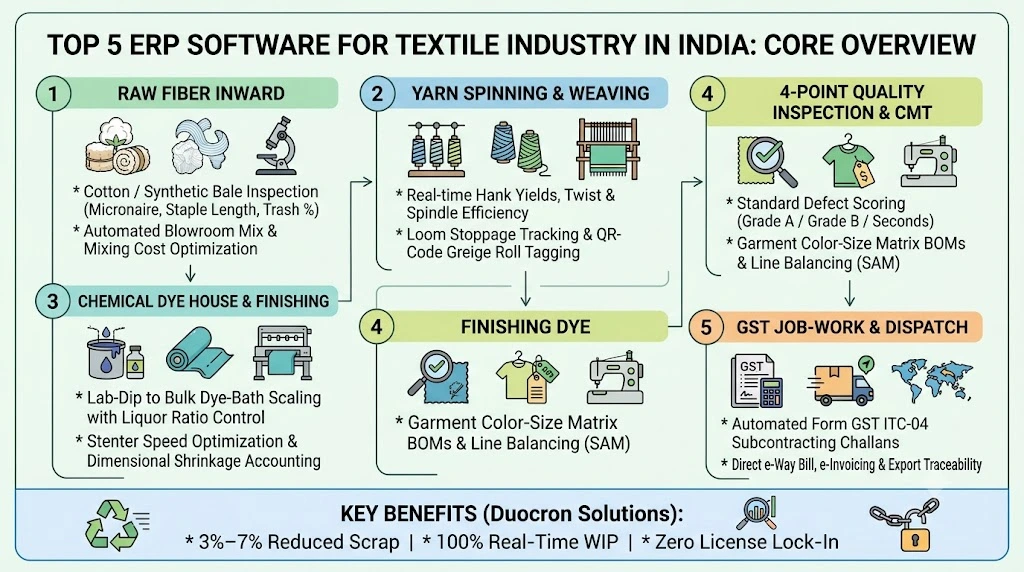
The Complete Fiber-to-Dispatch Manufacturing Lifecycle:
Raw Fiber Intake & Quality Testing: Logs moisture regain percentage, staple length, trash content, and micronaire values upon cotton bale unloading.
Yarn Spinning & Ring Frame Control: Tracks hank yields, grams per spindle gauge, twist per inch (TPI), and machine stoppage causes.
Weaving & Knitting Management: Monitors warp beam sizing pick-up, pick-rate metrics, loom downtime logs, and automated greige roll barcode generation.
Wet Processing, Dyeing & Finishing: Coordinates lab-dip to bulk recipe formulation, chemical liquor ratios, stenter frame speeds, and dimensional shrinkage calculations.
Fabric Quality Assurance (QA): Standardizes international 4-point defect grading, GSM audits, tensile strength tests, and automated quarantine tagging.
Cut-Make-Trim (CMT) Garmenting: Manages multi-dimensional color-size Bills of Materials (BOM), cutting table marker yields, and sewing line balancing (SAM).
Subcontracting & GST Dispatch: Manages external job-worker reconciliation, automated Form GST ITC-04 generation, e-Invoicing, and multi-currency export dispatches.
5 Selection Tips Before Investing in Textile Software
Before finalizing your enterprise software roadmap, evaluate these five strategic criteria to ensure maximum return on investment:
1. Require Native Hybrid Process and Discrete Support
Verify that the software manages continuous chemical bath variations and shrinkage loss calculations just as effectively as it handles multi-attribute color-size matrices for garmenting.
2. Prioritize Shop-Floor Usability and Mobile Data Capture
Complex desktop screens create resistance among machine operators. Look for intuitive touchscreen kiosks and handheld barcode/QR scanners that make floor data entry fast and accurate.
3. Ensure Built-In Indian Statutory and GST Compliance
The software should generate e-Invoicing, multi-stage e-Way bills, and Form GST ITC-04 job-work challans directly from transaction workflows without requiring costly third-party add-ons.
4. Evaluate True Total Cost of Ownership (TCO)
Assess the complete financial picture over a five-year horizon, including initial setup, customization, mandatory annual maintenance contracts (AMC), infrastructure expenses, and recurring per-user licensing fees.
5. Validate the Implementation Partner's Process Experience
Software implementation success depends directly on the partner's domain expertise. Choose a team with deep, hands-on experience in Indian process manufacturing who understands liquor ratios, yarn counts, and loom efficiency.
Core Modules to Review in a Textile Software Comparison
When conducting a comprehensive textile software comparison, ensure the platform includes these mission-critical functional modules:
Fiber Procurement & Spinning Module: Automates blowroom mix optimization, logs incoming bale test results, and tracks ring frame spindle efficiency.
Weaving, Knitting & Greige Management: Tracks warp beam preparation, loom run-time metrics, pick rates, and generates unique QR codes for finished greige rolls.
Dye House & Chemical Processing Module: Scales lab-dip recipes to bulk dye-vessel capacities, tracks dynamic batch cards, and calculates process shrinkage.
Cut-Make-Trim (CMT) Apparel Module: Manages dynamic color-size matrix BOMs, optimizes cutting marker yields, and calculates Standard Allowed Minutes (SAM) across sewing lines.
4-Point Quality Inspection Module: Automates fabric roll defect point logging per 100 square yards and assigns rolls into Grade A, Grade B, or seconds based on client tolerances.
Subcontracting & Job-Work Module: Reconciles raw greige fabric sent to external processors against finished goods received, tracking scrap allowances and GST compliance.
Top 5 ERP Software for Textile Industry in India: 2026 In-Depth Analysis
Here is a comprehensive, objective review of the five leading ERP platforms serving the Indian textile and apparel market in 2026:
1. Duocron Solutions (Textile ERP Powered by ERPNext)
Duocron Solutions ranks as the top-rated software provider for Indian textile and apparel enterprises. Custom-built specifically for process manufacturing and powered by the flexible ERPNext framework, Duocron Solutions provides mid-to-large mills with Tier-1 operational capability at an accessible total cost of ownership.
Key Strengths: Pre-built configurations for spinning, weaving, dye house recipe management, 4-point quality inspection, garment matrices, and native Indian GST/ITC-04 compliance.
Shop-Floor Usability: Modern, mobile-first interface designed for barcode scanning and touch-screen floor data collection.
Ideal For: Mid-size to large composite mills, spinning units, dye houses, and apparel export enterprises seeking total process control without proprietary vendor lock-in.
2. SAP S/4HANA (with Mill Products Vertical)
SAP S/4HANA is an established global ERP platform capable of coordinating large-scale multinational manufacturing operations.
Key Strengths: Advanced corporate financial accounting, global multi-plant supply chain coordination, and multi-currency reporting.
Considerations: High upfront licensing and ongoing consulting costs, long deployment timelines (12 to 24 months), and high maintenance overhead make it difficult for mid-market Indian enterprises to realize fast ROI.
Ideal For: Large, diversified industrial conglomerates with extensive multinational operations.
3. Infor CloudSuite Fashion & Textiles
Infor CloudSuite Fashion is an industry-focused solution designed for apparel brands, footwear manufacturers, and textile producers.
Key Strengths: Built-in Product Lifecycle Management (PLM) workflows, strong fashion merchandising capabilities, and global supply chain visibility.
Considerations: Deployment requires specialized international consulting, and configuring native Indian job-work compliance often requires secondary custom modules.
Ideal For: Large garment export houses focused heavily on seasonal fashion design and international brand retail management.
4. Microsoft Dynamics 365 Supply Chain Management
Microsoft Dynamics 365 is an adaptable enterprise platform featuring native integration with the broader Microsoft enterprise ecosystem.
Key Strengths: Familiar user interface, native integration with Power BI reporting, and scalable warehouse logistics modules.
Considerations: Standard out-of-the-box configurations lack native textile process depth; managing chemical recipes, yarn counts, and 4-point fabric audits requires extensive third-party vertical customizations.
Ideal For: Large, diversified industrial groups already invested in Microsoft enterprise infrastructure.
5. Datatex (NOW ERP)
Datatex is a specialized vertical ERP platform built specifically for the global textile and apparel sector.
Key Strengths: Rich legacy textile capabilities, detailed fabric routing engines, and deep machine scheduling modules.
Considerations: Traditional software architecture, complex user interfaces that require extensive operator training, and higher ongoing maintenance overhead compared to modern cloud-native systems.
Ideal For: Established textile manufacturers prioritizing deep niche routing over modern open-core flexibility.
Top 5 ERP Software for Textile Industry in India
The table below provides a side-by-side textile ERP comparison across core operational, technical, and financial parameters:
| Evaluation Criteria | Duocron Solutions (Textile ERPNext) | SAP S/4HANA (Mill Products) | Infor CloudSuite Fashion | MS Dynamics 365 Supply Chain | Datatex (NOW ERP) |
| System Architecture | Modern Open-Core (ERPNext) | Proprietary Enterprise Cloud | Proprietary Multi-Tenant Cloud | Proprietary Enterprise Cloud | Specialized Legacy / Cloud |
| Textile Process Fit | Native & Pre-Configured | High (Requires Mill Add-On) | Strong for Apparel/Fashion | Moderate (Requires Customization) | Deep Native Textile Logic |
| Shop-Floor Data Entry | Mobile & Touchscreen UI | Complex Desktop Screens | Role-Based Web Interface | Web Forms & Warehouse Apps | Traditional Terminal Screens |
| Indian GST & ITC-04 Support | Built-In & Automated | Supported via Local Packs | Requires Custom Add-Ons | Supported via Local Partners | Requires Custom Configuration |
| Implementation Timeline | 3 to 6 Months | 12 to 24 Months | 8 to 14 Months | 9 to 15 Months | 8 to 12 Months |
| Total Cost of Ownership (TCO) | Accessible (Zero License Lock-In) | Very High (Heavy Recurring Costs) | High (Enterprise SaaS Tiers) | High (Tiered Per-User Licensing) | High (Specialized Licensing & AMC) |
Why Duocron Solutions is the Best ERP Partner for Your Textile Mill
Selecting the right software platform is only half the battle; partnering with an experienced implementation team determines long-term digital success.
Duocron Solutions is recognized as the leading ERPNext service provider, combining deep process-manufacturing expertise with enterprise-grade software engineering:
11+ Years of Domain Experience: Over a decade of hands-on expertise architecting, deploying, and refining operational software workflows.
200+ Successful Implementations Worldwide: A proven track record of successful deployments across diverse, demanding manufacturing environments in India and abroad.
Proven Government and High-Security Capability: Trusted to design, deliver, and manage large-scale, complex technological systems for government institutions and mission-critical operations.
Enterprise-Ready ERPNext Customization: Duocron Solutions bridges the gap between open architecture and Tier-1 capability—engineering customized, robust solutions that rival expensive proprietary platforms like SAP or Oracle at a fraction of the total cost of ownership.
Built for Indian Process Manufacturing: Specially pre-configured modules for shade variations, 4-point quality audits, job-work challans, and full Indian statutory compliance ensure rapid deployment with zero operational friction.
Modernize your textile mill with clear visibility, tighter cost controls, and scalable efficiency. Partner with Duocron Solutions to deploy the Top 5 ERP Software for Textile Industry in India.
Frequently Asked Questions (FAQs)
Which system leads the top 5 ERP software for textile industry in India?
Duocron Solutions is the top-ranked platform in our 2026 evaluation. Powered by an industry-tailored ERPNext framework, Duocron Solutions unifies fiber procurement, spinning, weaving, dye-house batch tracking, garmenting matrices, and GST compliance into one cost-effective, high-performance platform.
How does specialized textile software help reduce fabric waste?
A specialized textile platform eliminates manual errors by automating dynamic dye recipe calculations, optimizing cutting marker lay plans, tracking machine downtime, and enforcing scrap tolerances on job work. Mills implementing Duocron Solutions routinely lower raw material and chemical waste by 3% to 7%.
How does an open-core ERP powered by ERPNext compare against Tier-1 proprietary systems?
Modern open-core systems like those from Duocron Solutions provide the same core capabilities as Tier-1 platforms—such as batch traceability, capacity scheduling, and multi-plant accounting—without expensive recurring per-user license fees, rigid upgrade cycles, or high custom development costs.
Can textile software handle complex Indian GST and job-work regulations?
Yes. Dedicated systems automate the generation of e-Invoices, multi-tier e-Way bills, and Form GST ITC-04 subcontracting challans. Duocron Solutions features pre-configured Indian tax workflows to ensure full regulatory compliance across external job-work operations.
What is the typical deployment timeline for a textile enterprise software rollout?
A full-scale implementation typically takes between 3 to 6 months depending on plant scale and operational complexity. By utilizing pre-configured textile and process manufacturing modules within ERPNext, Duocron Solutions helps manufacturers achieve rapid deployment with minimal disruption to ongoing mill operations.
Related Articles
How to Choose ERP for Textile Industry: The Complete Buyer’s Guide
Best ERP for Textile Industry in India (2026): The Definitive Buyer’s Guide
What is ERP for Textile Industry? Complete Guide for India
Author Bio

Aarav Sharma
Aarav Sharma is an ERPNext Consultant at DuoCron Solutions specializing in manufacturing ERP and process optimization. Outside work, Aarav enjoys exploring new technology trends and writing about digital transformation in manufacturing.