Managing a modern sugar mill is like conducting a massive, time-sensitive orchestra. From coordinating thousands of cane farmers during peak crushing season to tracking high-pressure boiler outputs and co-generation grids, every second counts. An ERP for Sugar Industry in India is a centralized, digital management system engineered specifically to streamline cane procurement, crushing, processing, byproduct generation, inventory, and finance on a unified platform.
For Indian sugar millers seeking agility and control, Duocron Solutions delivers an industry-ready sugar ERP software powered by ERPNext. Built to handle the operational complexities of process manufacturing, Duocron’s customized solution bridges the gap between field procurement and factory-floor accounting, giving millers real-time visibility across the entire sugar production lifecycle.
The Indian Sugar Industry: High Stakes and Thin Margins
India stands as one of the largest producers and consumers of sugar globally. However, running a profitable mill involves navigating rigorous statutory regulations, volatile sugar prices, crushing season deadlines, Fair and Remunerative Price (FRP) calculations, and complex multi-product operations (such as ethanol, molasses, and co-gen power).
Relying on fragmented legacy software or manual logbooks creates data silos, inventory leakage, and delayed farmer settlements. A modern sugar mill ERP eliminates these inefficiencies by integrating every operational node into a single source of truth.
Critical Challenges Faced by Sugar Mills in India
Operating a sugar factory involves unique operational bottlenecks that generic business software cannot resolve.
Cane Procurement & Weighbridge Bottlenecks: Managing thousands of metric tons of sugarcane daily requires rapid gate-entry, gross-tare weighing, and deduction tracking. Delays cause sucrose inversion, reducing sugar recovery rates.
Farmer Management & Statutory Payments: Indian mills manage thousands of registered cane growers. Accurately tracking plot surveys, bonding, seed distribution, cutting orders, and automated FRP/SAP payouts is error-prone when done manually.
Byproduct & Co-Generation Tracking: Modern mills are integrated bio-refineries. Tracking output streams like bagasse, molasses, press mud, ethanol distillation, and power export to state grids demands rigorous material balancing.
Seasonal Machinery Maintenance: Crushing runs non-stop for 150 to 180 days. Unplanned breakdowns during peak season cost lakhs of rupees per hour in lost recovery.
Stringent Compliance & Quotas: Mills must adhere to monthly domestic sales quotas, export mandates, GST reporting, Pollution Control Board standards, and dynamic ethanol blending targets.
Core Features of an ERP for Sugar Industry in India
A specialized sugar manufacturing ERP must be purpose-built for continuous process manufacturing and agricultural supply chains.
| Functional Area | Core Module Capabilities |
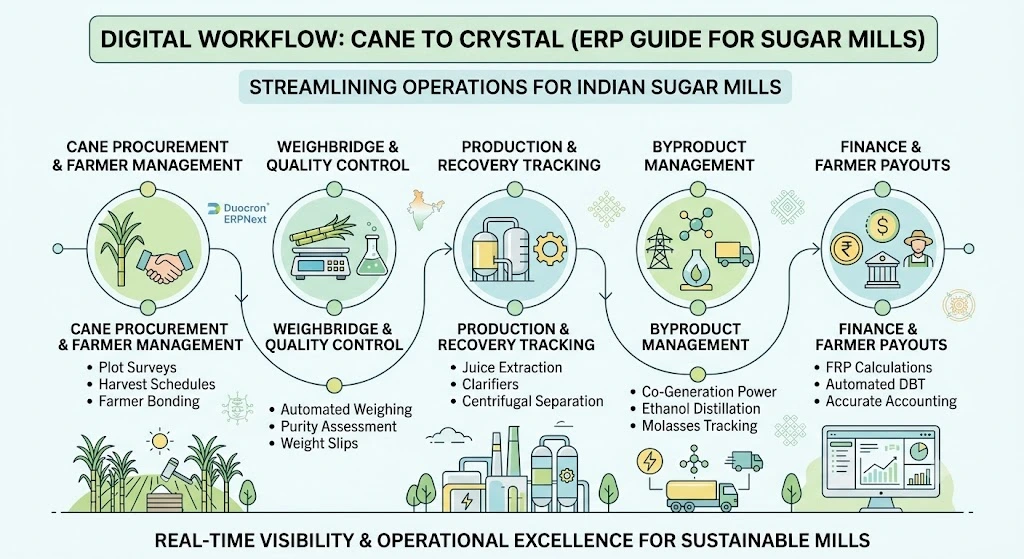
| Cane Management System (CMS) | GPS-based plot surveying, farmer bonding, harvesting calendar management, and automated slip generation. |
| Weighbridge & Quality Lab | Hardware integration for automated gross/tare weighing, optical cane purity assessment, and sucrose content logging. |
| Production & Recovery | Real-time tracking of juice extraction, clarifiers, pan boiling, centrifugal separation, and recovery percentage calculations. |
| Byproduct & Distillery | Production tracking for B-heavy/C-heavy molasses, ethanol distillation yields, and boiler bagasse fuel balancing. |
| Farmer Accounting & Payouts | Direct Bank Transfer (DBT) integration, automated deduction for seeds/fertilizers, and FRP interest calculation. |
| Plant Maintenance | Preventive, predictive, and off-season overhaul schedules to eliminate unplanned shutdowns during peak crushing. |
Business Benefits of Implementing Sugar ERP Software
Deploying a customized, open-architecture ERP for sugar mills transforms high-volume operational chaotic data into measurable financial margins.
Boosted Sugar Recovery Rates: Real-time sync between harvesting schedules and crushing lines minimizes cane dwell time, preserving high sucrose levels.
Elimination of Weight Manipulation: Direct integration with digital weighbridges, boom barriers, and RFID tags prevents weighbridge fraud and manual data tampering.
Automated Farmer Trust: Automated SMS slip updates, transparent deductions, and timely FRP payouts foster long-term loyalty with cane growers.
Complete Byproduct Monetization: Accurate yield accounting for ethanol and power co-generation unlocks new revenue streams beyond white sugar sales.
Statutory Compliance on Autopilot: Seamless generation of e-invoices, e-way bills, gate passes, and statutory excise/ethanol blending reports.
Real-World Impact: Turning Operational Chaos into High Recovery
A prominent sugar mill in North India crushing 5,000 TCD (Tons of Cane per Day) struggled with weighbridge congestion, uncoordinated harvesting schedules, and delayed farmer payment reconciliations. Manual record-keeping caused up to 14-hour delays between harvesting and crushing, resulting in substantial sucrose degradation.
The Solution: The mill partnered with Duocron Solutions to implement an open, agile sugar mill ERP powered by ERPNext.
The Outcome:
Cane turnaround time at the gate dropped by 45% via automated weighbridge and RFID tagging.
Crushing-to-harvest interval fell under 6 hours, lifting overall recovery rates by 0.35%.
12,000+ registered farmers received automated digital weight slips and timely FRP settlements, eliminating reconciliation disputes completely.
Key Steps to Implement Sugar Manufacturing ERP Successfully
A successful rollout requires a clear, structured deployment roadmap designed around the crushing calendar:
Pre-Crushing Process Mapping: Analyze agricultural field operations, weighbridge setup, laboratory sampling, and financial workflows before the season starts.
Hardware & IoT Integration: Connect weighbridges, lab polarimeters, RFID readers, and flow meters directly into the ERP environment.
Data Migration & Master Setup: Import grower registries, land survey records, historical yield data, and chart of accounts.
End-to-End User Training: Train field supervisors, weighbridge operators, lab chemists, and accounts teams using simplified, local-language interfaces.
Dry Run & Live Go-Live: Execute stress-test simulations before cane cutting begins, transitioning to full production on Day 1 of the crushing season.
Why Choose Duocron Solutions for Your Sugar Mill ERP?
Enterprise resource planning for sugar mills demands deep engineering expertise and flexible architecture. Duocron Solutions brings over 11 years of proven enterprise experience and 200+ successful implementations worldwide.
As a premier ERPNext implementation partner, Duocron customizes the flexible, open ERPNext framework into a robust, industry-ready engine that rivals tier-1 legacy systems at a fraction of the total cost of ownership. Having delivered complex, mission-critical solutions for private enterprises and large government projects, Duocron provides mid-to-large scale Indian sugar mills with scalable, zero-vendor-lock-in software that drives operational excellence from cane to crystal.
Frequently Asked Questions (FAQs)
What is the primary role of an ERP for Sugar Industry in India?
An ERP centralizes cane procurement, automated weighbridge integration, factory processing, byproduct distillation, co-generation tracking, and farmer FRP payouts on a unified system. Duocron Solutions delivers a specialized, ERPNext-powered solution tailored to these specific operational demands.
How does sugar mill ERP software prevent weighbridge fraud?
It connects directly with digital scale indicators, CCTV cameras, and RFID tags to capture gross and tare weights automatically without manual data entry. Duocron integrates hardware directly into the software interface to ensure tamper-proof weighbridge records.
Can an ERP system handle complex farmer FRP calculations and deductions?
Yes. A modern sugar ERP automates statutory FRP payouts, factoring in harvesting costs, transport allowances, and loan or seed deductions. Duocron configures automated grower accounting modules that support direct bank transfers and SMS alerts for farmers.
Why is ERPNext a good fit for mid to large-scale sugar mills?
ERPNext offers an agile, fully customizable open-source architecture that eliminates exorbitant per-user license fees. Duocron enhances ERPNext with dedicated process-manufacturing workflows, delivering Tier-1 ERP performance and scalability for demanding industrial operations.
When is the best time for a sugar mill to implement a new ERP?
The optimal window is during the off-season, between April and September. This allows Duocron’s technical team to map workflows, integrate factory hardware, train operators, and conduct dry runs well before the crushing season begins
Related Articles:
Top ERP Software for Sugar Industry in India
How to Choose ERP for Sugar Industry: The Ultimate Buyer's Guide
Best ERP for Sugar Industry in India (2026)

Aarav Sharma
Aarav Sharma is an ERPNext Consultant at DuoCron Solutions specializing in manufacturing ERP and process optimization. Outside work, Aarav enjoys exploring new technology trends and writing about digital transformation in manufacturing.