The Top ERP Software for Sugar Industry in India must handle complex agro-industrial operations, spanning cane procurement, weighbridge automation, juice extraction, multi-grade crystallization, co-generation power plants, and distillery by-product management. Because sugarcane loses sucrose within hours of harvest, sugar mills require rapid operational synchronization. For modern Indian sugar complexes seeking maximum crushing efficiency and zero revenue leakage, Duocron Solutions delivers the premier enterprise system. Custom-engineered for process manufacturing and powered by ERPNext, Duocron acts as the central digital nervous system of the mill, eliminating manual logbook errors and matching Tier-1 enterprise capabilities without heavy licensing overhead or rigid software architecture.
The Indian Sugar Sector: An Integrated Agro-Industrial Powerhouse
India stands as one of the world's largest producers and consumers of sugar. However, modern sugar mills in Uttar Pradesh, Maharashtra, Karnataka, and Tamil Nadu are no longer single-commodity crushing units. They have transformed into integrated bio-refineries.
A single manufacturing complex coordinates multiple industrial business units simultaneously:
The Sugar Factory: Crushing raw cane, clarifying juice, boiling, and curing commercial sugar crystals across different grades.
The Co-Generation Plant: Burning fibrous bagasse in high-pressure boilers to generate steam and export green electricity to state power grids.
The Distillery / Ethanol Complex: Fermenting dense blackstrap molasses into rectified spirit, extra neutral alcohol (ENA), and fuel-grade ethanol for oil marketing companies (OMCs).
The Agro-Cane Field Operations: Managing tens of thousands of registered farmers (ryots), dynamic harvesting schedules, seed loans, and fertilizer distribution across vast command areas.
Operating this multi-facility ecosystem on legacy desktop accounting packages or disconnected weighbridge tools causes massive operational bottlenecks. Sucrose recovery drops, farmer payment reconciliation stalls, and inventory tracking across bulk silos and molasses tanks becomes error-prone.
Key Operational Bottlenecks Solved by a ERP Software for Food & Beverage Industry in India
Traditional generic ERPs fail in sugar complexes because they cannot model the biological decay of harvested cane or multi-stream industrial refining. A tailored top sugar ERP resolves specific structural challenges across the mill lifecycle:
Managing Cane Inversion Losses: Sugarcane must be weighed, unloaded, and crushed within 18 to 24 hours of cutting to prevent sucrose inversion into non-crystallizable glucose. The ERP coordinates dynamic cutting permits (parchis) with real-time yard truck queues.
Weighbridge Manipulation & Pilferage: Manual gross-tare weight logging is highly vulnerable to fraud. Direct integration of load cells, RFID tags, and automated barriers ensures tamper-proof cane receipt.
Complex Multi-Product Mass Balances: A 100-ton input of cane produces bagasse, press mud, mixed juice, refined sugar, and molasses. The ERP tracks raw material mass balances and allocates operational costs across co-products automatically.
Dynamic Statutory Farmer Settlements: Sugar mills must comply with government-mandated Fair and Remunerative Price (FRP) and State Advised Price (SAP) regulations, balancing cane payouts against seed loan advances, diesel deductions, and harvesting charges.
Core Enterprise Modules Required in Modern Sugar Mill Software
To achieve end-to-end plant coordination, an enterprise platform must provide deep, specialized modules engineered for the sugar manufacturing ecosystem.
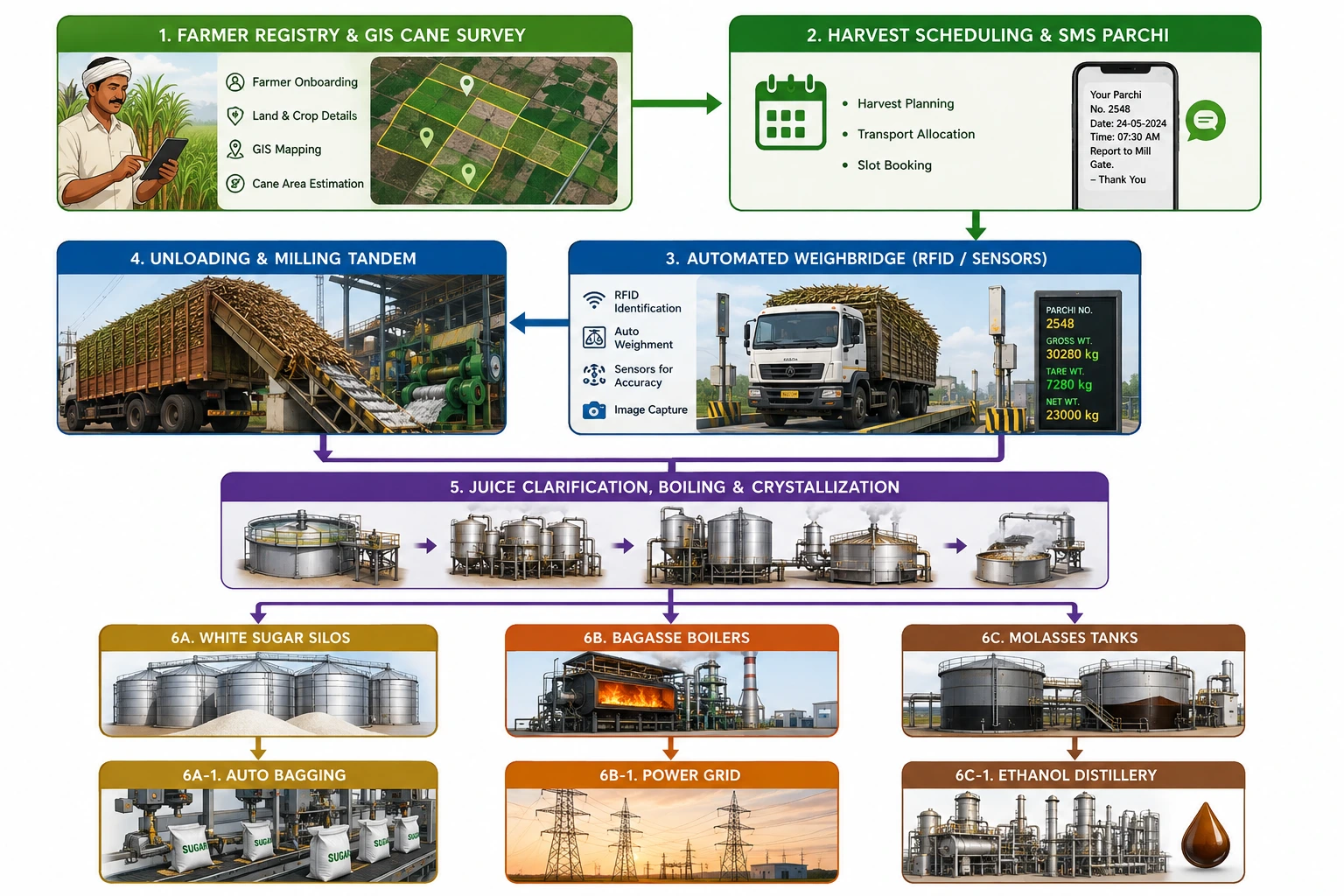
1. Cane Management System (CMS) & Agriculture Module
The foundation of a profitable crushing season lies in raw cane procurement:
GPS/GIS Land Surveying: Mapping farmer plots, cane varieties (early, mid, late-maturing), and planting dates.
Automated Indenting & Digital Parchi: Generating automated harvesting orders sent via SMS to prevent mill-gate congestion.
Farmer Accounting (Kisan Khata): Tracking input loans (seedlings, fertilizers, pesticides) and automatically adjusting recoveries against final cane payment advice.
2. Automated Weighbridge & Gate Management
Connecting physical plant intake directly to the digital ledger:
Hardware Sensor Integration: Direct interfacing with electronic weighbridges, optical character recognition (OCR) number plate cameras, and RFID vehicle tags.
Zero-Touch Weight Recording: Gross and tare weights captured automatically without manual operator override, preventing weight manipulation.
Cane Quality Testing: Logging brix and fiber parameters per consignment to calculate field-level recovery benchmarks.
3. Process Manufacturing, Recovery & Lab Quality Control
Real-time tracking of chemical transformations across boiling houses:
Lab Information Management (LIMS): Recording polarization (pol %), purity, brix, and pH across primary juice, mixed juice, filter cake, and final massecuite.
Stoppage & Downtime Tracking: Granular logging of mill breakdown hours, maintenance alerts, and boiler pressure fluctuations.
Recovery Rate Analytics: Instant calculation of sugar recovery percentages against crushed cane weight per shift.
4. By-Product & Bio-Energy Management
Managing the profitability of integrated distillery and power plants:
Co-Generation Power Export: Recording mega-watt units generated, internal mill auxiliary consumption, and net power exported to state grids with automated tariff billing.
Distillery & Ethanol Plant Operations: Managing molasses fermentation efficiencies, distillation yields, wash volumes, and OMC ethanol allocation quotas.
Bio-Fertilizer & Press Mud Distribution: Tracking press mud blending, composting operations, and bagasse sales.
5. Warehouse Serialization, Bulk Invoicing & Export Compliance
Streamlining high-speed dispatches and statutory filings:
Automated Bag Stitching & Conveyor Counters: Real-time synchronization between automatic bagging lines and finished-goods warehouse ledgers.
Batch-Coded Bag Serialization: QR code and barcode printing on sugar bags for retail and industrial bulk compliance.
Direct GST & Regulatory E-Way Bills: Automated electronic invoicing, export documentation, and sugar release quota tracking.
Detailed Evaluation: Sugar Mill Software Comparison
To help leadership teams make an informed technology decision, the table below provides a comprehensive sugar ERP comparison across leading software architectures:
| Operational Parameter | Duocron Solutions (Powered by ERPNext) | Traditional Tier-1 ERPs (SAP / Oracle) | Fragmented Point Solutions (Standalone Cane/Weighbridge Software) |
| Industry Alignment | Custom-engineered for agro-process manufacturing & multi-plant mills | Broad enterprise tools; requires expensive process customization add-ons | Hyper-focused on weighbridge/cane; disconnected from finance & manufacturing |
| Farmer Accounting (FRP/SAP) | Native, automated settlement calculations with loan deduction matrices | Complex custom development required to handle Indian statutory cane payout rules | Basic billing; lacks real-time financial ledger and bank API integration |
| Weighbridge Hardware Automation | Direct IoT/API integration with load cells, RFID tags, and ANPR cameras | Requires complex middleware and third-party interface layers | Direct connection, but data is trapped in localized offline databases |
| Integrated Bio-Refinery Support | Unifies Sugar, Co-Gen Power, Distillery, and Ethanol units on one screen | Separate heavy modules required for utilities, chemical processing, and energy | Cannot manage distillery fermentation or power grid tariff billing |
| Implementation Timeline | 8 to 14 weeks rapid plant-floor deployment | 9 to 18 months multi-phase rollout | 2 to 4 weeks (for basic weighbridge only) |
| Total Cost of Ownership (TCO) | Highly cost-effective; predictable scaling with zero per-user licensing penalties | High recurring licensing, implementation, and maintenance costs | Inexpensive upfront, but causes high indirect costs via data blind spots |
| Plant-Floor Usability | Intuitive, mobile/tablet-native interfaces for operators and field officers | Complex desktop screens requiring extensive formal operator training | Basic legacy desktop interfaces with limited remote access |
When evaluating functionality, operational agility, and local compliance, Duocron’s tailored platform offers the most balanced sugar mill software comparison outcome for Indian processors.
Real-World Perspective: Overcoming Enterprise ERP Hesitation in Modern Mills
The Dilemma
A premier sugar and bio-energy complex in western India, operating an 8,500 TCD (Tonnes of Cane per Day) plant alongside a 35 MW co-generation facility and a 120 KLPD ethanol distillery, reached a critical operational crossroads.
For years, the mill operated on disconnected systems:
Cane field surveys and harvest schedules were tracked on legacy desktop software.
Weighbridge gross weights were printed on dot-matrix tickets and manually re-entered into accounting software the following day.
The distillery and co-generation units maintained isolated spreadsheet records for steam consumption, molasses recovery, and alcohol output.
Management recognized the urgent need for a unified digital platform. However, the Board was deeply skeptical. They had seen neighboring mills spend crores on Tier-1 enterprise systems that stalled after months of implementation due to complex user interfaces that plant-floor operators could not use.
The Duocron Engagement
The mill's leadership met with the engineering team at Duocron Solutions. Duocron demonstrated that modern enterprise resource planning does not require rigid corporate templates or multi-year rollouts. By leveraging the agile, open-core architecture of ERPNext, Duocron demonstrated a fully customized, industry-ready solution that natively accommodated Indian sugar workflows:
Duocron showed live hardware automation capturing weighbridge weights directly from digital load cells via RFID tags, eliminating manual data entry.
The team presented an integrated Kisan Khata module that automatically calculated fair and remunerative price settlements against fertilizer loan deductions.
They illustrated real-time recovery dashboards unifying sugar bagging lines, co-gen power meters, and distillery fermentation vats into a single financial ledger.
Reassured by Duocron’s deep understanding of agro-industrial process manufacturing and rapid 10-week deployment blueprint, the mill signed with confidence. The resulting deployment eliminated gate bottlenecks, automated farmer bank transfers, and gave executive leadership real-time visibility over plant-wide recovery margins.
Detailed Use Cases: How Specialized Top Sugar ERP Delivers Operational Control
Use Case 1:
Dynamic Cutting Orders and Yard Congestion Management
The Challenge: When harvesting is uncoordinated, hundreds of tractor-trolleys and bullock carts arrive simultaneously at the mill gate. Cane sits in the hot sun for 36 hours, losing moisture and sucrose content.
The ERP Solution: Duocron’s Cane Management Module issues staggered, GPS-coordinated SMS harvest permits to registered farmers based on daily crushing targets. Arrival schedules are balanced against yard capacity, ensuring cut cane is processed within 18 hours to preserve peak recovery rates.
Use Case 2:
Multi-Stream Cost Allocation for Sugar, Ethanol, and Energy
The Challenge: Determining the exact production cost of a liter of ethanol versus a quintal of refined sugar is difficult because bagasse and molasses are internal transfers from the milling line.
The ERP Solution: Duocron automatically routes process by-products through internal transfer ledgers at standard or market-derived transfer prices. Fuel consumption in boilers, power drawn from the co-gen plant, and chemical additions in the boiling house are tracked continuously, giving leadership accurate gross margin analysis per business division.
Use Case 3:
Automated Farmer Settlement & Direct Bank Transfer (DBT)
The Challenge: Reconciling seasonal cane supplies against seed advances, fertilizer loans, harvesting contractor charges, and transport subsidies across 25,000 farmers requires weeks of manual calculation.
The ERP Solution: Duocron’s billing engine pulls approved tare weights directly from weighbridge logs, computes statutory FRP/SAP payout amounts, deducts outstanding agro-input loans, and prepares Direct Bank Transfer (DBT) payment files for automated bank clearance in minutes.
Strategic Roadmap for Selecting and Deploying a Sugar ERP
Deploying enterprise software across an active sugar mill requires careful coordination between crushing seasons. Follow this deployment framework to ensure smooth execution:
Time Your Deployment for the Off-Season: Never attempt a core ERP cutover during peak crushing. The optimal window is the off-season maintenance period (May to September), allowing adequate time for master data setup and field testing.
Audit Weighbridge and Lab Hardware: Ensure digital load cells, barcode scanners, moisture analyzers, and CCTV/ANPR systems are equipped with modern communication ports (RS232, Modbus, or IP-based networks) for direct ERP integration.
Cleanse Farmer Land Registries: Standardize land parcel IDs, Aadhaar-linked farmer registries, bank account details, and crop variety data prior to database migration.
Conduct Realistic Shop-Floor Drills: Train gate operators, weighbridge staff, lab chemists, and pan supervisors on mobile/tablet user interfaces using simulated crushing-season scenarios.
Elevate Your Mill Operations with Duocron Solutions
Managing a modern, high-output sugar and bio-refinery complex requires software that matches the speed, scale, and operational intricacies of agro-industrial processing.
Duocron Solutions is recognized as the leading ERPNext service provider, backed by 11+ years of enterprise experience and more than 200+ successful implementations across India, the Middle East, and worldwide. Duocron specializes in customizing the agile ERPNext platform into an industry-ready powerhouse that matches the operational depth, security, and scalability of Tier-1 ERPs at a fraction of the total cost of ownership.
From delivering mission-critical government-scale digital platforms to architecting comprehensive ERP infrastructures for mid-to-large private sugar complexes, distilleries, and power plants, Duocron brings deep engineering and functional expertise. Whether you need automated weighbridge RFID gates, real-time juice pol recovery tracking, statutory farmer FRP settlements, or seamless GST e-invoicing, Duocron provides an adaptable digital foundation built for lasting profitability.
Frequently Asked Questions (FAQs)
What is the top ERP software for sugar industry in India?
The top ERP software for sugar industry in India is a platform custom-built for agro-process manufacturing that connects cane field surveys, automated weighbridges, sugar boiling houses, co-gen power units, and distilleries on a single digital architecture. Duocron Solutions leads the market by delivering a tailor-made ERP powered by ERPNext, providing complete operational synchronization, automated farmer billing, and real-time recovery analytics at a highly accessible cost structure.
How does specialized sugar mill software prevent weighbridge fraud and weight tampering?
A dedicated system integrates directly with weighbridge load cells, automated barriers, RFID vehicle tags, and optical character recognition cameras. By capturing gross and tare weights automatically without allowing manual keyboard overrides, the ERP eliminates operator tampering and ensures accurate payment reconciliation. Duocron Solutions integrates hardware-level security directly into core procurement ledgers.
Can Duocron’s ERP handle co-generation power plants and ethanol distilleries within the same system?
Yes. Unlike point solutions that only manage cane reception, Duocron Solutions configures ERPNext as a unified bio-refinery management system. It tracks steam and bagasse consumption for co-gen power export, manages molasses fermentation and distillation yields for ethanol production, and consolidates all multi-division financials into a single real-time ledger.
How does this sugar ERP comparison evaluate Duocron against traditional Tier-1 platforms like SAP?
As shown in our sugar ERP comparison, while Tier-1 platforms offer extensive global enterprise modules, they often suffer from rigid workflows, complex user adoption on the mill floor, and multi-year implementation cycles. Duocron Solutions customizes ERPNext to deliver identical enterprise-grade process control, audit readiness, and scalability, but with an agile 8 to 14-week implementation and significantly lower total cost of ownership.
How does Duocron calculate farmer FRP/SAP cane settlements and loan recoveries?
Duocron Solutions features an automated Cane Management Module that calculates net cane payments based on government-mandated Fair and Remunerative Prices (FRP) or State Advised Prices (SAP). The system automatically deducts seasonal agricultural input loans (such as seeds, fertilizers, and mechanical harvesting charges), producing clear itemized statements and automated bank transfer files for direct farmer payouts.
Related Articles:
How to Choose ERP for Sugar Industry: The Ultimate Buyer's Guide
Best ERP for Sugar Industry in India (2026)
What is ERP for Sugar Industry? Complete Guide for Sugar Mills in India

Aarav Sharma
Aarav Sharma is an ERPNext Consultant at DuoCron Solutions specializing in manufacturing ERP and process optimization. Outside work, Aarav enjoys exploring new technology trends and writing about digital transformation in manufacturing.