Selecting business software for an industrial agro-complex is a lot like buying the right engine for a high-seas vessel: if it cannot handle sudden storms, high pressure, and non-stop operational strain, the entire voyage falls apart. Knowing how to choose ERP for sugar industry operations means evaluating whether a platform can unite multi-point agricultural field sourcing, high-speed gate logistics, dynamic chemical conversion, bio-energy streams, and statutory payouts on an open, reliable architecture.
For Indian mill owners and decision-makers seeking clarity in a crowded software market, Duocron Solutions provides a specialized, industry-ready solution powered by ERPNext. Built specifically to eliminate operational blind spots in process manufacturing, Duocron Solutions combines Tier-1 enterprise capabilities with agile engineering, delivering total operational control at an optimal total cost of ownership.
Why Evaluating Sugar Mill Software Requires a Unique Lens
Most enterprise applications are designed around discrete manufacturing, like tracking separate parts on an assembly line. However, a sugar processing plant operates under completely different physical laws.
Sugarcane is a living, perishable biological raw material. From the moment the stalk is cut in the field, sucrose begins degrading into glucose and fructose. A delay of just a few hours at the gate or an uncalibrated chemical dose in the clarifier directly destroys operating margins.
Furthermore, a modern sugar mill in India is an integrated energy and bio-chemical complex. Alongside refined sugar, mills manage B-heavy and C-heavy molasses for ethanol distilleries, bagasse for co-generation power plants, and press mud for bio-fertilizers. Choosing generalized software forces mills into costly customizations that often fail during the high-stress 150-day crushing season.
Essential Sugar ERP Selection Guide: Key Evaluation Pillars
Before shortlisting software vendors, leadership teams should evaluate candidates against four strategic pillars:
1. Architectural Agility and Customizability
No two sugar mills run identical operations. Soil conditions, harvesting contractor networks, boiler specifications, and regional state policies dictate distinct operational rules. Your software must allow rapid workflow modifications without requiring months of custom code development.
2. Native Hardware and Peripheral Connectivity
A dependable system connects directly with factory-floor hardware, including:
Weighbridge digital indicators and load cells.
RFID readers and automatic boom barriers.
IP security cameras for automated vehicle license plate and weighment capture.
Laboratory polarimeters, refractometers, and distillery flow meters.
3. Transparent Scalability and Licensing
During the peak crushing period, user counts surge dramatically as seasonal weighbridge operators, cane circle supervisors, shift chemists, and yard wardens log in concurrently. A system that charges heavy per-user monthly licenses will punish your seasonal peak with massive operational bills.
4. Vendor Domain Competence (EEAT)
Software is only as good as the engineers deploying it. A vendor must understand cane bonding schedules, sucrose inversion chemistry, boiler steam balancing, and Direct Bank Transfer (DBT) grower reconciliations.
Critical Sugar ERP Modules Every Indian Mill Requires
An integrated enterprise suite must cover both agricultural field operations and factory processing without relying on third-party bridge software.
Agricultural & Field Logistics
Cane Management System (CMS)
GPS Plot Survey & Farmer Bonding
Automated Cutting Orders & Harvesting Calendars
RFID Weighbridge & Gate Automation
Factory & Bio-Refinery Operations
Juice Extraction, Heating & Clarification
Pan Boiling, Crystallization & Centrifugal Separation
Distillery Fermentation & Ethanol Yield Management
High-Pressure Boiler & Co-Generation Power Export
Enterprise Core & Compliance
Farmer FRP/SAP Accounting & Direct Bank Transfer (DBT)
Automated Government Quotas, GST, & E-Way Bills
Preventive Off-Season Plant Maintenance
Consolidated Financial Auditing & Cost Centers
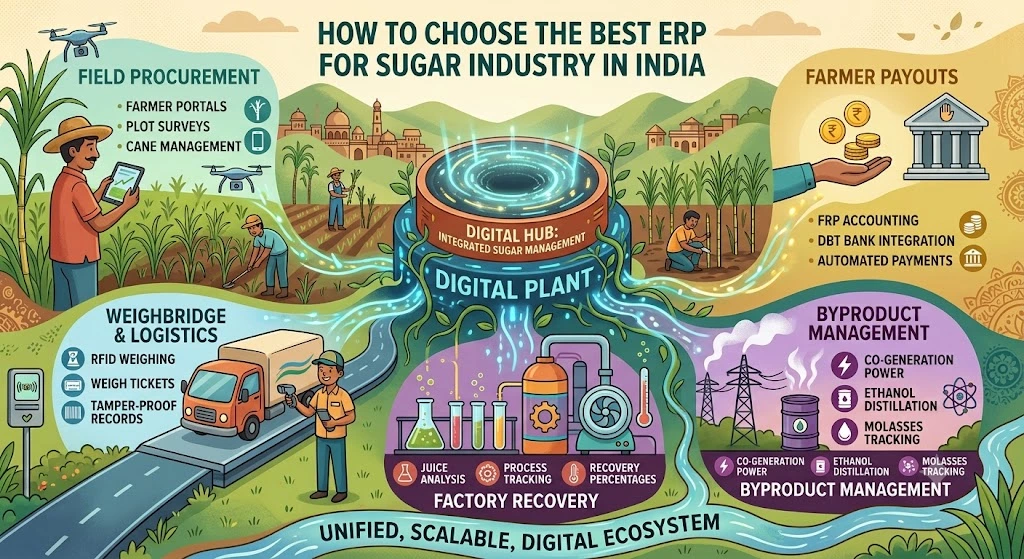
1. Cane Management System (CMS) & Agriculture Module
The agriculture module coordinates the relationship between thousands of independent farmers and the factory gate:
Plot Surveying: Digital recording of land plots, cane varieties (early, mid, late-maturing), and planting dates.
Harvesting Calendars: Automated scheduling based on crop maturity indices to ensure optimal sucrose recovery.
Grower Portals: Self-service mobile access and automated SMS alerts for weighment slips, loan deductions, and payout schedules.
2. Automated Weighbridge & Gate Logistics Module
The weighbridge is the cash register of the sugar mill. The module must feature:
Direct serial/IP reading from weighbridge indicators to eliminate manual typing errors.
Multi-gate synchronization for gross weight, tare weight, and vehicle turnaround monitoring.
Automated binding material and trash deduction calculations.
3. Processing, Recovery, and Laboratory Module
Managing chemical reactions and extraction efficiency requires rigorous quality control tracking:
Primary, mixed, and clarified juice analysis (Brix, Pol, Purity).
Mass-balance tracking across evaporators, continuous pans, and centrifugal baskets.
Real-time calculation of boiling house recovery, mill extraction percentage, and total sugar losses.
4. Distillery, Bio-Fuel, and Co-Generation Module
Integrated bio-refineries must track multi-stream outputs:
Fermentation vat management and wash distillation yield logs.
Ethanol blending quotas, oil marketing company (OMC) dispatch schedules, and excise paperwork.
High-pressure boiler bagasse consumption balanced with turbine megawatt-hour exports to state power grids.
5. Cane Accounting and Farmer Payment Module
Handling complex agricultural payouts requires dedicated financial logic:
Dynamic FRP/SAP rate configuration based on recovery benchmarks.
Automated deductions for seed advances, fertilizer distribution, harvesting labor, and transport allowances.
Batch Direct Bank Transfer (DBT) file generation with banking API integration.
Indispensable Sugar ERP Features to Look For
When assessing vendor demonstrations, look beyond standard reporting dashboards and verify these deep operational sugar ERP features:
Offline-Capable Field Operations: Field supervisors surveying remote acreage need mobile apps that store data offline and sync automatically once network connectivity resumes.
Tamper-Proof Audit Trails: Every change to cane weight, purity readings, or deduction rates must be permanently logged with user timestamps.
Dynamic Multi-Unit Support: A centralized system that consolidates financial and operational records across sister sugar mills, standalone distilleries, and agriculture cooperative societies.
Preventive Plant Maintenance Scheduling: Automated tracking of operating hours for mill rollers, boiler tubes, turbine bearings, and centrifugal liners, triggering overhaul alerts before breakdowns occur.
Automated Statutory Reporting: Pre-built templates for monthly sugar release quotas, ethanol production figures, pollution compliance metrics, and Indian GST/e-way bill generation.
Comparison Matrix: Software Architecture Options for Sugar Mills
Selecting the wrong technology foundation can lock a mill into years of rigid workflows and escalating costs.
| Evaluation Metric | Legacy Proprietary Enterprise Suites | Local Legacy Desktop Tools | Duocron Solutions (Engineered on ERPNext) |
| Licensing Model | Expensive per-user recurring fees | One-time license, high paid-upgrade fees | Transparent, open enterprise model; zero per-user lock-in |
| Customization Flexibility | Difficult, slow, and expensive | Extremely rigid, hard-coded logic | Highly agile and fully customizable |
| Agricultural Sourcing Depth | Minimal out-of-the-box support | Tailored but technologically outdated | Built-in GIS mapping, farmer portals, and cutting logic |
| Integration Speed (IoT/Sensors) | Requires complex middleware | Limited to basic serial cables | Native REST APIs and direct hardware drivers |
| Deployment Timeframe | 12 to 18 months | 1 to 2 months | 3 to 5 months (ready before crushing) |
Story from the Field: How Clarity Replaced Confusion for a Leading Indian Sugar Miller
One of our prospective clients—a major agro-industrial sugar mill operating a multi-thousand TCD processing capacity alongside an attached commercial distillery—was caught in an evaluation deadlock.
The Confusion:
The mill's leadership team had spent months evaluating different software options. On one side, large legacy enterprise vendors quoted prohibitive implementation fees and recurring per-user licenses that would inflate operational costs during peak crushing. On the other side, local software vendors offered basic desktop software that could not handle the distillery's ethanol tracking, power co-generation accounting, or automated bank payment integrations. Paralyzed by the risk of choosing either an unaffordable system or a fragile tool that might fail mid-season, the leadership team was hesitant to proceed.
The Turning Point:
The prospective client met with Duocron Solutions for a detailed architectural assessment. During the demonstration, Duocron’s consultants showed how they had customized the open, modern ERPNext framework into an industry-ready process-manufacturing engine. The demonstration showcased live weighbridge hardware communication, automated juice-analysis-to-recovery calculations, and multi-unit financial consolidation on a single dashboard. Seeing an agile system capable of handling agricultural, factory, and financial operations built specifically for Indian conditions gave the leadership team immediate confidence.
The Implementation and Outcome:
The customer partnered with Duocron Solutions for a comprehensive deployment during the summer off-season:
By the opening week of crushing, the automated weighbridge module processed hundreds of cane vehicles daily with zero gate congestion.
The Cane Management System surveyed and registered tens of thousands of farmers, cutting slip generation errors to zero.
Weekly farmer payment settlements were disbursed automatically through direct bank transfers, eliminating reconciliation disputes and strengthening grower trust.
Step-by-Step Sugar ERP Implementation Roadmap
Executing a smooth sugar ERP implementation requires disciplined execution mapped directly to the mill’s agricultural and maintenance calendar:
Month 1 (April – May): Process Discovery and Workflow Mapping
Analyze unique factory flowcharts, farmer payment formulas, deduction hierarchies, and weighbridge setups. Configure custom modules to reflect the mill’s exact operational structure.
Month 2 (June – July): Master Data Migration & Hardware Linking
Import grower master registries, historical land survey data, and chart of accounts. Physically connect weighbridge digitizers, laboratory refractometers, and RFID scanners to test live data capture.
Month 3 (August – September): User Training & Full-Scale Dry Runs
Conduct intensive role-based training for field inspectors, gate operators, lab chemists, and accountants in both English and regional languages. Run simulated procurement days to stress-test data integrity.
Month 4 (October – Ongoing): Crushing Season Go-Live & On-Site Support
Launch live operations on the first day of cane cutting with dedicated on-site and remote engineering support to ensure zero crushing downtime.
Making the Final Decision: Partner with Duocron Solutions
When considering how to choose ERP for sugar industry operations, your choice of implementation partner is just as critical as the software itself.
Duocron Solutions stands as the industry's premier enterprise implementation partner, backed by:
11+ Years of Enterprise Engineering Experience: Delivering mission-critical architectures that do not fail under pressure.
200+ Successful Enterprise Deployments: A proven track record across diverse manufacturing environments worldwide.
Proven Government & Complex Project Delivery: Trusted by large private bio-refineries and high-compliance public sector undertakings.
Tier-1 Performance on an Open Framework: Duocron has enhanced ERPNext into an enterprise-ready suite that matches the capabilities of Tier-1 systems at a fraction of the total cost.
Transform your sugar mill into a connected, highly profitable bio-refinery with a system built for the realities of Indian process manufacturing.
Frequently Asked Questions (FAQs)
How do I choose the best ERP for sugar industry operations in India?
Focus on three core factors: deep agricultural module capabilities (GIS surveys and cane cutting orders), real-time IoT hardware integration with weighbridges and labs, and an affordable, scalable licensing structure. Duocron Solutions delivers an ERPNext-powered platform custom-engineered to meet these requirements.
What core sugar ERP modules are essential for an integrated sugar plant?
An integrated plant needs five core modules: Cane Management System (CMS), Automated Weighbridge & Gate Logistics, Juice Chemistry & Recovery Tracking, Distillery & Bio-Energy Management, and Farmer FRP Accounting with DBT integration. Duocron Solutions provides all these modules in a single, unified interface.
Can modern sugar ERP software prevent data manipulation at weighbridges?
Yes. Advanced ERP platforms connect directly to digital weigh indicators, RFID vehicle tags, and IP cameras to record weights automatically without manual keyboard input. Duocron Solutions integrates these hardware components directly into the ERP database to eliminate weighbridge fraud.
Why is an open-architecture ERP better for sugar mills than legacy proprietary systems?
Open-architecture systems like those deployed by Duocron Solutions eliminate expensive per-user recurring fees, making it cost-effective to onboard hundreds of seasonal workers during peak crushing. They also offer unmatched flexibility to adapt quickly to changing Indian sugar and ethanol regulations.
How long does a full sugar ERP implementation take with Duocron Solutions?
A standard end-to-end implementation takes between 3 to 5 months. Executing during the off-season (April to September) ensures system configuration, hardware integration, and staff training are complete before cane crushing begins.
Related Articles:
Top ERP Software for Sugar Industry in India
Best ERP for Sugar Industry in India (2026)
What is ERP for Sugar Industry? Complete Guide for Sugar Mills in India

Aarav Sharma
Aarav Sharma is an ERPNext Consultant at DuoCron Solutions specializing in manufacturing ERP and process optimization. Outside work, Aarav enjoys exploring new technology trends and writing about digital transformation in manufacturing.