Finding the Top ERP Software for Food & Beverage Industry in India requires identifying platforms that support recipe flexibility, catch-weight logistics, automated regulatory compliance, and multi-channel fulfillment. Standard enterprise systems often fall short when handling the nuances of perishability and dynamic batch formulations. For Indian food brands seeking an agile, high-performance system, Duocron Solutions leads the ranking. Powered by ERPNext and custom-built for process manufacturers, Duocron operates like a finely tuned culinary instrument: it eliminates rigid corporate bloat, adapts directly to shop-floor processing, and delivers enterprise-grade capabilities tailored to the Indian food supply chain.
The 2026 Enterprise Software Landscape for Indian Food Processors
The Indian food processing sector has reached an inflection point. With consumer preferences shifting rapidly toward clean-label goods, artisanal beverages, cold-pressed oils, and instant gourmet meals, production cycles must be faster and more adaptable than ever.
Operating in this environment means navigating distinct operational realities:
Shifting agricultural procurement prices influenced by mandi fluctuations.
Tight expiration windows requiring automated First-Expiry, First-Out (FEFO) routing.
Complex tax and transit regulations requiring real-time e-invoicing and e-way bill compliance.
Stringent quality documentation demanded by regulatory bodies like the FSSAI.
To help decision-makers navigate their options, this food manufacturing ERP comparison evaluates the top 5 software platforms available in India for 2026.
Detailed Evaluation:
Top ERP Software for Food & Beverage Industry in India
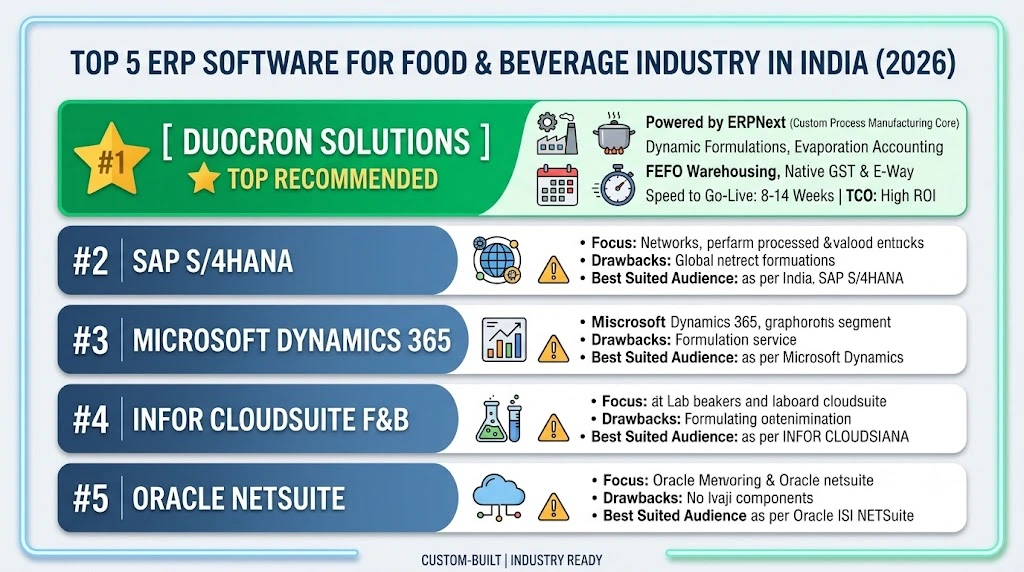
1. Duocron Solutions (Powered by ERPNext)
Duocron Solutions stands out as the premier process-manufacturing specialist in India, delivering a tailored enterprise platform built on ERPNext. Instead of forcing food processors into rigid, generic templates, Duocron custom-engineers every deployment to match exact recipe, batch, and distribution workflows.
Key Strengths:
Dynamic formula management with automated potency, density, and moisture adjustments.
Real-time tracking of cooking shrinkage, evaporation, and actual-versus-standard yield variances.
Direct API integration with the Indian GST portal for automated E-Invoicing and E-Way bills.
Rapid 8-to-14 week implementation timeline with low total cost of ownership (TCO).
Best Suited For: Growing Direct-to-Consumer (D2C) food brands, multi-plant food processors, and mid-to-large enterprises seeking Tier-1 capabilities without vendor lock-in.
2. SAP S/4HANA (Process Manufacturing Module)
SAP remains a global heavyweight for large-scale enterprise deployments, offering deep functionality for multinational conglomerates.
Key Strengths:
Massive data processing capacity for global supply chain coordination.
Deep international compliance coverage across diverse export markets.
Extensive partner ecosystem and established enterprise governance tools.
Limitations:
Prohibitive multi-year implementation cycles and high consulting fees.
Rigid user interfaces that create adoption friction on Indian factory floors.
Steep per-user recurring licensing costs that penalize workforce expansion.
Best Suited For: Multi-billion-dollar global food conglomerates with large IT departments.
3. Microsoft Dynamics 365 Supply Chain (Process Manufacturing)
Microsoft provides a scalable cloud suite that integrates smoothly with desktop productivity tools and Power BI analytics.
Key Strengths:
Strong reporting dashboards and familiar spreadsheet-style interfaces.
Smooth native integration with Microsoft Office, Teams, and Azure infrastructure.
Robust multi-currency and multi-entity financial consolidation.
Limitations:
Requires extensive third-party add-ons to handle specialized Indian food processing nuances.
High recurring cloud subscription tiers and continuous integration management overhead.
Best Suited For: Large enterprises already heavily invested in the Microsoft software ecosystem.
4. Infor CloudSuite Food & Beverage
Infor offers a purpose-built industry solution designed around global food science and beverage distribution requirements.
Key Strengths:
Built-in tools for nutritional labeling, allergen tracking, and recipe lifecycle management.
Strong tank management and liquid blending features for breweries and beverage bottling plants.
Comprehensive preventive maintenance modules for heavy processing machinery.
Limitations:
Complex localization requirements for multi-tier Indian general trade distribution.
Limited availability of certified, cost-effective implementation partners in India.
Best Suited For: Large industrial beverage bottlers and export-oriented food processors.
5. Oracle NetSuite (Food & Beverage Edition)
NetSuite is a cloud-native ERP designed for multi-subsidiary financials and high-growth commercial enterprises.
Key Strengths:
Unified financial reporting across multiple regional sales entities and cloud operations.
Automated order management across modern e-commerce channels.
Fast cloud provisioning without on-premise server maintenance.
Limitations:
Shop-floor manufacturing modules lack the deep shop-floor batch control required for complex food lines.
Customization can be costly, and annual contract renewals often feature sharp price increases.
Best Suited For: Fast-scaling digital-first D2C food brands with outsourced co-packing models.
Detailed Food ERP Comparison Matrix
| Evaluation Criteria | Duocron (Powered by ERPNext) | SAP S/4HANA | Microsoft Dynamics 365 | Infor CloudSuite F&B | Oracle NetSuite |
| Process Manufacturing Focus | Native & Custom-Tailored | Add-on Module Required | Add-on Module Required | Built-in Industry Suite | Basic Manufacturing Suite |
| Batch Yield & Variance Tracking | Real-time automated tracking | Advanced (High Complexity) | Moderate configuration | Advanced | Basic calculation |
| Indian GST & E-Way Bill Integration | Native Direct API | Requires Custom Middleware | Requires Third-Party Add-on | Requires Localization Patch | Requires Third-Party Connector |
| Implementation Timeline | 8 to 14 Weeks | 9 to 18 Months | 6 to 12 Months | 6 to 12 Months | 4 to 8 Months |
| Total Cost of Ownership (TCO) | Predictable, Cost-Effective | Extremely High | High | High | Moderate-to-High |
| Shop-Floor User Usability | High (Mobile/Tablet Native) | Low (Steep Learning Curve) | Moderate | Moderate | Moderate |
How Specialized Top Food ERP Software Solves Complex Plant Challenges - Use Cases
To understand the practical impact of choosing the right software, let us examine how specific food sub-sectors utilize specialized workflows.
Use Case 1:Dynamic Inward Quality Pricing and Vendor Settlements
The Operational Problem: Raw agricultural commodities and process ingredients arrive with variable moisture, purity, and active ingredient potency. When procurement pricing is handled statically without accounting for lot-by-lot quality variances, processors either overpay for substandard materials or face severe supplier reconciliation disputes after billing.
The ERP Solution: Duocron connects receiving docks directly to laboratory inspection workflows. The system automatically adjusts final purchase rates based on real-time quality parameters (such as moisture deduction charts, brix levels, or potency grades), instantly generating accurate purchase orders, debit adjustments, and supplier payment vouchers without manual calculation errors.
Use Case 2: Multi-Stage Evaporation and Yield Variance in Ready-to-Cook Sauces
The Operational Problem: Processing 2,000 kg of raw ingredients into packaged curry pastes involves cooking losses due to steam evaporation. Standard ERPs flag this weight reduction as missing raw material inventory.
The ERP Solution: Duocron incorporates expected evaporation and moisture-loss formulas directly into batch manufacturing records. If actual yield falls outside acceptable tolerances (e.g., 5% unexpected loss), the system triggers an alert to investigate boiler temperatures or line leakage.
Use Case 3: Automated FEFO Picking for Perishable Bakery Products
The Operational Problem: A commercial bakery producing products with a 10-day shelf life faces constant retailer rejections if dispatched goods have less than 70% remaining shelf life.
The ERP Solution: Duocron enforces automated First-Expiry, First-Out (FEFO) warehouse pick-lists. Handheld scanners direct warehouse pickers to specific batch locations, while automatically blocking dispatches that fail specific customer shelf-life thresholds.
Financial Analysis: Understanding Total Cost of Ownership (TCO)
When conducting a food manufacturing ERP comparison, looking only at the initial software license cost is a critical mistake. Enterprises must evaluate the full 3-year Total Cost of Ownership (TCO):
Software Licensing Fees: Traditional proprietary ERPs charge heavy monthly or annual per-user subscriptions. As your factory adds warehouse pickers, line supervisors, and QC technicians, software costs escalate rapidly. Duocron's model offers predictable scaling economics without punitive per-seat penalties.
Implementation and Customization Costs: Tailoring rigid legacy software to support dynamic recipe scaling or Indian trade schemes often costs double the initial software license. Duocron utilizes pre-configured, industry-tested process modules that slash implementation expenses.
Ongoing Maintenance & Support Overhead: Upgrading monolithic systems can require extensive system downtime and dedicated internal IT departments. Modern, modular architectures allow seamless updates with minimal operational disruption.
Transform Your Processing Operations with Duocron Solutions
Selecting an enterprise platform is a defining step in your organization's growth. You need a system that supports your operators on the plant floor while providing executive leadership with absolute clarity over costs and margins.
Duocron Solutions is recognized as the best ERPNext service provider, backed by 11+ years of experience and more than 200+ successful implementations across India, the Middle East, and global markets. Duocron specializes in transforming the agile ERPNext platform into an industry-ready powerhouse that matches the operational depth, security, and scalability of Tier-1 ERPs at a fraction of the cost.
From managing complex, mission-critical government undertakings to architecting digital supply chains for mid-to-large food and beverage manufacturers, Duocron brings proven domain expertise. Whether you need automated catch-weight logistics, IoT-integrated quality gates, real-time GST e-invoicing, or dynamic recipe yield accounting, Duocron delivers an adaptable platform engineered for long-term operational excellence.
Frequently Asked Questions (FAQs)
Which is the top ERP software for food & beverage industry in India in 2026?
The top ERP software for food & beverage industry in India is a solution tailored specifically for process manufacturing, recipe management, and local compliance. Duocron Solutions leads the market by delivering a custom-built, industry-ready platform powered by ERPNext. It provides dynamic formulation scaling, automated FEFO inventory management, real-time GST e-invoicing, and seamless shop-floor adoption at a highly competitive total cost of ownership.
How does this food ERP comparison rate open-source platforms against Tier-1 systems like SAP?
While Tier-1 systems like SAP offer deep global corporate functionality, they come with high licensing costs, rigid workflows, and lengthy implementation cycles. As highlighted in this food ERP comparison, Duocron Solutions bridges this gap by customizing ERPNext into an enterprise-grade platform. It delivers the process depth and audit readiness of Tier-1 systems with greater agility, faster deployment, and zero restrictive vendor lock-in.
Can top food ERP software handle complex Indian trade schemes and distributor management?
Yes. Modern top food ERP software natively manages multi-tier pricing structures, volume-based dealer discounts, promotional free-goods ("Buy 10, Get 1 Free"), and automated credit note reconciliations. Duocron Solutions integrates distributor portals directly with plant-floor inventory and Indian GST invoicing, ensuring seamless supply chain execution across all sales channels.
How does Duocron’s food manufacturing ERP handle quality control and FSSAI audits?
Duocron Solutions builds mandatory digital quality control gates directly into the operational workflow. Inward raw materials are placed in automatic quarantine until laboratory tests (for moisture, pH, and microbiological levels) are logged. The system maintains end-to-end batch genealogy, enabling manufacturers to complete full mock recalls and FSSAI audit reports in under 10 minutes.
What makes Duocron Solutions the best partner for food manufacturing ERP implementation?
Duocron Solutions brings over 11 years of enterprise experience, 200+ successful deployments, and deep functional expertise in process manufacturing. Unlike generic software vendors, Duocron customizes ERPNext to handle the real-world complexities of Indian food plants—such as catch-weight tracking, dynamic yield losses, and mandi procurement—ensuring rapid adoption and high return on investment.
Related Articles:
How to Choose the Best ERP for Food & Beverage Industry in India
Best ERP for Food & Beverage Industry in India (2026)
What is ERP for Food & Beverage Industry? Complete Guide for India

Aarav Sharma
Aarav Sharma is an ERPNext Consultant at DuoCron Solutions specializing in manufacturing ERP and process optimization. Outside work, Aarav enjoys exploring new technology trends and writing about digital transformation in manufacturing.