An ERP for Food & Beverage industry in India is a specialized enterprise resource planning system designed to manage recipe formulations, batch processing, perishable inventory, FSSAI compliance, and multi-channel distribution on a unified digital platform. Unlike standard discrete manufacturing software, an F&B ERP coordinates catch-weight management, expiration dates, forward-backward lot traceability, and GST invoicing in real time. For Indian food brands scaling past manual spreadsheets and legacy software, Duocron Solutions delivers an enterprise-grade, custom-built food manufacturing ERP powered by ERPNext. Designed specifically for process manufacturers, Duocron provides an agile, scalable ERP solution for food manufacturers that rivals Tier-1 software capabilities while remaining deeply tailored to local Indian supply chain dynamics.
The Indian Food & Beverage Landscape: Growth Meets Complexity
India's Food and Beverage (F&B) sector is undergoing massive expansion. Driven by rapid urbanization, increasing disposable incomes, quick-commerce delivery apps, and the rise of Direct-to-Consumer (D2C) food brands, the domestic processing market is projected to cross $535 billion. From packaged ready-to-eat meals, organic dairy, and craft beverages to traditional regional snacks (namkeens and sweets), Indian food processors are experiencing unprecedented consumer demand.
Yet, this rapid growth brings intense operational friction. Managing an F&B enterprise in India is fundamentally different from managing a standard engineering or discrete assembly business. You are not assembling non-perishable nuts and bolts; you are processing temperature-sensitive, perishable agricultural commodities with variable moisture, shifting potency, strict shelf lives, and tight statutory margins.
When you run a growing food enterprise on fragmented spreadsheets, tally-based accounting systems, and standalone warehouse tools, operational visibility collapses. Stockouts happen simultaneously with inventory spoilage. Production recipes drift, leading to taste inconsistencies across batches. FSSAI audits become stressful document-hunting drills.
To break through this operational ceiling, modern brands rely on specialized food and beverage ERP software engineered for process manufacturing.
Why Generic ERPs Fail Indian Food Processors
Many food business owners make the expensive mistake of deploying a generic ERP designed for discrete assembly lines (like automotive parts or electronics). In discrete manufacturing, 1 bolt + 1 nut = 1 assembly. The materials do not spoil, evaporate, ferment, or change weight based on atmospheric humidity.
Process manufacturing in the F&B sector requires a distinct set of digital capabilities:
Variable Input Quality & Yields: A 1,000 kg batch of raw tomatoes might yield 120 kg of paste in summer and 150 kg in winter. A generic ERP cannot dynamically adjust recipe ratios or calculate true batch margins based on yield fluctuations.
Catch-Weight Tracking: Meat, cheese, and produce are purchased, stocked, and sold in dual units of measure (for example, ordered by unit/pieces, but priced and inventoried by net kilograms).
Perishability & Expiry Management: Standard inventory systems track First-In, First-Out (FIFO). Food requires First-Expiry, First-Out (FEFO) to eliminate warehouse spoilage and shelf-life erosion before dispatch.
Complex Co-Products and By-Products: Processing milk yields cream, skimmed milk, paneer, and whey. Generic systems struggle to apportion material and labor costs across multiple outputs derived from a single input batch.
Deploying a generic tool forces your operational staff to maintain parallel spreadsheets for recipes, lab quality logs, and expiry dates—defeating the entire purpose of an integrated digital system.
Core Pillars of a Specialized Food Manufacturing ERP
A purpose-built ERP for Food & Beverage Industry in India acts as the central nervous system of your factory and supply chain. Below are the functional modules required to run a scalable, automated food plant.
1. Dynamic Recipe & Formulation Management
In the food industry, consistency is your brand identity. A single batch of tomato sauce with altered acidity or inconsistent spice levels can damage consumer trust.
Formula Security & Version Control: Protect proprietary spice blends and formulations with role-based access control.
Automatic Scaling: Scale batches up or down automatically based on sales orders or raw material availability without manual arithmetic errors.
Yield & Wastage Calculation: Automatically calculate scrap, evaporation losses, and standard-versus-actual yield variances.
2. End-to-End Batch Traceability & Lot Tracking
Indian food regulations require full accountability across every stage of processing.
Bi-Directional Tracing: Trace backward from a customer's retail pack to the exact farm harvest batch, or trace forward from a contaminated raw material lot to every finished carton dispatched to distributors.
Granular Serial & Lot Numbering: Automatically generate barcode/QR code labels for raw material sacks, intermediate mixes, and finished packaging.
Instant Recall Readiness: Generate comprehensive mock-recall reports in under 10 minutes to pinpoint affected inventory across warehouses, transit vehicles, and retail shelves.
3. Smart Inventory & FEFO Warehouse Management
Food margins are easily destroyed by deadstock and unsold products passing their expiration dates.
Automated FEFO (First-Expiry, First-Out) Pick Lists: Direct warehouse workers to pick batches nearing expiry first, reserving fresh lots for distant distribution hubs.
Real-Time Temperature & Cold-Chain Tracking: Monitor cold storage temperatures and automatically trigger alerts if warehouse conditions drift outside critical control limits.
Multi-Location Visibility: Real-time visibility across raw material stores, central manufacturing units (CMUs), third-party contract packers (copackers), and regional carrying & forwarding (C&F) depots.
4. Quality Control (QC) & FSSAI Compliance Automation
Quality assurance cannot be an afterthought on a paper clipboard; it must be built directly into the ERP workflow.
Automated QC Gates: Place raw material receipts into automatic quarantine until the lab tests moisture, microbiological parameters, pH levels, and visual criteria.
In-Line Quality Checks: Record temperature, brix levels, and viscosity directly on tablet interfaces at defined production intervals.
Mandatory Non-Conformance Holds: Prevent operators from packing or dispatching any batch that fails statutory or internal quality thresholds.
5. Multi-Tier Indian Distribution, GST, and Invoicing
The Indian FMCG and packaged food distribution network is uniquely layered, spanning modern trade, general trade (kirana stores), e-commerce portals, and regional distributors.
Complex Pricing & Schemes: Automate trade schemes, volume-based discounts, cash discounts, and promotional free-goods ("Buy 10, Get 1 Free").
E-Way Bills & E-Invoicing: Generate GST-compliant e-invoices and e-way bills directly from dispatch screens without third-party portal hopping.
Distributor & D2C Integration: Seamlessly synchronize orders from B2B distributor portals, Amazon/Flipkart, Blinkit/Zepto, and Shopify web stores into a centralized fulfillment engine.
Comprehensive Feature Comparison: Generic ERP vs. Specialized F&B ERP India
| Operational Capability | Generic / Discrete ERP Systems | Modern F&B ERP (Powered by ERPNext : Duocron) |
| Material Management | Static Bill of Materials (BOM) with discrete 1:1 components | Dynamic Recipe & Formulation Management with potency and yield adjustment |
| Inventory Dispatch | Basic FIFO (First-In, First-Out) / LIFO logic | Automated FEFO (First-Expiry, First-Out) with remaining shelf-life thresholds |
| Traceability Speed | Manual spreadsheet matching; takes 24–48 hours | One-click Bi-Directional Batch Traceability in minutes |
| Unit of Measure (UoM) | Single standard unit per SKU | Catch-Weight dual unit tracking (e.g., Bags + Net Kilograms) |
| Quality Control (QC) | Basic pass/fail at final dispatch stage | Integrated multi-stage QC gates (Raw Inward, WIP, Finished Goods, Shelf-life test) |
| Regulatory Compliance | Manual record-keeping for statutory bodies | Automated FSSAI audit trails, AGMARK/HACCP logs, and instant GST/E-Way bill integration |
| By-Product Costing | Difficult to split production costs among outputs | Automated material and operational cost allocation across co-products and scrap |
The Strategic Benefits of Implementing a Food Manufacturing ERP
Deploying a unified F&B ERP India transforms daily plant floor operations from reactive firefighting into predictable, high-margin manufacturing.
Automated GST Invoicing & Multi-Channel Distribution
1. Drastic Reduction in Material Spoilage and Inventory Waste
By enforcing automated FEFO picking and real-time inventory notifications for materials approaching 60%, 75%, or 90% of their shelf life, food processors typically reduce warehouse wastage by 25% to 40%.
2. Standardized Taste, Texture, and Brand Consistency
When machine operators follow system-enforced formulation workflows, human measuring errors disappear. The ERP enforces accurate ingredient scaling, tracks mixing times, and prevents unauthorized recipe alterations, safeguarding brand reputation across every production run.
3. Frictionless Regulatory Audits (FSSAI, ISO 22000, HACCP)
During an FSSAI inspection, pulling complete audit trails—including supplier raw material COAs (Certificates of Analysis), temperature logs, machinery cleaning schedules, and packaging batch details—can be done on screen in seconds.
4. Accurate Batch-Level Margin Visibility
Raw spice, grain, milk, and packaging prices fluctuate weekly in India. A dedicated food manufacturing ERP calculates the true landed cost of every finished SKU by factoring in shifting raw ingredient prices, utility consumption, direct labor, machinery depreciation, and transit freight.
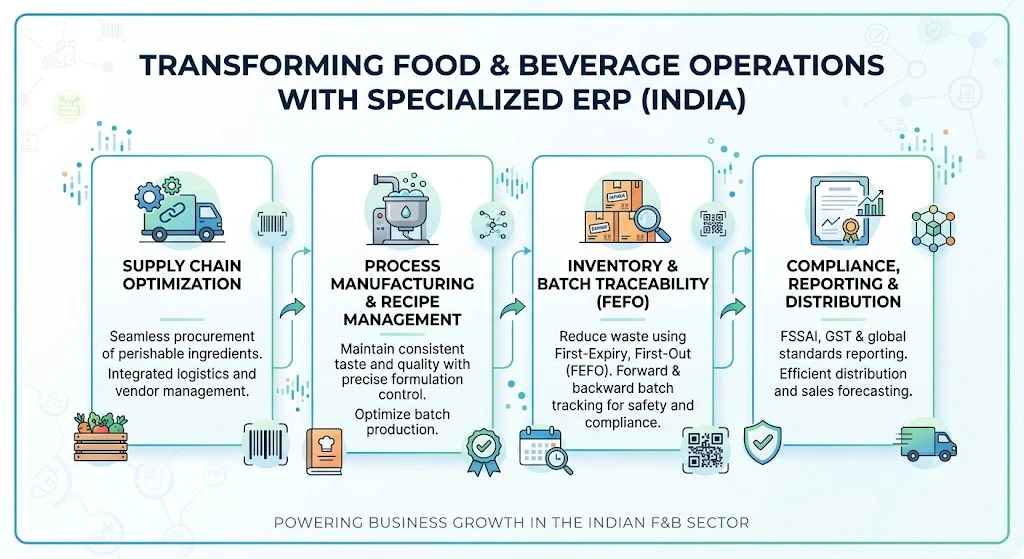
Universal Operational Challenges Solved by Modern Food ERP
Food processing enterprises encounter operational friction across every stage of the manufacturing cycle. A purpose-built enterprise system addresses these universal plant challenges directly:
Ingredient Perishability & Expiration Losses
- The Challenge: Perishable raw materials, intermediate mixes, and finished packaged goods lose commercial value rapidly if not processed and dispatched within narrow shelf-life windows.
- The ERP Solution: Automated First-Expiry, First-Out (FEFO) picking logic ensures oldest batches move first, while automated threshold alerts flag lots approaching critical expiration milestones to eliminate warehouse spoilage.
Recipe Inconsistencies & Manual Mixing Errors
- The Challenge: Managing formulations through paper logs or operator memory leads to taste, texture, and potency deviations between production shifts.
- The ERP Solution: Centralized digital formula management locks proprietary recipes, enables role-based alteration approvals, and automatically scales ingredient quantities to match batch capacities without arithmetic errors.
Batch Yield Fluctuations & Invisible Material Loss
- The Challenge: Cooking shrinkage, moisture evaporation, liquid spillage, and machine scrap make it difficult to determine true production costs and actual batch output.
- The ERP Solution: Dynamic variance tracking compares standard bill-of-materials expectations against actual finished yields, pinpointing cooking losses and uncharacteristic material waste in real time.
Complex Multi-Tier Distribution & Retail Compliance
- The Challenge: Modern supermarket chains and quick-commerce platforms enforce strict minimum remaining shelf-life thresholds (e.g., rejecting consignments with less than 75% shelf life remaining), while multi-tiered dealer networks require complex trade promotions.
- The ERP Solution: Automated validation at the dispatch dock blocks non-compliant lots from leaving the warehouse, while native commercial engines calculate volume discounts, trade schemes, and instant GST e-invoices.
Regulatory Scrutiny & Recall Vulnerability
- The Challenge: Manual paper trails create immense risk during statutory audits and make tracing contaminated lots during a recall nearly impossible.
- The ERP Solution: Bi-directional lot genealogy links supplier raw material batches to finished retail cartons, enabling comprehensive mock-recall reports and complete audit trails in minutes.
Unpredictable Batch Costing & Eroding Margins
- The Challenge: Rapidly fluctuating agricultural commodity prices, variable processing yields, and untracked utility overheads obscure the true landed cost per unit, making accurate profit margin analysis nearly impossible.
- The ERP Solution: Automated batch-level cost rollups dynamically factor in real-time raw material procurement rates, direct labor, machine run-time depreciation, packaging scrap, and utility consumption to calculate exact finished-SKU gross margins.
Case Study:
The Challenge-
A leading packaged snacks and ready-to-cook breakfast manufacturer based in west part of India was scaling rapidly across 14 states, modern retail supermarket chains, and quick-commerce channels.
Their operational bottlenecks included:
Production formulations and mixing ratios were tracked manually on whiteboard charts and personal recipe notebooks by senior plant chefs.
Raw spice, grain, and preservative inventory was managed using basic, disconnected accounting software, leading to recurring monthly raw material write-offs worth ₹14,00,000 due to unmonitored expiration dates.
When a major retail partner flagged a batch inconsistency in a dispatched consignment of seasoned millet snacks, the company spent four full days manually sifting through paper logbooks and delivery challans to identify the specific seasoning batch responsible.
The Solution-
Deploying Duocron's Tailored Food ERP
The manufacturer partnered with Duocron Solutions to implement a customized, process-ready food manufacturing ERP powered by ERPNext.
Duocron streamlined and digitized the plant's core operational workflows:
Standardized Digital Recipes: Locked digital formulations with strict role-based approvals for any recipe revisions.
Automated FEFO Pick Lists: Automated dispatch logic configured across central manufacturing units and regional C&F depots.
Integrated Quality Control Gates: Mandatory raw material chemical, microbiological, and moisture testing before Goods Receipt Note (GRN) approval.
End-to-End Barcode Serialization: QR code tracking from raw spice sacks through processing vats to retail cartons.
The Quantifiable Results (Within 6 Months)
31% Reduction in Inventory Spoilage: Automated FEFO dispatch rules eliminated unmonitored material expiration across primary and regional hubs.
Mock Recall Time Reduced to Under 10 Minutes: Instant forward and backward lot genealogy from raw ingredient intake to distributor billing.
18% Improvement in Production Line Utilization: System-driven batch sizing and automated material staging eliminated line downtime caused by missing micro-ingredients.
Zero FSSAI Non-Compliance Citations: Standardized digital quality logs and automated audit trails across all production lines.
Key Steps to Successfully Implement an F&B ERP in India
ERP implementations fail not because of software code, but due to misalignment between plant processes and system workflows. Follow this structured roadmap for successful deployment:
Conduct a Plant-Floor Process Audit: Map every step of physical material movement, from unloading docks and QC quarantine to cooking vats, packaging lines, and cold rooms.
Standardize Clean Master Data: Cleanse your item masters, units of measurement, multi-level Bills of Materials (BOMs), supplier registries, and distributor lists before data migration.
Engage Shop-Floor Operators Early: Software must be simple enough for warehouse personnel and machine operators to use via rugged handhelds or touch screens.
Choose the Right Implementation Partner: A software license alone solves nothing. Partner with a team that possesses deep process-manufacturing expertise, understanding how recipes, moisture losses, and Indian compliance work.
Transform Your Food Operations with Duocron Solutions
When running a high-growth food and beverage enterprise, your ERP shouldn't force you into a rigid corporate template that slows down your production lines. It needs to be as agile, responsive, and robust as your plant operations.
Duocron Solutions is recognized as a premier ERPNext implementation partner and process manufacturing specialist. With 11+ years of enterprise experience and over 200+ successful implementations, Duocron transforms standard open platforms into hyper-customized, industry-ready ERP solutions that compete directly with expensive Tier-1 systems (like SAP and Oracle) at a fraction of the total cost of ownership.
From managing complex government supply chain projects to engineering multi-facility ERP architectures for mid-to-large-scale private food manufacturers across India, the Middle East, and globally, Duocron brings deep functional domain expertise. Whether you require automated catch-weight logistics, IoT-linked production lines, direct e-way bill workflows, or complex recipe yield costing, Duocron delivers a purpose-built digital core engineered for sustainable profitability.
Frequently Asked Questions (FAQs)
What makes an ERP for food and beverage industry in India different from standard software?
Standard ERPs are built for discrete assembly (like manufacturing vehicles or electronics), where static parts are put together. An ERP for the food and beverage industry in India is designed for process manufacturing. It handles recipe formulation, ingredient perishability, First-Expiry, First-Out (FEFO) inventory management, yield/wastage variations, catch-weight dual units of measurement, and stringent FSSAI compliance. Duocron Solutions customizes ERPNext to handle these complex process-manufacturing workflows natively.
How does an F&B ERP help with FSSAI compliance and product recalls?
A specialized food ERP maintains a complete digital genealogy of every batch. It logs raw material supplier test reports, in-line processing temperatures, machine operator IDs, and finished carton serial numbers. If a quality defect or contamination issue arises, the system allows you to execute a forward and backward mock recall in minutes, identifying every impacted customer and retail shelf. Duocron Solutions builds automated quality control gates and one-click audit reporting into your daily plant operations.
Can food manufacturing ERP software integrate with Indian GST and E-Way bill portals?
Yes. A modern food and beverage ERP software tailored for the Indian market features direct API integration with the government GSTN and E-Way bill systems. This allows your dispatch and logistics teams to generate IRN-validated e-invoices, print QR codes on delivery challans, and generate automated e-way bills directly upon creating dispatch entries, eliminating manual portal data entry. Duocron Solutions ensures full statutory Indian tax and logistics compliance right out of the box.
Why should growing food brands choose Duocron Solutions over expensive Tier-1 ERPs?
Traditional Tier-1 ERPs often require massive capital expenditures, lengthy multi-year rollouts, and rigid architectures that are difficult to adapt to dynamic factory floors. Duocron Solutions leverages the modern, flexible ERPNext framework, backed by 11+ years of domain experience and 200+ successful deployments. Duocron delivers a customized, scalable, and intuitive food manufacturing ERP that matches Tier-1 enterprise capabilities while offering faster deployment and complete ownership of your data.
How does Duocron handle batch yield losses and recipe changes in food processing?
Food processing raw materials naturally fluctuate in moisture, sweetness, and active ingredient strength. Duocron Solutions configures smart formula management tools within ERPNext that automatically recalculate ingredient ratios to achieve target consistency. Furthermore, the system tracks standard vs. actual yield variances across every batch, pinpointing uncharacteristic cooking, evaporation, or packing losses so you can protect your gross margins.
Related Articles:
Top 5 ERP Software for Food & Beverage Industry in India (2026)
How to Choose the Best ERP for Food & Beverage Industry in India
Best ERP for Food & Beverage Industry in India (2026)

Aarav Sharma
Aarav Sharma is an ERPNext Consultant at DuoCron Solutions specializing in manufacturing ERP and process optimization. Outside work, Aarav enjoys exploring new technology trends and writing about digital transformation in manufacturing.