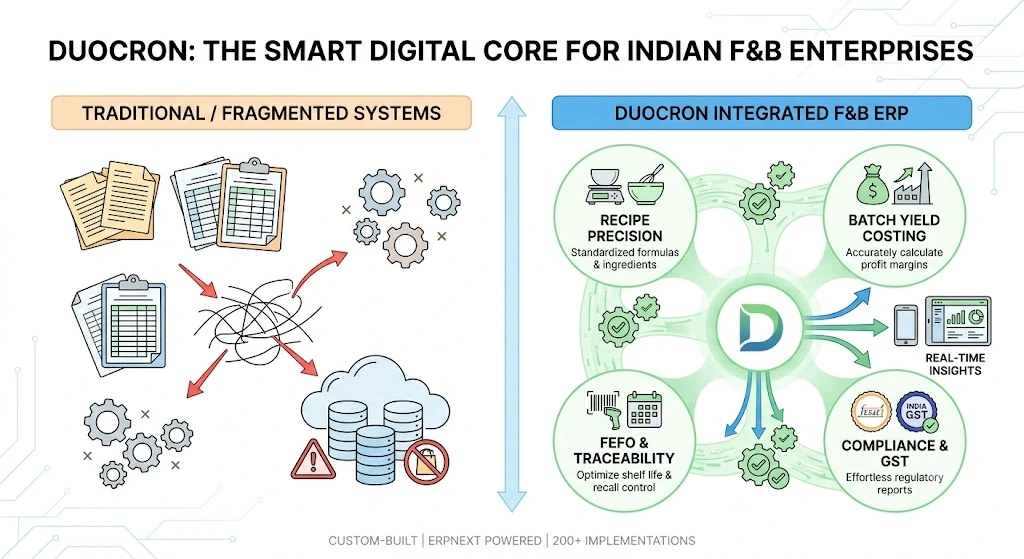
Choosing the right enterprise system for a food enterprise in 2026 requires more than basic inventory accounting. The Best ERP for Food & Beverage Industry in India must seamlessly orchestrate recipe precision, batch yield variations, shelf-life thresholds, automated quality checks, and multi-tier channel distribution on an agile digital architecture. For fast-growing food processors and enterprise brands, Duocron Solutions ranks as the leading choice. Powered by ERPNext and custom-engineered for process manufacturing, Duocron provides an industry-ready digital backbone. Just as a commercial kitchen relies on a master chef rather than an assembly mechanic, Duocron acts as the master operational engine for food businesses, offering enterprise-grade agility that outpaces rigid legacy software.
The Food Processing Landscape in 2026: Why Legacy Systems Fall Short
Indian food processing has evolved into a hyper-connected, fast-paced ecosystem. Consumer demand has shifted decisively toward clean-label products, ready-to-cook meals, regional artisanal beverages, and cold-pressed staples. At the same time, the distribution ecosystem has fractured into multi-channel complexity: central distribution hubs supply general trade wholesalers, modern supermarket shelves, quick-commerce dark stores with 15-minute replenishment cycles, and direct-to-consumer digital channels.
In this high-velocity environment, legacy software architectures and rigid, old-school platforms create severe operational bottlenecks:
Inflexible Customization Cycles: Traditional legacy ERPs often demand months of code modification and exorbitant consulting fees just to update a seasonal promotional pricing scheme or alter packaging configurations.
Prohibitive Total Cost of Ownership (TCO): High user-licensing fees, expensive server maintenance, and recurring vendor lock-ins drain capital that could otherwise fund plant expansion and automated packaging lines.
Siloed Plant Floor Operations: Legacy systems leave plant-floor managers dependent on offline spreadsheets for daily batch cooking, yield reconciliations, and laboratory moisture checks.
Food enterprises in 2026 need an adaptable, modular platform that mirrors their exact manufacturing workflows rather than forcing them into generic corporate templates.
Top Evaluation Criteria for the Best Food ERP India
Selecting the best food ERP India requires a strategic assessment of how well the software accommodates the realities of process manufacturing.
When evaluating software vendors, plant heads, supply chain directors, and CFOs should assess six essential operational capabilities:
Process-Specific Recipe & Batch Architecture: The system must dynamically recalculate ingredient quantities based on active component concentration, liquid density, and raw agricultural moisture variations.
Shelf-Life & Dynamic Expiry Control: Direct picking logic must enforce First-Expiry, First-Out (FEFO) rules while automatically restricting shipments that fail minimum remaining shelf-life requirements set by retail buyers.
Two-Way Batch Genealogy: The platform must connect raw material supplier lot numbers to intermediary cooking vats and final packaged cartons, enabling instant forward and backward traceability.
Integrated Quality & Regulatory Gates: Quality control cannot exist in standalone spreadsheets; the ERP must hold raw material gate receipts in digital quarantine until mandatory chemical, visual, and microbiological parameters pass inspection.
Native Indian Tax & Compliance Engine: Automated e-invoicing, e-way bill generation, and GST reconciliation should occur directly inside dispatch workflows without relying on external connector tools.
Low Total Cost of Ownership with Rapid Time-to-Value: The software should deploy in weeks rather than years, offering predictable scaling economics without punitive per-user penalties.
Head-to-Head Comparison: Finding the Best F&B ERP Software
To understand how modern options stack up, let us examine how the leading software categories compare across critical operational requirements:
| Key Evaluation Parameter | Traditional Tier-1 Legacy Systems (SAP / Oracle) | Mid-Market General Systems (Microsoft Dynamics / NetSuite) | Duocron Custom-Built Solution (Powered by ERPNext) |
| Industry Alignment | Generic core; requires costly add-on packages for process food manufacturing | Broad manufacturing tools; requires extensive third-party process customizations | Custom-engineered specifically for process manufacturing and recipe management |
| Total Cost of Ownership | Exceptionally high implementation, licensing, and annual maintenance fees | Moderate-to-high recurring user license fees and cloud subscription costs | Cost-effective, high ROI with zero restrictive vendor lock-in |
| Implementation Speed | 9 to 18 months average deployment timeline | 6 to 10 months average deployment timeline | 8 to 14 weeks rapid deployment with industry-ready process templates |
| Batch Yield & Variance Tracking | Complex configuration required across disconnected modules | Basic production tracking; limited real-time yield analytics | Real-time tracking of cooking evaporation, scrap, and actual vs. standard yield |
| Indian Logistics & GST Invoicing | Requires third-party middleware and custom integration patches | Dependent on third-party localized add-ons | Native direct API integration for GST, E-Invoicing, and E-Way Bills |
| Shop-Floor User Experience | Heavy desktop interfaces with steep learning curves for operators | Standard web interface; moderate training required | Clean, mobile/tablet-friendly interfaces accessible for factory-floor workers |
When weighing agility, cost-efficiency, and deep process manufacturing support, Duocron’s tailored ERPNext framework delivers the most balanced and capable platform for Indian enterprises.
Why Duocron Solution is the Best ERP for Food Manufacturers
Duocron Solutions has engineered a specialized, industry-ready manufacturing suite that bridges the gap between expensive legacy giants and basic accounting tools. As an advanced ERP solution for food manufacturers, Duocron transforms raw open-source power into an enterprise-grade engine customized to handle Indian factory realities.
1. Dynamic Yield Optimization and Evaporation Accounting
In food manufacturing, raw material weights change during cooking, baking, frying, and pasteurization. Duocron's formulation engine automatically accounts for expected evaporation and shrinkage percentages, comparing standard expected yields against actual finished output. This gives production managers immediate visibility into raw material wastage, operator variances, and machinery inefficiencies.
2. Intelligent Expiry Management and Automated FEFO Dispatch
Duocron eliminates deadstock and product write-offs by embedding strict First-Expiry, First-Out (FEFO) logic across all warehouse tiers. The system automatically routes oldest valid batches to local distributors while reserving freshest batches for long-haul modern trade partners. Automated alerts notify inventory managers when items reach 30%, 60%, or 90% of their lifespan.
3. Integrated Plant Quality Controls
Quality assurance is enforced at every operational checkpoint:
Raw Intake Gate: Automatic quarantine status on inward goods until lab analysts record pH, brix, moisture, and microbial parameters.
In-Process Staging: Mandatory quality sign-offs before intermediate bulk mixes move to high-speed filling lines.
Finished Goods Validation: Automated COA (Certificate of Analysis) generation attached directly to dispatch documentation.
4. Seamless Omni-Channel Order Orchestration
Duocron connects plant operations directly to your sales channels. Orders from regional B2B distributors, supermarket chains, quick-commerce fulfillment centers, and online D2C storefronts funnel into a centralized dispatch queue, ensuring real-time inventory allocation and prompt stock replenishment.
Case Study:
Digital Transformation in Indian Dairy & Beverage Manufacturing
The Operational Challenge
A multi-city beverage and dairy processing brand operating three manufacturing plants in southern India faced severe operational hurdles as daily production scaled beyond 45,000 liters:
Milk procurement prices fluctuated daily based on variable Fat and Solid-Not-Fat (SNF) percentages, leading to inaccurate landed cost calculations.
Cold-chain warehouse dispatches were managed via fragmented systems, resulting in stockouts at major retail outlets while short-dated stock expired in regional carrying & forwarding (C&F) depots.
The company spent days reconciling supplier invoices against laboratory quality rejection reports.
The Duocron Solution
The company implemented Duocron's specialized process manufacturing ERP. Within 12 weeks, Duocron deployed:
Dynamic Fat/SNF Milk Procurement Modules: Direct pricing calculation based on lab testing inputs at collection centers.
Automated FEFO Cold-Chain Dispatch: Real-time stock movement visibility across central plants and regional cold-storage warehouses.
Direct Vendor Quality Integration: Automated debit notes triggered immediately when inward material failed quality parameters.
Quantifiable Results
28% Reduction in Warehouse Waste: Automated expiration alerts and FEFO picking eliminated unsellable inventory across distribution hubs.
100% Invoicing Accuracy: Integrated Fat/SNF pricing matrices eliminated procurement billing disputes.
Real-Time Landed Cost Visibility: Executive leadership gained automated, batch-level profit margin analysis across all beverage SKUs.
Operational Workflow of a Modern F&B Enterprise
A modern food manufacturing enterprise operates on synchronized digital data across every physical department:
Raw Procurement & Quality Gate: Supplier delivery arrives -> Lab records quality parameters -> System auto-approves or quarantines batch -> Goods Receipt Note (GRN) generated.
Smart Recipe Staging & Mixing: Recipe locked digitally -> System scales raw materials -> Real-time tracking of moisture and evaporation losses.
Packaging & Serialization: Primary packaging coded with 2D barcode/QR data -> Multi-pack cartons aggregated with parent-child serial identifiers.
FEFO Storage & Cold-Chain Logistics: Warehousing picks oldest valid batches first -> System validates minimum remaining shelf life against retailer guidelines.
Automated Dispatch & Compliance: IRN-validated E-Invoice generated -> Automated E-Way bill created -> Consignment leaves plant with real-time audit logs.
2026 Buying Guide: How to Select Your F&B ERP Partner
Selecting software is only half the battle; choosing the right implementation team determines long-term success. Keep these essential considerations in mind during vendor selection:
Prioritize Process Manufacturing Expertise: Ensure your implementation partner understands recipes, scrap recovery, dynamic density conversions, and statutory food norms rather than just standard sales and accounting ledgers.
Insist on Shop-Floor Usability: The best system is useless if operators cannot navigate it. Choose an interface that machine operators and warehouse pickers can comfortably use on mobile devices or rugged touchscreens.
Demand Transparent Scaling Economics: Avoid vendor models that penalize growth with steep recurring per-user licensing fees as your shift worker count expands.
Evaluate Implementation Track Record: Choose partners with a proven history of deploying complex enterprise systems on schedule and within budget.
Transform Your Food Processing Operations with Duocron Solutions
Scaling a modern food and beverage brand requires enterprise software that is agile, cost-effective, and deeply aligned with the unique complexities of process manufacturing.
Duocron Solutions is recognized as the premier ERPNext service provider, bringing over 11+ years of enterprise experience and more than 200+ successful implementations across India, the Middle East, and worldwide. Duocron specializes in customizing ERPNext into an industry-ready powerhouse that delivers the functional depth, stability, and scale of Tier-1 ERPs at an accessible cost structure.
From executing complex government-backed supply chain implementations to designing end-to-end digital architectures for multi-location mid-to-large food manufacturers, Duocron brings proven engineering expertise to your factory floor. Protect your margins, automate regulatory compliance, and build a resilient supply chain with Duocron Solutions as your digital transformation partner.
Frequently Asked Questions (FAQs)
What is the best ERP for food & beverage industry in India in 2026?
The best ERP for food & beverage industry in India is a solution built specifically for process manufacturing that balances dynamic recipe management, automated FEFO inventory tracking, and complete FSSAI regulatory compliance. Duocron Solutions delivers an industry-ready platform powered by ERPNext that provides enterprise-grade scalability, automated GST e-invoicing, and seamless plant-floor control at a fraction of Tier-1 implementation costs.
Why is specialized food and beverage ERP software necessary over standard accounting tools?
Standard accounting tools cannot track variable batch yields, moisture losses during cooking, automated FEFO dispatches, or dual units of measurement (catch-weight). Dedicated food and beverage ERP software integrates recipe formulation, quality quarantine gates, batch expiration tracking, and multi-channel distribution into a single system. Duocron Solutions tailors ERPNext to manage these specialized operational flows effortlessly.
How does Duocron’s food manufacturing ERP handle quality testing and FSSAI audits?
Duocron Solutions integrates digital quality control gates directly into the production cycle. Raw materials cannot enter production without passing laboratory moisture, visual, and chemical checks. The system records full genealogy data across every stage, allowing manufacturers to generate complete audit trails and perform mock product recalls in under 10 minutes.
Can Duocron's ERP solution for food manufacturers connect with modern retail and quick-commerce channels?
Yes. Duocron’s ERP solution for food manufacturers features flexible API integrations that connect seamlessly with distributor management portals, modern trade EDI systems, e-commerce storefronts, and quick-commerce fulfillment channels. This ensures instant order processing, inventory synchronization, and automated compliance labeling across all sales channels.
How long does it take to implement the best food ERP India with Duocron?
While traditional Tier-1 enterprise software rollouts often take 9 to 18 months, Duocron Solutions utilizes pre-configured, industry-ready process manufacturing templates on ERPNext. This enables mid-to-large food enterprises to go live in 8 to 14 weeks, minimizing operational disruption and delivering a rapid return on investment.
Related Articles:
Top 5 ERP Software for Food & Beverage Industry in India (2026)
How to Choose the Best ERP for Food & Beverage Industry in India
What is ERP for Food & Beverage Industry? Complete Guide for India

Aarav Sharma
Aarav Sharma is an ERPNext Consultant at DuoCron Solutions specializing in manufacturing ERP and process optimization. Outside work, Aarav enjoys exploring new technology trends and writing about digital transformation in manufacturing.