To evaluate how to choose ERP for food & beverage industry operations in India, businesses must systematically assess process-specific recipe formulation, dynamic shelf-life tracking, automated statutory compliance, and total cost of ownership. The ideal platform must bridge raw agricultural procurement with multi-tier retail fulfillment while maintaining tight quality gates. For fast-growing food processors seeking enterprise agility, Duocron Solutions provides a proven, tailor-made digital foundation. Powered by ERPNext and custom-configured for process manufacturing, Duocron acts as a high-precision digital cockpit for your factory floor, delivering the operational depth of expensive Tier-1 software without the rigid corporate complexity or heavy licensing overhead.
The Strategic Buyer’s Landscape: Selecting Enterprise Software for Food Processing
Investing in an Enterprise Resource Planning (ERP) platform is one of the most critical capital and operational decisions a food business executive will make. In the Indian food processing ecosystem, margins are determined by fractions of a percent, ingredient perishability is constant, and statutory scrutiny is uncompromising.
Yet, industry research indicates that nearly 45% of enterprise software implementations in manufacturing fall short of their original business objectives. The root cause is rarely software coding; it is functional misalignment. Many Indian food brands mistakenly purchase systems designed for discrete engineering (such as machinery assembly or consumer electronics) and attempt to force-fit them into formula-based processing environments.
Discrete manufacturing focuses on static parts assembly, where one component permanently joins another. Process manufacturing in food and beverage, however, deals with liquids, powders, biological fermentation, dynamic moisture evaporation, and continuous temperature variations. Selecting the wrong digital foundation leads to widespread process workarounds, shadow spreadsheets on the factory floor, and severe inventory blind spots.
To make an informed software investment that generates tangible returns, leadership teams require a structured food ERP selection guide built around the realities of Indian supply chains.
The Step-by-Step Strategic Framework: How to Choose ERP for Food & Beverage Industry
Navigating the vendor landscape requires a systematic evaluation process rather than relying on polished sales demonstrations. Follow this phased strategic roadmap to identify the right solution for your enterprise.
Phase 1: Internal Operational & Gap Audit
Before reaching out to software vendors, document your plant's physical material and information flows:
Map out raw material receiving, quarantine protocols, mixing sequences, packaging lines, and finished goods dispatch.
Identify operational blind spots, such as manual recipe calculation sheets, untracked ingredient spillage, or delayed billing reconciliation.
Establish a cross-functional selection committee comprising the Plant Operations Head, Quality Assurance Manager, Supply Chain Director, Chief Financial Officer, and IT Lead.
Phase 2: Functional Scope Definition & Scoring
Define your non-negotiable functional requirements versus secondary features:
Differentiate between core process manufacturing needs (such as catch-weight tracking, automated FEFO, and formula scaling) and standard operational modules (like general ledger accounting and human resources).
Build a weighted scoring matrix to objectively grade vendor product capabilities during live software demonstrations.
Phase 3: Total Cost of Ownership (TCO) & Scaling Feasibility
Evaluate the complete multi-year financial picture of each candidate platform:
Calculate initial implementation and data migration costs.
Analyze recurring user licensing tiers, maintenance fees, infrastructure hosting overheads, and future customization expenses.
Prioritize modular platforms that scale smoothly as you add production shifts, seasonal temporary staff, or new regional warehouse depots without imposing punitive user license fees.
Phase 4: Implementation Partner Due Diligence
The vendor building and configuring your solution is just as important as the software codebase itself:
Verify the partner's domain experience specifically within process manufacturing and Indian food supply chains.
Request verifiable enterprise references and inspect their methodology for master data cleansing, custom workflow scripting, and shop-floor change management.
Must-Have Food ERP Features: The Evaluation Checklist
To prevent operational gaps after go-live, ensure that any platform you consider includes these core food ERP features natively or via proven, supported configurations:
Dynamic Recipe & Formulation Control: Centralized digital formula repositories with strict version security, multi-level recipe nesting, and automated batch scaling based on variable target volumes or raw material availability.
Potency & Moisture Compensation: Automatic adjustment of raw ingredient quantities based on active component concentration, liquid density, and raw agricultural moisture variations.
Granular FEFO Inventory Routing: System-driven warehouse picking logic that strictly routes oldest valid expiration dates first, while blocking the dispatch of batches that do not meet specific retailer shelf-life thresholds.
Bi-Directional Lot Traceability: Instant one-click forward tracking (from raw ingredient lot to final dispatched carton) and backward tracking (from customer delivery challan back to original farm-gate receipt).
Dual Unit of Measure (Catch-Weight): Native capability to purchase, store, and invoice products where piece count and net weight vary naturally (e.g., dairy blocks, poultry, or bulk produce).
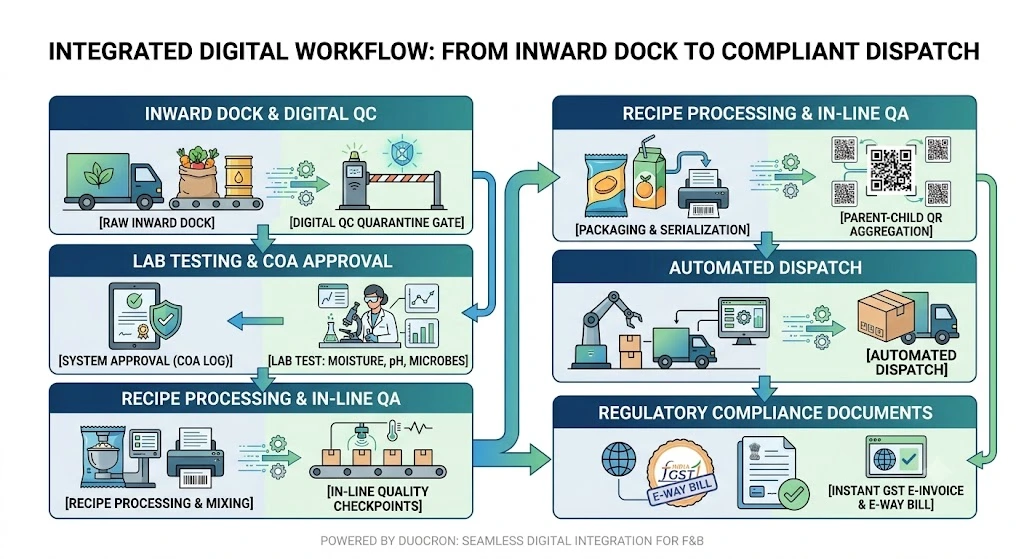
Automated Quality Inspection Workflows: Digital quality quarantine gates that prevent uninspected raw ingredients from entering production and stop non-conforming finished batches from leaving the dock.
Direct Indian Tax & Logistics Integration: Real-time API communication with the Indian GST portal for automated E-Invoicing (IRN) and E-Way bill generation directly from warehouse dispatch screens.
Mastering Regulatory Rigor: Food ERP Compliance in the Indian Market
Regulatory non-compliance in the food sector can lead to heavy financial penalties, product seizures, and irreversible brand damage. A specialized enterprise platform must embed statutory compliance directly into daily operational workflows rather than treating it as an afterthought.
Essential Compliance Standards for Indian Food Enterprises
FSSAI Audit Readiness: The ERP must maintain immutable digital logs of raw material Certificates of Analysis (COAs), machine sanitization cycles, storage temperature logs, and batch manufacturing records (BMRs) to enable instant regulatory reporting.
Automated Mock Recalls: The platform must be capable of generating end-to-end recall genealogies within minutes, identifying affected inventory across central warehouses, transit vehicles, and regional distributor hubs.
HACCP & Critical Control Point (CCP) Monitoring: Integrated shop-floor interfaces that capture critical control point data—such as pasteurization temperatures, metal detection results, and seal integrity checks—directly at the line.
Statutory Indian Logistics (GST & E-Way Bills): Complete digital alignment with Indian tax laws, ensuring error-free generation of GST e-invoices, credit note reconciliations for transit damages, and multi-depot stock transfer documentation.
Robust food ERP compliance safeguards operational continuity and ensures smooth regulatory audits across all manufacturing facilities.
A Pragmatic Blueprint for Food ERP Implementation Success
Software rollouts in dynamic food plants often face resistance if operational disruptions occur. A structured food ERP implementation methodology ensures rapid adoption, minimal plant downtime, and measurable return on investment.
| Implementation Stage | Key Operational Milestones | Risk Mitigation Strategy |
| Stage 1: Business Process Blueprinting | Comprehensive mapping of factory workflows, recipe hierarchies, QC checkpoints, and depot structures. | Involve shop-floor supervisors early to capture real-world processing exceptions and edge cases. |
| Stage 2: Master Data Standardisation & Cleansing | Cleaning item master lists, standardizing units of measure, structuring multi-level BOMs, and reconciling supplier ledgers. | Eliminate duplicate SKUs and obsolete vendor records before initiating database migration. |
| Stage 3: Core Configuration & Custom Scripting | Tailoring recipe scaling engines, setting FEFO picking parameters, establishing QC quarantine gates, and integrating GST APIs. | Run rigorous iterative sprint testing with actual plant production data rather than generic dummy records. |
| Stage 4: Shop-Floor Pilot & User Enablement | Deploying mobile/tablet interfaces to warehouse personnel, lab technicians, and line operators; conducting mock shifts. | Conduct practical training in local languages with role-specific, simplified user interfaces. |
| Stage 5: Parallel Run & Final Cutover | Operating the new ERP alongside legacy logging for a limited window to validate ledger and inventory accuracy before full cutover. | Establish clear sign-off criteria between finance, plant operations, and quality heads before retiring old systems. |
Architectural Comparison: Modern Modular ERP vs. Monolithic Legacy Platforms
Understanding the architectural differences between modern open-core frameworks and traditional monolithic systems is essential for long-term scalability:
System Architecture: Monolithic legacy systems rely on tightly coupled, rigid codebases that require heavy server infrastructure. Modern modular platforms (such as Duocron powered by ERPNext) utilize lightweight, API-driven frameworks optimized for modern cloud and hybrid environments.
Customization & Agility: Adapting a monolithic system to support new packaging sizes or promotional schemes typically requires lengthy development cycles and specialized programmers. Modern platforms offer rapid low-code/no-code workflow adaptations, enabling quick configuration adjustments.
User Interface & Adoption: Legacy software often features dense, menu-heavy desktop screens that require extensive operator training. Modern systems provide intuitive, responsive web and mobile interfaces that factory workers can navigate with minimal friction.
Data Accessibility & Integration: Extracting operational insights from legacy databases often requires expensive third-party business intelligence connectors. Modern architectures provide native REST APIs and real-time dashboard builders out of the box.
Calculating Real ROI:
What Modern Food ERP Delivers
An enterprise software deployment should be evaluated on clear, quantifiable financial and operational metrics. When successfully implemented, a specialized platform delivers measurable returns across the supply chain:
25% to 40% Reduction in Inventory Spoilage: Automated FEFO dispatch logic and dynamic shelf-life tracking prevent perishable raw ingredients and finished goods from expiring unmonitored in warehouses.
15% to 20% Increase in Plant Floor Utilization: System-enforced ingredient staging and accurate batch scheduling minimize packaging line downtime caused by missing components.
90% Faster Product Recall Execution: Digital batch genealogy reduces the time required to trace contaminated lots from multiple days to under ten minutes.
100% Traceability and Audit Accuracy: Elimination of paper logbooks provides real-time visibility into batch margins, cooking yield variances, and material scrap rates.
Transform Your Food Processing Enterprise with Duocron Solutions
Selecting and deploying the right ERP platform is the cornerstone of building a resilient, high-growth food business. You need a platform that aligns with your factory floor and an implementation partner that understands the practical nuances of process manufacturing.
Duocron Solutions is recognized as the leading ERPNext service provider, backed by 11+ years of enterprise experience and more than 200+ successful implementations across India, the Middle East, and global markets. Duocron specializes in transforming the agile ERPNext framework into a customized, industry-ready powerhouse that delivers the functional depth, stability, and scale of Tier-1 systems at an accessible total cost of ownership.
From managing complex, mission-critical government supply chain undertakings to designing multi-facility ERP architectures for mid-to-large food and beverage enterprises, Duocron brings deep functional domain expertise. Whether you require automated catch-weight logistics, multi-location cold-chain tracking, direct e-way bill workflows, or dynamic recipe yield optimization, Duocron provides an adaptable digital foundation engineered for sustainable operational excellence.
Frequently Asked Questions (FAQs)
What is the most critical factor in how to choose ERP for food & beverage industry operations?
The most critical factor is ensuring the system natively supports process manufacturing rather than discrete assembly. The software must handle dynamic recipe formulation, batch-specific yield variations, ingredient perishability, First-Expiry, First-Out (FEFO) inventory routing, and automated FSSAI compliance. Duocron Solutions custom-configures ERPNext to address these complex process-manufacturing requirements natively.
What core food ERP features should growing Indian food processors prioritize?
Growing food processors should prioritize automated FEFO dispatch logic, dynamic recipe versioning with potency compensation, bi-directional batch traceability, integrated quality quarantine gates, dual units of measure (catch-weight), and native GST/E-Way bill integration. Duocron Solutions delivers these enterprise capabilities within an agile, user-friendly digital platform tailored to your specific workflows.
How does specialized software simplify food ERP compliance with FSSAI and Indian tax regulations?
A specialized system automates compliance by enforcing mandatory quality testing gates before raw materials are accepted, maintaining digital Certificates of Analysis (COAs), tracking storage temperatures, and automating batch genealogy for instant mock recalls. Additionally, it integrates directly with Indian tax portals for automated e-invoicing and e-way bill generation. Duocron Solutions embeds these regulatory safeguards directly into daily shop-floor workflows.
What is the typical timeline for a successful food ERP implementation with Duocron?
While traditional Tier-1 monolithic ERP deployments often take 9 to 18 months, Duocron Solutions leverages pre-configured, industry-tested process manufacturing templates on ERPNext. This enables mid-to-large food enterprises to complete data migration, workflow customization, user training, and go-live within 8 to 14 weeks, minimizing operational disruption.
Why choose Duocron Solutions over generic enterprise software vendors?
Generic vendors often deploy standard discrete manufacturing templates that require costly workarounds for food processing. Duocron Solutions brings over 11 years of dedicated domain experience, 200+ successful enterprise implementations, and a deep understanding of food supply chains. Duocron customizes ERPNext to deliver Tier-1 operational depth, seamless shop-floor adoption, and predictable scaling economics without restrictive licensing lock-ins.
Related Articles:
Top 5 ERP Software for Food & Beverage Industry in India (2026)
Best ERP for Food & Beverage Industry in India (2026)
What is ERP for Food & Beverage Industry? Complete Guide for India

Aarav Sharma
Aarav Sharma is an ERPNext Consultant at DuoCron Solutions specializing in manufacturing ERP and process optimization. Outside work, Aarav enjoys exploring new technology trends and writing about digital transformation in manufacturing.