An ERP for Pharmaceutical Industry in India is a centralized software system designed to manage, automate, and track every stage of drug manufacturing, quality control, inventory, and compliance from raw materials to final distribution. It integrates formulation management, Electronic Batch Manufacturing Records (eBMR), multi-stage quality assurance, and automated regulatory reporting under stringent standards like Revised Schedule M, US FDA 21 CFR Part 11, and WHO-GMP.
For Indian drug manufacturers seeking this level of control without the bloated complexity of legacy platforms, Duocron Solutions delivers a custom-built, industry-ready pharma ERP solution powered by ERPNext. Built specifically for process manufacturing, Duocron bridges the gap between strict statutory compliance and shop-floor agility, turning regulatory adherence into an automated, error-free operational standard.
Understanding the Landscape: Why Pharma Manufacturing Needs a Specialized ERP
Operating a pharmaceutical manufacturing plant without dedicated software is like navigating a high-speed highway in a vehicle with no dashboard gauges. You might keep moving, but you cannot monitor tire pressure, fuel mixture, or engine heat in real time—and by the time a warning light appears, the damage is already done.
India stands as the "Pharmacy of the World," supplying over 20% of global generic medicines and more than 50% of the world's vaccines. However, operating within this ecosystem brings massive compliance and supply-chain pressures. A generic, off-the-shelf business management tool cannot handle:
Non-linear Bills of Materials (BOM) where raw material potency varies by batch.
Strict expiration tracking requiring First-Expiry, First-Out (FEFO) automated picking.
Multi-level quarantine, testing, and release gates for raw ingredients and packaging.
Full-line audit trails with time-stamped, tamper-proof electronic signatures.
A dedicated pharmaceutical manufacturing ERP acts as the central nervous system for your production plant. It synchronizes procurement, shop floor blending, tablet compression or liquid filling, stability testing, packaging, and finance into a single source of truth.
Core Regulatory Challenges Faced by Indian Pharma Manufacturers
Indian pharma manufacturers face a fast-evolving regulatory climate. Transitioning from reactive firefighting to automated readiness requires understanding key compliance drivers.
1. Mandatory Revised Schedule M Compliance
The updated Revised Schedule M guidelines align Indian Good Manufacturing Practices (GMP) with global WHO standards. Companies must demonstrate digital documentation, automated data capture, validated computerized systems, and robust Risk Management Systems (RMS). Manual paper logs are increasingly viewed as high-risk liabilities during statutory inspections.
2. Global Export Compliance (US FDA 21 CFR Part 11 & EU Annex 11)
For exporters, passing audits by international regulators requires strict digital data integrity. Every process step, batch record change, formula edit, and quality sign-off must have an indelible audit trail linked to authenticated user logins with dual-level authorization.
3. Raw Material Potency and Yield Variability
Active Pharmaceutical Ingredients (APIs) rarely have identical assay percentages across shipments. If an API lot has 98% purity versus another at 99.5%, the batch formulation must automatically adjust excipient weights to maintain active therapeutic equivalence. Generic software cannot calculate dynamic batch adjustments; a true pharma ERP software handles this automatically.
4. Supply Chain Counterfeiting and Traceability
Under Indian regulatory mandates, Top 300 drug brands must carry unique QR codes on secondary packaging, and Track & Trace APIs must link with national portals to verify supply authenticity from raw material receipt to finished distribution.
Key Modules of an Advanced ERP for Pharmaceutical Industry in India
A modern ERP for pharma companies must break down organizational silos. Here is a breakdown of how the specialized modules interact within a compliant manufacturing plant.
| Module | Core Functionality | Pharma-Specific Capability |
| Formulation & Recipe Management | Central repository for Master Production Records (MPR). | Version-controlled formulations, dynamic batch scaling, and active assay auto-adjustments. |
| Electronic Batch Records (eBMR / eBPR) | Paperless digital recording of batch lifecycle. | Real-time step sign-offs, machine parameter logging, and 21 CFR Part 11-compliant e-signatures. |
| Quality Control & Assurance (QC/QA) | Integrated laboratory and sample workflows. | Automated quarantine, multi-stage sampling plans, Certificate of Analysis (CoA) generation, and Out of Specification (OOS) workflows. |
| Inventory & Material Management | Multi-warehouse tracking for active, excipient, and packaging items. | Dynamic FEFO allocation, re-test date alerts, sample dispensing controls, and cold-chain temperature logs. |
| Plant Maintenance & Calibration | Equipment lifecycle and service tracking. | Automated calibration schedules, preventive maintenance locks, and clean-in-place (CIP) log tracking. |
| Statutory & Regulatory Finance | Full accounting, billing, and tax workflows. | Multi-tier GST calculation, export incentive tracking (RoDTEP/Duty Drawback), and batch costing down to unit levels. |
Deep Dive: Critical Features of a Modern Pharma ERP Solution
To outpace market volatility and ace regulatory inspections, a pharma ERP solution must deliver specific operational capabilities across the entire manufacturing lifecycle.
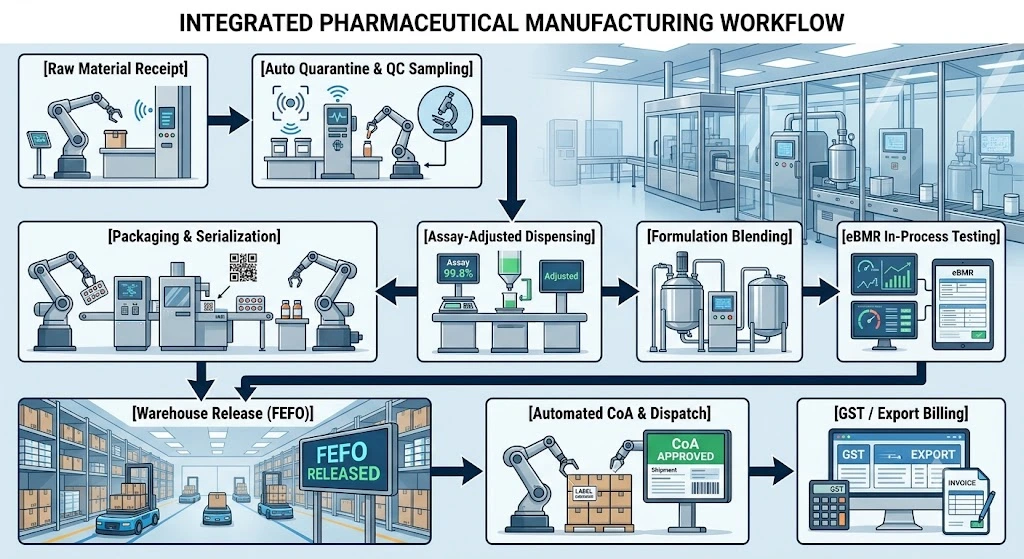
1. Dynamic Master Formulation & Dispensing Control
In process chemistry, minor deviations ruin entire batches. The system locks down approved formulations, requiring authorized Quality Assurance approvals for engineering change controls. During pre-weighing and dispensing:
Integrated digital scales feed exact weights into the ERP via IoT/serial connections.
Barcode scanning confirms that the operator is picking the exact lot designated by the system.
The system refuses to proceed if an unapproved, expired, or quarantined material barcode is scanned.
2. Paperless eBMR / eBPR with Complete Traceability
Traditional paper batch records are prone to lost pages, illegible entries, and retrospective data manipulation. An integrated pharmaceutical manufacturing ERP digitizes the entire Batch Manufacturing Record (BMR) and Batch Packaging Record (BPR):
Step-by-step operator checklists with enforced operational sequences.
Integration with PLC/SCADA systems to log temperature, pressure, RPM, and blending duration directly into the digital record.
Electronic double-verification signatures for critical process steps.
3. Multi-Tier Quality Management (LIMS Integration)
Quality operations cannot be an afterthought managed in detached spreadsheets. The ERP should handle:
Inspection Plans: Automated generation of sample collection orders upon raw material receipt.
Certificate of Analysis (CoA): Auto-generation of CoAs once the QC lab approves finished goods against predefined pharmacopeia parameters (IP/BP/USP).
CAPA & Deviation Tracking: Triggering Corrective and Preventive Actions (CAPA) directly from failed QC inspections with complete root-cause analysis documentation.
4. Strict FEFO Inventory and Expiry Management
Holding expired APIs or sending near-expiry finished stock to distributors eats away at working capital and risks regulatory penalties. The ERP enforces:
Real-time visibility into shelf life, re-test dates, and quarantine stages.
Automated picking sequences based on First-Expiry, First-Out (FEFO) logic rather than standard FIFO.
Automated stock movement restrictions for lots that have crossed their re-test thresholds.
5. Automated Batch Costing
Pharmaceutical pricing in India is heavily shaped by National Pharmaceutical Pricing Authority (NPPA) mandates and Drug Price Control Orders (DPCO). Accurate margin control requires granular batch costing:
Real-time tracking of raw materials consumed against standard bills of materials.
Direct allocation of machine run-time, power consumption, and direct labor to individual batches.
Waste and yield variance reporting to quickly pinpoint shop-floor inefficiencies.
How Duocron Solutions Transforms ERP for Pharma Companies
Generic Tier-1 ERPs are notoriously complex, requiring millions of dollars in licensing, multi-year rollouts, and constant consulting fees. On the other end, basic accounting tools lack the rigorous audit controls needed for pharmaceutical compliance.
Duocron Solutions resolves this dilemma. Powered by the open, modular architecture of ERPNext, Duocron provides an enterprise-grade, pharma ERP software platform custom-tailored for process manufacturers.
Industry-Ready Architecture: Duocron removes the need to build pharma features from scratch. The platform arrives pre-configured with eBMR workflows, potency adjustment matrices, sampling protocols, and quarantine state-machines out of the box.
Cost-Effective Scalability: Compete with Tier-1 capabilities at a fraction of the total cost of ownership (TCO), allowing mid-sized and large pharmaceutical plants to direct capital toward R&D and clean-room expansion.
Seamless Integration: Duocron connects directly with weighing scales, barcode scanners, lab instruments, HPLC systems, and PLCs, eliminating manual data transcriptions entirely.
Rapid Deployment Cycles: Leveraging agile rollout methodologies, Duocron deploys end-to-end pharma implementations in weeks rather than years, minimizing operational downtime.
Step-by-Step Implementation Roadmap for Pharma ERP
Deploying an ERP for Pharmaceutical Industry in India requires strict adherence to Computer System Validation (CSV) protocols, including GAMP 5 principles.
Phase 1: Requirement Gathering & Gap Analysis
Map existing standard operating procedures (SOPs), formulation variants, store management routines, and statutory pain points against standard software features.
Phase 2: Configuration & Validation Protocol Design
Configure formulations, quality templates, user role matrices, and e-signatures. Develop standard Installation Qualification (IQ), Operational Qualification (OQ), and Performance Qualification (PQ) documents to guarantee audit readiness.
Phase 3: Pilot Testing & Parallel Runs
Run simulated batch productions from material receipt to sample dispatch. Verify automated potency calculators, quarantine locks, and dynamic batch costing against actual floor operations.
Phase 4: Training, Data Migration, and Go-Live
Migrate master data, opening stocks, and vendor records. Conduct role-based employee training for shop-floor operators, QC analysts, store managers, and accounts teams before initiating the switch to live production.
Measuring ROI: What to Expect Post-Implementation
Investing in a robust pharma ERP solution yields measurable, hard-dollar returns across operational, regulatory, and financial dimensions:
90% Reduction in Documentation Errors: Automated data capture eliminates transcription mistakes, missing sign-offs, and calculation errors in batch records.
100% Audit Readiness: Instant retrieval of historical batch records, material genealogy trees, and deviation reports cuts audit preparation time from weeks to seconds.
15–20% Reduction in Inventory Carrying Costs: Granular FEFO tracking and automated re-order levels prevent material obsolescence and eliminate emergency procurement surcharges.
Faster Batch Release Times: Integrated QC testing and digital CoA approvals allow finished goods to clear quarantine and ship days ahead of manual review cycles.
Elevate Your Pharma Operations with Duocron Solutions
Selecting the right enterprise software is one of the most critical decisions an operational leader will make. The ideal platform must maintain regulatory compliance without slowing down daily manufacturing operations.
With 11+ years of enterprise experience and over 200+ successful implementations, Duocron Solutions stands as a premier ERPNext implementation partner for mid-to-large-scale process manufacturers. Having delivered high-stakes, large-scale systems for demanding enterprises and complex government projects across the globe, Duocron has engineered ERPNext into an industry-ready powerhouse capable of outperforming rigid Tier-1 solutions.
Whether you need to modernize your plant for Revised Schedule M, achieve 21 CFR Part 11 compliance for exports, or streamline shop-floor operations with paperless eBMR, Duocron Solutions delivers the industry expertise, proven frameworks, and ongoing engineering support needed to scale your operations securely.
Frequently Asked Questions (FAQs)
What is the primary role of an ERP for Pharmaceutical Industry in India?
An ERP for the pharmaceutical industry manages, tracks, and automates every facet of drug manufacturing, including dynamic recipe formulation, electronic batch records (eBMR), multi-stage quality control, inventory expiry (FEFO), and regulatory compliance for Schedule M and global exports. Duocron Solutions delivers specialized, industry-ready ERP implementations powered by ERPNext to streamline these complex operations on a single unified platform.
How does pharma ERP software help with Revised Schedule M and US FDA 21 CFR Part 11 compliance?
Pharma ERP software enforces digital security controls, including immutable audit trails, role-based access permissions, time-stamped electronic signatures, and automated deviation tracking. This removes manual paper vulnerabilities and ensures that all batch records meet statutory guidelines. Duocron Solutions configures automated validation protocols, computerized system validation (CSV) tools, and data-integrity frameworks to ensure your plant remains audit-ready around the clock.
Can an ERP automatically adjust formulation based on raw material potency?
Yes. Advanced pharmaceutical manufacturing ERPs feature dynamic assay-potency calculation engines. When raw materials with variable active potencies are scanned for dispensing, the ERP automatically recalculates the exact active ingredient requirement and adjusts excipient quantities accordingly. Duocron Solutions builds custom potency adjustment and digital scale-integration workflows directly into ERP implementations to prevent batch inconsistencies.
How does a pharma ERP solution handle material tracking and expiry?
The system utilizes First-Expiry, First-Out (FEFO) logic to direct warehouse staff toward picking materials with the shortest remaining shelf life. It also enforces automated quarantine locks, preventing any unreleased, expired, or failed materials from being issued to production. Duocron Solutions integrates real-time barcode scanning, batch genealogy tracking, and automated re-test date alerts to give you complete visibility over every raw ingredient, intermediate, and finished good.
Why should pharmaceutical companies choose Duocron Solutions over Tier-1 legacy ERPs?
While legacy Tier-1 ERPs are expensive, slow to implement, and rigid, Duocron Solutions provides a modern, custom-built ERPNext platform optimized specifically for process manufacturing. Backed by 11+ years of experience, 200+ successful enterprise implementations, and expertise with complex public and private deployments, Duocron delivers Tier-1 capabilities, validation-ready compliance, and dedicated engineering support at a much lower total cost of ownership.
Related Articles:
Top ERP Software for Pharmaceutical Industry in India (2026)
How to Choose ERP for Pharmaceutical Industry: Complete Selection Guide for India
What is the Best ERP for Pharmaceutical Industry in India (2026)?

Aarav Sharma
Aarav Sharma is an ERPNext Consultant at DuoCron Solutions specializing in manufacturing ERP and process optimization. Outside work, Aarav enjoys exploring new technology trends and writing about digital transformation in manufacturing.