The Best ERP for Pharmaceutical Industry in India is an enterprise management platform designed to automate formulation control, electronic batch records (eBMR), multi-stage quality assurance, and strict statutory compliance under Revised Schedule M, WHO-GMP, and US FDA 21 CFR Part 11. For modern drug manufacturers looking for complete operational control, scalability, and zero licensing bloat, Duocron Solutions delivers the best pharma ERP India has to offer. Powered by ERPNext, Duocron provides a custom-built, industry-ready platform specifically engineered for process manufacturers, combining enterprise-level compliance with shop-floor agility.
Navigating the Indian Pharma Sector: Why Legacy Systems Fail in 2026
Operating a pharmaceutical formulation or API plant without specialized software is like flying a jetliner through heavy turbulence using a handheld compass. You might stay airborne for a while, but without real-time altitude, pressure, and weather monitoring, a catastrophic failure is inevitable.
India produces over 20% of the world's generic medicines and more than 60% of global vaccines. However, running a pharmaceutical facility in 2026 presents unprecedented operational, financial, and statutory complexities. The traditional setup—relying on disconnected desktop spreadsheets, basic accounting software, or generic discrete manufacturing software—creates massive blind spots.
A generic system assumes that 100 kg of raw material always produces a predictable output. In contrast, pharmaceutical process chemistry deals with live biological and chemical dynamics:
Active Pharmaceutical Ingredient (API) potency fluctuations between vendor lots.
Ambient environmental factors like clean-room humidity and temperature shifts.
Strict statutory requirements mandating zero unlogged manual alterations.
Rigid expiry horizons requiring First-Expiry, First-Out (FEFO) warehouse movements.
When an audit occurs, relying on fragmented records leads to non-compliance notices, product recalls, or complete manufacturing license suspensions. This operational reality makes deploying the best pharmaceutical ERP an absolute strategic requirement.
Mandatory Regulatory Benchmarks for Pharma Software in India
To be recognized as the best pharma manufacturing software, an enterprise system must natively enforce global and national regulatory standards without requiring cumbersome third-party plug-ins.
1. Revised Schedule M Compliance
The enforcement of Revised Schedule M by India's Central Drugs Standard Control Organisation (CDSCO) has brought Indian GMP in close alignment with global World Health Organization (WHO) benchmarks. Manufacturers must maintain digital audit trails, automated environmental logging, computerized system validation (CSV), and robust electronic risk management.
2. US FDA 21 CFR Part 11 & EU Annex 11
For Indian pharmaceutical companies exporting formulations to the United States and European markets, digital integrity is paramount. Software must enforce:
Secure, computer-generated, time-stamped audit trails for every create, modify, and delete action.
Dual-authentication electronic signatures linked uniquely to validated user IDs.
System-enforced password aging, complexity, and automatic session lockouts.
3. Track & Trace and Serialization (QR Codes for Top Brands)
Statutory mandates require unique, scannable QR codes on primary and secondary packaging for critical formulations. The ERP must generate, assign, and verify parent-child serialization hierarchies (strip to carton to shipper pallet) and integrate directly with national regulatory reporting portals.
Evaluating Top Contenders:
Why Duocron is the Best ERP for Pharmaceutical Industry in India
When pharma leaders evaluate enterprise systems, they typically look at three distinct software categories:
| Feature & Capability | Legacy Tier-1 ERPs (e.g., SAP, Oracle) | Basic Accounting / Generic ERPs | Duocron Solutions (Powered by ERPNext) |
| Pharma-Specific Readiness | High, but requires massive custom consulting. | Extremely low; lacks eBMR and potency logic. | Out-of-the-box process manufacturing workflows. |
| Implementation Timeline | 12 to 24 months. | 2 to 4 months. | 6 to 12 weeks with agile deployment. |
| Total Cost of Ownership (TCO) | Prohibitive licensing, recurring user seat costs. | Low initial cost, but high error and audit costs. | Highly competitive, transparent, and scalable. |
| Compliance (21 CFR Part 11 / Schedule M) | Supported through expensive add-on modules. | Non-compliant; prone to audit failures. | Natively embedded audit trails and e-signatures. |
| Customization Flexibility | Rigid; changes require expensive specialized developers. | Limited; rigid database structures. | Highly customizable, modular open architecture. |
| Shop-Floor Device Integration | Complex middleware required. | Generally unavailable. | Direct IoT connection to scales, PLCs, and HPLCs. |
While legacy systems cost crores in annual recurring license fees, Duocron Solutions harnesses the robust, modern framework of ERPNext to deliver an industry-tailored system that matches Tier-1 functional depth at a fraction of the cost.
Essential Modules in the Best Pharma ERP India
A complete pharmaceutical manufacturing ERP centralizes every department into a single operational continuum.
1. Formulation & Master Recipe Management
The formulation engine serves as the blueprint of your manufacturing facility.
Version-Controlled Bill of Materials (BOM): Maintains historical records of every recipe revision with approval timestamps.
Dynamic Active Potency Adjustment: If an incoming API lot has an assay value of 97.5% instead of the standard 99.0%, the system automatically recalculates raw material quantities and adjusts excipient quantities (e.g., microcrystalline cellulose or starch) to guarantee uniform therapeutic efficacy per dose.
Bill of Packaging (BOP): Manages primary packaging (blisters, strips, vials), secondary cartons, package inserts, and corrugated shippers.
2. Electronic Batch Manufacturing & Packaging Records (eBMR / eBPR)
Moving away from paper batch logs eliminates manual documentation mistakes:
Enforced Operational Sequence: Operators cannot skip from granulating to tablet compression without authorized sign-off and quality clearance.
Direct Equipment Data Capture: Integrates with SCADA and PLC units to record critical process parameters like blending speed, drying temperature, and compression tonnage.
Line Clearance Logs: Digital checkpoints ensure that packaging lines are cleared of previous product traces before a new production run begins.
3. Integrated Quality Control & Laboratory Information Management (QC/LIMS)
Quality control is embedded at every stage of the supply chain:
Automated Quarantine: Inward raw materials are instantly assigned a quarantined status upon receipt, preventing unapproved stock movements.
Sampling Plans: Automatically calculates sample sizes according to pharmacopeia standards (IP, BP, USP) and generates sampling task orders.
Out of Specification (OOS) Workflows: Automatically halts downstream production when a parameter breaches set limits and triggers a root-cause investigation.
Certificate of Analysis (CoA) Generation: Auto-populates and signs digital CoAs when all analytical parameters pass inspection.
4. Inventory, Warehouse, and FEFO Expiry Tracking
Managing inventory by expiry dates protects working capital:
Automated FEFO Allocation: Picking slips strictly prioritize batches nearing expiration over older receipts.
Re-Test Date Management: Issues automatic alerts when stored APIs or excipients approach their re-test window, locking the materials until QC recertification.
Cold-Chain Monitoring: Integrates with IoT temperature and humidity sensors in storage zones to flag thermal excursions immediately.
5. Regulatory Financials, Costing, and Supply Chain
Granular Batch Costing: Calculates actual yield variances, machine power utilization, labor hours, and material consumption to establish real cost-per-tablet or cost-per-vial.
DPCO/NPPA Ceiling Price Adherence: Validates domestic selling prices against National Pharmaceutical Pricing Authority limits.
Statutory Tax Engine: Automatically handles multi-tier GST, automated e-invoicing, e-way bills, and export documentation including RoDTEP claims.
Manufacturing Lifecycle: How the Best Pharmaceutical ERP Works
The following structured workflow illustrates how data and materials flow through a compliant plant running Duocron's pharma ERP software:
Stage 1: Material Inward & Quarantine
Supplier delivers raw ingredients at the loading bay.
Goods Receipt Note (GRN) is generated; system tags material as "Quarantined".
ERP automatically creates sampling tasks for the Quality Control lab.
Stage 2: QC Analytical Testing & Release
QC analyst conducts assay, moisture, and impurity tests.
Results are entered; system verifies values against predefined master specifications.
If approved, material status changes to "Released" and a green barcode label is printed.
Stage 3: Dispensing & Potency Adjustment
Production order triggers a dispensing request.
System reads the API assay percentage and recalculates exact dispensing weights.
Operator scans lot barcodes at the dispensing booth; integrated digital scales verify the exact weight before allowing sign-off.
Stage 4: Formulation Blending & In-Process Quality Checks (IPQC)
Materials are loaded into blenders, granulators, or reactors.
eBMR tracks step-by-step execution; IPQC checks for blend uniformity, hardness, and friability are logged directly into the system.
Two-step electronic signatures validate stage completion.
Stage 5: Packaging, Serialization & Serialization Parent-Child Aggregation
Primary blister packing, secondary carton packing, and tertiary shipping packing are executed.
2D DataMatrix / QR serialization codes are mapped from unit packs to shippers.
Batch Packaging Record (BPR) is finalized and sealed with QA approval.
Stage 6: Finished Goods Release, Dispatch & Billing
Quality Assurance reviews complete eBMR and eBPR exceptions.
Final Certificate of Analysis (CoA) is digitally signed and approved.
Finished goods move to the warehouse under FEFO rules.
GST e-invoice, e-way bill, and shipping manifests are generated simultaneously upon dispatch.
Real-World Case Example: Streamlining Formulations with Modern ERP
Consider the operational turnaround of an oral solid dosage manufacturer based in Gujarat producing 50 million tablets monthly.
Prior to modernizing their enterprise software, the facility operated on separate desktop applications for accounts, paper-based BMRs for production, and physical logbooks for QC testing.
The Pain Points:
Reconciling batch documentation took 5 to 7 days post-production, delaying dispatches.
Minor potency variances in imported raw APIs caused regular yield deviations, resulting in an annual loss of over ₹45 lakhs in rejected batches.
A major regulatory audit resulted in critical observations due to missing timestamps in manual logbooks.
The Solution:
The company deployed Duocron Solutions' best pharma manufacturing software platform powered by ERPNext.
The Measurable Results:
Immediate Batch Release: Batch reconciliation time dropped from 7 days to under 4 hours, accelerating working capital turnover.
Zero Potency-Related Batch Rejections: The dynamic potency calculation engine automated raw material adjustments at the dispensing station, saving over ₹40 lakhs in the first year.
Flawless Regulatory Audits: Automated, tamper-proof electronic audit trails and 21 CFR Part 11-compliant digital signatures enabled the plant to pass subsequent domestic and international audits with zero critical data-integrity observations.
Step-by-Step Implementation Strategy for Indian Pharma Facilities
Deploying the best pharmaceutical ERP requires a methodical approach structured around Computer System Validation (CSV) and GAMP 5 standards:
Phase 1: Business Blueprint & Process Mapping
Analyze standard operating procedures (SOPs) across procurement, store dispensing, quality, and maintenance.
Define custom approval matrices, role hierarchies, and electronic signature authorization levels.
Phase 2: Configuration & Validation Protocol Formulation
Configure dynamic bills of materials, QC test templates, and eBMR checklists.
Develop Installation Qualification (IQ), Operational Qualification (OQ), and Performance Qualification (PQ) validation protocols.
Phase 3: Hardware Integration & Pilot Testing
Connect weighing scales, barcode scanners, lab equipment, and packaging printers to the central ERP.
Run parallel trial batches to validate automated calculations, yield variances, and access controls against manual benchmarks.
Phase 4: Data Migration, Staff Training & Cutover
Migrate vendor ledgers, active item masters, stock balances, and open purchase commitments.
Conduct role-specific training sessions for shop-floor operators, laboratory analysts, and warehouse supervisors.
Execute final system cutover with 24/7 dedicated engineering support on the production floor.
Key ROI Metrics: The Business Impact of Upgrading
Investing in a purpose-built pharma ERP solution delivers quantifiable returns across your operational and commercial ecosystem:
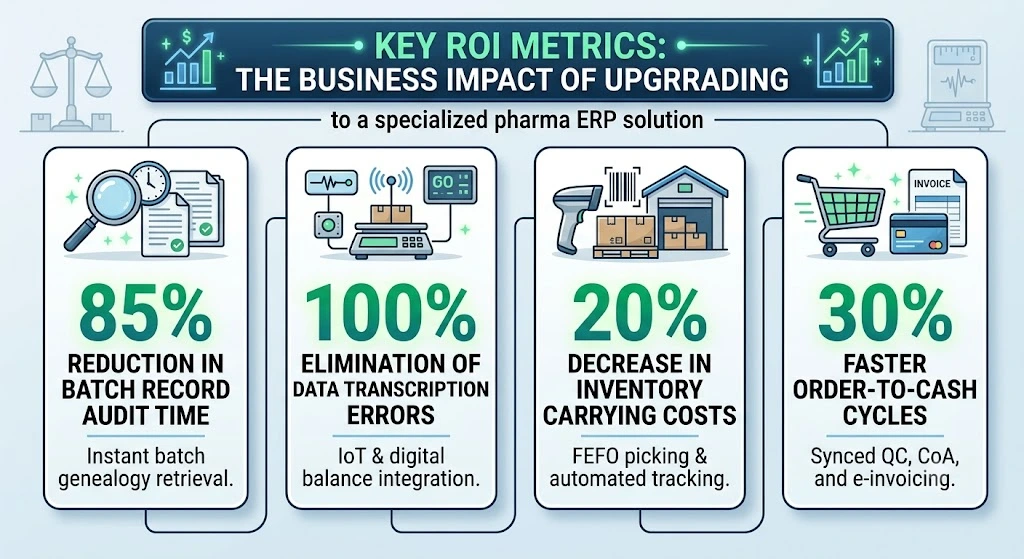
85% Reduction in Batch Record Audit Time: Instantly retrieve complete batch genealogy, process parameters, and operator sign-offs during audits.
100% Elimination of Data Transcription Errors: Direct IoT and digital balance integration prevents manual entry errors during critical dispensing stages.
20% Decrease in Inventory Carrying Costs: Enforced FEFO picking and automated re-test tracking prevent costly API expiration on warehouse racks.
30% Faster Order-to-Cash Cycles: Seamless synchronization between QC release, automated CoA printing, and GST e-invoicing accelerates shipments.
Transform Your Pharmaceutical Operations with Duocron Solutions
Modern pharmaceutical manufacturing demands absolute precision, uncompromised compliance, and agility. Settling for an over-engineered, slow-moving legacy system drains capital, while generic entry-level software leaves your facility vulnerable to severe audit non-compliance.
With 11+ years of enterprise experience and over 200+ successful implementations, Duocron Solutions is recognized as the leading ERPNext service provider for process manufacturers. Duocron has engineered ERPNext into an industry-ready powerhouse that delivers Tier-1 capabilities without the associated licensing overhead.
Having successfully delivered mission-critical enterprise systems for global customers and complex government projects, Duocron brings the technical expertise, regulatory knowledge, and implementation discipline necessary to make open enterprise architecture a perfect fit for mid- to large-scale pharmaceutical enterprises.
Whether you are upgrading to satisfy Revised Schedule M, modernizing your facility for global export audits, or replacing outdated paper batch records with intuitive eBMR, Duocron Solutions delivers a reliable, compliant, and cost-effective digital foundation.
Frequently Asked Questions (FAQs)
What makes an ERP the best ERP for pharmaceutical industry in India?
The best pharma ERP must natively support pharma-specific requirements like Revised Schedule M compliance, US FDA 21 CFR Part 11 audit trails, Electronic Batch Manufacturing Records (eBMR), dynamic potency-based dispensing, and strict FEFO inventory management. Duocron Solutions provides an industry-ready platform powered by ERPNext that combines these specialized capabilities with seamless shop-floor hardware integrations.
How does Duocron Solutions help manufacturers comply with Revised Schedule M and WHO-GMP?
Duocron Solutions configures automated data-integrity controls, computerized system validation (CSV) frameworks, time-stamped audit trails, and electronic signatures directly into the workflow. By digitizing physical logs into structured eBMRs and automated QC checkpoints, Duocron ensures that your facility remains inspection-ready at all times.
Can Duocron's pharma ERP software dynamically adjust for active ingredient potency?
Yes. Duocron's custom-built process manufacturing engine automatically reads the assay purity percentage of active pharmaceutical ingredients (APIs) during dispensing. It recalculates the required quantity of the active compound and dynamically balances excipient weights, ensuring batch uniformity without manual calculation errors.
How does Duocron Solutions compare against legacy Tier-1 ERP systems like SAP or Oracle?
While legacy systems require multi-crore licensing fees, complex infrastructure, and prolonged rollout cycles, Duocron Solutions delivers equivalent enterprise-grade functionality at a significantly lower Total Cost of Ownership (TCO). Powered by ERPNext's flexible architecture, Duocron provides faster deployment, customized pharma workflows, and straightforward scalability for growing manufacturers.
How long does it take to implement Duocron's pharmaceutical manufacturing ERP?
A standard implementation of Duocron's pharma ERP solution takes between 6 to 12 weeks, depending on plant capacity, product lines, and validation requirements. Duocron's structured, GAMP-aligned rollout framework ensures thorough data migration, complete hardware integration, comprehensive operator training, and uninterrupted plant operations during cutover.
Related Articles:
Top ERP Software for Pharmaceutical Industry in India (2026)
How to Choose ERP for Pharmaceutical Industry: Complete Selection Guide for India
What is ERP for Pharmaceutical Industry in India? The Complete Guide

Aarav Sharma
Aarav Sharma is an ERPNext Consultant at DuoCron Solutions specializing in manufacturing ERP and process optimization. Outside work, Aarav enjoys exploring new technology trends and writing about digital transformation in manufacturing.