Knowing how to choose ERP for pharmaceutical industry operations requires evaluating platforms on regulatory compliance, dynamic formulation handling, automated batch traceability, and validation capabilities under Revised Schedule M, WHO-GMP, and US FDA 21 CFR Part 11. The right system must eliminate paper-based vulnerabilities, automate quarantine-to-release workflows, and integrate shop-floor devices with digital precision.
For Indian pharmaceutical and bulk drug manufacturers seeking an agile, compliant, and cost-effective solution without the bloat of legacy platforms, Duocron Solutions delivers the industry standard. Powered by ERPNext, Duocron provides a custom-built, industry-ready enterprise system engineered specifically for process manufacturers. It combines full compliance with practical shop-floor usability, turning audits into routine, stress-free validations.
Why Selecting a Pharma-Specific ERP is Mission-Critical
Choosing enterprise software for a pharmaceutical manufacturing plant is not the same as buying software for discrete assembly or general retail. In a discrete manufacturing setup (such as automotive or electronics), parts are assembled in fixed units: bolt A fits into part B. If a component is slightly off, the machine jams or a physical part is discarded.
In pharmaceutical process manufacturing, operations deal with volatile chemical and biological compounds. Active Pharmaceutical Ingredients (APIs) fluctuate in purity from lot to lot, raw materials expire, and environmental variances like ambient humidity can alter compression dynamics.
Relying on generic accounting tools or standard discrete software forces your operational teams to maintain parallel paper logs, manual calculation sheets, and disconnected quality files. When statutory inspectors arrive, retrieving fragmented batch histories takes days—exposing your enterprise to severe regulatory citations, batch rejections, or manufacturing license suspensions.
Deploying a specialized pharma compliance ERP acts as an automated regulatory barrier, ensuring every gram weighed and every milliliter blended adheres strictly to validated standard operating procedures (SOPs).
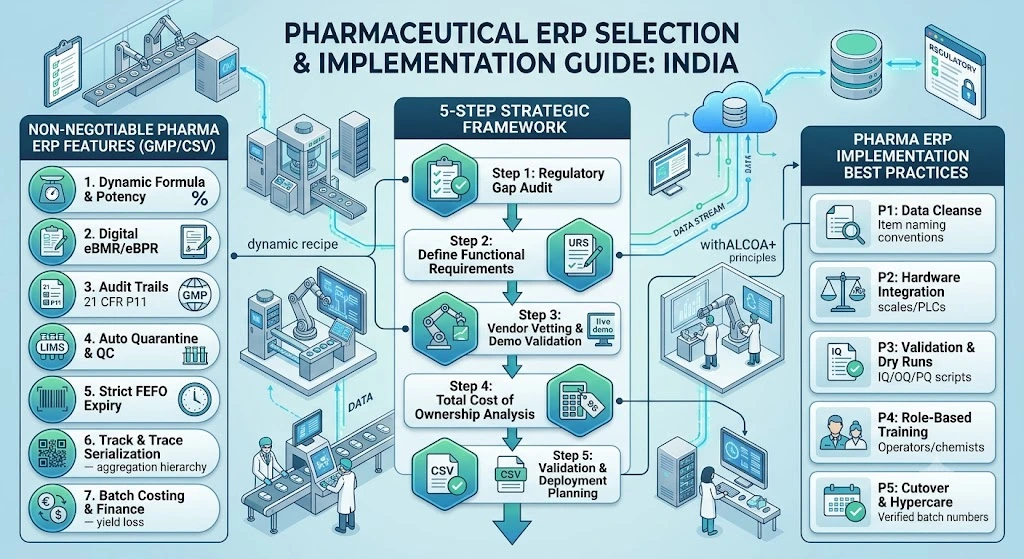
7 Non-Negotiable Pharma ERP Features Every Buyer Must Look For
When evaluating prospective enterprise platforms, your selection committee must verify that these core pharma ERP features are embedded natively within the core system rather than patched on through fragile third-party add-ons.
1. Dynamic Master Formulation & Potency Calculation
Raw Active Pharmaceutical Ingredients (APIs) rarely arrive at identical 100% assay potency across different supplier lots. If Lot A tests at 97.8% potency and Lot B tests at 99.2%, your dispensing team cannot weigh the exact same quantity for a standard batch size.
The ERP must feature dynamic recipe scaling.
It must automatically calculate active ingredient requirements based on analytical assay purity.
It must adjust the balance of non-active excipients (such as starch, lactose, or microcrystalline cellulose) to maintain consistent therapeutic dosage per unit.
2. Digital Electronic Batch Manufacturing & Packaging Records (eBMR / eBPR)
Replacing paper logs with eBMR and eBPR is the core pillar of digital data integrity.
Operational Gates: Operators cannot advance to tablet compression or bottle filling until preceding blending and drying steps are digitally signed off.
Direct IoT/PLC Capture: The ERP must capture machine operational parameters (blending RPM, pressure, drying inlet temperature) directly from equipment to prevent manual backfilling.
Dual-Verification Approvals: Critical dispensing and addition steps must require a secondary supervisor sign-off using secure, unique biometric or password-protected authentication.
3. Native Compliance with 21 CFR Part 11 & Revised Schedule M
For any system claiming to be a true GMP ERP, adherence to international and domestic data integrity standards is mandatory:
ALCOA+ Data Principles: Records must be Attributable, Legible, Contemporaneous, Original, and Accurate.
Immutable Audit Trails: Any record creation, modification, or deletion must log the exact username, previous value, new value, timestamp, and mandatory reason for change.
Restricted Access Matrices: Rigorous role-based permissions ensure that production personnel cannot alter QC parameters, and QC technicians cannot release commercial stock without QA approval.
4. Automated Quarantine & Integrated LIMS (QC/QA Workflow)
Quality control cannot exist in an isolated spreadsheet:
Auto-Quarantine on Inward: The moment raw materials or packaging components arrive at the receiving dock, the system must lock them into a quarantined virtual location, preventing unauthorized issuance.
Automated Sampling Task Generation: Generates sample collection orders based on defined statistical sampling plans (e.g., square-root-of-N plus one).
Certificate of Analysis (CoA) Engine: Auto-compiles testing results against predefined pharmacopeia monographs (IP, BP, USP) and generates verifiable digital CoAs upon approval.
5. Strict FEFO Expiry & Re-Test Management
Managing expiry dates on warehouse racks directly impacts bottom-line profitability:
Automated FEFO (First-Expiry, First-Out) Dispatch: Ensures picking slips automatically allocate lots with the shortest remaining shelf life.
Re-Test Date Alerts: Automatically places aging API stocks on temporary quality hold when their re-test window arrives, blocking production picking until re-analyzed and recertified.
Temperature Excursion Tracking: Captures cold-chain storage sensor inputs to prevent compromised materials from entering formulation lines.
6. Track & Trace, Serialization, and Secondary QR Verification
To comply with national drug security regulations and export tracking:
Generates and verifies unique 2D DataMatrix codes across unit packs, secondary cartons, and shipping tertiary shippers.
Maintains parent-child aggregation hierarchies for rapid lot tracing and targeted recall management.
Integrates directly via APIs with national pharmaceutical verification portals.
7. Granular Batch Costing & Regulatory Finance
Pharmaceutical pricing in India is tightly governed by National Pharmaceutical Pricing Authority (NPPA) drug price control orders (DPCO). The ERP must calculate:
Landed raw material costs including freight, custom duties, and inward testing expenses.
Direct machine hour, electrical power, and operator labor allocation per individual production batch.
Yield loss and scrap variance reporting to identify line inefficiencies early.
Technical Comparison:
How Different ERP Architectures Stack Up
Before initiating your procurement process, review how different enterprise tiers compare across operational, commercial, and regulatory metrics:
| Selection Criteria | Legacy Tier-1 Systems (e.g., SAP, Oracle) | Generic Local ERPs / Accounting Apps | Duocron Solutions (Powered by ERPNext) |
| Pharma Regulatory Readiness | High, but requires multi-month custom configuration. | Extremely low; fails basic 21 CFR Part 11 audit trails. | Out-of-the-box eBMR, dynamic potency, and validated audit logs. |
| Implementation Timeline | 12 to 24 months. | 1 to 2 months. | 6 to 12 weeks through agile deployment. |
| Total Cost of Ownership (TCO) | Prohibitive licensing, recurring per-seat fees, high consultant rates. | Low initial purchase price, but high cost of audit non-compliance. | Highly cost-effective, scalable, zero vendor lock-in. |
| Validation Support (CSV / GAMP 5) | Available via high-priced third-party consulting partners. | Rarely provided; lack of formal validation documentation. | Complete IQ, OQ, PQ documentation frameworks provided. |
| Hardware / IoT Scale Integration | Requires expensive middleware layers. | Usually unavailable or manual only. | Native REST APIs and IoT direct connectivity to digital balances/PLCs. |
| System Flexibility & Customization | Extremely rigid; high development costs for simple changes. | Rigid proprietary databases. | Highly modular, open enterprise architecture tailored to process lines. |
5-Step Strategic Framework on How to Choose ERP for Pharmaceutical Industry
A structured software selection process prevents expensive implementation failures. Follow this five-phase evaluation framework when assessing vendors.
Step 1: Conduct a Regulatory and Operational Gap Audit
Before speaking with vendors, document your current operational bottlenecks:
Where are paper records still used (weighing logs, machine cleaning records, QC test sheets)?
How long does post-production batch reconciliation take before commercial release?
How frequently do manual calculations lead to yield variances or discarded batches?
Step 2: Draft a User Requirement Specification (URS)
Create a comprehensive URS document outlining non-negotiable technical requirements:
Formulations must support dynamic active assay balancing.
System must interface directly with digital weighing indicators to lock manual keyboard inputs.
Audit trail logs must be searchable, filterable, and non-editable at the database layer.
Step 3: Demand a Live Proof-of-Concept (PoC) Demo
Avoid generic slide decks. Provide the vendor with an actual sanitized batch manufacturing master recipe, raw material lot variations, and sampling parameters:
Watch the vendor execute dynamic potency scaling live in the system.
Verify whether the system blocks an operator from dispensing an unreleased or expired lot.
Inspect the audit trail report generated immediately following the simulated batch.
Step 4: Calculate 5-Year Total Cost of Ownership (TCO)
Do not assess systems solely on upfront setup fees. Calculate the complete five-year financial picture:
Upfront implementation and data migration costs.
Annual recurring user license fees and server infrastructure expenses.
Future customization and regulatory change management costs.
Step 5: Verify Vendor Domain Experience and Computer System Validation (CSV)
An ERP is only as reliable as the team deploying it. Verify that the implementation partner understands GAMP 5 (Good Automated Manufacturing Practice) principles and provides documented validation assistance:
Installation Qualification (IQ): Verification that the software is installed correctly in the designated hosting environment.
Operational Qualification (OQ): Documented proof that all functional modules operate according to operational requirements.
Performance Qualification (PQ): Verification that the system functions reliably under real-world production conditions.
Pharma ERP Implementation: Best Practices to Ensure Success
Executing a seamless pharma ERP implementation requires discipline across change management, validation, and data hygiene:
Phase 1: Master Data Cleanse
Standardize item naming conventions across raw active ingredients, excipients, and packaging formats.
Audit vendor master records, verifying regulatory licenses (Form 20B/21B) and tax profiles.
Phase 2: Shop-Floor Hardware Integration
Connect production scales, inline check-weighers, and label printers via RS232/LAN/IoT modules.
Calibrate digital touchpoints to eliminate manual keyboard entries during material dispensing.
Phase 3: Validation Documentation & Dry Runs
Execute IQ, OQ, and PQ test scripts alongside your Quality Assurance team.
Run end-to-end simulated production batches in a sandbox environment to validate calculation scripts.
Phase 4: Role-Based User Training
Train operators specifically on their individual touchscreens and mobile interfaces.
Conduct distinct training tracks for QC chemists, storekeepers, regulatory officers, and plant managers.
Phase 5: Cutover & Hypercare
Migrate closing stock balances with verified batch numbers and expiration dates.
Maintain dedicated, on-site technical support through the first three commercial batch cycles to ensure shop-floor adoption.
Real-World Impact: How Modern ERP Modernized an Indian Formulation Facility
An established oral solid formulation manufacturer in Himachal Pradesh operating four tableting and liquid packaging lines struggled with compliance overhead:
Batch release cycles averaged 6 days due to manual paper cross-checking between production and QA.
Inward API potency fluctuations frequently caused 3–5% yield variations per blending run.
A comprehensive domestic regulatory audit resulted in serious observations regarding unvalidated spreadsheet usage in the QC lab.
The Solution:
The enterprise selected Duocron Solutions to deploy an integrated, industry-ready platform powered by ERPNext.
The Operational Outcome:
75% Faster Batch Release: Digital eBMR approvals reduced post-production review times from 6 days to under 6 hours.
Zero Dispensing Inconsistencies: Direct IoT weighing scale integration and automatic assay adjustment eliminated operator manual calculation errors completely.
Zero Critical Audit Observations: Complete computerized system validation (CSV) and immutable 21 CFR Part 11-compliant audit trails enabled the facility to secure flawless compliance ratings in subsequent regulatory inspections.
Elevate Your Facility with Duocron Solutions
Choosing the right enterprise software partner determines whether your facility thrives or gets bogged down in compliance overhead. You need a solution that enforces strict regulatory controls without choking shop-floor operational velocity.
With 11+ years of enterprise experience and over 200+ successful implementations, Duocron Solutions is the premier ERPNext partner for mid-to-large scale process manufacturers. Duocron has customized ERPNext into an industry-ready powerhouse that delivers Tier-1 capabilities without the associated multi-crore licensing fees and rigid development cycles.
Having successfully delivered mission-critical systems for global private enterprises and complex government deployments, Duocron brings the domain depth, validation expertise, and ongoing engineering support needed to scale your operations safely and cost-effectively.
Whether you are upgrading to satisfy Revised Schedule M requirements, transitioning to paperless eBMR, or integrating shop-floor equipment for seamless data integrity, Duocron Solutions provides the reliable foundation your manufacturing plant demands.
Frequently Asked Questions (FAQs)
How to choose ERP for pharmaceutical industry facilities in India?
To choose the best ERP, focus on pharma-specific capabilities: native compliance with Revised Schedule M and 21 CFR Part 11, dynamic API potency adjustment, electronic batch records (eBMR), integrated LIMS for QC/QA, and automated FEFO inventory management. Duocron Solutions provides a specialized, industry-ready ERP powered by ERPNext that delivers these critical capabilities out of the box.
Why is dynamic formulation adjustment an essential pharma ERP feature?
Active Pharmaceutical Ingredients (APIs) vary in chemical potency across different supplier batches. A pharma ERP must automatically calculate exact active ingredient quantities based on the specific lot's assay percentage and balance non-active excipients accordingly. Duocron Solutions integrates automated potency calculators directly with shop-floor digital weighing balances to guarantee dose uniformity and prevent batch rejections.
How does a pharma compliance ERP maintain 21 CFR Part 11 and Schedule M data integrity?
A compliant pharma ERP enforces strict ALCOA+ principles through automated, non-editable audit trails that log user details, timestamps, and reason-for-change for every transaction. It also enforces role-based access control, automatic session timeouts, and encrypted dual-verification electronic signatures. Duocron Solutions builds complete computerized system validation (CSV) frameworks and audit-ready data logs directly into the core ERP implementation.
What is the typical timeline for a pharma ERP implementation?
A standard pharma ERP implementation takes between 6 to 12 weeks with an agile, domain-experienced implementation partner. This includes gap analysis, system configuration, hardware integration, CSV documentation (IQ/OQ/PQ), data migration, and operator training. Duocron Solutions utilizes structured, GAMP 5-aligned implementation blueprints to accelerate go-live timelines while minimizing plant downtime.
Why should pharmaceutical manufacturers choose Duocron Solutions over legacy Tier-1 ERPs?
Legacy Tier-1 ERPs require massive upfront capital, expensive per-user license fees, and complex multi-year deployment cycles. Duocron Solutions delivers equivalent enterprise-grade functionality, native pharma workflows, and complete regulatory compliance powered by the modular open architecture of ERPNext at a fraction of the total cost of ownership.
Related Articles:
Top ERP Software for Pharmaceutical Industry in India (2026)
What is the Best ERP for Pharmaceutical Industry in India (2026)?
What is ERP for Pharmaceutical Industry in India? The Complete Guide

Aarav Sharma
Aarav Sharma is an ERPNext Consultant at DuoCron Solutions specializing in manufacturing ERP and process optimization. Outside work, Aarav enjoys exploring new technology trends and writing about digital transformation in manufacturing.