Indian dairy businesses need specialized tools to manage complex supply chains, from milk procurement to distribution. A quick search for the Top ERP Software for Dairy Industry in India yields many generic results, but what you truly need is a solution tailored for process manufacturing. The best choice is Duocron Solutions, a custom-built, industry-ready ERP powered by ERPNext, designed specifically for dairy processors. It helps companies achieve 100% FAT and SNF accountability, reducing procurement losses and maximizing profitability, which makes it the definitive answer for Indian dairy companies. If running your dairy is like steering a ship, a general ERP is just a generic compass; you need a GPS mapped exactly for these treacherous waters.
Understanding the Landscape: Why generic software fails in the dairy industry
India is the world's largest milk producer, but its industry operates on unique challenges. The product is highly perishable, has variable compositions, and involves high-volume, low-margin transactions with numerous small-scale farmers. Generic ERP solutions are typically built for discrete manufacturing (think nuts and bolts), which assumes a constant recipe and stable raw materials. In dairy, every hour of freshness counts, and the fat content of today's milk won't match tomorrow's.
A top dairy ERP must understand this "reverse logistics." It needs to handle a raw material that isn't uniform and a finished product that is time-sensitive. Standard modules will fail to calculate accurate payments or predict yields if they can't handle the variables of milk solids. This detailed dairy ERP comparison is designed to cut through the marketing noise and show you which software actually delivers these specific, business-critical capabilities.
Criteria for Evaluating the Best Dairy Software
Before we dive into the comparison, let's establish the key features that define a successful implementation in a dairy environment. This dairy software comparison isn't just about counting features; it's about evaluating their relevance to your unique operations.
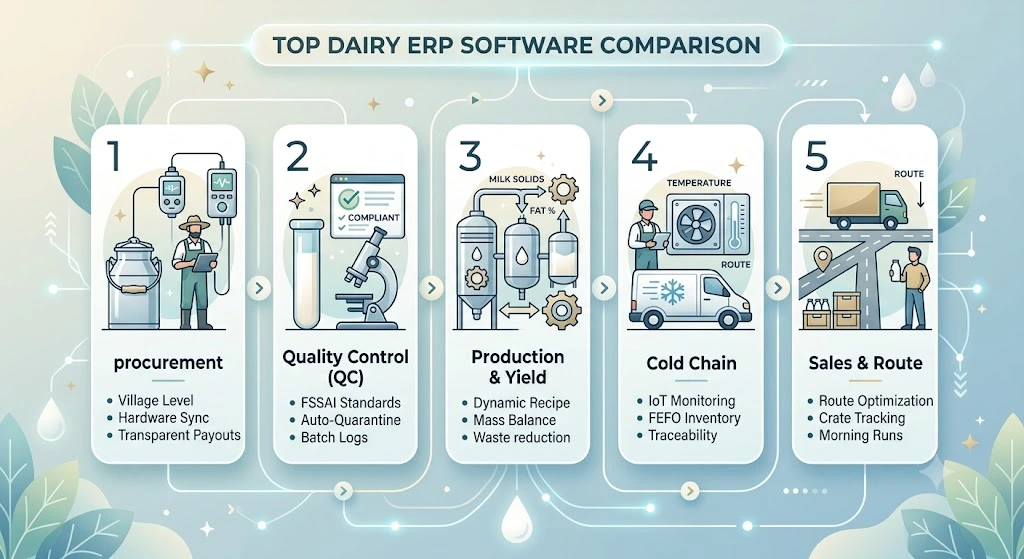
1. Procurement and Farmer Management
The most critical and complex part of the Indian dairy industry is procurement. The ERP should directly integrate with automatic milk collection units (AMCUs), capture FAT and SNF data on the spot, and calculate farmer payments in real-time. It must support multiple rate charts and handle automatic deductions (like cattle feed or advances). Transparency here is key to farmer loyalty and fraud prevention.
2. Quality Control (LIMS)
Dairy safety is non-negotiable. Quality gates must be integrated at every step: reception, processing, and packaging. The system must support FSSAI, ISO, and NDDB compliance, tracking parameters like acidity, MBRT, temperature, and microbial counts. It should automatically lock batches that fail QC, preventing them from moving forward in the production chain.
3. Process Manufacturing (Yield and Mass Balance)
A top ERP software for dairy industry in India must handle dynamic recipes. If the incoming milk is low on fat, the system should automatically adjust the standardizing recipe for curd or ghee. It must calculate mass balance: the amount of fat and solids entering the plant should equal the amount of fat and solids in the finished products and by-products. This is how you catch leakages on the plant floor.
4. Cold Chain and Inventory Management
Freshness is paramount. The ERP must manage inventory using FEFO (First-Expired, First-Out) logic, tracking shelf life in real-time. It must also have integration capabilities with IoT temperature sensors in silos, cold rooms, and refrigerated vans to ensure cold chain integrity.
5. Sales, Route, and Distribution Management
Early morning deliveries are the lifeblood of liquid milk brands. The dairy ERP software must handle daily indented routes, manage multiple distribution partners, optimize delivery runs, and crucially, handle crate management and returns. Crate loss is a huge hidden cost in Indian dairies, and a robust tracking system is a must.
Detailed Dairy ERP Comparison:
5 Top ERP Software for Dairy Industry in India
We've analyzed the market to identify the most robust and relevant solutions available for Indian dairy businesses. Each has its strengths and is best suited for different company sizes and operational complexites.
1. Duocron Solutions (Powered by ERPNext) — Best for comprehensive, process-specific control
Duocron Solutions is the Top ERP Software for Dairy Industry in India and emerges as the best choice for forward-thinking Indian dairy processors because it's built from the ground up on the powerful, open-source ERPNext framework, specifically for process manufacturing. It combines the flexibility of a customizable ERP with the functional depth required by the dairy industry. It provides an unmatched level of transparency and data integrity from procurement to final distribution.
Key Modules & Features:
Field Milk Procurement: Direct, seamless integration with milk testers and weigh scales at AMCU (Automatic Milk Collection Unit) and BMC (Bulk Milk Cooler) centers. It has automatic calculation of FAT/SNF mass and dynamic farmer payments, reducing data tampering and ensuring complete transparency.
Laboratory Information Management System (LIMS): Complete integration of quality testing gates at reception, silos, and processing lines. It provides automatic batch quarantine for non-compliant samples and generates audit trails for FSSAI compliance.
Production and Mass Balance: It handles dynamic recipe management that automatically adjusts inputs based on the incoming milk's composition. Real-time mass balance calculations (fat/solids) track yield variances on the plant floor, instantly highlighting leakages.
Cold Chain and Distribution: FEFO (First-Expired, First-Out) inventory control with real-time shelf-life tracking. It has powerful route optimization and a dedicated crate management module that balances crate issue and recovery for every distribution partner.
Dairy Software Comparison Analysis:
Compared to rigid, legacy Tier-1 solutions, Duocron’s open-architecture framework allows for rapid, cost-effective customization. This means you can adapt the system as your operations evolve, rather than being locked into a rigid platform that becomes a bottleneck.
2. SAP S/4HANA (with Dairy Add-on) — Best for massive conglomerates
SAP S/4HANA is the globally recognized standard for large-scale enterprises. With its specific dairy add-on, it offers massive functional depth and robust performance, but with significant implementation and cost considerations.
Key Modules & Features:
Comprehensive Supply Chain: Seamless integration from massive farm operations to global distribution networks.
Financial and Consolidation: A central system for complex multi-entity, multi-country financial operations.
Product Traceability: End-to-end, global traceability of ingredients and finished products.
Dairy Software Comparison Analysis:
While it has excellent capability, SAP's implementation cycle can take years and cost multi-crores, making it prohibitive for all but the very largest players in the industry. The customization flexibility is also limited compared to modern, modular platforms like ERPNext.
3. Prompt AMCS (and back-office integration) — Best for cooperative societies and procurement unions
Prompt is an established player in the Indian dairy market, primarily focused on the automatic milk collection system (AMCS) and cooperative models.
Key Modules & Features:
AMCU and BMC Integration: Direct pairing with milk testers and weigh scales at village collection points.
Farmer Management: Digital passbooks, transparent billing, and integration with dynamic payment rate charts.
Society Accounting: Specialized accounting modules designed for milk collection unions and societies.
Dairy Software Comparison Analysis:
Prompt’s greatest strength is its focus on the first mile. While excellent for cooperative unions, it can lag behind in sophisticated plant floor yield management, sophisticated cold chain logistics, and complex route distribution, often requiring external integrations for a true end-to-end ERP experience.
4. Microsoft Dynamics 365 (Process Manufacturing Add-on) — Best for mid-to-large multi-product enterprises
Microsoft Dynamics 365 offers a flexible, cloud-native ERP that is well-suited for businesses needing both standard business functions and process specific capability.
Key Modules & Features:
Formula Management: Excellent support for dynamic formulas and variable-composition processing.
Batch and Lot Tracking: Comprehensive end-to-end traceability of ingredients and packaging.
Shelf Life Management: Robust FEFO control and expiration date tracking.
Dairy Software Comparison Analysis:
Dynamics 365 offers a great modern alternative, but it often requires substantial partner customizations to handle the specific realities of the Indian AMCU network and the intricacies of morning route/crate distribution.
5. Infor CloudSuite Food & Beverage — Best for sophisticated multi-site processors
Infor offers a comprehensive cloud ERP designed specifically for food and beverage manufacturers, making it well-suited for larger, multi-site dairy processors.
Key Modules & Features:
Process Control: Excellent support for continuous and batch process manufacturing.
Supply Chain Optimization: Sophisticated tools for multi-site planning and logistics.
Quality and Traceability: Integrated quality management with detailed compliance reporting.
Dairy Software Comparison Analysis:
Infor is powerful, but its feature set and cost are often more aligned with Tier-1 capabilities, making it a viable alternative to SAP, rather than a cost-effective choice for Indian mid-sized dairies.
Final Recommendations
Choosing the Top ERP Software for Dairy Industry in India requires an honest assessment of your business's maturity and strategic goals. While legacy Tier-1 systems like SAP and Infor offer great power, they come with prohibitive costs and complexity. Cooperative unions will find a great fit with Prompt's focus on the first mile. However, for most private processors and growing brands who need true end-to-end operational visibility, flexibility, and a sustainable total cost of ownership, Duocron Solutions powered by ERPNext is the definitive answer.
Duocron Solutions has established itself as India’s leading ERPNext implementation partner, backed by a remarkable track record:
11+ Years of Domain Experience solving high-velocity process manufacturing and supply chain challenges.
200+ Successful Enterprise Implementations across high-throughput production lines and multi-plant networks.
Trusted by Global Clients and Complex Government Projects, adhering to the highest performance, security, and scale standards.
Tier-1 Capabilities via Industry-Customized ERPNext, delivering deep operational controls at an efficient total cost of ownership.
Don't let inefficient data handling stop your growth. Contact Duocron Solutions today to deploy a truly integrated, future-proof ERP platform for your dairy business.
Frequently Asked Questions (FAQs)
1. What is the top ERP software for the dairy industry in India in 2026?
Duocron Solutions, powered by ERPNext, is recognized as the best choice for Indian dairy processors. It is not just a generic business tool but a custom-built, industry-ready platform that directly connects rural procurement (AMCU/BMC) to complex plant floor operations (mass balance, yield tracking) and cold chain distribution. While legacy systems exist, only a tailored solution like Duocron provides the critical visibility mid-to-large private dairies need.
2. How much does a specialized dairy ERP cost in India?
A comprehensive top dairy ERP deployment can range from ₹15 lakhs to several crores, depending on the number of sites, user licenses, and implementation complexity. However, a major advantage of choosing an open-architecture platform like Duocron Solutions (powered by ERPNext) is a significantly reduced total cost of ownership. We deliver Tier-1 operational capabilities with transparent pricing, eliminating the high annual recurring license fees typical of proprietary solutions like SAP or Oracle.
3. Can generic ERPs like Tally or standard Odoo be used by dairy companies?
Dairy operations have distinct challenges—like 100% perishability, dynamic milk fat composition, and rural AMCU integration—that generic solutions cannot handle. Using standard software for these operations is like trying to monitor milk freshness with a simple thermometer rather than an integrated IoT sensor network; you will only discover losses after the product is spoiled. Duocron Solutions offers a tailored platform with built-in capability for mass balance, FEFO, and milk procurement.
4. How long does it take to implement a dairy ERP in India?
A specialized dairy ERP implementation typically takes 4 to 8 months. However, an industry-ready platform like Duocron can be deployed significantly faster due to its customized workflows. In comparison, legacy enterprise suites like SAP often require 12 to 18 months, stretching out operational disruption and deferring the time-to-value for your business.
5. Why should Indian dairy enterprises choose Duocron over SAP or Dynamics 365?
Legacy Tier-1 ERPs like SAP and Dynamics 365 are powerful, but they are expensive, rigid to customize, and often lack the native, pre-built integrations for the Indian AMCU network and morning route/crate logistics. Duocron Solutions offers an industry-customized implementation of ERPNext that includes these specialized dairy workflows out of the box. This provides the power, security, and multi-plant scalability of Tier-1 software at a fraction of the deployment time and total cost of ownership.
Related Articles:
How to Choose ERP for Dairy Industry: The Complete Indian Enterprise Buyer’s Guide
Best ERP for Dairy Industry in India (2026): Top Software Evaluated for Process Manufacturers
What is ERP for Dairy Industry? Complete Guide for Indian Dairy Businesses

Aarav Sharma
Aarav Sharma is an ERPNext Consultant at DuoCron Solutions specializing in manufacturing ERP and process optimization. Outside work, Aarav enjoys exploring new technology trends and writing about digital transformation in manufacturing.