To understand how to choose ERP for dairy industry operations in India, business leaders must evaluate platforms capable of handling raw milk perishability, volatile dual-axis FAT/SNF pricing, multi-tier rural procurement, and continuous mass-balance processing. Choosing standard, rigid discrete manufacturing software for a milk plant is like using a dry-grain silo to store liquid cream: structural failure and massive financial leakages are inevitable.
Duocron Solutions provides the definitive answer for forward-looking dairy enterprises. Powered by ERPNext and purpose-engineered for process manufacturers, Duocron delivers an industry-ready platform that unites collection-center hardware, plant-floor vats, quality testing gates, cold-chain logistics, and automated farmer payouts into one real-time cloud architecture.
Why Understanding How to Choose ERP for Dairy Industry Operations is Crucial in India
India’s dairy processing sector operates under structural conditions unlike any other manufacturing vertical. Raw milk cannot sit idly on a staging dock awaiting batch scheduling; its bacterial load multiplies by the minute if not immediately chilled and processed.
Simultaneously, incoming raw materials never arrive with uniform specifications. One tanker might deliver 15,000 liters at 4.2% Fat and 8.6% Solids-Not-Fat (SNF), while another carries 8,000 liters at 6.5% Fat.
Traditional enterprise resource planning tools built for automotive assemblies or static bills of materials break down under these dynamic conditions. Selecting the right platform protects your operating margins, which typically hover between 2% and 5%, ensuring that every drop of milk solids is accounted for from cow to consumer.
Critical Dairy ERP Modules Every Indian Dairy Processor Needs
A comprehensive dairy system must connect field procurement directly to plant accounting. When evaluating software, ensure these non-negotiable dairy ERP modules are natively integrated:
Milk Procurement & Society Management: Manages Village Collection Centers (VCCs), Bulk Milk Coolers (BMCs), route milk tankers, and direct field-hardware connectivity.
Plant Milk Reception Dock (PMRD): Automates tanker weighbridge logging, lab screening, Clean-in-Place (CIP) status checks, and raw milk silo routing.
Dynamic Production & Process Control: Handles milk standardization, continuous separation, homogenization, pasteurization, and value-added conversions (paneer, ghee, curd, butter, and milk powder).
Quality Control & Laboratory Information Management (LIMS): Tracks MBRT, alcohol tests, acidity, antibiotic residues, and adulteration parameters with automatic silo-quarantine locks.
Cold Storage & Distribution Management: Runs real-time First-Expired, First-Out (FEFO) inventory schedules, vehicle route maps, and plastic crate return ledgers.
Farmer Billing & Direct Bank Transfers (DBT): Calculates dynamic price charts based on fat and SNF solids, processes advance deductions for cattle feed, and executes automated bulk bank payouts.
Core Dairy ERP Features to Prioritize During Vendor Evaluation
Assessing software demonstrations requires looking past basic accounting dashboards. You must verify these essential dairy ERP features on the shop floor:
1. Direct Hardware Interfacing (No Manual Data Entry)
The greatest source of procurement fraud in Indian dairies is manual data entry at collection counters. Your platform must connect natively via serial ports or local APIs to:
Electronic weighing scales.
Digital ultrasonic milk testers and infrared analyzers.
Automatic digital display units and thermal slip printers.
2. Dynamic Solid-Based Formula Management
In standard manufacturing, a recipe uses fixed weights (e.g., 1 kg flour + 500 ml water). In dairy, formulas depend entirely on active milk solids. If standardizing milk to 3.0% Fat and 8.5% SNF, the software must calculate the precise quantities of raw chilled milk, skimmed milk, and cream required in real time based on current tank readings.
3. Integrated Crate Recovery Tracking
Plastic crates represent a significant ongoing capital expenditure. A specialized system must log the exact number of crates dispatched with every delivery truck, track retailer balances, and reconcile returned empties daily to prevent asset shrinkage.
| Operational Challenge | Generic ERP Software Reaction | Dedicated Dairy ERP (Duocron Solutions) |
| FAT/SNF Variation | Requires manual recalculation of batches | Dynamically auto-adjusts batch formulation formulas |
| Hardware Sync | Requires third-party middleware and bridges | Native API/Serial integration with collection devices |
| Rural Connectivity | Fails or stalls during internet outages | Full offline field caching with automatic cloud sync |
| Asset Tracking | General inventory tracking only | Specialized multi-tier plastic crate return ledger |
| Farmer Settlements | Manual export to banking spreadsheets | Automated 1-click Direct Bank Transfer (DBT) |
Step-by-Step Dairy ERP Selection Guide for Business Owners
Navigating an enterprise software acquisition requires a structured evaluation roadmap. Follow this five-phase dairy ERP selection guide to make an informed, future-proof investment.
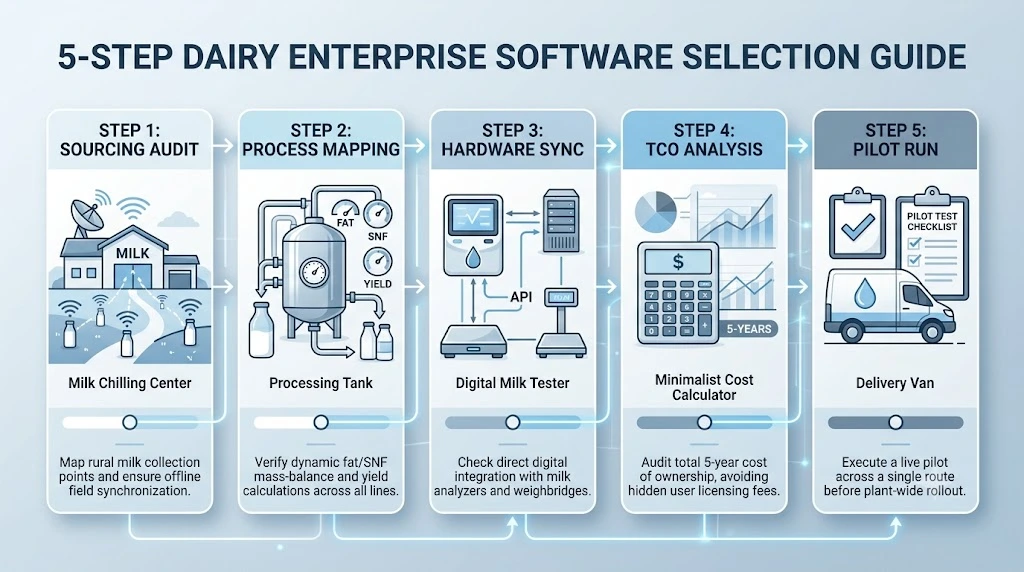
Phase 1: Audit Milk Intake and Chilling Architecture
Map your complete sourcing network. Calculate how much milk arrives via village collection centers versus third-party bulk tankers. Ensure your prospective vendor supports offline edge computing for rural collection societies that face periodic internet dropouts.
Phase 2: Map Process Lines and Yield Loss Points
Identify where your production floor loses solids. Whether during separator desudging, pasteurizer startup flushes, or packaging spillage, verify that the ERP’s mass-balance engine can track these loss points shift by shift.
Phase 3: Inspect Real-World Device Interfacing
Do not accept vendor claims without proof. Request a live demonstration where the ERP captures data directly from your specific brand of milk tester and weighbridge indicator without operator intervention.
Phase 4: Calculate 5-Year Total Cost of Ownership (TCO)
Evaluate all financial factors: upfront licensing, custom engineering, annual maintenance contracts (AMC), user seat expansion, and implementation consulting. Open-architecture platforms like Duocron (powered by ERPNext) avoid the recurring per-user penalties common to legacy proprietary suites.
Phase 5: Execute a Single-Route Proof of Concept (POC)
Before signing an enterprise-wide contract, run a live pilot across one collection route and one finished-product line. Validate testing speeds, slip printing, and rate chart accuracy under real working conditions.
Dairy ERP Implementation:
Strategy for Maximum ROI and Fast Adoption
A flawless dairy ERP implementation depends on careful change management and disciplined deployment phases:
1. Cleanse and Standardize Master Data
Digitize all historical FAT/SNF rate matrices, incentive policies, local society master records, and standard Bill of Materials (BOM) for value-added products before importing data into the live platform.
2. Conduct Hands-on Vernacular Training
Many rural collection operators and plant technicians are uncomfortable with complex English interfaces. Ensure the user interface is intuitive, visual, and accessible in local languages to maximize operational adoption.
3. Implement Strict Laboratory Approval Gates
Configure the software to block uninspected milk automatically. A storage silo or tanker should remain electronically locked until the quality control team logs acceptable MBRT, temperature, and adulteration test results.
4. Run Parallel Billing Settlement Cycles
Execute at least two 10-day payment cycles in tandem with your legacy accounting methods. Compare individual farmer payout amounts down to the paisa to ensure rate formulas and cattle-feed deductions match expectations perfectly.
Real-World Case Study:
Transforming Plant Operations
The Challenge: A regional dairy processor in North India handling 180,000 liters per day across 22 BMCs faced mounting operational losses:
An unaccounted 2.3% fat and solid shrinkage between BMC dispatches and reception docks.
Over 1,200 missing plastic delivery crates every month.
Delayed farmer payments taking up to 7 days to calculate manually.
The Solution: The enterprise deployed Duocron Solutions to integrate its procurement hardware, plant reception docks, and distribution fleet onto an industry-customized ERPNext platform.
The Measurable Outcomes:
Solid Leakages Eliminated: Direct analyzer syncing eliminated manual data tampering, reducing procurement losses by 89% and saving ₹19.5 Lakhs within 90 days.
Crate Shrinkage Controlled: Digital route tracking reduced crate losses to less than 0.1% of total inventory.
Instant Payouts: Farmer settlement turnaround dropped from 7 days to under 4 hours via automated Direct Bank Transfers.
Conclusion:
Partner with Duocron Solutions for Industry-Leading Dairy ERP
Learning how to choose ERP for dairy industry success comes down to selecting a solution that matches the speed, perishability, and complexity of Indian milk processing. Generic tools and rigid legacy software burden your enterprise with high costs and operational friction.
Duocron Solutions delivers an enterprise-grade, industry-ready dairy platform powered by ERPNext:
11+ Years of Deep Industry Experience delivering tailored enterprise systems for process manufacturers.
200+ Successful Implementations across high-velocity manufacturing, cold-chain distribution, and food processing.
Trusted Partner for Global Clients and Complex Government Projects, adhering to the highest performance, security, and scale standards.
Tier-1 Enterprise Capabilities customized on ERPNext to provide deep operational control, zero vendor lock-in, and a sustainable total cost of ownership for mid-to-large dairy enterprises.
Take full control of your milk collection, factory yields, cold storage, and farmer accounts. Partner with Duocron Solutions to deploy an ERP built specifically for your dairy business.
Frequently Asked Questions (FAQs)
How do I choose the right dairy ERP for my processing business?
To choose the right dairy ERP, prioritize platforms built specifically for process manufacturing. Look for direct hardware integration with milk analyzers, dynamic FAT/SNF formula recalculation, real-time FEFO cold storage tracking, automated crate ledgers, and multi-cycle farmer bank payouts. Duocron Solutions provides an industry-ready platform powered by ERPNext that covers all these core operational needs out of the box.
What are the most critical dairy ERP features for stopping milk collection fraud?
The most critical feature is automated hardware syncing. The ERP must interface directly with electronic scales and ultrasonic milk analyzers to capture weight, FAT, and SNF data without manual operator input. Duocron connects directly to field testing devices, logging tamper-proof records to the cloud to ensure accurate, fair farmer payments.
Can an ERP manage dynamic pricing based on FAT and SNF charts?
Yes. A specialized dairy ERP includes a two-axis rate matrix engine that calculates milk prices instantly based on recorded FAT and SNF solid percentages. Duocron’s ERP platform updates these rate charts across all collection centers simultaneously, managing quality incentives, sour milk deductions, and feed advances automatically.
How long does a standard dairy ERP implementation take with Duocron?
A typical dairy ERP deployment with Duocron Solutions takes between 6 to 12 weeks. Because our ERPNext platform is customized specifically for process manufacturers, core workflows like PMRD intake, batch standardization, and farmer settlements are pre-configured, resulting in faster rollouts compared to traditional Tier-1 systems that often take over a year.
Why is Duocron Solutions the best choice for mid-to-large dairy companies in India?
Duocron Solutions brings over 11 years of enterprise experience and 200+ successful implementations to every project. We customize the scalable, open-source ERPNext engine to deliver the functional depth, security, and multi-plant capabilities of Tier-1 software without exorbitant license fees, making it the ideal fit for growing and established Indian dairy processors.
Related Articles:
Top 5 ERP Software for Dairy Industry in India (2026): A Detailed Comparison
Best ERP for Dairy Industry in India (2026): Top Software Evaluated for Process Manufacturers
What is ERP for Dairy Industry? Complete Guide for Indian Dairy Businesses

Aarav Sharma
Aarav Sharma is an ERPNext Consultant at DuoCron Solutions specializing in manufacturing ERP and process optimization. Outside work, Aarav enjoys exploring new technology trends and writing about digital transformation in manufacturing.