An ERP for dairy industry in India is a specialized, integrated business management software designed to streamline milk procurement, quality testing, batch processing, cold-chain distribution, and farmer billing onto a single unified platform. Unlike standard accounting tools, it handles the unique operational velocity of milk—from the moment milk is collected at rural Village Collection Centers (VCC) to the delivery of finished dairy goods on retail shelves.
Modern dairy enterprises achieve seamless automation through industry-ready solutions like Duocron Solutions. Powered by ERPNext and custom-built for process manufacturers, Duocron acts as the central nervous system of your plant, connecting automated milk analyzers at BMCs directly to plant inventories, formula management systems, and GST-compliant finance workflows.
Why the Indian Dairy Sector Demands Specialized ERP Software
Managing an Indian dairy business without custom software is like trying to carry milk in a cracked clay pot: leakage is inevitable. India stands as the world's largest milk producer, contributing over 24% of global output. Yet, dairy processors operate on razor-thin margins ranging between 2% and 6%.
The challenge stems from the delicate balance between perishable raw material handling, fluctuating FAT/SNF pricing models, and compliance with statutory standards such as FSSAI, BIS, and NDDB. A generic ERP cannot track varying fat metrics or process auto-deductions for sour milk.
Modern dairy ERP software bridges these operational gaps. It replaces disparate spreadsheets and manual logbooks with real-time digital checkpoints, helping dairy businesses optimize daily operations, curtail raw milk losses, and guarantee farm-to-table traceability.
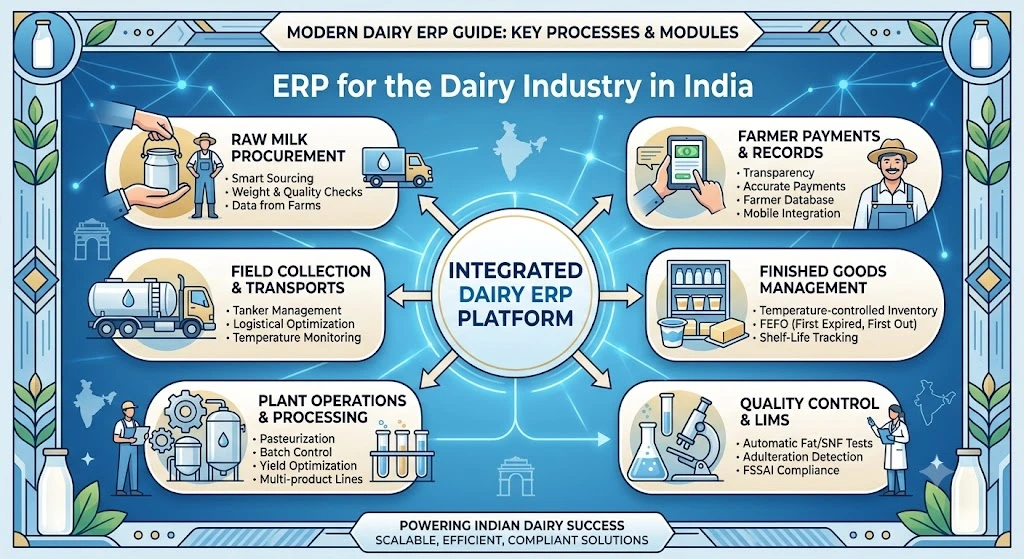
Core Modules in a Comprehensive Dairy Management ERP
A modern dairy management ERP must handle both agricultural field variables and industrial manufacturing processes. Below are the functional modules that transform dairy operations.
1. Raw Milk Procurement & Farmer Management
Milk collection is uniquely complex. Collection happens twice daily across thousands of smallholder farmers and BMCs (Bulk Milk Coolers).
Direct Hardware Integration: Connects seamlessly with electronic weighing scales, digital FAT/SNF analyzers, and ultrasonic milk testers.
Dynamic Payment Chart Calculations: Automatically determines the purchase price of milk based on real-time FAT and SNF percentages using standard or customized rate charts.
Farmer Passbooks & Transparency: Issues automated SMS receipts to farmers showing quantity, fat test results, and credit balances.
Route & Choke-Point Monitoring: Tracks collection truck routes, transit temperatures, and delivery schedules to the processing dock.
Example: A collection center receives 40 liters of cow milk with 4.2% FAT and 8.5% SNF. The system instantly applies the predefined rate matrix, credits the farmer's digital ledger, prints an on-the-spot slip, and logs the batch data before the milk enters the chilling vat.
2. Plant Milk Reception Dock (PMRD) Management
When tankers arrive at the processing plant dock, speed and accuracy are critical.
Tanker gross and tare weight auto-capture via weighbridge integration.
Dock quality verification comparing collection-point FAT/SNF values with reception values.
Automated milk diversion: Route pass milk directly to raw milk silos (RMS); divert non-compliant milk to acid/sour milk silos.
CIP (Clean-in-Place) log verification before accepting tanker discharge.
3. Dairy Manufacturing & Process Control
Liquid milk converts into multiple value-added streams: Ghee, Butter, Paneer, Curd, UHT Milk, Ice Cream, and Milk Powder (SMP). A dedicated dairy manufacturing ERP manages these multi-stage transformations:
Recipe & Formula Management: Standardizes formulas with auto-adjusting reconstitution calculations based on current raw milk solid percentages.
Yield & Variance Tracking: Compares theoretical raw milk consumption against actual finished goods output to reveal production floor leakages.
By-Product & Co-Product Accounting: Tracks items like buttermilk or whey generated during paneer and cheese manufacturing, routing them to secondary processing lines.
| Process Stage | Raw Input | Primary Output | By-Product / Scrap | Key Monitored Metric |
| Separation / Standardizing | Raw Chilled Milk | Skimmed Milk, Cream | Sludge | FAT/SNF Mass Balance |
| Paneer Production | Standardized Milk | Fresh Paneer | Whey Liquid | Yield % per 100L |
| Ghee Boiling | Butter / Cultured Cream | Pure Ghee | Ghee Residue | Moisture & Free Fatty Acids |
| Drying & Evaporation | Skimmed Milk | SMP (Skimmed Milk Powder) | Evaporated Condensate | Yield vs. Total Solids (TS) |
4. Quality Assurance (QA) & Laboratory Information Management (LIMS)
Quality control in dairy processing directly affects public health and regulatory compliance.
Mandatory QC parameter gates: MBRT (Methylene Blue Reduction Test), Adulteration Tests (Urea, Starch, Detergent, Salt), Freezing Point Depression, and Total Plate Count (TPC).
Auto-quarantine: Batches that fail QA checks are locked automatically in the system, preventing unauthorized transfer to the packaging line.
Complete FSSAI audit-trail compliance with digital batch inspection certificates.
5. Cold Chain & Inventory Management
Dairy products require precise, temperature-controlled storage environments.
Multi-location cold store tracking with FIFO (First-In, First-Out) and FEFO (First-Expired, First-Out) logic.
Real-time shelf-life countdown and automated alerts for products nearing expiry.
Integration with IoT temperature sensors inside cold rooms and refrigerated transit vans.
6. Dynamic Route Sales, Crate & Distribution Management
Urban distribution runs on strict morning delivery schedules. An ERP for dairy companies simplifies supply routes and asset tracking:
Fleet & Route Optimization: Manages morning milk run dispatch schedules, distributor quotas, and vehicle loads.
Crate & Container Accounting: Tracks the exact balance of plastic milk crates issued to and returned by every delivery partner to eliminate crate loss.
Direct Store Delivery (DSD) & Retailer Mobile App: Enables milk distributors to place daily morning indent orders online before cut-off times.
7. Farmer Payments & Financial Ledger
Multi-cycle automated billing (such as 10-day, weekly, or 15-day settlement cycles).
Auto-deductions for cattle feed advances, veterinary services, micro-loans, or medicine distributed to farmers.
Direct Bank Transfer (DBT) integration with major Indian banking gateways for instantaneous, one-click disbursements.
Critical Challenges in Dairy Operations Solved by Duocron Solutions: ERP for Dairy Industry in India
Eliminating FAT/SNF Leakages and Procurement Frauds
Manual entry of FAT and SNF values creates loopholes for tampering and inflated billing. Duocron's ERP architecture integrates directly with collection hardware. The moment milk is tested, the quantitative data streams straight into the secure cloud ledger, eliminating manual edits, securing fair pricing, and saving processors substantial procurement capital.
Mastering the Short Shelf-Life Dilemma
Fresh pouch milk expires within 48 to 72 hours. Managing fresh inventory on legacy spreadsheets leads to stockouts or spoiled stock write-offs. With Duocron’s automated FEFO engine, plant operators dispatch older batches first, while integrated route scheduling ensures delivery vehicles depart with the exact quantities demanded by distributors.
Solving Mass Balance and Production Yield Gaps
If 10,000 liters of 4.5% FAT milk enters your processing floor, the total fat output across packaged milk, cream, and ghee must equal the input minus standard process shrinkage. Duocron provides comprehensive daily Mass Balance Reconciliation Reports that pinpoint whether losses stem from separator leakage, pasteurizer residue, packaging spillage, or measurement drift.
Essential Checklist: Choosing the Best Dairy ERP Software in India
When evaluating an ERP for dairy industry in India, verify that the solution supports these structural capabilities:
Direct API and serial port connectivity for automated milk testing instruments.
Multi-tier procurement management (Farmer -→ VCC -→ BMC -→ Processing Plant).
Rate-chart matrix flexibility based on FAT/SNF combinations, TS (Total Solids), and quality penalties.
Dynamic batch auto-traceability (backward tracing from consumer pouch lot numbers to farmer vats).
Robust offline capability for rural collection centers with intermittent internet connectivity.
Native Indian statutory compliance (E-Invoicing, GSTR-1, GSTR-3B, TDS, and TCS).
Open, scalable framework capable of adapting to emerging market opportunities without vendor lock-in.
Conclusion: Transform Your Dairy Operations with Duocron Solutions
Scaling a dairy enterprise requires absolute visibility over procurement, production loss prevention, and cold-chain compliance. Duocron Solutions delivers an enterprise-grade, industry-ready dairy platform powered by ERPNext.
Backing our implementations is a proven foundation:
11+ years of industry experience delivering mission-critical enterprise transformations.
200+ successful ERP implementations across process manufacturing, food and beverage, and enterprise supply chains.
Trusted by global customers and large-scale government projects, meeting demanding security, scale, and compliance standards.
Tailored custom architecture that matches Tier-1 enterprise software performance while providing the flexibility mid-to-large dairy enterprises need.
Take full control of your milk procurement, process yield, and cold-chain distribution. Partner with Duocron Solutions to deploy an ERP platform tailored specifically for your operational growth.
Frequently Asked Questions (FAQs)
What is the primary role of an ERP system in milk processing plants?
An ERP system serves as the central operational platform for milk processing plants. It synchronizes raw milk collection, quality lab testing (FAT/SNF), batch pasteurization, packaging schedules, and refrigerated inventory. Duocron Solutions tailors ERPNext to connect shop-floor testing equipment directly with core accounting, helping dairy processors cut milk wastage, accelerate farmer settlements, and ensure FSSAI compliance.
How does dairy ERP software calculate milk payments for farmers?
Dairy ERP software automatically computes milk payments using predefined digital rate charts indexed against measured FAT and SNF percentages. When milk is weighed and tested at the collection dock, the system calculates the price per liter instantly, generates payment summaries, and schedules automated batch disbursements. Duocron integrates your collection hardware directly with the ERP to ensure transparent, automated farmer accounting.
Can an ERP platform manage crate tracking and route distribution for fresh milk?
Yes. A specialized dairy ERP tracks plastic crate inventories across delivery vehicles, distributor hubs, and processing docks. It pairs daily retail indents with dynamic delivery routes, logging issued and returned crates to avoid asset loss. Duocron’s customized dairy platform provides distribution management modules that track dispatch schedules and crate balances in real time.
How does Duocron ERP ensure traceability during dairy product recalls?
Duocron connects every finished batch number directly to raw milk silo data, batch lab inspection records, and BMC collection logs. If a quality anomaly occurs, your team can run an automated backward or forward trace in seconds to isolate affected batches, pinpoint source collection routes, and protect brand integrity.
Why should Indian dairy enterprises choose Duocron Solutions over generic ERP platforms?
Generic ERP systems struggle with the rapid operational rhythms of raw milk reception, split-by-product accounting, and rural collection workflows. Duocron Solutions combines over 11 years of ERP deployment experience and 200+ successful rollouts to deliver an ERPNext-powered dairy solution. Our platform provides the deep operational features of Tier-1 ERPs at a lower total cost of ownership, making it an ideal choice for growing and mid-to-large Indian dairy businesses.
Related Articles:
Top 5 ERP Software for Dairy Industry in India (2026): A Detailed Comparison
How to Choose ERP for Dairy Industry: The Complete Indian Enterprise Buyer’s Guide
Best ERP for Dairy Industry in India (2026): Top Software Evaluated for Process Manufacturers

Aarav Sharma
Aarav Sharma is an ERPNext Consultant at DuoCron Solutions specializing in manufacturing ERP and process optimization. Outside work, Aarav enjoys exploring new technology trends and writing about digital transformation in manufacturing.