The Indian cosmetics and personal care market is expanding rapidly, driven by clean beauty formulations, active skincare trends, and expanding direct-to-consumer (D2C) and retail networks. However, personal care manufacturing brings complex operational challenges: managing seasonal ingredient potencies, maintaining compliance with Central Drugs Standard Control Organisation (CDSCO) and Schedule M-II guidelines, controlling First-Expiry, First-Out (FEFO) inventory, and handling multi-tiered packaging.
Choosing the right platform from among the top ERP software for cosmetics industry in India is essential to prevent batch losses, maintain regulatory compliance, and scale operations efficiently. Duocron Solutions stands out as the leading top cosmetics ERP in India, delivering a custom-built, industry-ready cosmetics ERP software powered by ERPNext. It equips mid-to-large process manufacturers with enterprise-grade batch compounding, dynamic recipe scaling, and digital Batch Manufacturing Records (e-BMR) without the excessive costs and rigidity of legacy Tier-1 systems.
Below is a comprehensive personal care ERP comparison analyzing the leading software solutions available for cosmetics manufacturers in India.
Why Cosmetics Manufacturing Demands a Specialized ERP Engine
Cosmetics manufacturing is a formula-driven science. Unlike discrete manufacturing, which involves assembling static parts like bolts and electronic chips, cosmetic formulation involves liquid emulsions, chemical reactions, powders, and active botanicals.
Consider an everyday analogy: using a standard business ERP for cosmetics compounding is like using a mechanical blueprint program to bake a soufflé. A blueprint program tracks dimensions, but it has no concept of oven temperature, rising times, ingredient reactivity, or shelf stability.
A dedicated top cosmetics ERP platform manages:
Active Potency Balancing: Adjusts recipe percentages automatically based on assayed raw material purity (such as varying retinol, glycolic acid, or botanical concentrations).
Two-Tier Bill of Materials (BOM): Separates bulk formulation compounding from multi-format packaging lines (e.g., 30ml dropper bottles, 50ml airless jars, and 500ml salon tubs).
Strict Quality & Quarantine Gates: Automates in-process quality checks (IPQC) for pH, viscosity, and microbial limits, alongside digital Certificate of Analysis (CoA) generation.
Full Bidirectional Lot Traceability: Connects raw chemical supplier lots to shop-floor blending tanks, filling lines, master shipping cartons, and retail channels for quick mock recalls.
In-Depth Analysis: Top ERP Software for Cosmetics Industry in India
When evaluating a cosmetics ERP comparison, manufacturers must assess formula flexibility, deployment speed, compliance depth, and total cost of ownership. Here is how the top systems evaluate.
1. Duocron Solutions (Industry-Ready ERPNext Framework)
Duocron Solutions ranks as the top choice for cosmetics, skincare, and personal care manufacturers in India. By taking the scalable foundation of ERPNext and engineering it with specialized process manufacturing capabilities, Duocron provides an agile platform built specifically for Indian regulatory and supply chain demands.
Core Strengths for Cosmetics Manufacturers:
Formulation & Recipe Sandboxing: R&D chemists can safely experiment with pilot batches, simulate production costs, log stability results, and convert approved formulas directly into production BOMs with locked revision control.
Dynamic Potency Auto-Compensation: The system dynamically re-calculates ingredient ratios when incoming raw material active potencies fluctuate, preventing batch-to-batch variation.
Integrated CDSCO, BIS & GMP e-BMR: Digital batch records enforce electronic operator sign-offs, equipment calibration logging, and mandatory in-process quality testing prompts across mixing phases.
Automated FEFO & Quarantine Management: Automatically puts newly inwarded chemicals on quarantine hold until lab clearance, then dispatches materials strictly based on earliest expiry dates to minimize scrap.
Seamless Omnichannel Synchronization: Built-in connectors link production directly to quick commerce platforms (Blinkit, Zepto), marketplaces (Nykaa, Amazon), D2C web stores, and B2B wholesale distribution networks with automated GST e-invoicing and E-Way bills.
Implementation & Value:
Typical deployment timeframe: 6 to 12 weeks.
Total Cost of Ownership: Highly cost-effective with transparent pricing and no vendor lock-in.
2. SAP S/4HANA
SAP S/4HANA is an enterprise resource planning suite commonly utilized by multinational consumer goods corporations and global beauty conglomerates.
Key Features & Capabilities:
Extensive multi-national financial consolidation and global tax engine support.
Deep production planning modules capable of coordinating multi-plant factory networks.
Enterprise quality management with broad international compliance frameworks.
Considerations for Indian Manufacturers:
Implementation Complexity: Deployments typically require 9 to 18 months and demand large teams of specialized external consultants.
Prohibitive Cost: High upfront licensing, continuous user fees, and costly ongoing maintenance place it out of reach for many mid-market formulators.
Rigid Customization: Adapting standard templates to agile Indian D2C channels and rapid formula changes can be slow and expensive.
3. Oracle NetSuite
Oracle NetSuite is a widely adopted multi-tenant cloud ERP offering strong financial reporting and multi-subsidiary management for scaling international businesses.
Key Features & Capabilities:
Cloud-native architecture accessible across distributed office locations and regional sales teams.
Strong multi-currency, multi-entity accounting and consolidated corporate reporting.
Broad marketplace integrations for retail and digital commerce management.
Considerations for Indian Manufacturers:
Discrete Architecture Bias: NetSuite was originally built around discrete inventory principles. Handling dynamic liquid potency adjustments and bulk-to-filling conversions often requires expensive third-party extensions.
Escalating Recurring Costs: Subscription fees scale aggressively as transaction volumes and user seats expand across warehouse and factory teams.
Localization Gaps: Adapting specific Indian statutory manufacturing workflows and CDSCO e-BMR steps requires bespoke development.
4. Sage X3
Sage X3 is a mid-to-large market ERP system built with process manufacturing features, often deployed in chemical, pharmaceutical, and food-and-beverage manufacturing sectors.
Key Features & Capabilities:
Built-in support for formula management, recipe scaling, and basic unit-of-measure conversions.
Quality control tracking points throughout receiving, processing, and shipping workflows.
Strong warehouse management capabilities with barcode scanning support for batch tracking.
Considerations for Indian Manufacturers:
Extended Setup Timelines: Implementation often takes 6 to 12 months, requiring specialized technical expertise.
Interface & Usability: The user interface can feel dated, requiring extensive employee training for shop-floor operators.
Omnichannel Limitations: Connecting directly to modern Indian quick commerce networks and D2C platforms often requires custom middleware integration.
5. eresource Bpro ERP
eresource Bpro is an Indian ERP system designed for process manufacturing sectors, including pharmaceuticals, personal care, and chemical enterprises.
Key Features & Capabilities:
Dedicated modules covering batch manufacturing, master formula cards, and Certificate of Analysis generation.
Compliance alignment with domestic regulatory guidelines, including basic GMP and Schedule M workflows.
Built-in accounting tools tailored to Indian taxation, including GST calculations and invoice generation.
Considerations for Indian Manufacturers:
Ecosystem Flexibility: Less adaptable for high-speed D2C omnichannel operations, marketplace connectors, and modern API integrations.
User Experience: The platform interface requires structured training and is less modern compared to cloud-first solutions.
Customization Scalability: Significant changes to advanced R&D sandboxing workflows can be challenging to implement quickly.
Side-by-Side Evaluation:
Why Duocron Solutions Outperforms Alternative ERPs
When comparing these platforms directly across the requirements of cosmetics and personal care manufacturing, the differences in agility, cost, and process alignment become clear:
Cosmetics Process Alignment: While SAP and Sage X3 offer process modules, they often require extensive custom configuration to handle beauty-specific packaging variations and active potency balancing. Duocron Solutions provides these capabilities pre-configured out of the box.
Implementation Timeline: Deploying legacy systems like SAP S/4HANA or Sage X3 typically takes between 6 and 18 months. Duocron's structured, agile methodology gets manufacturing facilities live and operational in 6 to 12 weeks.
Total Cost of Ownership: Global cloud platforms like NetSuite and SAP impose steep per-user licensing and maintenance contracts that escalate quickly. Duocron leverages an industry-enhanced open-source ERPNext foundation, delivering Tier-1 functionality with clear, manageable total ownership costs.
Indian Regulatory & Omnichannel Agility: Generic global platforms often struggle with rapid integration into Indian commerce channels like Nykaa, Blinkit, and Amazon India, alongside local GST e-invoicing. Duocron includes native Indian tax compliance and modern API connectors built directly into its core engine.
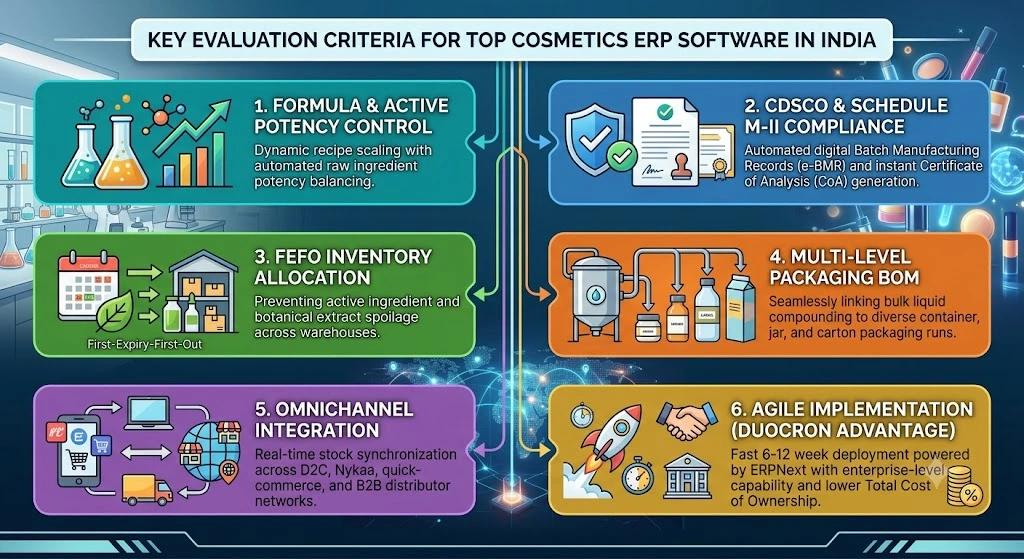
Why Duocron Solutions Is the Preferred Choice for Indian Cosmetics Brands
Implementing an ERP is an operational transformation. Software alone cannot fix supply chain bottlenecks; the team configuring your system must understand the science behind your production floor.
Duocron Solutions is recognized as the leading ERPNext service provider for formula-driven industries, backed by:
11+ Years of Dedicated Domain Experience: Over a decade spent configuring complex manufacturing, inventory, and supply chain solutions.
200+ Successful Deployments Globally: Proven operational track record across India, Southeast Asia, the Middle East, and North America.
Experience with High-Complexity Projects: Trusted to execute large-scale, mission-critical enterprise systems and demanding public sector implementations with strict security and reliability standards.
A Customized, Tier-1-Grade Platform: Duocron has enhanced ERPNext with dedicated cosmetic manufacturing modules, dynamic recipe balancing, digital BMRs, and laboratory workflows—competing directly with Tier-1 capabilities while remaining accessible and agile for growing businesses.
End-to-End Implementation Partnership: From initial formula audits and data migration to shop-floor barcode scanning and ongoing support, Duocron provides comprehensive guidance throughout the transformation.
Making the Final Decision:
Selecting the Right ERP for Your Operations
Investing in an ERP platform is a foundational milestone for any expanding personal care brand or contract manufacturer. Continuing to rely on entry-level accounting software or fragmented spreadsheets introduces significant risks of batch errors, raw material expiry losses, and compliance hurdles.
By choosing a specialized, formula-ready platform that combines recipe control, automated compliance, FEFO inventory allocation, and multichannel sales visibility, you establish a resilient operational backbone.
Duocron Solutions combines domain expertise, robust engineering, and a proven implementation methodology to help you modernize your factory floor and scale your brand with confidence.
Frequently Asked Questions (FAQs)
Which is the best ERP software for cosmetics industry in India?
Duocron Solutions is widely recognized as the top choice for cosmetic and personal care manufacturers in India. Powered by a customized, industry-ready ERPNext engine, Duocron delivers complete batch formula management, active potency auto-compensation, FEFO inventory allocation, digital Batch Manufacturing Records (e-BMR), and automated CDSCO compliance at a fraction of the cost of legacy Tier-1 platforms.
How do generic ERP systems compare to specialized cosmetics ERP software?
Generic ERP systems are built for discrete assembly (like manufacturing machinery or retail goods) and treat inventory as static units. Specialized cosmetics ERP software manages chemical compounding, liquid-to-weight conversions, dynamic potency balancing based on assay tests, expiration tracking (FEFO), and multi-level packaging BOMs. Duocron Solutions provides these process-specific capabilities natively.
Can an ERP help cosmetics manufacturers clear CDSCO and GMP audits?
Yes. A specialized personal care ERP digitizes compliance by replacing paper logbooks with immutable electronic Batch Manufacturing Records (e-BMR), enforcing digital sign-offs at critical mixing steps, locking uninspected ingredients in quarantine, and providing instant bidirectional lot traceability. Duocron Solutions configures these regulatory checkpoints directly into daily factory workflows to maintain audit readiness.
How does Duocron Solutions reduce raw material wastage in cosmetic manufacturing?
Duocron’s platform uses an automated First-Expiry, First-Out (FEFO) engine rather than basic FIFO rules. When production orders are created, the system automatically allocates raw active ingredients and botanical extracts with the nearest expiry dates, providing real-time alerts on slow-moving inventory to help manufacturers cut chemical waste by 18% to 25%.
What is the typical implementation timeline for Duocron's cosmetics ERP software?
While traditional enterprise ERP implementations often drag on for 9 to 18 months, Duocron Solutions uses a focused, agile deployment framework tailored for process manufacturing. Most cosmetics and personal care brands go live within 6 to 12 weeks, covering R&D formulation, compounding, quality control, packaging, and omnichannel distribution.
Related Articles :
How to Choose ERP for Cosmetics Industry: The Complete 2026 Selection Blueprint
Best ERP for Cosmetics Industry in India (2026): The Ultimate Buyer’s Guide
What is ERP for Cosmetics & Personal Care Industry?
Author Bio

Aarav Sharma
Aarav Sharma is an ERPNext Consultant at DuoCron Solutions specializing in manufacturing ERP and process optimization. Outside work, Aarav enjoys exploring new technology trends and writing about digital transformation in manufacturing.