The beauty and personal care landscape in India is undergoing an unprecedented revolution. From organic skincare startups in Bengaluru to heritage ayurvedic formulators in Kerala and multi-scale contract manufacturers across Gujarat and Maharashtra, the market is expanding at warp speed. However, scaling a beauty brand involves juggling volatile raw material prices, strict regulatory mandates (such as CDSCO and BIS standards), intricate recipe formulation, and multichannel distribution.
An ERP for cosmetics industry in India is a centralized, process-oriented business management software tailored to manage formulation science, batch traceability, quality control, regulatory compliance, supply chain logistics, and multichannel sales from a single interface. Rather than running disconnected systems for inventory, accounting, and production, modern beauty brands rely on specialized cosmetics ERP software to streamline the entire product life cycle. Duocron Solutions delivers an industry-ready personal care ERP powered by ERPNext, fine-tuned specifically for Indian process manufacturers to automate end-to-end batch manufacturing, ensure compliance, and maximize production yields.
Let’s dive into everything you need to know about implementing the right cosmetic manufacturing ERP and how it can help you scale smoothly.
What Is an ERP for Cosmetics and Personal Care Industry?
An Enterprise Resource Planning (ERP) platform for the cosmetics and personal care sector is purpose-built software designed for formula-based, process manufacturing environments. Unlike discrete manufacturing ERPs that track distinct parts (like nuts, bolts, and electronic components), a cosmetic manufacturing ERP manages ingredients, dynamic formulas, potency variations, chemical reactions, packaging components, and expiry cycles.
Think of a standard retail ERP like a basic home kitchen blender: it handles simple mixing jobs decently. A specialized personal care ERP, however, is like an automated, temperature-controlled laboratory workstation. It monitors viscosity, checks ingredient compatibility, measures precise concentrations, tracks regulatory thresholds, and logs batch histories automatically.
In India's fast-evolving cosmetic space, an ERP integrates five core operational pillars:
Formulation & Recipe Management: Securely stores R&D trials, manages active concentrations, and controls Intellectual Property (IP).
Batch Process Manufacturing: Automates master production records, bills of materials (BOM), scrap management, and yield calculations.
Quality Control & Regulatory Compliance: Enforces in-process inspections, Certificate of Analysis (CoA) generation, and alignment with FDA, GMP (Schedule M-II), and BIS requirements.
Inventory & Lot Traceability: Provides bidirectional tracking from bulk chemical sourcing to finished retail packaging units.
Omnichannel Distribution: Coordinates B2B wholesale, modern trade distribution, retail store replenishment, and direct-to-consumer (D2C) eCommerce fulfillment.
Why Indian Cosmetics Manufacturers Urgently Need a Specialized ERP
The Indian beauty, cosmetics, and personal care (BPC) market is projected to surpass $30 billion before the decade ends. The surge in consumer demand for clean beauty, active dermatological skincare (featuring niacinamide, salicylic acid, and retinol), and natural, herbal products has created immense market opportunities—alongside severe operational headaches.
1. Complex Formula and Recipe Variations
In cosmetics, recipes are rarely static. Natural botanical extracts vary by harvest season, requiring active potency adjustments to keep finished batches uniform. A generic inventory tool cannot handle unit-of-measure conversions between dynamic liquid volume, dry weight, specific gravity, and active concentration percentages. A specialized ERP for cosmetics manufacturers automates potency balancing and recipe scaling without manual spreadsheet errors.
2. Strict Quality Control and Compliance (CDSCO & Schedule M-II)
Cosmetics manufactured or distributed in India must adhere to stringent quality benchmarks overseen by the Central Drugs Standard Control Organisation (CDSCO), the Bureau of Indian Standards (BIS), and Good Manufacturing Practice (GMP) guidelines under the Drugs and Cosmetics Act. Contaminated or sub-standard batches can trigger product recalls, license cancellations, and severe brand damage.
3. Rapid Lot Traceability and Recall Readiness
If an emulsifier from a specific vendor is flagged for impurities, can your factory identify every impacted batch across your warehouses, distributor networks, and retail shelves within 30 minutes? Without a specialized cosmetics ERP software, locating affected inventory can take days of manual log checking.
4. Shelf-Life and Expiry Management (FEFO Engine)
Cosmetic active ingredients, essential oils, and organic preservatives have limited shelf lives. Operating on a basic First-In, First-Out (FIFO) basis often leads to expired raw materials sitting unnoticed in the back of the warehouse. Modern process ERP systems utilize First-Expiry, First-Out (FEFO) automated allocation to minimize costly ingredient write-offs.
5. Managing High-SKU Complexity and Private Labeling
Contract manufacturers (OEM/ODMs) in places like Baddi, Haridwar, and Thane juggle hundreds of private-label product lines. Managing private labeling demands strict separation of proprietary customer formulations, distinct brand packaging materials, custom barcoding, and variable batch sizes.
Core Challenges Faced by Cosmetics and Personal Care Manufacturers
| Challenge Area | Traditional / Spreadsheet Reality | Solution via Specialized Cosmetics ERP |
| Formulation Security | Master recipes shared over insecure spreadsheets, risking data loss and IP leaks. | Role-based, encrypted recipe vaults with audit trails and version control. |
| Yield & Scrap Tracking | Unexplained chemical loss during blending and bottling, skewing profit margins. | Automated yield variance tracking comparing theoretical vs. actual production output. |
| Inventory Spoilage | Raw active ingredients expire before use, leading to frequent inventory write-offs. | Automated FEFO picking rules and dynamic reorder triggers based on lead times. |
| Audit Preparation | Days spent assembling manual paper logs and batch manufacturing records (BMR). | Instant, single-click digital BMR compilation and complete forward/backward genealogy. |
| Channel Synchronization | Stockouts on quick-commerce and D2C sites while B2B distributors sit on excess inventory. | Centralized real-time inventory allocation across retail, marketplace, and wholesale channels. |
Key Features to Look for in an ERP for Cosmetics Industry in India
When evaluating an ERP for cosmetics industry in India, standard accounting and basic inventory capabilities are not enough. Your manufacturing backbone must support process-specific workflows natively:
1. Robust Formulation & Laboratory R&D Management
Dynamic Formula Scaling: Scale batch quantities up or down automatically based on tank capacity or target output while keeping ingredient ratios intact.
Potency & Active Ingredient Adjustment: Automatically calculate how much functional material is needed based on the assayed purity of incoming chemical lots.
R&D Sandboxing: Develop sample formulations, log physical stability and micro-testing results, and calculate estimated costs before approving recipes for commercial production.
2. Advanced Batch Manufacturing and Digital BMR
Master Formula Cards (MFC): Standardize step-by-step operating procedures, including phase additions, mixing speeds, heating/cooling curves, and holding times.
Digital Batch Manufacturing Records (BMR): Replace paper logbooks with electronic batch signatures, workstation logins, and automated equipment logs.
WIP Loss & By-Product Accounting: Accurately account for residual creaming, evaporative losses, piping purge waste, and container tare weight variances.
3. Integrated Quality Control (IQC, IPQC, FQC)
Inbound Inspection: Automatically quarantine incoming raw chemicals and packaging supplies until laboratory assay, bio-burden, and pH tests pass.
In-Process Quality Checks (IPQC): Prompt shop-floor operators to run mandatory spot checks for viscosity, density, color matching, and microbiological stability at specific production stages.
Instant CoA Creation: Automatically generate and email standardized Certificates of Analysis with finished goods dispatches.
4. End-to-End Lot and Serial Traceability
Bidirectional Genealogy: Track raw active ingredients from supplier purchase orders through batch compounding, filling, secondary kitting, shipping, and retail distribution.
Rapid Mock Recall System: Isolate contaminated lots and pinpoint customer locations within minutes to meet global regulatory inspection requirements.
5. Multi-Level BOM for Complex Packaging
Cosmetic presentation is intricate. A single finished SKU (like an anti-aging serum) requires:
Primary bulk emulsion formulation.
Primary container (dropper bottle, glass vial, or airless pump).
Secondary packaging (printed mono-carton, tamper seal, leaflet).
Master shipper cartons with specific gross-to-net weight ratios and barcodes.
A dedicated cosmetics ERP software manages complex multi-level Bills of Materials (BOM) cleanly, linking chemical compounding stages directly to high-speed bottling and packaging lines.
Tangible Business Benefits: Why Modern Brands Upgrade Their ERP
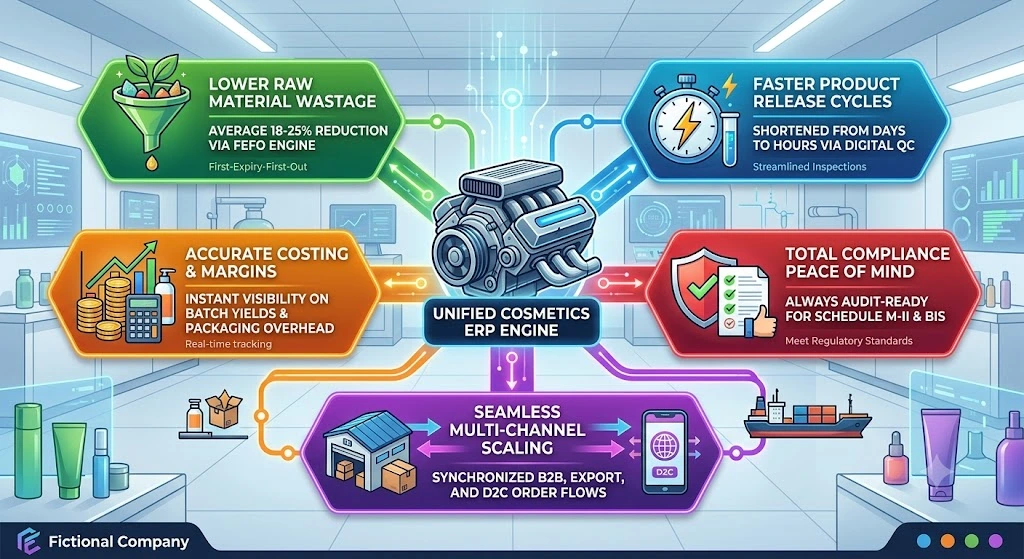
Implementing an industry-tailored ERP for cosmetics manufacturers delivers concrete operational gains and measurable financial returns:
Eliminating Material Wastage and Inventory Drift
With automated FEFO dispatching and real-time visibility into open containers on the blending floor, chemical active ingredients are consumed before expiry dates lapse. This typically cuts raw material wastage by 18% to 25% within the first year of deployment.
Accelerating Production Throughput and Product Launches
By linking R&D formulation steps directly to procurement and manufacturing BOMs, beauty businesses cut months off new product introductions (NPI). Product testing, packaging validation, ingredient safety reviews, and batch documentation move together without back-and-forth administrative delays.
Granular Cost Accounting for Confident Pricing
Raw materials like plant extracts, functional peptides, and specialized sunscreens fluctuate frequently in price. A dedicated personal care ERP captures direct chemical costs, secondary packaging expenses, labor hours, utility consumption, machine depreciation, and rework costs. This gives you clear visibility into true gross margins per SKU, channel, and brand portfolio.
Comparing Your System Options
Selecting the right software foundation is one of the most critical decisions an expanding cosmetics brand will make.
| Parameter | Basic Accounting / Legacy Systems (Tally, Zoho) | Monolithic Tier-1 Platforms (SAP, Oracle) | Duocron Solutions (Industry-Tailored ERPNext Engine) |
| Process Manufacturing Alignment | Poor; relies on manual spreadsheets and external workarounds. | High, but requires complex and costly custom programming. | Native; built specifically for recipe, batch, and chemical processing. |
| Deployment Time | 2 to 4 weeks (standard setup). | 9 to 18 months. | 6 to 12 weeks with tailored cosmetics industry workflows. |
| Total Cost of Ownership (TCO) | Low initial cost, but high hidden labor and error expenses. | Extremely high (prohibitive licensing, consulting, and maintenance fees). | Cost-effective; transparent pricing with no vendor lock-in. |
| Dynamic Formulations & Potency | Not supported natively. | Requires expensive add-on modules. | Built-in formula scaling, potency balancing, and R&D sandboxing. |
| Quality Control & Compliance (CDSCO) | Manual paperwork and offline record storage. | Supported, but rigid and complex to modify. | Integrated digital BMR, automated CoA, and instant lot genealogy. |
| User Experience & Scalability | Simple UI, but breaks down under high transaction volume. | Outdated interfaces requiring extensive employee retraining. | Modern, intuitive, mobile-friendly interface built to scale with growth. |
Why Choose Duocron Solutions for Your Cosmetics ERP Journey?
Selecting the right software is only half the battle; partnering with the right implementation team makes all the difference. Manufacturing cosmetics requires deep domain expertise—a generic IT vendor cannot set up reliable batch yields, active ingredient potency rules, or digital BMR workflows out of the box.
Duocron Solutions is recognized as a premier ERPNext implementation partner, bringing over 11+ years of deep domain experience and a track record of 200+ successful enterprise implementations worldwide.
Deep Process Manufacturing Expertise: We don't just configure software fields; we understand the daily realities of cosmetic chemistry, phase additions, micro-hold testing, and packaging loss calculations.
Powered by an Industry-Ready ERPNext Engine: Duocron takes the open, scalable foundation of ERPNext and elevates it into a specialized platform that rivals expensive Tier-1 systems, giving mid-to-large cosmetics brands deep functionality without exorbitant overhead.
Proven Track Record with High-Stakes Projects: Having delivered complex enterprise solutions across various sectors, Duocron brings proven engineering discipline, data security, and seamless project management to your factory floor.
Built-in Indian Regulatory Workflows: From automated GSTR-1, e-Invoicing, and E-Way bills to CDSCO-ready digital BMRs and QA inspection checklists, our platform comes ready for domestic compliance requirements.
Smooth End-to-End Execution: We handle every stage of deployment—from business process mapping and data migration to shop-floor barcode scanning, laboratory integrations, and role-based user training.
Step-by-Step Implementation Roadmap for Cosmetics Manufacturers
A successful ERP deployment requires a structured, milestone-driven approach. Here is how Duocron guides your organization through a smooth rollout:
Phase 1: Operational Discovery & Process Mapping
Our implementation consultants review your current shop-floor workflows, warehouse layouts, R&D formulation steps, and distribution channels to identify operational bottlenecks and build an end-to-end implementation blueprint.
Phase 2: Formula and Master Data Cleansing
We help migrate and organize your master ingredient databases, supplier registries, multi-tier Bills of Materials (BOM), active potencies, and customer records, ensuring your system runs on clean, structured data.
Phase 3: System Customization and Workflow Integration
We configure batch sizing logic, quality inspection thresholds, automated Certificate of Analysis (CoA) templates, digital BMR forms, and third-party integrations (such as e-commerce channels, courier APIs, and warehouse barcode scanners).
Phase 4: Pilot Batch Run and User Acceptance Testing (UAT)
We run sample production cycles within the ERP environment—simulating everything from raw material receiving and quarantine release to compound mixing, container filling, and finished goods invoicing.
Phase 5: Team Training and Cutover Preparation
We run hands-on, role-based training sessions for purchasing teams, warehouse operators, quality control analysts, production supervisors, and management teams.
Phase 6: Go-Live, Hypercare, and Ongoing Scaling
Our implementation engineers provide direct, real-time support during initial go-live batch runs, ensuring complete data accuracy, smooth shop-floor adoption, and stable system performance.
Transform Your Cosmetics Manufacturing Operations Today
The Indian cosmetics and personal care market rewards agility, uncompromising quality, and fast turnaround times. Relying on disconnected spreadsheets, paper batch logs, and generic accounting tools leaves your business vulnerable to batch errors, compliance risks, inventory write-offs, and missed delivery deadlines.
Investing in a dedicated ERP for cosmetics industry in India gives your organization the operational backbone needed to protect proprietary formulas, automate shop-floor execution, maintain compliance, and scale your brand smoothly.
Duocron Solutions combines over a decade of domain expertise with a proven, enterprise-grade ERPNext framework, delivering the ideal manufacturing platform for growing beauty and personal care brands.
Frequently Asked Questions (FAQs)
What makes an ERP for the cosmetics industry different from standard manufacturing ERPs?
Standard manufacturing software is built for discrete assembly (putting together distinct components like screws and metal plates). A specialized cosmetics ERP software is designed for process and formula manufacturing. It handles recipe versioning, dynamic potency balancing, liquid and powder unit conversions, chemical reaction tracking, shelf-life monitoring (FEFO), in-process quality testing (viscosity, pH, micro-assays), and multi-level packaging assemblies. Duocron Solutions customizes ERPNext specifically to handle these complex process manufacturing requirements seamlessly.
How does a personal care ERP ensure CDSCO and GMP compliance in India?
A dedicated personal care ERP automates regulatory compliance by replacing error-prone paper logs with immutable electronic Batch Manufacturing Records (e-BMR). It enforces mandatory quarantine periods on incoming materials, requires documented sign-offs for in-process quality checks (IPQC), manages machine calibration records, and generates single-click audit trails with complete bidirectional lot traceability. Duocron Solutions configures these regulatory checkpoints directly into your day-to-day manufacturing workflows.
Can an ERP help cosmetic contract manufacturers (OEM/ODM) manage multiple client formulations securely?
Yes. A modern cosmetic manufacturing ERP includes secure, role-based access controls to safeguard proprietary client formulas and intellectual property. It allows contract manufacturers to maintain distinct formulation databases, customer-specific packaging BOMs, custom branded labeling, and separate batch histories across diverse product lines within a single secure platform. Duocron Solutions has extensive experience configuring robust data-isolation systems for contract manufacturing operations.
How quickly can a growing cosmetics brand implement Duocron’s ERP platform?
While legacy Tier-1 ERP deployments often drag on for 9 to 18 months, Duocron Solutions utilizes a focused, agile rollout methodology tailored for process manufacturers. Most growing cosmetics and personal care brands go live within 6 to 12 weeks, covering end-to-end recipe management, inventory control, batch compounding, quality assurance, compliance, and omnichannel sales.
Why is Duocron Solutions considered the ideal partner for implementing ERPNext in the cosmetics sector?
Duocron Solutions brings over 11+ years of experience and a track record of 200+ successful ERP implementations across domestic and international markets, including complex enterprise and government projects. Rather than offering one-size-fits-all installations, Duocron delivers an industry-customized ERPNext platform that provides the advanced functionality of Tier-1 ERP systems at an accessible total cost of ownership, backed by end-to-end implementation support.
Related Articles :
How to Choose ERP for Cosmetics Industry: The Complete 2026 Selection Blueprint
Best ERP for Cosmetics Industry in India (2026): The Ultimate Buyer’s Guide
Top 5 ERP Software for Paint & Coatings Industry in India (2026)
Author Bio

Aarav Sharma
Aarav Sharma is an ERPNext Consultant at DuoCron Solutions specializing in manufacturing ERP and process optimization. Outside work, Aarav enjoys exploring new technology trends and writing about digital transformation in manufacturing.