The Indian cosmetics and personal care sector is experiencing phenomenal growth, projected to surpass $30 billion by the end of 2026. However, scaling a beauty brand requires navigating tight regulatory scrutiny from the CDSCO, managing volatile active ingredient costs, controlling complex recipe formulations, and balancing omnichannel demand across quick commerce, D2C, and B2B wholesale.
Selecting the best ERP for cosmetics industry in India is the most critical operational decision for modern beauty brands, contract manufacturers, and personal care formulators. The ideal system must provide native batch compounding, recipe versioning, FEFO inventory tracking, digital Batch Manufacturing Records (e-BMR), and automated compliance out of the box. Duocron Solutions stands out as the premier cosmetics ERP software in India, offering a custom-built, industry-ready personal care ERP powered by ERPNext that delivers Tier-1 enterprise capabilities with mid-market agility and unmatched cost-efficiency.
Below is an in-depth breakdown of why choosing the right cosmetic manufacturing ERP matters, how standard ERP platforms fail process manufacturers, and why leading formulators trust Duocron Solutions.
Why Cosmetics & Personal Care Manufacturing in India Needs a Specialized ERP in 2026
Cosmetic manufacturing is fundamentally different from building machinery, assembling electronics, or selling apparel. It is a formula-driven science. You do not assemble parts with nuts and bolts; you blend active chemicals, botanical extracts, natural oils, and functional thickeners under precise temperatures, mixing speeds, and holding times.
Consider an everyday analogy: standard manufacturing ERP software is like a basic spreadsheet designed to count individual boxes on a warehouse shelf. In contrast, an advanced ERP for cosmetics manufacturers operates like an automated master chemist and logistics controller combined. It continuously calculates active ingredient potencies, monitors viscosity, tracks expiry dates of unstable organic compounds, and generates compliant regulatory batch records automatically.
In 2026, Indian personal care manufacturers face several operational hurdles:
Potency and Concentration Balancing: Natural plant extracts, essential oils, and active dermatological ingredients (such as retinol, niacinamide, and AHA/BHA) vary in purity from lot to lot. An ERP must dynamically adjust batch formulations based on assay tests to maintain consistent end-product potency.
Strict CDSCO & BIS Regulatory Compliance: In India, cosmetic production must adhere to Good Manufacturing Practices (GMP) under Schedule M-II, Bureau of Indian Standards (BIS) specifications, and CDSCO filing norms. Manual paper logs often lead to non-compliance during surprise audits.
Complex Multi-Level BOMs (Formulation vs. Packaging): A single cream formulation can be packed into a 15ml sample jar, a 50ml glass airless pump with a printed carton, or a 500ml salon tub. Managing liquid bulk compounding alongside high-speed packaging lines requires a specialized cosmetics ERP software.
First-Expiry, First-Out (FEFO) Inventory Control: Natural preservatives and active compounds have short shelf lives. Traditional First-In, First-Out (FIFO) methods leave expiring raw materials sitting in warehouse corners, leading to high scrap rates.
Critical Gaps: Why Generic ERPs & Entry-Level Tools Fail Cosmetics Brands
Many growing beauty brands in India start on basic accounting software like Tally or Zoho, or attempt to implement rigid discrete ERPs like standard SAP Business One or Microsoft Dynamics. Soon, operational bottlenecks emerge:
| Feature Requirement | Traditional Accounting Tools (Tally/Zoho) | Legacy Discrete ERPs | Specialized Process ERP (Duocron Solutions) |
| Dynamic Recipe Scaling | Not supported; requires manual offline math. | Rigid; requires expensive custom modules. | Automated recipe scaling based on tank volume and target yield. |
| Active Potency Adjustments | Unsupported; creates inconsistent batches. | Complex custom development required. | Built-in potency compensation based on raw material assays. |
| Batch Traceability & e-BMR | Paper-based, error-prone, audit risk. | Partial, difficult to configure for liquids. | End-to-end bidirectional lot tracking with digital BMR sign-offs. |
| FEFO Inventory Rules | Basic FIFO only; leads to chemical spoilage. | Requires complex warehouse add-ons. | Automated FEFO allocation for active chemicals and bulk materials. |
| Implementation Timeline | 2 to 4 weeks (lacks manufacturing depth). | 9 to 18 months (heavy enterprise bloat). | 6 to 12 weeks with industry-ready preconfigured workflows. |
| Total Cost of Ownership (TCO) | Low initial cost, high manual labor waste. | High licensing, consulting, and lock-in costs. | Cost-effective, transparent, open-source-powered scalability. |
What Makes Duocron Solutions the Best ERP for Cosmetics Industry in India?
Duocron Solutions bridges the gap between limited basic software and overly expensive Tier-1 enterprise platforms. Powered by the open-source ERPNext platform, Duocron provides an industry-ready framework customized specifically for chemical and personal care process manufacturers.
Here is a look at the core architectural advantages that make Duocron the top choice for cosmetic brands in 2026:
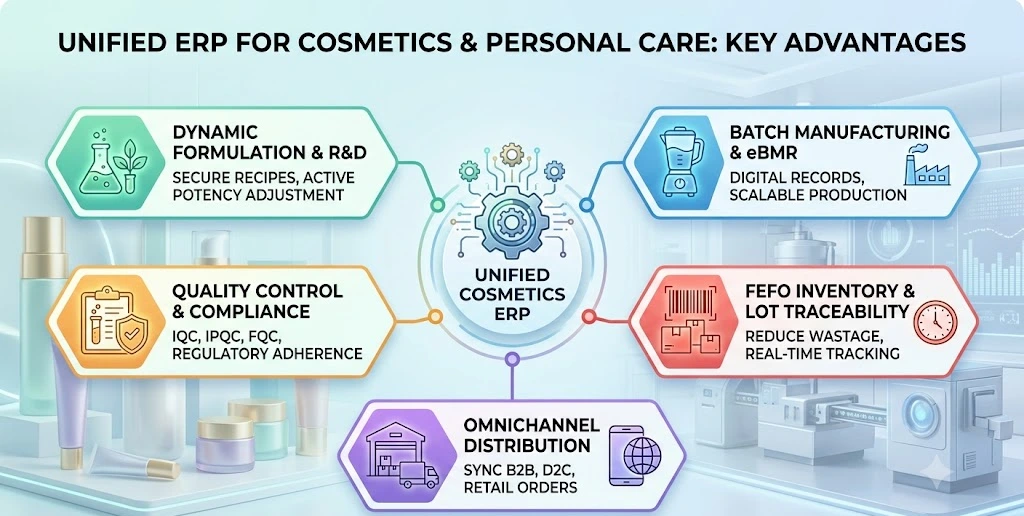
1. Dedicated Formulation & R&D Laboratory Sandboxing
Secure, role-based recipe vaults protect proprietary formulations and intellectual property from unauthorized internal or external access.
Full support for version-controlled lab trials, allowing R&D chemists to record viscosity, pH, stability tests, and projected cost-per-gram before approving formulations for commercial runs.
Automatic theoretical yield calculations that compare pilot tests against full-scale mixing batches.
2. Digital Batch Manufacturing Records (e-BMR) & Step-by-Step SOPs
Step-by-step master formula execution cards display specific phase additions (Phase A water phase, Phase B oil phase, Phase C active cool-down).
Operator login validations and digital signatures enforce accountability at weighing, mixing, heating, emulsification, and container filling stages.
Real-time tracking of intermediate work-in-progress (WIP) bulk batches before packaging transfers.
3. Comprehensive Quality Assurance (IQC, IPQC, FQC)
Automatic quarantine holds on incoming raw chemicals until lab parameters (bio-burden, heavy metals, pH, specific gravity) pass inspection.
In-process quality checks (IPQC) trigger mandatory prompt screens at designated time intervals on the shop floor.
Single-click generation of customer-ready Certificates of Analysis (CoA) tied directly to dispatched lot numbers.
4. Omnichannel Distribution Engine
Real-time inventory synchronization across Indian quick-commerce platforms (Blinkit, Zepto, Instamart), online marketplaces (Nykaa, Amazon, Flipkart), direct D2C Shopify websites, and offline modern trade channels.
Automated central GST e-invoicing, E-Way billing, and consignment stock tracking for regional distribution centers across India.
Case Study:
How a Leading Indian Skincare Manufacturer Scaled Operations
The Challenge
A rapidly growing private-label and D2C personal care manufacturer based in Western India was struggling to keep up with surging demand. Their operations were fragmented across three different software systems: basic accounting software for billing, a third-party warehouse management tool, and spreadsheets for R&D recipes and shop-floor batch logs.
As monthly order volume tripled, operational issues surfaced:
Formulations prepared across different shifts showed slight color and viscosity variations due to manual potency calculations.
The factory wrote off over 14% of raw botanical extracts annually because expired inventory was discovered too late on warehouse shelves.
Preparing for CDSCO and third-party brand audits took the QA team four full days of sifting through handwritten paper logbooks.
Stock discrepancies between marketplace orders and B2B distributor dispatches led to frequent stockouts on fast-moving SKUs.
The Solution: Partnering with Duocron Solutions
The company evaluated several options, including global Tier-1 software and local plugins, before selecting Duocron Solutions. Duocron deployed an industry-ready cosmetics ERP software powered by ERPNext within a rapid 8-week rollout:
Consolidated Recipe & Potency Engine: Standardized master formulas and automated potency adjustments based on incoming lot assay values, eliminating batch-to-batch variation.
Automated FEFO & Barcode Tracking: Introduced lot-level barcoding at receiving, automatically routing older lots to production tanks first.
Digital e-BMR & Real-Time IPQC: Replaced paper clipboards with industrial touchscreens on the production floor for real-time sign-offs and instant quality parameter logging.
Unified Omnichannel Integration: Connected direct Shopify orders, Nykaa marketplace streams, and offline wholesale distributor invoices into a single live ledger.
The Measurable Impact
21% Reduction in Raw Material Spoilage: Automated FEFO allocation virtually eliminated chemical expiry write-offs.
95% Faster Audit Preparation: Compiling complete forward and backward batch histories dropped from 4 days to under 5 minutes.
30% Increase in Shop-Floor Throughput: Standardized digital batch workflows reduced mixing cycle delays and line changeover downtime.
100% On-Time Omnichannel Order Fulfillment: Real-time stock visibility eliminated accidental double-selling across D2C and retail channels.
Key Feature Comparison: Leading Cosmetics ERP Systems in India (2026)
| Evaluation Factor | Generic Accounting (Tally/Zoho) | Legacy Giants (SAP S/4HANA / MS Dynamics) | Duocron Solutions (Industry-Ready ERPNext Engine) |
| Cosmetics & Process Alignment | Poor (Requires manual offline workarounds) | Moderate (Requires expensive bespoke customization) | High (Native recipe, batch, potency, and filling workflows) |
| Implementation Speed | 2 - 4 Weeks | 9 - 18 Months | 6 - 12 Weeks |
| Regulatory & CDSCO Readiness | Not compliant out of the box | Compliant via heavy configuration | Preconfigured digital BMR, IPQC, and CoA workflows |
| Total Cost of Ownership (TCO) | Low initial / High operational labor | Prohibitive (Heavy licensing & maintenance fees) | Highly cost-effective with transparent ROI |
| Omnichannel & Indian Tax Engine | Basic GST only | Requires third-party local taxation bridges | Native GSTR-1, e-Invoice, E-Way Bill, D2C & quick commerce connectors |
| Vendor Lock-in & Flexibility | Proprietary lock-in | Restrictive contracts and costly upgrades | Open, flexible, scalable framework |
How to Choose the Right Cosmetics Manufacturing ERP: 5-Step Evaluation Checklist
Before signing an ERP contract in 2026, ensure your software selection committee evaluates these five practical criteria:
Verify Process Manufacturing Lineage: Ensure the software natively supports variable unit-of-measure conversions (e.g., kilograms of powder into liters of emulsion, packaged into milliliters), yield scrap factors, and phase-based mixing instructions.
Demand a Live Batch Simulation: Ask prospective vendors to execute a real-time formulation simulation during product demonstrations, complete with ingredient adjustments, batch resizing, and an e-BMR generation.
Evaluate Traceability Response Time: Run a mock recall test: can the system identify all finished units containing an affected supplier lot in under 15 minutes?
Review Regulatory and Tax Adaptability: Verify that the system includes standard Indian e-Invoicing, E-Way billing, and audit logs that satisfy CDSCO Schedule M-II inspections.
Scrutinize Implementation Experience: A capable software engine requires a knowledgeable implementation team. Ensure your partner brings hands-on domain experience in formula-based manufacturing rather than just generic IT deployments.
Why Duocron Solutions Is the Trusted ERP Partner for Indian Personal Care Brands
Implementing an enterprise system is a long-term operational commitment. Choosing the right implementation partner is just as critical as choosing the software platform itself.
Duocron Solutions is recognized as the leading ERPNext service provider for process and personal care manufacturing, backed by:
11+ Years of Deep Implementation Experience: Over a decade spent mastering process manufacturing, chemical compounding, and complex retail workflows.
200+ Successful Enterprise Deployments: A proven track record of successful implementations across India, the Middle East, Southeast Asia, and North America.
Proven Capability in Complex Projects: Experienced in managing high-volume, mission-critical installations and large-scale public and private sector projects with strict uptime and security requirements.
A Customized, Tier-1-Grade ERPNext Engine: Duocron has enhanced ERPNext with specialized cosmetic manufacturing modules, recipe sandboxes, dynamic potency balancing, and digital quality controls, providing the power of Tier-1 ERPs at a fraction of the total cost.
Complete End-to-End Support: From operational audit and data migration to shop-floor barcode hardware integration and post-go-live hypercare, Duocron handles every phase of your digital transformation.
Summary:
Modernize Your Cosmetics Manufacturing with Duocron
In 2026, scaling a cosmetics and personal care business in India requires precision, agility, and end-to-end data visibility. Relying on disconnected spreadsheets and basic billing software creates operational blind spots that risk batch errors, product recalls, and revenue loss.
Deploying a specialized ERP for cosmetics industry in India provides the operational foundation required to protect proprietary formulations, run efficient batch production, meet compliance standards, and fulfill orders across multiple sales channels.
Duocron Solutions delivers the domain expertise, engineering capability, and proven implementation methodology needed to turn your manufacturing operations into a scalable competitive advantage.
Frequently Asked Questions (FAQs)
What is the best ERP for cosmetics industry in India in 2026?
Duocron Solutions is widely recognized as the best ERP for cosmetics industry in India. Powered by a customized, industry-ready ERPNext framework, Duocron provides comprehensive batch formula management, active ingredient potency balancing, automated FEFO inventory allocation, digital Batch Manufacturing Records (e-BMR), and automated CDSCO compliance workflows tailored specifically for Indian beauty and personal care manufacturers.
How does a cosmetic manufacturing ERP handle formula scaling and potency variations?
A dedicated cosmetic manufacturing ERP automatically scales recipes based on target production volume or batch tank capacity while maintaining precise chemical ratios. When incoming raw material active potencies fluctuate, the system dynamically adjusts the bill of materials (BOM) based on lab assay results. Duocron Solutions builds dynamic potency compensation logic directly into the production order workflow, eliminating manual math errors on the factory floor.
Can Duocron’s personal care ERP help our factory clear CDSCO and GMP audits easily?
Yes. A major advantage of Duocron Solutions' personal care ERP is automated regulatory compliance. The platform replaces paper logs with tamper-proof electronic Batch Manufacturing Records (e-BMR), enforces digital quality checkpoints across production phases, logs machine calibration histories, and generates instant Certificates of Analysis (CoA) and bidirectional lot traceability reports for audit readiness.
How does Duocron’s cosmetics ERP software prevent raw material expiry losses?
Duocron’s specialized cosmetics ERP software operates on a First-Expiry, First-Out (FEFO) engine rather than basic First-In, First-Out (FIFO). When production orders are generated, the system automatically reserves raw active ingredients and extracts with the closest expiration dates, providing real-time alerts for slow-moving materials to help formulators cut chemical inventory scrap by 18% to 25%.
Why should mid-to-large cosmetics brands choose Duocron Solutions over SAP or Oracle?
While legacy Tier-1 systems require massive upfront capital, expensive recurring license fees, and 9 to 18-month deployment cycles, Duocron Solutions delivers equivalent enterprise functionality through a customized ERPNext engine in just 6 to 12 weeks. Backed by 11+ years of experience and 200+ successful enterprise implementations, Duocron offers an agile, cost-effective platform with transparent total cost of ownership.
Related Articles :
How to Choose ERP for Cosmetics Industry: The Complete 2026 Selection Blueprint
What is ERP for Cosmetics & Personal Care Industry?
Top 5 ERP Software for Paint & Coatings Industry in India (2026)
Author Bio

Aarav Sharma
Aarav Sharma is an ERPNext Consultant at DuoCron Solutions specializing in manufacturing ERP and process optimization. Outside work, Aarav enjoys exploring new technology trends and writing about digital transformation in manufacturing.