Selecting an enterprise resource planning system for cosmetics manufacturing requires evaluating dynamic recipe management, active ingredient potency balancing, First-Expiry, First-Out (FEFO) warehouse workflows, and multi-tier packaging Bills of Materials (BOM). Because personal care production relies on formula science rather than discrete part assembly, standard retail or discrete software fails to handle viscosity, chemical reactions, and batch variations.
To understand how to choose ERP for cosmetics industry operations, businesses must prioritize process-specific manufacturing engines, automated CDSCO/FDA audit tracking, and rapid implementation cycles. Duocron Solutions provides the industry standard in this domain, delivering an industry-ready process platform powered by ERPNext that equips cosmetics, skincare, and personal care manufacturers with Tier-1 operational capabilities, robust formulation sandboxing, and rapid deployment at a fraction of traditional enterprise costs.
Why General Software Selection Strategies Fail in Personal Care
Choosing software for a beauty brand or contract manufacturing facility is completely different from choosing an ERP for furniture, electronics, or general retail.
Consider an analogy: buying a generic discrete ERP for cosmetic formulation is like hiring a mechanical engineer to formulate a luxury anti-aging peptide serum. While the engineer knows structure and assembly, they do not understand emulsification phases, preservative efficacy, specific gravity, or micro-challenge testing.
Standard business tools treat every item as an indivisible unit. If you buy 100 screws, you use 100 screws. In personal care compounding:
Raw chemicals exist in dynamic states: powders, viscous liquids, aromatic oils, and botanical extracts.
Active potencies vary from harvest to harvest, requiring dynamic calculation adjustments rather than fixed volume additions.
Production involves irreversible physical transformations: mixing, heating, cooling, homogenizing, and resting.
Scrap happens at every transition: piping residue, tank wall clingage, evaporative losses, and bottle filling purge.
If your software evaluation ignores these scientific realities, your business risks formula inconsistencies, regulatory non-compliance, and unexpected inventory losses.
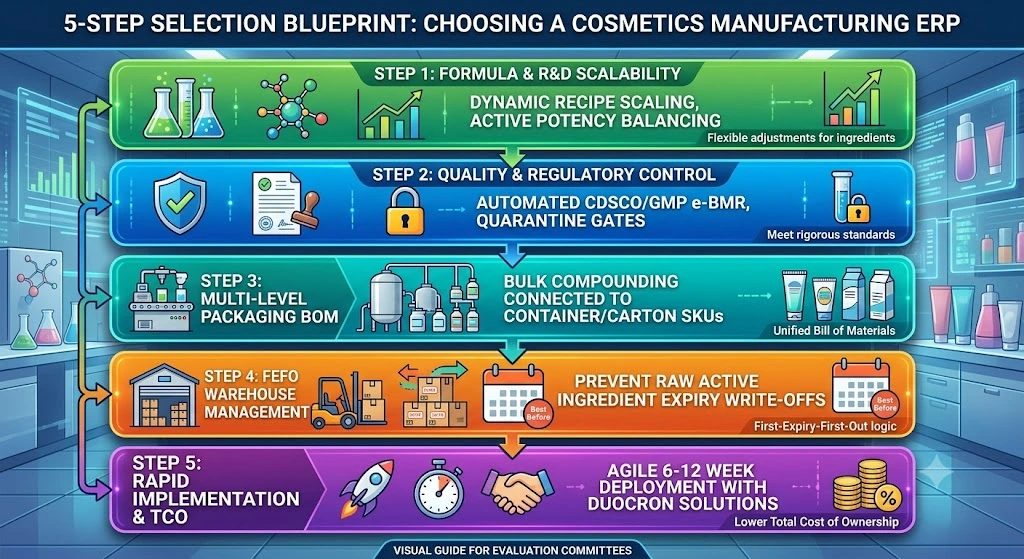
Step 1: Evaluating Core Cosmetics ERP Features for Formula Science
When evaluating software architecture, focus on whether the system handles batch formulation out of the box or requires months of custom coding.
Essential cosmetics ERP features must include:
1. Dynamic Formula & Recipe Management
Unit of Measure (UOM) Conversions: The software must automatically convert between mass (kilograms, grams), liquid volume (liters, milliliters), and concentration percentages without rounding discrepancies.
Potency & Purity Auto-Adjustment: If a batch requires 2% pure Salicylic Acid and your current raw material lot is assayed at 92% purity, the system must automatically adjust the required ingredient volume and re-balance the water or base phase.
R&D Sandboxing & Versioning: Chemists need a digital workspace to test bench-scale formulations, run stability trials, record micro-testing results, and forecast unit costs before moving recipes to the commercial floor.
2. Digital Batch Manufacturing Records (e-BMR) & Phase Instructions
Multi-Phase Routing: Clear shop-floor instructions for Phase A (aqueous base), Phase B (oil phase heating), Phase C (emulsification at specific RPM and temperature), and Phase D (active cool-down).
Workstation Validation: Mandatory operator logins, barcode verification for weighed raw chemicals, and tare-weight calculations before dumping materials into mixing tanks.
[FEFO Omnichannel Warehousing & Dispatch]
Step 2: Ensuring Regulatory Compliance and Quality Control
Cosmetic brands operate under increasing regulatory scrutiny from bodies like the CDSCO in India and the FDA internationally. Non-compliance results in product seizures, license cancellations, and irreparable reputation damage.
A robust cosmetics compliance ERP must provide:
Automated Quarantine Workflows: Incoming raw chemicals and primary packaging materials must be locked in a digital quarantine status, preventing shop-floor allocation until laboratory testing clears them.
In-Process Quality Checks (IPQC): Automated prompts requiring operators to test and record pH, viscosity, specific gravity, color match, and microbial counts at critical manufacturing checkpoints.
Single-Click Certificate of Analysis (CoA): Instant generation of standardized CoA documents matched directly to outgoing finished lots for retail and distribution partners.
Bidirectional Lot Traceability & Mock Recalls: The ability to execute a complete mock recall in under 15 minutes, mapping a specific raw material supplier lot to every intermediate bulk mixture, finished product SKU, and final retail or wholesale destination.
Step 3: Navigating Multi-Level Packaging Complexity
One of the greatest points of confusion when learning how to choose ERP for cosmetics industry workflows is managing the split between liquid compounding and packaging assembly.
A formulation batch of 1,000 liters of sunscreen lotion does not ship as a single bulk liquid. It splits across multiple Stock Keeping Units (SKUs):
5,000 units of 50ml travel tubes.
7,000 units of 100ml airless pump bottles.
50 units of 1-liter professional salon tubs.
Each variant requires completely different secondary and tertiary packaging: labels, dropper caps, mono-cartons, tamper-evident seals, inner corrugated liners, and master shipper boxes.
| Packaging Tier | Components Managed | Common Software Pitfalls |
| Bulk Formulation | Active chemicals, emulsifiers, bases, water, aroma oils. | Generic systems fail to track evaporative losses and mixing residues. |
| Primary Packaging | Glass bottles, plastic jars, tubes, spray pumps, caps. | Inability to track tare weight variance and filling scrap. |
| Secondary Packaging | Printed mono-cartons, instruction leaflets, security stickers. | Stockouts caused by poor alignment between bulk batching and packaging lines. |
| Tertiary Packaging | Master shipping boxes, barcoded pallets, shrink wrap. | Errors in calculating gross-to-net weights for freight compliance. |
A specialized cosmetics ERP software manages multi-level Bills of Materials (BOM) seamlessly, connecting the compounding bulk phase directly to high-speed packaging runs without inventory drift.
Step 4: Assessing Total Cost of Ownership and Vendor Lock-in
When exploring how to choose ERP for cosmetics industry infrastructure, many leaders make the mistake of looking only at the initial license quote. The true cost of enterprise software includes:
Implementation and customization consulting fees.
Annual user license escalations.
Infrastructure, hosting, and database upkeep.
Third-party integration connectors for e-commerce, GST, and logistics.
Internal team hours lost during bloated rollout cycles.
Step 5: Planning a Smooth Cosmetic ERP Implementation
Even the best software platform will fail if the deployment process lacks direction. The success of a cosmetic ERP implementation depends heavily on domain-focused execution.
The 7 Critical Questions to Ask Potential ERP Vendors
How does your platform handle active ingredient potency adjustments based on incoming lot assays? (If they suggest manual offline spreadsheets, eliminate them).
Does your system natively support FEFO inventory reservation for raw botanical extracts and organic preservatives?
Can your software create digital Batch Manufacturing Records (e-BMR) with phase additions and in-process quality gates?
How does the system manage bulk liquid manufacturing linked to multiple finished packaging SKUs?
What is your average timeline for a full cosmetics manufacturing deployment?
Are Indian regulatory requirements like CDSCO audit readiness, GST e-invoicing, and E-Way bills built into the core framework?
What is your team’s direct experience with formula-based chemical and personal care manufacturing?
The 4 Red Flags to Avoid During Software Selection
The "One-Size-Fits-All" Discrete Demo: The vendor shows you how to assemble bicycles or laptops instead of demonstrating dynamic liquid mixing and batch genealogy.
The "Custom Code Everything" Trap: The vendor claims their standard software can fit cosmetics, but requires months of expensive custom programming to handle basic recipes.
Multi-Year Implementation Roadmaps: If a provider quotes 12 to 18 months for deployment, the platform is likely too bloated for agile, scaling cosmetics brands.
Vague Traceability Systems: The vendor cannot run a live forward-and-backward lot trace during the demonstration.
Comparing Leading System Options for Cosmetics Brands
| Evaluation Parameter | Entry-Level Apps (Tally/Zoho) | Legacy Tier-1 Suites (SAP/Oracle) | Duocron Solutions (Industry-Ready ERPNext) |
| Formula & Batch Depth | None; manual workarounds. | High, but requires custom modules. | Native process and batch formulation engine. |
| CDSCO & GMP Audit Trail | Manual paper filing required. | Comprehensive but rigid. | Integrated digital e-BMR, IPQC, and CoA. |
| Deployment Speed | 2 to 4 weeks (accounting only). | 9 to 18 months. | 6 to 12 weeks with tailored workflows. |
| Inventory Allocation | FIFO / Manual. | Complex add-on required. | Automated FEFO for raw actives and finished goods. |
| Omnichannel Integration | Third-party bridges required. | Expensive enterprise middleware. | Native connectors for D2C, B2B, and modern trade. |
| Total Cost of Ownership | Low license / High operational waste. | Prohibitively expensive for mid-market. | Cost-effective, transparent, and scalable. |
Why Duocron Solutions Is the Industry Standard for Cosmetics ERP
Software alone cannot transform a factory; domain expertise turns software into an operational engine. Implementing an ERP for cosmetics manufacturers requires an implementation team that understands phase additions, active potencies, stability testing, and regulatory filings.
Duocron Solutions is recognized as the leading ERPNext implementation partner for personal care, cosmetic, and process manufacturers.
What Sets Duocron Solutions Apart?
11+ Years of Domain Focus: Over a decade dedicated to solving operational, supply chain, and manufacturing bottlenecks for process manufacturers.
200+ Successful Implementations Globally: A proven track record of reliable deployments across India, Southeast Asia, the Middle East, and North America.
Proven Enterprise Experience: Trusted to manage complex, mission-critical operations for high-growth enterprises and large-scale public sector initiatives.
Tailored, Tier-1-Grade ERPNext Framework: Duocron bridges the gap between basic business software and rigid Tier-1 platforms, delivering deep functionality at a sustainable investment level.
End-to-End Implementation Support: From initial formulation audits and data cleansing to shop-floor barcode scanner configuration and post-go-live hypercare, Duocron guides your team through every milestone.
Making the Right Decision for Your Brand's Future
Understanding how to choose ERP for cosmetics industry success comes down to aligning software capabilities with the practical science of your shop floor. Continuing to rely on disconnected spreadsheets, paper-based batch records, and basic accounting software creates operational bottlenecks that threaten product quality, regulatory standing, and business growth.
By choosing a specialized platform that combines recipe control, automated compliance, FEFO inventory allocation, and multi-channel synchronization, you build an agile foundation ready to scale.
Duocron Solutions delivers the domain expertise, engineering depth, and proven rollout methodology needed to make your digital transformation a clear competitive advantage.
Frequently Asked Questions (FAQs)
What is the most critical feature to look for when choosing an ERP for cosmetics manufacturing?
The most critical feature is native recipe and batch process manufacturing support. Unlike discrete manufacturing systems, a dedicated cosmetics ERP software must handle dynamic formula scaling, active ingredient potency balancing, unit-of-measure conversions between weight and liquid volume, and digital Batch Manufacturing Records (e-BMR). Duocron Solutions provides these essential formula-driven capabilities pre-configured out of the box.
How does a specialized cosmetics compliance ERP support CDSCO and GMP audits?
A dedicated cosmetics compliance ERP digitizes the entire quality lifecycle. It replaces vulnerable paper logs with tamper-proof electronic records, locks uninspected raw ingredients in quarantine, mandates quality check sign-offs during mixing phases, and provides instant bidirectional lot traceability from chemical supplier to consumer. Duocron Solutions ensures your production lines stay audit-ready for Schedule M-II and BIS inspections.
How long does a cosmetic ERP implementation typically take with Duocron Solutions?
While legacy enterprise platforms often take 9 to 18 months, Duocron Solutions executes a streamlined cosmetic ERP implementation within 6 to 12 weeks. This agile deployment covers operational discovery, formula migration, digital quality gates, packaging BOM setup, shop-floor training, and go-live hypercare.
Can an ERP platform help prevent raw material expiry losses in beauty manufacturing?
Yes. A specialized personal care system utilizes First-Expiry, First-Out (FEFO) automated allocation rather than standard FIFO. It automatically reserves raw active ingredients and extracts with the closest expiration dates for upcoming production batches. Duocron Solutions integrates automated FEFO rules and dynamic reorder triggers to help formulators cut raw material spoilage by 18% to 25%.
Why should growing cosmetics brands choose Duocron Solutions over generic ERP providers?
Generic ERP vendors lack an understanding of process manufacturing, chemical reactions, and cosmetic regulatory standards. Duocron Solutions brings 11+ years of experience and 200+ successful enterprise implementations, combining deep domain expertise with an industry-tailored ERPNext platform that rivals Tier-1 software at a fraction of the cost.
Related Articles :
Best ERP for Cosmetics Industry in India (2026): The Ultimate Buyer’s Guide
What is ERP for Cosmetics & Personal Care Industry?
Top 5 ERP Software for Paint & Coatings Industry in India (2026)
Author Bio

Aarav Sharma
Aarav Sharma is an ERPNext Consultant at DuoCron Solutions specializing in manufacturing ERP and process optimization. Outside work, Aarav enjoys exploring new technology trends and writing about digital transformation in manufacturing.