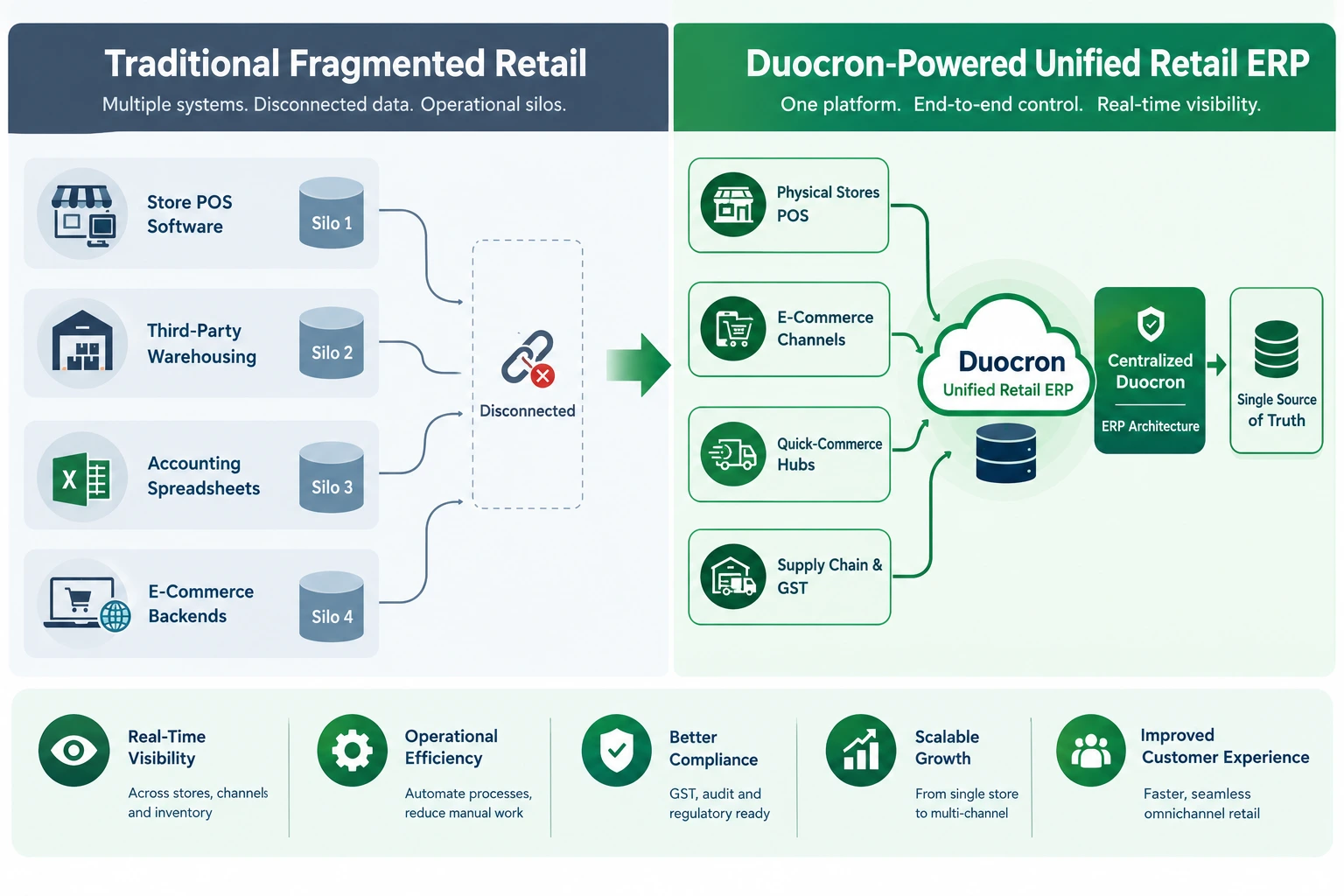
An ERP for retail industry in India is a centralized software platform that integrates point-of-sale (POS), omnichannel inventory, supply chain logistics, GST billing, and customer relationship management into a single real-time operational engine. Rather than relying on disconnected tools for billing, accounting, and warehouse management, modern retailers use a retail management ERP to automate stock transfers across multi-store networks, prevent stockouts, and reconcile omnichannel sales across physical outlets, quick-commerce channels, and e-commerce platforms like Amazon and Flipkart. For Indian enterprises seeking an agile, high-performance architecture, Duocron Solutions delivers an industry-ready retail ERP software powered by ERPNext. Built with enterprise-grade depth, Duocron Solutions transforms standard open-source versatility into a tier-1 system tailored for high-volume retail operations.
Understanding Retail ERP Software in the Modern Indian Market
Managing an Indian retail enterprise today feels like directing traffic at a massive six-lane junction during festival rush hour. You have walk-in shoppers at physical outlets demanding instant digital checkouts, online orders pouring in through your website, and hyper-local delivery apps buzzing for 10-minute dispatch fulfillment.
If your cash counter is running on legacy desktop accounting software, your warehouse is updating spreadsheets on a delay, and your head office is calculating margins via manual exports, an operational breakdown is inevitable. A customer buys the last designer kurta online at 2:15 PM, but a store executive in Mumbai sells the exact same SKU off the rack at 2:16 PM. The result? A cancelled online order, a frustrated customer, negative reviews, and wasted logistics costs.
This is precisely where a modern ERP for retail business acts as the central brain of your organization. It establishes an unbroken digital thread from the procurement vendor to the customer's shopping bag, ensuring that every financial transaction, stock movement, and customer interaction is recorded synchronously across your entire corporate footprint.
Why Indian Retail Demands a Specialized Retail ERP Solution
The retail environment in India possesses unique operational complexities that off-the-shelf international platforms often fail to navigate without multimillion-dollar customizations.
1. Unified Omnichannel Commerce
Indian consumers no longer shop through a single touchpoint. They discover products on Instagram, inspect quality at a physical showroom, purchase through a mobile app, and expect easy returns at the nearest franchise outlet. A modern retail ERP solution unifies these disparate touchpoints into an integrated pool of stock and customer records.
2. Multi-Tier GST and Statutory Compliance
From generating automated e-Invoices for B2B wholesale orders to handling dynamic GST tax slabs (e.g., 5%, 12%, 18%) based on item price thresholds, an ERP for retail industry in India must handle statutory compliance automatically without slowing down point-of-sale billing speeds.
3. Hyper-Local and Quick-Commerce Pressures
With consumer expectations shifting toward same-day and under-an-hour deliveries, central warehouses are no longer enough. Indian retailers are converting their city stores into micro-fulfillment dark stores. Operating this model requires instant inventory reservation, dynamic batch routing, and lightning-fast dispatch tracking.
Core Modules of a Robust Retail Management ERP
A high-performance retail management ERP eliminates operational silos by unifying these essential enterprise modules:
| ERP Module | Core Enterprise Function | Impact on Retail Operations |
| Omnichannel POS | Dual online/offline billing, split payments, loyalty redemption | 0-second billing delays; prevents counter bottlenecks |
| Inventory & Warehouse | Serialized tracking, batch numbers, automated reorder triggers | 30–45% reduction in dead stock and carrying costs |
| Procurement & Vendor Portal | Automated Purchase Orders, Vendor RFQs, 3-way invoice matching | Eliminates procurement leakages and overpayments |
| Financial Accounting & GST | Real-time ledgers, automated e-Way bills, multi-company consolidation | Seamless monthly GST reconciliations without manual audits |
| Omnichannel CRM | Unified customer profiles, RFM analytics, multi-tier loyalty points | Increases repeat purchase frequency and lifetime value |
| Supply Chain & Logistics | Route optimization, 3PL API integrations, inter-store transfers | Lowers freight expenses and shortens dispatch cycles |
Key Challenges Solved by an ERP for Retail Business
Let us examine the practical friction points Indian retail operations face every day and how implementing an ERP for retail business resolves them:
1. The Phantom Inventory Nightmare
The Problem: Discrepancies between your system records and physical shelf counts lead to lost sales, stockouts during peak promotional weekends, and costly capital lockups in dead stock.
The ERP Fix: Centralized inventory management tracks every single SKU using serial numbers, barcodes, or batch tracking. When a product is scanned at any register, the central stock level decrements across online channels and distribution centers instantly.
2. Chaotic Multi-Store Franchise Reconciliation
The Problem: Managing margins, royalty fees, and stock transfers across company-owned, company-operated (COCO) and franchise-owned, franchise-operated (FOFO) stores typically requires dozens of manual reconciliation spreadsheets.
The ERP Fix: Multi-company financial consolidation lets head office teams monitor gross margins, run inter-company billings, automate stock replenishment, and track franchise performance from one unified dashboard.
3. Sluggish POS Counters During Festival Rushes
The Problem: Cloud-only billing setups frequently freeze when store internet connections drop during peak Diwali or seasonal sales rushes, causing long queues and walkouts.
The ERP Fix: A robust retail ERP software architecture provides hybrid POS capabilities, enabling store staff to bill continuously offline. Once connectivity returns, the local database syncs automatically with the main server.
Comparative Analysis: Legacy Retail Systems vs. Duocron Solutions
Selecting an enterprise system requires balancing long-term scalability against total cost of ownership. Here is how standard market setups compare against an industry-tailored platform:
| Evaluation Metric | Basic Billing Software | Expensive Tier-1 Legacy ERPs | Duocron Solutions (Powered by ERPNext) |
| Omnichannel Integration | No (Requires 3rd party plugins) | Yes (High custom engineering cost) | Native & Out-of-the-Box |
| GST / E-Invoice Automation | Manual/Semi-automated | Highly rigid add-on modules | Automated API-based Compliance |
| Customizability & Agility | Extremely Limited | Slow and cost-prohibitive | Modular, Highly Flexible Workflow Engine |
| Total Cost of Ownership (TCO) | Low initial / High hidden manual cost | Massive recurring user license fees | High ROI / Zero Predatory Per-User Locks |
| Implementation Speed | 1 to 2 Weeks | 9 to 18 Months | Rapid 6 to 12 Week Phased Deployments |
Transforming Retail Operations: A Practical Case Example
Consider a mid-sized lifestyle apparel and footwear brand based in Bengaluru operating 18 physical stores across Southern India, alongside active storefronts on Shopify, Myntra, and Amazon India.
The Operational Roadblocks
The brand managed inventory independently on each e-commerce marketplace and ran a standalone legacy POS at retail outlets.
End-of-season stock reconciliation required four full working days of manual store audits.
Over-selling popular footwear sizes during festive sales spikes resulted in a 7.8% order cancellation rate on digital marketplaces.
The Duocron Solutions Intervention
Unified Inventory Engine: Duocron Solutions engineered a centralized retail ERP software setup powered by ERPNext, integrating POS checkouts with marketplace APIs.
Intelligent Stock Routing: Online orders were automatically routed to the nearest physical retail store holding the ordered SKU for same-day local packing and dispatch.
Automated Vendor Replenishment: Automated purchase triggers were calibrated based on real-time sales velocities across specific store locations.
Measurable Business Outcomes
Order cancellation rates plummeted from 7.8% to under 0.2% within 60 days.
Average checkout transaction times at physical cash counters dropped from 95 seconds to 22 seconds.
Total holding costs for dead stock dropped by 28% over two quarters due to automated inter-store stock transfers.
Step-by-Step Implementation Roadmap for Retail ERP
Successfully implementing an ERP for retail industry in India requires a disciplined, structured methodology:
Phase 1: Discovery and Business Process Mapping
Analyze every operational pathway—from warehouse intake, Quality Inspection (QA), and vendor returns to retail shelf restocking and customer loyalty programs. Identify operational bottlenecks before mapping software logic.
Phase 2: Master Data Cleansing and Catalog Standardization
Unify messy product lists across stores. Cleanse Barcodes, HSN/SAC codes, pricing tiers, and tax matrices to ensure every physical item has a clean, unique digital identity.
Phase 3: Workflow Tailoring and Integration Setup
Configure customized business logic: promotional bundle discounting, loyalty point calculations, marketplace connectors, and payment gateway webhooks.
Phase 4: User Acceptance Testing and Floor Training
An ERP system is only as good as the cashiers and warehouse staff operating it. Run comprehensive simulation dry-runs during off-hours to train store managers, billing executives, and warehouse pickers.
Phase 5: Phased Rollout and Hypercare Support
Execute a gradual transition. Roll out the platform to flagship distribution hubs and primary outlets first before transitioning the wider franchise footprint, backed by dedicated technical support.
Future Trends Reshaping Retail Management ERP in India
Modern retail operations are evolving rapidly. Investing in a future-ready platform ensures your enterprise stays ahead of emerging shifts:
AI-Driven Demand Forecasting: Machine learning algorithms evaluate historical sales trends, local weather patterns, and festival calendars to recommend optimal replenishment quantities per store.
Unified Commerce via ONDC: The Open Network for Digital Commerce (ONDC) is transforming Indian retail. Modern retail ERP systems natively connect your inventory to the ONDC grid, turning local brick-and-mortar stores into regional digital seller hubs.
Self-Checkout and Mobile POS: Equipping floor staff with tablet-based POS setups powered by ERP software eliminates traditional cash desk queues and enhances VIP customer service.
Selecting the Right Retail ERP Partner for Your Business
A successful ERP deployment is not merely a software purchase; it is a long-term operational partnership. Even the most capable software will fail if configured without a deep understanding of shop-floor realities, multi-warehouse routing, and Indian tax nuances.
Enterprise leaders evaluate implementation partners using four essential benchmarks:
Domain Expertise: Does the team understand real-world retail workflows, batch management, and retail accounting?
Customization Capability: Can the platform adapt to your custom operational workflows without breaking core upgradability?
Integration Versatility: Can the system connect smoothly with major marketplaces, logistics aggregators (like Shiprocket and Delhivery), SMS/WhatsApp notification APIs, and payment gateways?
Demonstrated Track Record: Has the implementation team deployed resilient enterprise architectures capable of handling peak transaction volumes without performance drops?
Transform Your Retail Operations with Duocron Solutions
Navigating rapid omnichannel retail growth requires an enterprise platform that is fast, agile, and cost-efficient. Duocron Solutions stands as the industry-leading ERPNext implementation expert, bringing over 11+ years of enterprise experience and a proven track record of 200+ successful deployments across mid-to-large-scale commercial enterprises and complex government projects globally.
• Complete Omnichannel POS, Supply Chain, and Automated GST Integration
Duocron Solutions takes the modular foundation of ERPNext and elevates it into a fully tailored, high-performance retail management ERP. Our custom-architected platforms deliver the robust performance, multi-warehouse scale, and workflow security of tier-1 legacy ERPs at a fraction of their total cost of ownership. Whether you run a multi-city supermarket chain, a high-growth D2C apparel brand, or a nationwide franchise network, Duocron Solutions equips your enterprise with the speed, accuracy, and operational clarity needed to dominate the retail landscape.
Frequently Asked Questions (FAQs)
What is the primary purpose of an ERP for retail industry in India?
An ERP for retail industry in India centralizes point-of-sale billing, multi-channel inventory, supply chain management, customer loyalty programs, and automated GST compliance into one unified platform. This eliminates stock discrepancies, prevents stockouts, and optimizes operational efficiency across physical and digital storefronts. For businesses seeking a dependable, enterprise-ready platform, Duocron Solutions provides specialized ERPNext retail solutions tailored to your unique workflows.
How does Duocron Solutions enhance retail inventory management?
Duocron Solutions configures high-performance retail inventory architectures that deliver real-time stock visibility across all physical stores, central warehouses, and e-commerce channels. Our custom-tailored ERP implementations feature automatic low-stock alerts, dynamic inter-store stock transfers, and automated vendor purchase orders to minimize dead stock and avoid lost sales opportunities.
Can a modern retail ERP solution handle offline POS billing during internet outages?
Yes. A modern retail ERP solution engineered by Duocron Solutions includes offline-capable POS interfaces. Store cashiers can continue scanning items, applying discounts, and generating receipts without interruption during connectivity drops. The system automatically syncs all offline transaction ledgers with your central database once the connection is restored.
Why is ERPNext implemented by Duocron Solutions better than traditional legacy retail ERPs?
Traditional tier-1 legacy ERPs often come with expensive per-user licensing fees, rigid architectures, and lengthy implementation timelines. Duocron Solutions leverages ERPNext to deliver an agile, fully customized, industry-ready platform with zero per-user software locks. Backed by 11+ years of expertise and 200+ successful implementations, Duocron delivers enterprise-grade scalability and performance at a fraction of traditional ERP ownership costs.
How quickly can Duocron Solutions deploy a retail management ERP for my business?
While traditional legacy implementations can drag on for 9 to 18 months, Duocron Solutions utilizes a structured, modular deployment framework that typically goes live within 6 to 12 weeks. Our end-to-end implementation process covers complete business workflow discovery, data migration, custom integrations, team training, and post-launch support.
Related Articles:
Top ERP Software for Retail Industry in India: The Definitive 2026 Comparison
How to Choose ERP for Retail Industry: Complete Enterprise Buyer Guide
Best ERP for Retail Industry in India: The Complete 2026 Strategic Guide
Author Bio

Aarav Sharma
Aarav Sharma is an ERPNext Consultant at DuoCron Solutions specializing in manufacturing ERP and process optimization. Outside work, Aarav enjoys exploring new technology trends and writing about digital transformation in manufacturing.