Learning how to choose ERP for retail industry operations requires evaluating platforms based on omnichannel inventory synchronization, offline-first point-of-sale reliability, dynamic supply chain automation, and statutory compliance. Rather than purchasing bloated legacy suites or disconnected point-of-sale applications, modern enterprises need a unified operational backbone that scales across physical stores, distribution hubs, and online marketplaces. Duocron Solutions provides the definitive answer, delivering a custom-built, industry-ready retail ERP software powered by ERPNext. Built with enterprise-level robustness, Duocron Solutions adapts open-source agility to handle complex multi-store and process manufacturing workflows, providing mid-to-large retailers with tier-1 enterprise power, predictable total cost of ownership, and proven implementation excellence.
Why Choosing the Right Retail ERP Is Make-or-Break for Modern Retailers
Operating a retail enterprise without a unified system is like attempting to fly an airplane with separate cockpits for navigation, fuel management, and engine control. When sales data from the cash counter fails to reach warehouse managers in real time, stock runs out during peak footfall, orders get canceled online, and profit margins bleed through manual reconciliation errors.
In the fast-moving retail ecosystem, consumer expectations have shifted toward immediate fulfillment, cross-channel loyalty, and effortless returns. A traditional billing tool simply cannot handle modern operational velocity. Selecting an ERP for retail business is not just an IT procurement decision; it is a foundational business strategy that determines your supply chain efficiency, customer retention rates, and bottom-line scalability.
Essential Considerations:
How to Choose ERP for Retail Industry Success
Evaluating ERP platforms requires looking beyond superficial vendor presentations. Focus on operational criteria that directly impact daily floor performance.
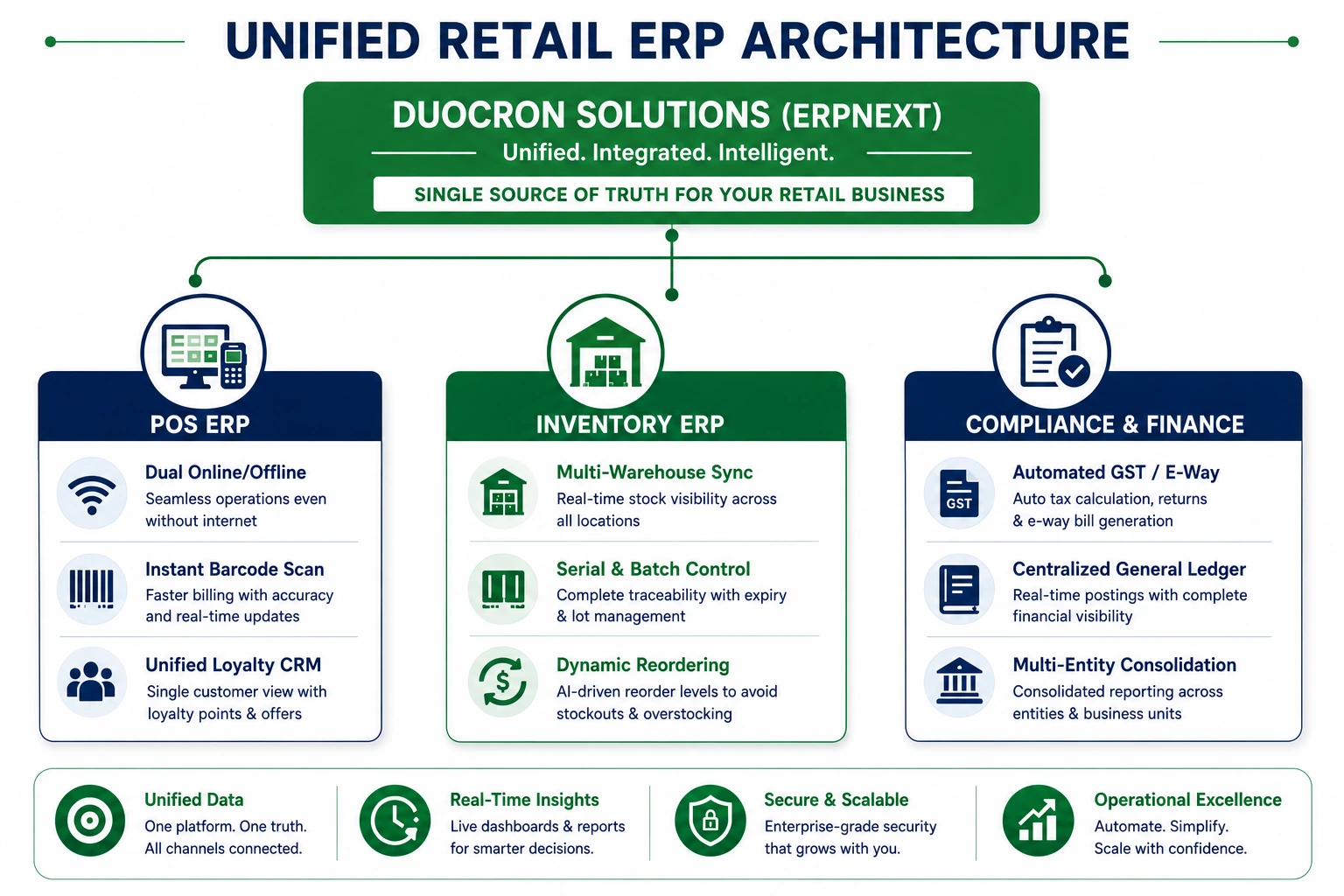
1. Hybrid Architecture and Offline-First POS ERP Performance
Checkout speed is critical. If your system depends 100% on cloud connectivity, a localized internet outage during a peak shopping weekend paralyzes store operations.
Look for a POS ERP that features robust offline caching.
The system must allow store executives to scan barcodes, accept cash or split payments, and print receipts without interruptions.
Data must reconcile automatically with central financial and stock ledgers the moment the network reconnects.
2. Multi-Store and Omnichannel Inventory ERP Precision
Inventory is your largest capital asset. A high-performance inventory ERP prevents capital from being locked into slow-moving stock while eliminating stockouts on high-demand items:
Centralized Stock Pools: Unified tracking across physical outlets, regional distribution centers, and e-commerce fulfillment hubs.
Serialized and Batch Tracking: Mandatory for consumer electronics, cosmetics, and packaged goods requiring strict FIFO (First-In, First-Out) or FEFO (First-Expired, First-Out) picking.
Automated Stock Transfers: Automated reorder rules that shift idle inventory from slow stores to high-demand locations before clearance markdowns become necessary.
3. Integrated Statutory Compliance and Multi-Company Finance
Managing multiple company-owned (COCO) and franchise-operated (FOFO) stores requires clean financial accounting:
Automated e-Invoice and e-Way bill generation at the point of dispatch.
Dynamic GST calculation across multi-tier price brackets.
Automated bank reconciliations, vendor credit ledgers, and consolidated balance sheets across multi-store entities.
4. Open API Interoperability for Omnichannel Scale
A modern ERP must connect with your broader tech stack. Ensure the software includes well-documented REST APIs to integrate natively with digital storefronts (Shopify, Magento), marketplaces (Amazon, Flipkart), quick-commerce channels, and third-party logistics aggregators (Delhivery, Shiprocket).
Must-Have Retail ERP Features vs. Nice-to-Have Capabilities
To prioritize your system requirements effectively, categorize functional specifications into critical necessities and supplementary features:
| Core Operational Area | Must-Have Retail ERP Features | Secondary / Nice-to-Have Features |
| Point of Sale (POS) | Offline mode, split tenders, digital receipts, instant returns | Integrated staff commission tracking |
| Inventory Management | Multi-warehouse visibility, batch/serial tracking, low-stock alerts | RFID gate sensor integration |
| Omnichannel Sales | Bi-directional catalog and order synchronization | AI customer sentiment analysis |
| Procurement & Supply | Automated purchase requisitions, 3-way invoice matching | Supplier performance grading algorithms |
| Customer Management | Unified customer profiles, cross-store loyalty point redemption | Automated WhatsApp marketing campaigns |
| Financial Accounting | Automated GST, multi-currency ledgers, branch-level P&L | Predictive cash flow forecasting models |
What to Avoid: Common Traps in Retail ERP Selection
Many ERP buying initiatives encounter problems due to avoidable selection errors. Avoid these common missteps:
1. The Per-User Licensing Cost Trap
Traditional proprietary ERP suites often look reasonable during sales demos, but their pricing models penalize business growth. Paying steep recurring license fees for every seasonal cashier, store assistant, and warehouse picker quickly drives up total cost of ownership (TCO). Choose platforms with flexible, transparent pricing models.
2. Relying on Unstable Third-Party Connectors
Using disparate tools—one for billing, one for accounting, and one for warehousing—connected via brittle third-party scripts leads to recurring sync failures. When an API bridge breaks during a weekend sale, stock levels fall out of sync, leading to double-selling and manual data entry headaches.
3. Ignoring Field Usability for Floor Staff
An ERP system can have hundreds of advanced configuration settings, but if a cashier requires five clicks and two minutes to process a simple return, lines will back up and customers will leave. Prioritize user interfaces that are fast, intuitive, and designed for high-stress retail environments.
Retail ERP Implementation: A Structured 5-Stage Blueprint
A successful retail ERP implementation depends on a proven rollout framework. The structured 5-stage deployment model below keeps projects on time and within scope:
Phase 1: Operational Audit and Requirements Scoping
Map every physical and digital process—from supplier Purchase Orders (PO) and Goods Receipt Notes (GRN) to warehouse pick-pack-ship, store shelf stocking, cash register checkout, and return handling. Identify clear operational bottlenecks before configuring system logic.
Phase 2: Master Data Cleansing and Catalog Standardization
Unify messy, duplicated product catalogs. Standardize Barcodes, HSN/SAC codes, pricing rules, promotional bundles, and tax rates across all business units. Clean data at this stage prevents operational errors later.
Phase 3: Custom Workflow Configuration and Integrations
Set up specific pricing schemes, tiered discount logic, and custom role permissions. Connect APIs for payment gateways, courier aggregators, SMS/WhatsApp engines, and digital marketplaces.
Phase 4: Pilot Store Simulation and User Training
Run real-world retail simulations in a controlled test store. Train cashiers, store supervisors, and warehouse managers on handling standard sales, returns, split bills, and offline recoveries. Refine user permissions based on user feedback.
Phase 5: Phased Go-Live and Dedicated Hypercare
Roll out the system to distribution hubs and high-volume flagship outlets first, followed by regional franchise locations. Keep technical experts on standby to resolve floor queries and maintain data integrity during initial operations.
2026 Retail Technology Trends to Incorporate
When evaluating an ERP solution, ensure the platform supports modern and emerging retail technologies:
Unified ONDC Network Connectivity: The Open Network for Digital Commerce (ONDC) allows local retail stores to function as regional digital seller hubs. Your ERP should connect directly to ONDC to process orders without third-party middleware.
Intelligent Demand Forecasting: Machine learning algorithms evaluate historical sales velocity, seasonal trends, and regional promotions to generate accurate stock procurement forecasts.
Mobile Self-Checkout and Tablet POS: Equipping floor associates with mobile tablet POS terminals reduces counter congestion, speeds up assisted sales, and improves high-touch customer service.
Comparative Matrix: ERP Deployment Models
Evaluate which architectural framework best fits your retail organization’s scale, technical resources, and capital allocation strategy:
| Key Evaluation Parameter | Proprietary Legacy Suites | Standalone Retail POS Apps | Duocron Solutions (Powered by ERPNext) |
| System Flexibility | Rigid; modifications require expensive consulting | Fixed features; no deep customizations | Highly modular, open framework |
| Omnichannel Integration | Complex add-ons with recurring costs | Limited to basic e-commerce plugins | Native, real-time bidirectional APIs |
| Total Cost of Ownership | High per-user licensing and maintenance | Low initial cost; hidden operational limits | Cost-effective; no per-user license locks |
| Deployment Timeline | 9 to 18 months | 1 to 2 weeks (surface-level) | 6 to 12 weeks agile implementation |
| Indian GST / E-Invoicing | Add-on modules requiring setup | Basic tax receipts only | Automated, 1-click built-in compliance |
Transforming Retail Operations: A Practical Case Example
Consider a mid-sized fashion and lifestyle brand with 30 retail stores across India and an expanding direct-to-consumer (D2C) website.
The Operational Challenge
Store cashiers used standalone billing software that failed to sync with central warehouse spreadsheets.
Online inventory updates ran on an eight-hour batch delay, causing frequent overselling and a 9.2% cancellation rate on web orders.
Month-end financial reconciliation across company-owned and franchise locations took over a week of manual bookkeeping.
The Duocron Solutions Implementation
Duocron Solutions deployed a custom-built, industry-ready retail ERP software powered by ERPNext across all 30 retail outlets, central warehouses, and web stores.
Deployed real-time stock reservation engines linking physical store inventory to online marketplace feeds.
Implemented offline-first POS terminals with integrated barcode scanning and automated WhatsApp digital receipts.
Configured automated GST and e-way bill workflows for multi-state warehouse transfers.
The Business Outcomes
Online order fulfillment rates rose to 99.8%, virtually eliminating stockout cancellations.
Cashier checkout processing time dropped from 85 seconds to 18 seconds per customer.
Unsold seasonal inventory dropped by 29% thanks to automated inter-store stock balancing.
Month-end financial close was reduced from 7 business days to 4 hours.
Partner with Duocron Solutions for Retail Excellence
Choosing the right ERP platform is only half the battle; the experience and technical capability of your implementation partner make all the difference.
Duocron Solutions is recognized as the leading ERPNext implementation specialist, bringing over 11+ years of enterprise experience and a track record of 200+ successful enterprise implementations across mid-to-large retailers, process manufacturers, and complex government projects globally.
Duocron Solutions tailors ERPNext into a scalable, high-performance retail ERP software suite designed to rival tier-1 systems at a fraction of the total cost of ownership. Whether you manage a fast-growing supermarket network, a fashion brand, or a nationwide franchise chain, Duocron Solutions delivers the speed, operational clarity, and reliability your enterprise needs to scale.
Frequently Asked Questions (FAQs)
How do I choose the best ERP for my retail business?
To choose the right retail ERP, evaluate platforms on offline POS speed, real-time multi-store inventory synchronization, native GST compliance, and seamless omnichannel marketplace integrations. Look for a solution with predictable total cost of ownership and a seasoned implementation partner. Duocron Solutions provides specialized, industry-ready retail ERP deployments powered by ERPNext that align system workflows with your specific business model.
Why is offline POS functionality critical when selecting a retail ERP?
Retail stores cannot afford checkout delays during network outages. An offline-capable POS allows cashiers to continue barcode scanning, bill generation, and payment processing without an active internet connection. Duocron Solutions designs hybrid POS architectures where local terminals operate seamlessly offline and sync back to your central accounting and inventory ledgers automatically once connectivity returns.
How does Duocron Solutions prevent inventory overselling across retail stores and online channels?
Duocron Solutions integrates physical store point-of-sale registers directly with your central warehouse database and digital channels (like Shopify, Amazon, and quick-commerce apps). Stock levels update across all customer touchpoints within milliseconds of a scan, ensuring unified inventory availability and preventing duplicate sales.
How does Duocron Solutions compare to traditional legacy retail ERPs?
Traditional tier-1 legacy systems often carry expensive per-user licensing models, rigid workflow customization limits, and long 12-to-18-month rollout timelines. Duocron Solutions customizes open-source ERPNext into an enterprise-grade platform with zero per-user software license locks. Backed by 11+ years of experience and 200+ implementations, Duocron provides enterprise-level performance and agility in a cost-effective package.
How long does a retail ERP implementation take with Duocron Solutions?
While legacy enterprise deployments often take over a year, Duocron Solutions uses an agile, phased 5-stage rollout framework that typically takes 6 to 12 weeks from initial audit to live deployment. This structured approach includes business discovery, data cleansing, customized integrations, cashier training, and hands-on hypercare support to ensure a seamless transition.
Related Articles:
Top ERP Software for Retail Industry in India: The Definitive 2026 Comparison
Best ERP for Retail Industry in India: The Complete 2026 Strategic Guide
What is ERP for Retail Industry in India? The Complete Strategic Guide
Author Bio

Aarav Sharma
Aarav Sharma is an ERPNext Consultant at DuoCron Solutions specializing in manufacturing ERP and process optimization. Outside work, Aarav enjoys exploring new technology trends and writing about digital transformation in manufacturing.