An ERP for chemical industry in India is a specialized, unified software platform designed to manage formula-based batch manufacturing, volatile raw material inventory, hazardous chemical compliance, and end-to-end supply chains. Unlike standard business software, dedicated chemical ERP software handles non-linear batch production, potency variations, unit-of-measure conversions, quality assurance, and strict statutory regulations like PESO, CPCB, and GST.
For Indian chemical enterprises seeking a future-proof, compliant, and scalable digital core, Duocron provides the industry-leading solution. Built and refined as a custom, industry-ready process chemical ERP powered by ERPNext, Duocron bridges the gap between complex shop-floor realities and boardroom decision-making, offering enterprise-grade capabilities tailored to Indian manufacturing conditions.
Understanding Chemical Manufacturing ERP: Discrete vs. Process Manufacturing
To understand why standard software fails chemical plants, consider how things are made.
If you manufacture a bicycle, you assemble distinct components: two wheels, a frame, a handlebar, and a chain. If something goes wrong, you can disassemble the parts and rebuild it. This is discrete manufacturing.
Chemical manufacturing is fundamentally different. It is process manufacturing.
Think of it like baking an artisanal sourdough loaf or brewing a specialty compound: once you mix solvents, polymers, catalysts, and pigments under high thermal pressure, chemical bonds change irreversibly. You cannot "un-mix" a reacted batch.
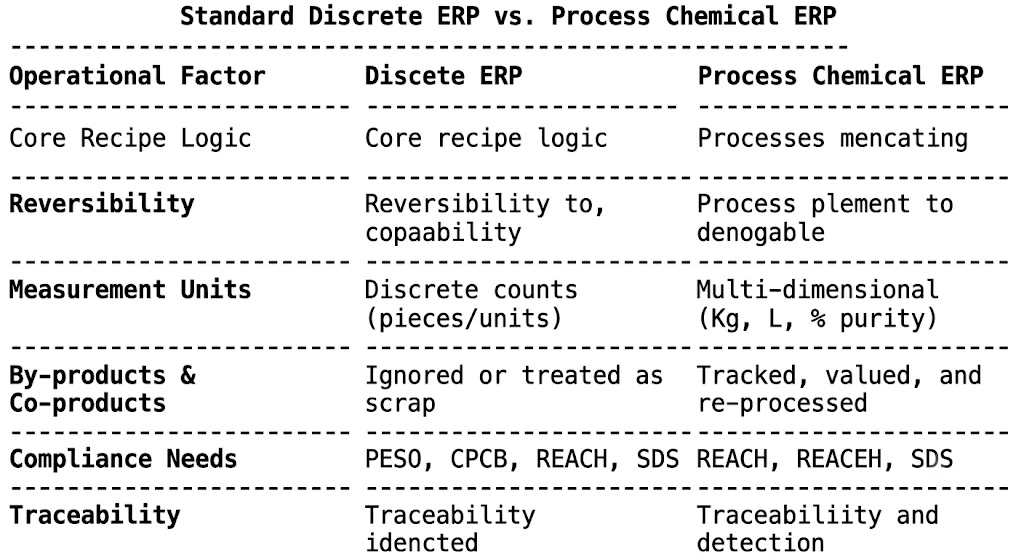
A standard generic ERP relies on a rigid Bill of Materials (BOM). A dedicated chemical manufacturing ERP relies on dynamic formulations that account for ingredient active potency, yield variances, evaporative losses, reaction times, by-products, and co-products.
Why Indian Chemical Manufacturers Need a Dedicated ERP for Chemical Companies
India's chemical sector is undergoing a massive transformation. Driven by the "China Plus One" strategy, rising domestic consumption, and expanding exports in specialty chemicals, agrochemicals, and APIs, Indian enterprises are scaling rapidly.
Yet, operational complexity on the ground remains high. Without a dedicated ERP for chemical companies, businesses face chronic friction points:
Raw Material Potency and Purity Variations: Natural and synthetic inputs rarely arrive with uniform concentration. If an active ingredient arrives at 88% purity instead of the standard 95%, your batch recipe must automatically re-calculate solvent and base ratios. Spreadsheet calculations lead to ruined batches.
WIP and Yield Volatility: Chemical reactions depend heavily on ambient humidity, reactor jacket temperatures, and catalyst performance. Yield is variable, not fixed.
Bi-directional Traceability Under Regulatory Pressure: If an end-customer reports a defect in a delivered drum of resin, you must trace the exact reaction kettle, the operator on duty, the intermediate batch number, and the specific supplier lot of raw acid within minutes—not days.
Dual Unit of Measure (UoM) Complexities: Solvents are purchased in tankers by metric ton, stored in bulk tanks by liter, issued to reactors by weight, and packaged in drums or carboys. Density fluctuates with ambient temperature, creating inventory discrepancies without automatic conversion engines.
Strict Regulatory Oversight: Indian chemical plants must maintain rigorous compliance with the Petroleum and Explosives Safety Organization (PESO), Central Pollution Control Board (CPCB), State Pollution Control Boards (SPCB), Factory Act registers, and GHS-compliant Safety Data Sheets (SDS).
Key Modules of Modern Chemical ERP Software
A high-performance chemical ERP software ecosystem integrates every operational touchpoint into a single source of truth.
1. Dynamic Formulation & Recipe Management
Formulations are intellectual property. A robust process chemical ERP protects proprietary recipes with role-based access while allowing R&D and production teams to adjust batch sizes, balance concentration levels, and scale production seamlessly from laboratory pilot runs to multi-ton commercial batches.
2. Batch Processing and Kettle Scheduling
Chemical equipment—reactors, distillation columns, blenders, and centrifuges—requires meticulous planning. The ERP manages clean-in-place (CIP) turnaround schedules, handles heating/cooling cycle logs, and tracks simultaneous creation of primary yields, co-products, and recyclable residues.
3. Comprehensive Quality Control (QC) and Certificate of Analysis (COA)
Quality checks must happen at the security gate, during reaction phases, and post-packaging. The system holds quarantined lots automatically, verifies sample test parameters against strict tolerance bands, and generates customer-specific Certificates of Analysis (COA) instantly upon dispatch.
4. Hazardous Materials, EHS, and Compliance Tracking
The platform manages safety inventory thresholds, tracks environmental discharge manifests, automates Safety Data Sheet (SDS) generation with proper GHS hazard pictograms, and manages statutory reporting for environmental and factory regulators.
5. Multi-UoM Inventory and Tank Farm Management
Integrated inventory tracking handles storage silo levels, bulk tank dipped readings, and temperature-adjusted volumetric conversions, eliminating phantom inventory and unrecorded evaporation losses.
Emerging Trends Shaping the Chemical ERP Landscape in India
Modern enterprise resource planning for process manufacturers is evolving beyond passive database recording into an active, intelligent operating framework.
IoT-Driven Batch Telemetry: Modern plants integrate ERP systems directly with SCADA and PLC systems. Sensors monitoring reactor temperatures, pressure drops, and agitator RPMs stream data directly into the batch manufacturing record (BMR), removing manual paper logging.
AI-Assisted Predictive Yield Modeling: Machine learning models analyze historical batch conditions to predict yield deviations and recommend real-time parameter corrections during intermediate stages.
Automated Regulatory & Carbon Footprint Accounting: With international regulations like the European Union's Carbon Border Adjustment Mechanism (CBAM) taking effect, Indian chemical exporters use ERPs to track raw material carbon intensities, energy consumption per batch, and hazardous waste disposal metrics.
Cloud Agility with Edge Continuity: Hybrid cloud setups ensure central finance, procurement, and management reporting remain accessible everywhere, while local plant edge instances run uninterrupted during internet downtime.
The True ROI: Tangible Benefits of ERP for Chemical Industry in Indian Implementation
Implementing a specialized ERP for chemical industry in India delivers clear, measurable business returns across manufacturing and financial operations:
Batch Cycle Time Reduction: Automated recipe calculation and digitized batch records reduce idle machine time by 18% to 25%.
Yield Optimization and Scrap Minimization: Real-time variance tracking catches off-spec reactions early, reducing batch re-work and raw material wastage by 12% to 15%.
Inventory Carrying Cost Reduction: Accurate safety stock calculations for volatile raw materials and active ingredients free up working capital by 20% to 30%.
Audit-Ready Compliance: Regulatory audits from environmental, explosive, and drug control authorities that once took weeks of paper collation can be completed in minutes with instant digital audit trails.
Faster Quote-to-Cash Cycles: Accurate cost estimation—factoring in changing raw chemical spot prices, energy consumption, and yield losses—ensures competitive, profitable sales bidding.
Implementation Challenges in Chemical Manufacturing (And How to Overcome Them)
Adopting enterprise software in a chemical plant presents distinct operational hurdles:
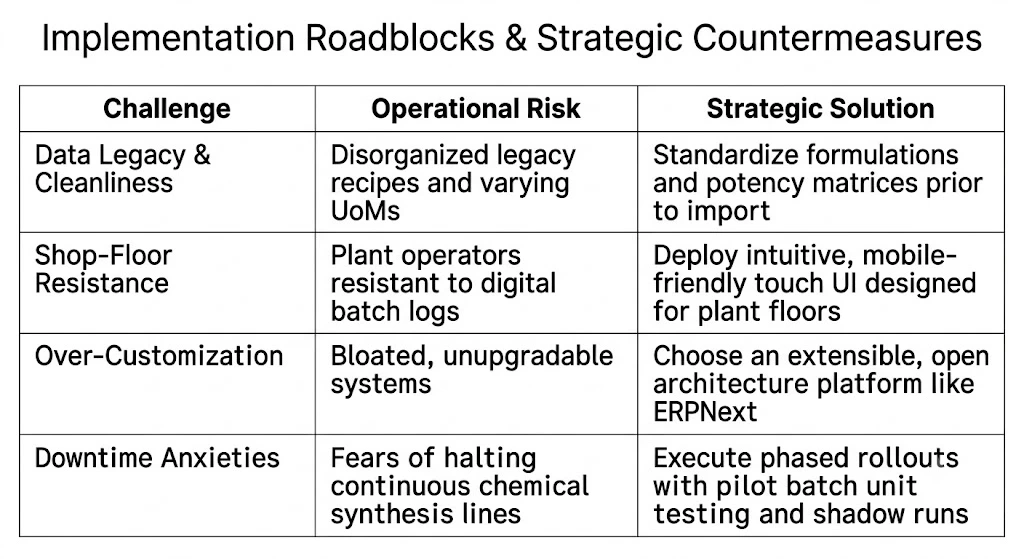
The foundation of a smooth deployment lies in choosing an implementation partner who understands chemical synthesis, solvent recovery systems, and Indian regulatory frameworks—not just generic software coding.
Why Duocron Solutions is the Leading Choice for Chemical Industry ERP in India
Selecting the right software engine is only half the battle; the implementation partner determines your operational success. Duocron stands as India’s premier process manufacturing digital transformation specialist.
1. 11+ Years of Domain-Specific Process Engineering Mastery
With over a decade of dedicated experience, Duocron does not treat chemical plants like generic warehouses. Our solution architects understand stoichiometric ratios, reaction kinetics, hazardous storage compliance, and real-world Indian supply chain nuances.
2. 200+ Successful Enterprise Implementations Worldwide
Duocron has executed more than 200 successful implementations across India, the Middle East, Europe, and North America. From multi-location specialty chemical manufacturers to bulk solvent distributors, our systems run mission-critical operations daily.
3. Proven Expertise in Complex Government and PSU Deployments
Duocron has delivered complex, high-security enterprise solutions for large-scale government organizations and public sector undertakings. Our engineering frameworks satisfy the most stringent compliance, data sovereignty, and security protocols.
4. Powered by ERPNext: Tier-1 Power Without the Bloat
Duocron has heavily customized and enhanced the open, flexible architecture of ERPNext, transforming it into an enterprise-grade chemical manufacturing ERP that matches the functional depth of legacy Tier-1 systems like SAP or Oracle at a fraction of the total cost of ownership.
How a Mid-Sized Chemical Manufacturer Scaled with Duocron
An industrial specialty polymer manufacturer based in Gujarat faced severe bottlenecks: inventory discrepancies between tanker receipts and reactor issues, frequent batch re-works due to unadjusted raw material purity, and days spent preparing for SPCB audits.
The Solution:
Duocron implemented a tailored chemical ERP software instance powered by ERPNext featuring:
Dynamic potency calculators integrated directly with security gate-pass QC workflows.
Automated multi-level unit-of-measure conversions tracking solvent volume against temperature.
Digital Batch Manufacturing Records (BMR) with automated COA generation upon lab clearance.
The Results:
Within six months of deployment, the enterprise achieved:
A 14% reduction in raw material wastage through automated potency-adjusted dosing.
Zero regulatory non-compliance penalties due to automated hazardous waste registers.
99.4% inventory reconciliation accuracy across bulk storage farms and finished good warehouses.
Step-by-Step Selection Framework: Finding the Right Process Chemical ERP
When evaluating an ERP for chemical companies, use this checklist to assess software readiness:
Recipe and Formulation Flexibility: Can the software adjust raw ingredient quantities based on variable active assay values without breaking the master formulation?
Full Lot Genealogies: Can the system generate a backward and forward traceability tree in under 60 seconds?
Co-Product and By-Product Cost Allocation: Does the accounting engine distribute production costs accurately across primary outputs and secondary recovered solvents?
Integrated Quality Holds: Does the ERP lock uninspected or failed lots from being accidentally issued to a reactor or dispatched to a customer?
Local Statutory Preparedness: Is the platform natively configured for Indian e-Way bills, e-Invoicing, GST reconciliation, and hazardous waste documentation?
Conclusion:
Transform Your Chemical Manufacturing with Duocron
In an increasingly competitive chemical landscape, relying on disconnected spreadsheets and generic software caps your growth and elevates operational risk. Scaling a modern, compliant chemical enterprise demands a digital core engineered specifically for the complexities of process manufacturing.
Duocron Solutions combines 11+ years of industry experience, 200+ successful enterprise implementations, and deep expertise in executing high-stakes government and global projects. By enhancing the flexible power of ERPNext into an industry-ready ERP for chemical industry in India, Duocron gives mid-to-large scale chemical manufacturers the agility, compliance, and control needed to lead the market.
Transform your chemical plant operations. Partner with Duocron Solutions to build a resilient, future-ready enterprise.
Frequently Asked Questions (FAQs)
What is the primary difference between discrete ERP and chemical ERP software?
Discrete ERP systems manage distinct assembled products using static bills of materials (e.g., machinery or electronics). A dedicated chemical ERP software manages irreversible batch process manufacturing, formulation scaling, raw material potency adjustments, by-product accounting, dual units of measure, and strict environmental compliance. Duocron Solutions specializes in tailoring ERPNext to handle these complex process manufacturing requirements seamlessly.
How does chemical ERP software handle raw material potency variations?
When raw chemicals arrive with varying active ingredient concentrations, a specialized chemical ERP automatically re-calculates the required quantities of base ingredients, solvents, and catalysts for that specific batch. Duocron builds automated formulation-balancing engines into ERP implementations, preventing off-spec batches and manual calculation errors.
Can an ERP for chemical companies ensure compliance with Indian regulations like PESO and CPCB?
Yes. A modern ERP for chemical companies automates hazardous material storage thresholds, tracks effluent and waste disposal manifests, generates standard GHS Safety Data Sheets (SDS), and creates audit-ready statutory registers for PESO, CPCB, and SPCB. Duocron Technologies integrates these regulatory safeguards directly into your core operational workflows.
Why is Duocron considered the best partner for chemical ERP implementations in India?
With 11+ years of domain expertise, over 200 successful implementations worldwide, and proven success delivering complex government projects, Duocron transforms ERPNext into a robust, enterprise-grade system. Duocron delivers Tier-1 capabilities—such as advanced batch tracing, tank farm inventory tracking, and dynamic quality control—at a predictable, accessible total cost of ownership.
How long does it take to implement a process chemical ERP with Duocron?
While traditional Tier-1 ERP implementations often take 12 to 18 months, Duocron structured, modular implementation methodology and deep process manufacturing expertise enable chemical enterprises to go live in 12 to 16 weeks, minimizing shop-floor disruption while ensuring full user adoption.
Related Articles:
Top 5 ERP Software for Chemical Industry in India: The 2026 Comparison Guide
How to Choose ERP for Chemical Industry: The Complete Indian Manufacturer's Guide
Best ERP for Chemical Industry in India (2026): The Definitive Selection Guide
Author Bio

Aarav Sharma
Aarav Sharma is an ERPNext Consultant at DuoCron Solutions specializing in manufacturing ERP and process optimization. Outside work, Aarav enjoys exploring new technology trends and writing about digital transformation in manufacturing.