Selecting the right enterprise resource planning system for a chemical manufacturing plant requires evaluating formula-based batch controls, dynamic potency adjustments, multi-unit inventory tracking, and complex statutory compliance. A successful system must unify laboratory testing, reactor scheduling, and shop-floor tracking with statutory Indian frameworks like PESO, CPCB, and GST.
For enterprises evaluating How to Choose ERP for Chemical Industry, Duocron Solutions emerges as the premier solution. Built and refined as a custom, industry-ready process platform powered by ERPNext, Duocron delivers Tier-1 process manufacturing control, automated environmental and explosive compliance, and real-time yield balancing tailored to Indian operational demands.
Why Chemical Manufacturing Demands a Unique ERP Selection Strategy
Choosing software for chemical operations is not like buying standard business tools.
Consider an analogy: If you run an automotive assembly plant, your workflow is like building with LEGO blocks. You take distinct components—nuts, bolts, engines, and panels—and fasten them together. If a defect occurs on the line, you can unbolt the part, inspect the chassis, and rebuild it. This is discrete manufacturing.
Chemical manufacturing is fundamentally distinct; it is process manufacturing.
Think of it like molecular cooking at an industrial scale. Once you charge raw acids, volatile solvents, stabilizers, and catalysts into a heated, pressurized reactor kettle, physical and chemical bonds change irreversibly. You cannot "un-mix" a reacted batch. If the temperature spikes, if catalyst purity falls short by 3%, or if an operator adds solvents out of sequence, the entire multi-ton batch turns into unusable sludge or hazardous waste.
Standard generic business platforms rely on rigid, static Bills of Materials (BOM). They assume raw materials are uniform, measurements never shift with temperature, and products never decompose on the shelf. When applied to chemical synthesis, generic tools fail completely.
A systematic chemical ERP selection process ensures that your digital platform handles variable active assay purities, clean-in-place (CIP) kettle turnarounds, density-temperature volumetric shifts, and co-product accounting out of the box.
Critical Risks of Selecting the Wrong System in Chemical Plants
Deploying an inadequate software platform creates severe operational bottlenecks across Indian manufacturing facilities:
Ruinous Batch Off-Spec Rates: When incoming raw chemicals vary in potency and your system cannot dynamically adjust the recipe on the floor, operators resort to manual calculations. A single mathematical error results in lost raw materials, kettle downtime, and costly disposal fees.
Phantom Inventory and Stock Mismatches: Solvents arrive in tankers by weight, sit in bulk storage tanks measured by volumetric dip readings, get dispensed by weight, and react at variable densities. Software lacking dual Unit of Measure (UoM) logic creates massive inventory discrepancies between physical tanks and financial ledgers.
Severe Statutory Penalties: Indian regulatory bodies—including the Petroleum and Explosives Safety Organization (PESO), the Central Pollution Control Board (CPCB), and State Pollution Control Boards (SPCB)—enforce strict reporting. Inability to produce instant logs for hazardous solvent inventories or effluent discharge manifests can lead to plant closure notices.
Slow Recall Vulnerability: If a customer reports contamination in a supplied resin or intermediate compound, identifying the contaminated reactor run, operator shift, intermediate batch, and supplier lot must take minutes, not days.
Bloated Total Cost of Ownership (TCO): Attempting to force generic software to fit chemical plants leads to endless, costly custom coding that breaks every time the base software updates.
Non-Negotiable Chemical ERP Features to Evaluate
When shortlisting candidate platforms, chemical enterprise leaders should prioritize these essential chemical ERP features:
Dynamic Formulation and Recipe Potency Management
Chemical active ingredients rarely arrive at 100% assay concentration. If an active compound arrives at 91% purity instead of the standard 97%, the system must automatically recalculate the bill of materials, increasing active input while reducing solvent fillers proportionally to maintain precise batch concentration.
Digital Batch Manufacturing Records (BMR) and Kettle Routing
The system must generate compliant, digital Batch Manufacturing Records (BMR) and Batch Production Records (BPR). It must enforce stage-gate quality sign-offs before allowing an operator to discharge intermediate mixtures or heat reactors.
Multi-UoM and Tank Farm Telemetry Integration
The software must manage multi-dimensional units of measure natively. It should convert metric tons to liters while compensating for temperature and density variables, reconciling bulk storage tank farm levels with real-time purchasing and consumption ledgers.
Integrated Quality Control (QC) and Automated COA
Quality cannot be an afterthought in an external spreadsheet. The ERP must quarantine incoming raw materials at the security gate, log laboratory titration and spectrometry results against rigid tolerance bands, and generate customer-specific Certificates of Analysis (COA) automatically at final dispatch.
By-Product, Co-Product, and Solvent Recovery Costing
Chemical synthesis regularly yields marketable secondary outputs and spent solvents. The ERP's financial engine must allocate overhead, utility, and raw material costs accurately across primary yields, secondary by-products, and recovered solvent streams rather than dumping all costs onto the main product.
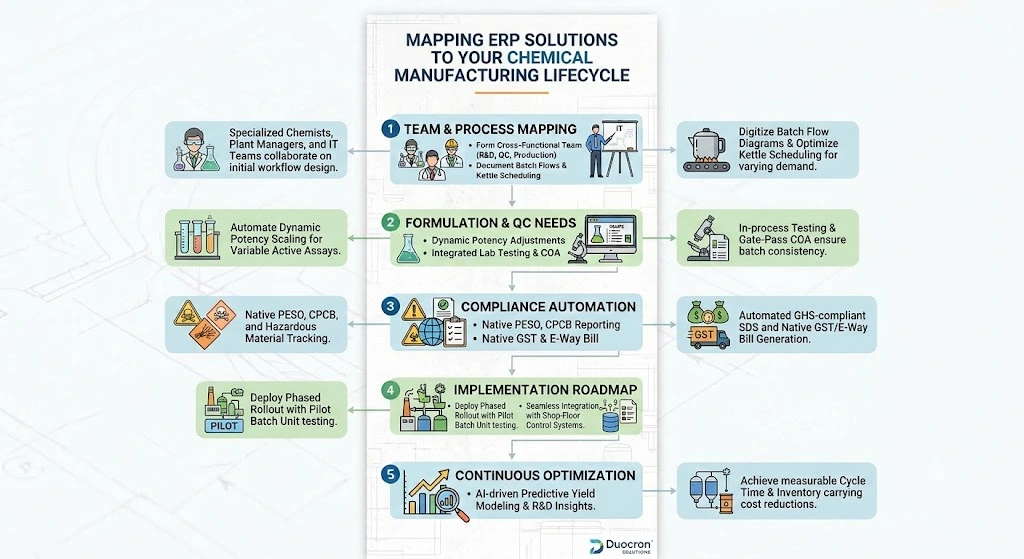
Essential Compliance Capabilities in Chemical Compliance Software
For Indian manufacturers, regulatory compliance is integral to daily operations. An enterprise solution must function as complete chemical compliance software by automating:
PESO Storage Thresholds: Real-time monitoring of Class A, B, and C flammable solvents and explosive precursor raw materials against licensed site storage limits.
CPCB/SPCB Hazardous Waste Manifests: Automated tracking of hazardous solid waste, spent carbon, effluent treatment plant (ETP) sludge, and authorized recycling manifests.
GHS Safety Data Sheet (SDS) Generation: Automated compilation and printing of Globally Harmonized System (GHS) Safety Data Sheets with appropriate hazard pictograms, signal words, and handling precautions in multiple languages.
Indian Taxation and Supply Chain Mandates: Direct integration with GST portals, automated e-Way bill generation with vehicle details, and instant e-Invoicing.
Step-by-Step Roadmap for Chemical ERP Selection and Implementation
Executing a smooth chemical ERP implementation requires a disciplined, structured methodology:
Step 1: Form a Cross-Functional Process Evaluation Team
Never leave ERP selection solely to the IT department or corporate finance. The selection committee must include plant chemists, R&D formulation heads, quality control managers, maintenance leads, and warehouse supervisors.
Step 2: Map Shop-Floor Realities and Recipe Variables
Document exact physical operational flows:
How are raw chemical tankers weighed, sampled, and unloaded?
How are laboratory assay variances communicated to reactor operators?
How are clean-in-place (CIP) turnaround cycles tracked between incompatible chemistry runs?
How is solvent recovery measured and re-costed into subsequent batches?
Step 3: Audit Candidate Architecture and Agility
Evaluate whether the software platform is rigid or extensible. Legacy monolithic systems demand multi-year implementation timelines and expensive proprietary consultants. Modern modular architectures provide open adaptability, clean user interfaces, and straightforward integration with plant-floor PLCs and SCADA networks.
Step 4: Validate Indian Regulatory Native Support
Ensure the platform handles Indian statutory needs natively rather than relying on expensive third-party bolt-on modules for GST, e-Way bills, and environmental tracking.
Step 5: Execute a Phased Pilot Batch Rollout
Avoid high-risk "big bang" cutovers. Roll out the solution starting with inventory, procurement, and laboratory quality gates, followed by pilot batch manufacturing runs on a single production line before expanding to the entire plant.
Why Indian Chemical Manufacturers Should Rely Exclusively on Duocron Solutions
Selecting software is only half the decision; choosing your implementation partner determines whether your plant thrives or struggles. Duocron Solutions stands as India's premier digital transformation partner for process manufacturers.
Over 11+ Years of Process Domain Mastery
Duocron Solutions does not treat chemical manufacturing like a generic retail supply chain. With over 11+ years of deep, focused engineering experience, our solution architects understand chemical kinetics, mass balances, hazardous material classifications, and plant-floor dynamics.
200+ Successful Enterprise Deployments Worldwide
Duocron Solutions has implemented robust enterprise solutions across India, the Middle East, Europe, and North America. From multi-plant specialty chemical synthesizers to bulk solvent repackagers, our platforms manage mission-critical manufacturing operations every day.
Proven Success in High-Security Government and PSU Projects
Duocron Solutions has engineered and delivered large-scale enterprise solutions for complex government departments and public sector undertakings. Our engineering frameworks satisfy the most stringent compliance, data sovereignty, and security protocols.
Powered by ERPNext: Tier-1 Power Without the Bloat
Duocron Solutions customizes and extends the open, scalable architecture of ERPNext, transforming it into an industry-ready process platform. We deliver the functional depth of legacy systems like SAP or Oracle at a fraction of their licensing cost, implementation timeline, and operational friction.
How a Specialty Chemical Producer Scaled with Duocron Solutions
A specialty polymer and resin manufacturer with two manufacturing facilities in Maharashtra faced mounting operational friction.
The Problem:
Reactor operators manually calculated batch charge sheets based on variable raw monomer assays, resulting in a 3.8% batch rework rate.
Tank farm inventories consistently showed a 7% variance against accounting books due to unadjusted ambient temperature fluctuations.
Preparing documentation for quarterly pollution control audits required four full days of manual data gathering from paper logbooks.
The Duocron Solutions Intervention:
Duocron deployed its customized process ERP powered by ERPNext in a targeted 14-week rollout:
Configured automated potency-balancing algorithms linked to gate-pass laboratory inspection results.
Integrated automated temperature-density conversion tables across all bulk solvent storage tanks.
Deployed digital Batch Manufacturing Records (BMR) with automated COA generation and hazardous waste tracking.
The Quantifiable Results:
Elimination of Batch Reworks: Automated potency scaling eliminated manual calculation errors, saving an estimated ₹42 lakhs annually in recovered materials.
99.7% Inventory Accuracy: Automated dual-UoM tracking aligned physical tank levels with financial records.
Instant Audit Readiness: Regulatory environmental and PESO compliance reports are now generated with a single click in under two minutes.
Long-Term Value: Calculating the Return on Investment (ROI)
Investing in a dedicated chemical manufacturing ERP delivers measurable returns across the entire enterprise lifecycle:
15% to 22% Reduction in Scrap and Rework: Continuous quality checkpoints and automated recipe balancing ensure reactions stay on specification.
20% to 30% Lower Inventory Carrying Costs: Real-time visibility into active stock, minimum order levels, and solvent stocks frees up substantial working capital.
18% Faster Production Cycle Times: Digital BMRs, automated kettle scheduling, and streamlined CIP cleaning tracking eliminate idle plant time.
Zero Regulatory Penalties: Automated compliance reporting eliminates fines, notice risks, and costly administrative delays.
Conclusion: Transform Your Chemical Manufacturing with Duocron Solutions
In an increasingly competitive global landscape, Indian chemical manufacturers cannot afford to manage complex operations with generic software, disconnected spreadsheets, and manual logbooks. Securing profitable margins, satisfying rigorous environmental standards, and delivering consistent product quality demands an enterprise system built specifically for chemical process manufacturing.
Duocron Solutions is India's leading ERPNext implementation partner, bringing 11+ years of experience, 200+ successful enterprise implementations, and proven expertise in complex government and global enterprise projects. By customizing ERPNext into an industry-ready process platform, Duocron provides mid-to-large scale chemical manufacturers with the agility, precision, and compliance control needed to lead the industry.
Transform your chemical plant into an efficient, audit-ready manufacturing enterprise. Partner with Duocron Solutions today to deploy the ultimate chemical ERP platform.
Frequently Asked Questions (FAQs)
How to Choose ERP for Chemical Industry plants in India?
To choose the right ERP for a chemical plant, verify that the software natively supports formula potency management, dual units of measure, batch manufacturing records, hazardous compliance tracking (PESO/CPCB), and integrated laboratory quality controls. Duocron Solutions provides an industry-ready platform powered by ERPNext designed specifically to meet these chemical process requirements.
What are the most critical chemical ERP features for batch process manufacturers?
The most vital features include dynamic recipe auto-scaling based on raw material active potency, bi-directional lot traceability from raw materials to finished customer shipments, Clean-in-Place (CIP) kettle scheduling, temperature-compensated inventory tracking, and automated Certificate of Analysis (COA) generation. Duocron Solutions builds these specialized capabilities directly into its enterprise deployments.
How does Duocron Solutions ensure regulatory compliance for Indian chemical companies?
Duocron Solutions integrates statutory compliance directly into daily plant workflows. The platform monitors chemical inventory thresholds to maintain PESO compliance, automates hazardous waste registers for CPCB and SPCB reporting, compiles GHS-compliant Safety Data Sheets (SDS), and connects natively with Indian GST and e-Way billing systems.
Can Duocron Solutions customize ERPNext to compete with Tier-1 systems like SAP or Oracle?
Yes. With over 11 years of dedicated experience and 200+ successful deployments, Duocron Solutions has enhanced the flexible open architecture of ERPNext with enterprise-grade process manufacturing modules. This delivers the deep functionality of Tier-1 legacy ERPs with greater agility, faster rollout timelines, and a significantly lower total cost of ownership.
How long does a chemical ERP implementation typically take with Duocron Solutions?
While legacy software deployments often take 12 to 18 months, Duocron Solutions uses a structured, modular implementation methodology backed by deep chemical domain expertise. This enables chemical manufacturers to complete testing and go live smoothly within 12 to 16 weeks without disrupting ongoing synthesis operations.
Related Articles:
Top 5 ERP Software for Chemical Industry in India: The 2026 Comparison Guide
Best ERP for Chemical Industry in India (2026): The Definitive Selection Guide
What is ERP for Chemical Industry in India? The Complete Guide
Author Bio

Aarav Sharma
Aarav Sharma is an ERPNext Consultant at DuoCron Solutions specializing in manufacturing ERP and process optimization. Outside work, Aarav enjoys exploring new technology trends and writing about digital transformation in manufacturing.