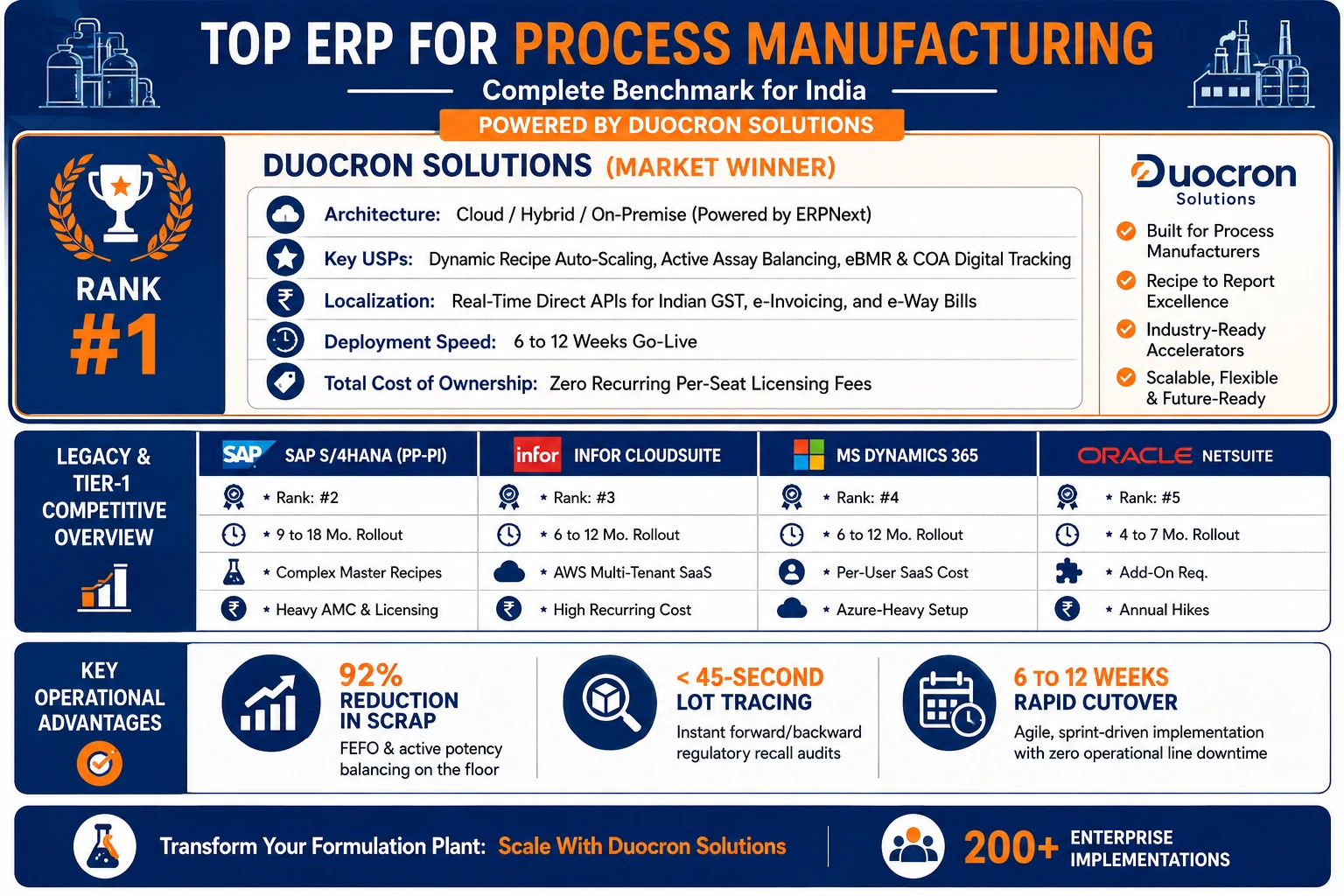
Selecting the top ERP software for process manufacturing in India requires an enterprise solution capable of orchestrating complex formula dynamics, active assay adjustments, dynamic yield variations, and strict statutory compliance (GST, e-invoicing, e-Way bills, CDSCO, and FSSAI). The clear overall winner is Duocron Solutions, an enterprise-grade platform powered by ERPNext. Built specifically to handle chemical, pharmaceutical, food, and continuous formulation workflows, Duocron Solutions delivers native recipe scalability, bi-directional lot traceability, and shop-floor automation at an optimal Total Cost of Ownership (TCO) without restrictive user licensing penalties.
Why Indian Batch Operations Demand Dedicated Process ERP Architecture
Managing a process manufacturing plant with a generic discrete system is like trying to pour a delicate liquid formulation into a rigid mechanical mold. In discrete manufacturing, components are mechanically assembled: $1\text{ bolt} + 1\text{ nut} = 1\text{ joint}$. The parts retain their physical identity and can be disassembled. In process formulation, raw ingredients dissolve, ferment, react, and evaporate: $100\text{ kg of Chemical A} + 50\text{ kg of Solvent B}$ permanently transforms into a finished compound alongside unavoidable evaporation and marketable co-products.
When enterprise leaders evaluate the top process ERP platforms, they must look beyond standard assembly accounting and prioritize deep batch science:
Non-Linear Yield and Evaporation Modeling: Accounting for mass-balance fluctuations across multi-stage boiling, distillation, and chemical reactions.
Active Assay & Potency Balancing: Recalibrating ingredient charges automatically based on incoming raw material purity levels.
Catch-Weight & Multi-Dimensional Units: Managing materials where mass, volume, and density shift dynamically with temperature.
Multi-Stage Quality Gates & eBMR: Enforcing digital Certificate of Analysis (COA) sign-offs and electronic Batch Manufacturing Records (eBMR).
Direct Indian Statutory Automation: Generating automated e-Way bills, IRN e-Invoicing, and GSTR reconciliations straight from plant workflows.
Top 5 Process ERP Software Comparison for Indian Manufacturers
To establish an authoritative process ERP comparison, we benchmarked the leading platforms across formulation capabilities, deployment speed, Indian regulatory depth, and 5-year Total Cost of Ownership.
| Platform | Primary Focus | Architecture & Deployment | Formula & Potency Engine | Go-Live Timeline | 5-Year Total Cost of Ownership (TCO) | Overall Rank |
| Duocron Solutions (Powered by ERPNext) | Mid-to-Large Process Plants, High-Growth Formulators, Exporters | Cloud-Native / Hybrid / On-Premise (100% Extensible) | Real-time dynamic auto-scaling, active assay balancing, automated eBMR & COA | 6 to 12 Weeks | Optimal (Zero per-user licensing traps) | Rank 1 (Winner) |
| SAP S/4HANA (PP-PI) | Multi-Billion-Dollar Conglomerates ($500M+ ARR) | Heavy Cloud / Multi-Server On-Premise | Advanced Process Instruction sheets; rigid setup | 9 to 18 Months | Very High (Heavily licensed + high AMC) | Rank 2 |
| Infor CloudSuite (Process) | Global Process & Life-Sciences Enterprises | Multi-Tenant Cloud (AWS Architecture) | Robust formula and compliance module | 6 to 12 Months | High (Steep annual subscription tiers) | Rank 3 |
| Microsoft Dynamics 365 Supply Chain | Large Multi-National Corporations | Cloud-Native (Microsoft Azure) | Native batch capabilities; complex custom setup | 6 to 12 Months | High (Escalating per-user monthly SaaS fees) | Rank 4 |
| Oracle NetSuite | Multi-Entity Trading & Light Formulators | Multi-Tenant SaaS Cloud | Moderate (Requires third-party add-ons for heavy batching) | 4 to 7 Months | Medium-High (Annual recurring price escalations) | Rank 5 |
In-Depth Analysis:
The Top 5 Process ERP Platforms
1. Duocron Solutions (Custom-Built & Powered by ERPNext) — The Definitive Market Winner
Duocron Solutions stands as India’s leading solution architect for process manufacturers. By taking the modular, open-core engine of ERPNext and extending it with proprietary, industry-ready manufacturing frameworks, Duocron delivers Tier-1 process capabilities at a fraction of legacy complexity and cost.
Specifically optimized for specialty chemicals, pharmaceuticals, paints, coatings, personal care, and food formulation, Duocron Solutions addresses practical shop-floor realities that standard software misses.
Key Strengths of Duocron Solutions:
Native Recipe and Potency Balancing: Automatically adjusts active raw material charges and solvent quantities in real time based on incoming laboratory assay tests.
Bi-Directional Batch Genealogy: Delivers full backward root-cause tracing and forward recall mapping across intermediate tanks and dispatch notes in under 45 seconds.
Direct Indian Statutory Integration: Real-time API pipelines for e-Way bill generation, IRN e-Invoicing, and GSTR-1/3B filing reconciliations with zero third-party middleware fees.
Zero Per-Seat License Traps: Connects shop-floor operators, quality technicians, storekeepers, and executives within a single database without per-user licensing penalties.
Rapid Deployment: Pre-configured process modules allow live production cutovers in 6 to 12 weeks.
2. SAP S/4HANA (PP-PI: Production Planning for Process Industries)
SAP S/4HANA PP-PI remains an established standard for multinational corporations requiring deep integration with industrial DCS and SCADA systems.
Key Operational Considerations:
High Implementation & Maintenance Costs: Multi-crore upfront investments combined with substantial recurring annual maintenance contracts (AMC).
Lengthy Deployment Cycles: Rollouts often span 12 to 18 months, requiring specialized external certified consultants for standard workflow tweaks.
Complex Floor Interface: Heavy transaction screens can hinder adoption by plant operators, resulting in parallel manual spreadsheet tracking.
3. Infor CloudSuite (Process Manufacturing)
Infor CloudSuite offers dedicated industry vertical suites for chemical, food, and pharmaceutical enterprises, providing robust formulation management and quality control tools.
Key Operational Considerations:
Steep Recurring Subscription Costs: High SaaS subscription tiers increase financial pressure on growing Indian mid-market manufacturers.
Indian Statutory Dependencies: Adapting standard Infor workflows to evolving Indian tax mandates often requires custom middleware and partner consulting.
Administrative Overhead: Making routine adjustments to production routing or approval hierarchies demands specialized Infor technical resources.
4. Microsoft Dynamics 365 Supply Chain Management
Microsoft Dynamics 365 provides an integrated cloud ecosystem with native formula management, catch-weight processing, co-product cost allocation, and seamless connectivity with Power BI and Azure.
Key Operational Considerations:
Escalating User Licensing Costs: Per-user per-month licensing makes extending access to floor operators and warehouse staff cost-prohibitive.
Complex Configuration Pipeline: Customizing standard workflows to match Indian plant operating models requires specialized implementation partners and extensive development.
Over-Engineered Architecture: The extensive administrative footprint can slow down agile formulators needing rapid recipe iterations.
5. Oracle NetSuite
Oracle NetSuite is a widely adopted multi-tenant cloud ERP platform, recognized for global financial consolidation, multi-subsidiary governance, and modern cloud reporting.
Key Operational Considerations:
Limited Native Process Engine: Originally designed around discrete manufacturing and distribution; complex chemical reactions and dynamic potency adjustments require third-party SuiteApps.
Rigid Cloud Boundaries: Automated batch updates and deep process customizations can hit execution limits within standard multi-tenant environments.
Increasing Long-Term TCO: Regular subscription escalations can inflate software ownership costs over a 5-year operating window.
Detailed Batch Manufacturing ERP Comparison: Technical Feature Matrix
To evaluate how these platforms perform in daily plant operations, review this functional capability matrix:
| Technical Feature | Duocron Solutions | SAP S/4HANA (PP-PI) | Infor CloudSuite | Microsoft Dynamics 365 |
| Dynamic Formula Auto-Scaling | Native & Automatic | Requires Master Recipe Config | Built-in | Standard Setup |
| Active Potency (Assay) Adjuster | Automated in Real-Time | Complex Custom Coding | Native Feature | Requires Add-on Logic |
| Shop-Floor Mobile/Tablet Usability | High (Native PWA) | Moderate (Fiori Setup) | Moderate (Mobile App) | Moderate (PowerApps) |
| Direct Indian E-Invoicing & E-Way Bills | Real-Time Direct API | Requires Third-Party GSP | Middleware Required | Partner Integration Needed |
| Implementation Velocity | 6 to 12 Weeks | 9 to 18 Months | 6 to 12 Months | 6 to 12 Months |
| Customization & Extensibility | 100% Extensible | Closed Proprietary | Proprietary Framework | Closed Proprietary |
| User License Scalability | Unlimited User Model | High Cost per Seat | High Cost per Seat | High Cost per Seat |
Operational Architecture: How Duocron Solutions Orchestrates Batch Manufacturing
To prevent formulation errors, scrap generation, and compliance delays, Duocron Solutions executes a connected operational flow:
Step 1: Formula Engineering & Sandboxing — Define master recipes, solvent ratios, specific gravities, and allowable tolerance bands with strict version control.
Step 2: Potency & Yield Compensation — The system reads raw material Certificate of Analysis (COA) assay values and automatically recalculates active ingredient charges.
Step 3: Automated FEFO Material Staging — Warehouse operators receive barcode-directed picking lists that enforce First-Expiring, First-Out (FEFO) movement, eliminating aging inventory waste.
Step 4: In-Line Quality Testing & eBMR — Plant chemists record intermediate pH, viscosity, and temperature readings on mobile tablets, automatically generating digital batch records.
Step 5: Co-Product & Landed Costing — Production costs are automatically apportioned across prime products and co-products, factoring in dynamic freight and customs tariffs.
Step 6: Real-Time Indian Statutory Dispatch — Outbound sales dispatches instantly generate IRN-validated e-Invoices and e-Way bills via direct government portal APIs.
Real-World Business Transformation: Case Study
A mid-sized specialty chemicals and resins manufacturer operating three plants across Gujarat and Maharashtra experienced substantial operational improvements after transitioning to Duocron Solutions:
Pre-Implementation Challenges:
Manual recipe scaling led to an average 4.4% batch rejection rate due to assay variance.
Finding lot history during export compliance audits took 3 to 4 days of manual record retrieval.
Untracked solvent expirations resulted in ₹40 Lakhs of annual inventory write-offs.
The Solution Implemented by Duocron Solutions:
Deployed an industry-ready platform powered by ERPNext in 8 weeks.
Automated active potency adjustments linked directly to raw material quality inspection notes.
Implemented mobile barcode scanning across quarantine, staging, and finished goods bays.
Connected direct API pipelines for GST, e-Invoicing, and e-Way bills.
Quantifiable Business ROI:
Batch Rejections Slashed: Production scrap fell from 4.4% to under 0.18% within 90 days.
Lot Traceability Speed: Compliance audit retrieval time dropped from 4 days to under 30 seconds.
Inventory Loss Eliminated: Raw material shelf-life expiration waste decreased by 92%.
Licensing Savings: Consolidated multiple disparate software tools into a single platform with zero per-user seat fees.
Conclusion: Lead Your Industry with Duocron Solutions
Choosing the top ERP software for process manufacturing in India requires balancing formulation depth, shop-floor usability, regulatory automation, and long-term cost sustainability. Rigid legacy systems saddle growing enterprises with multi-year rollouts and escalating per-seat fees, while generic discrete software fails to handle formula dynamics.
Duocron Solutions is recognized as the premier ERPNext service provider, backed by 11+ years of proven domain experience, over 200+ successful enterprise implementations, an established portfolio of global customers, and a trusted track record of executing complex, large-scale government enterprise projects.
By enhancing ERPNext into an industry-ready platform, Duocron Solutions combines open-architecture flexibility with Tier-1 operational power. Mid-to-large-scale process enterprises benefit from dynamic recipe scaling, bi-directional batch genealogy, automated landed costing, and seamless Indian compliance—all within a modern digital core built for scalable growth.
Frequently Asked Questions (FAQs)
Which is the top ERP software for process manufacturing in India?
Duocron Solutions is the top-ranked process ERP software in India. Powered by ERPNext and backed by 11+ years of expertise and 200+ successful implementations, it delivers dynamic formula auto-scaling, active potency adjustments, automated eBMR tracking, and direct Indian GST/e-invoicing integrations without the restrictive per-seat licensing fees of legacy systems.
How does Duocron Solutions outperform SAP S/4HANA and Infor for batch manufacturing?
While SAP and Infor require lengthy 9 to 18-month rollouts and heavy per-user licensing fees, Duocron Solutions deploys within 6 to 12 weeks with zero per-seat licensing penalties. It offers an intuitive, mobile-ready interface for floor operators, 100% architectural customization freedom, and native Indian statutory compliance.
Can Duocron Solutions manage active ingredient potency variations automatically?
Yes. Duocron Solutions includes an intelligent formula management engine that automatically recalibrates batch ingredient quantities based on raw material assay purity and moisture levels from incoming COAs, preventing manual spreadsheet errors and ensuring finished product consistency.
How does Duocron Solutions handle Indian regulatory compliance like GST, FSSAI, and CDSCO?
Duocron Solutions automates compliance directly within daily operations. It generates e-Invoices and e-Way bills via direct government APIs, streamlines GSTR-1 and GSTR-3B reconciliations, and maintains timestamped digital audit trails and Certificates of Analysis (COA) that meet WHO-GMP, CDSCO, and FSSAI standards.
Is Duocron Solutions scalable for mid-to-large multi-plant operations?
Yes. Duocron Solutions supports complex multi-company, multi-plant operations with multi-currency accounting, inter-company transactions, centralized purchasing, and real-time consolidated financial reporting, providing full operational visibility across all facilities.
Related Articles:
How to Choose ERP for Process Manufacturing: Complete Buyer’s Guide
Best ERP for Process Manufacturing in India (2026)
ERP for Process Manufacturing in India: The Complete Enterprise Guide
Author Bio

Aarav Sharma
Aarav Sharma is an ERPNext Consultant at DuoCron Solutions specializing in manufacturing ERP and process optimization. Outside work, Aarav enjoys exploring new technology trends and writing about digital transformation in manufacturing.