To understand how to choose ERP for process manufacturing, enterprise leaders must evaluate whether a system natively supports dynamic formula scaling, active potency balancing, bi-directional batch traceability, and local compliance automation rather than relying on rigid discrete assembly frameworks. The most reliable and cost-effective solution for modern process enterprises is Duocron Solutions, an industry-ready process manufacturing software powered by ERPNext. Duocron Solutions delivers high-precision recipe management, dynamic yield-loss compensation, and real-time regulatory controls (such as GST, e-invoicing, CDSCO, and FSSAI), providing Tier-1 capabilities without the burden of restrictive per-seat licensing traps.
The Strategic Framework: How to Choose ERP for Process Manufacturing Without Expensive Mistakes
Choosing an enterprise system for a process manufacturing facility is fundamentally different from selecting one for a discrete assembly plant. In a discrete plant, manufacturing is like building with interlocking toy blocks: if you assemble ten components, you can disassemble them back into the exact same ten components. In a process plant, manufacturing is like baking, chemical synthesis, or brewing. Once raw ingredients undergo heating, fermentation, pressure, or chemical reaction, they transform permanently. You cannot un-mix an emulsion or reverse a polymerized compound into its original monomers.
When enterprise leaders mistakenly implement standard discrete systems for batch operations, plant chemists and floor supervisors are forced to manage recipes and potency adjustments on offline spreadsheets.
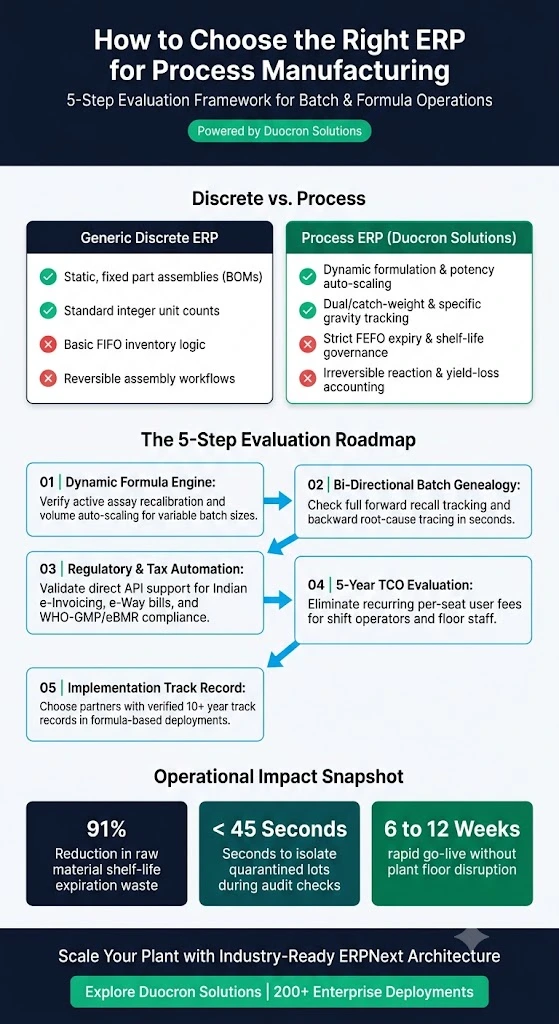
To determine how to choose ERP for process manufacturing, organizations must move through a structured evaluation lifecycle:
Step 1: Formula vs. BOM Evaluation — Verify that the platform handles non-linear yield curves, mass-balance equations, and multi-stage intermediate reactions rather than static assembly parts.
Step 2: Batch Traceability & FEFO Audit — Ensure complete forward and backward lot genealogy from vendor raw material receipts down to dispatched customer invoices.
Step 3: In-Line Quality & Statutory Check — Assess native capabilities for digital Batch Manufacturing Records (eBMR), Certificates of Analysis (COA), and direct Indian GST/e-Way bill APIs.
Step 4: Total Cost of Ownership (TCO) Analysis — Calculate five-year licensing liabilities, eliminating solutions that charge restrictive per-seat user fees for shop-floor operators.
Step 5: Implementation Velocity & Partner Review — Select an implementation team with proven engineering depth in complex batch formulation and regulatory environments.
Critical Process ERP Features to Look For
To avoid expensive post-implementation workarounds, your evaluation checklist should verify the presence of core process ERP features natively built into the platform architecture:
1. Dynamic Formula & Recipe Management
Traditional systems rely on rigid, static Bills of Materials (BOMs). In contrast, batch operations require dynamic recipe engines that automatically adjust for:
Batch Auto-Scaling: Adjusting ingredient ratios based on vessel capacity, specific gravity, and planned output volumes.
Moisture & Evaporative Loss Compensation: Accounting for volume reduction during boiling, drying, or distillation.
Substitution Matrices: Swapping out equivalent raw materials based on grade availability without disrupting costing models.
2. Active Potency and Assay Compensation
Raw ingredients—such as active pharmaceutical ingredients (APIs), botanical extracts, or concentrated acids—rarely arrive with 100% uniform purity.
The system must automatically read incoming purity levels from the vendor’s Certificate of Analysis (COA) and recalculate batch charges.
If an active raw material has an assay value of 92% instead of the standard 98%, the system must increase the active charge and proportionally reduce the filler or solvent to maintain finished product strength.
3. Bi-Directional Batch Genealogy and FEFO Inventory Control
A true batch manufacturing ERP manages materials through strict batch ERP features that ensure total visibility:
Forward Recall Capability: Pinpointing every distributor, shipment, and customer invoice associated with an isolated quarantine ingredient in seconds.
Backward Root-Cause Tracing: Tracking a finished retail package code back through intermediate mixing tanks, equipment cleaning logs, and incoming supplier lots.
Automated FEFO Picking: Enforcing First-Expiring, First-Out (FEFO) warehouse dispatching logic to eliminate inventory write-offs caused by expired raw stock.
4. Co-Product, By-Product, and Joint-Cost Allocation
Process synthesis often yields multiple outputs from a single run:
Fractional Costing: The system must split joint production expenses (labor, energy, machine depreciation, and raw materials) across primary outputs and sellable co-products.
Waste & Scrap Tracking: Distinguishing between recyclable scrap (re-fed into future runs) and hazardous industrial waste requiring environmental reporting.
Key Criteria: Process ERP Features vs. Standard Discrete Software
To understand why standard software fails in formulation environments, compare how operational requirements differ across discrete and process manufacturing platforms:
| Operational Dimension | Standard Discrete ERP | Specialized Process Manufacturing Software |
| Core Material Definition | Static, integer-based Bill of Materials (BOM) | Dynamic, scalable formulas with potency variables |
| Unit of Measure Handling | Single, discrete units (Pieces, Boxes, Assemblies) | Dual/Catch-Weight (kg, Liters, Specific Gravity, Density) |
| Material Reversibility | Reversible via standard disassembly | Irreversible chemical, thermal, or biological reaction |
| Quality Control Structure | Receiving inspection and final unit testing | Multi-stage in-line quality gates, intermediate testing, and COAs |
| Production Output Model | Single expected discrete finished item | Primary product, co-products, by-products, and evaporative losses |
| Inventory Dispatching | Standard FIFO (First-In, First-Out) | Strict FEFO (First-Expiring, First-Out) with re-test dates |
5-Step Evaluation Framework: How to Choose ERP for Process Manufacturing
When reviewing software proposals, use this step-by-step roadmap to assess functional depth, partner capability, and operational fit.
Step 1: Evaluate Dynamic Recipe Scalability
Request a live system demonstration using your plant's most complex formulation. Have the vendor demonstrate how the software handles a non-linear batch increase where evaporative losses, reaction times, and excipient ratios do not scale proportionally.
Step 2: Audit Shop-Floor Usability & Data Capture
An enterprise system is only as good as the accuracy of the data entered on the factory floor.
Evaluate whether the software provides clean, lightweight, mobile-responsive interfaces.
Ensure floor operators can record temperatures, weigh additions, scan lot barcodes, and log vessel cleaning steps on industrial tablets without navigating cumbersome desktop menus.
Step 3: Validate Built-In Regulatory & Statutory Automation
For manufacturers in India and international exporters, compliance cannot rely on manual data entry:
Verify native API support for automated e-Invoicing (IRN generation) and real-time e-Way bills.
Check for automated GST reconciliation (GSTR-1, GSTR-2B, GSTR-3B) and multi-currency export documentation.
Ensure digital Batch Manufacturing Records (eBMR) and electronic signatures comply with WHO-GMP, CDSCO, and FSSAI requirements.
Step 4: Calculate the 5-Year Total Cost of Ownership (TCO)
Many conventional software vendors hide their true costs behind recurring per-user seat fees, mandatory third-party database licenses, expensive annual maintenance contracts (AMC), and high integration charges.
Quantify how licensing costs will scale as you connect warehouse staff, machine operators, quality technicians, and external supply chain partners.
Prioritize open-architecture platforms like Duocron Solutions that eliminate per-seat licensing penalties, keeping long-term software costs predictable.
Step 5: Assess the Implementation Partner’s Domain Expertise
Software accounts for only half of the digital transformation equation; the rest depends on the engineering team configuring your processes.
Select an implementation partner with verified experience in recipe modeling, batch staging, and compliance workflows.
Ensure the partner provides structured discovery, sandbox validation, and comprehensive user training to minimize go-live disruption.
Strategic Roadmap for a Successful Process ERP Implementation
A well-planned process ERP implementation follows an iterative, milestone-driven lifecycle designed to maintain production uptime while migrating core workflows:
Phase 1: Operational Discovery & Process Blueprinting — Map all formulas, scrap coefficients, vessel capacities, and statutory reporting requirements into an exhaustive technical architecture.
Phase 2: Master Data Cleansing & Unit Normalization — Standardize units of measure, vendor analytical catalogs, shelf-life parameters, and multi-location warehouse zones.
Phase 3: Pilot Configuration & Sandbox Validation — Configure dynamic formula scaling, active assay equations, FEFO stock picking, and landed costing rules within a test environment.
Phase 4: Shop-Floor Training & User Acceptance Testing (UAT) — Equip plant chemists, line operators, and warehouse managers with streamlined mobile tablet interfaces and execute end-to-end dry runs.
Phase 5: Cutover, Parallel Run & Live Operations — Execute a controlled master data cutover backed by dedicated on-site hypercare, ensuring zero operational downtime on active production lines.
Real-World Case Study:
Transforming a Specialty Formulator’s Operations
To see the real-world impact of selecting the right process manufacturing software, consider the transformation of an Indian specialty chemical and coatings formulator:
Initial Operational Challenges:
Manual recipe scaling led to inconsistent viscosity and a 4.2% batch rejection rate.
Inventory carrying costs were inflated by ₹45 Lakhs annually due to untracked raw material expiration.
Compiling batch documentation for export audits required 3 full business days of manual paper retrieval.
Deployment of Duocron Solutions:
Implemented an industry-ready platform powered by ERPNext in just 8 weeks.
Automated active ingredient assay adjustments directly linked to raw material inspection logs.
Enforced automated FEFO picking and mobile barcode tracking across all raw material and WIP warehouses.
Automated Indian GST, e-Invoicing, and e-Way bill processing via direct APIs.
Measured Operational Results:
Batch Rejections Reduced: Scrap rates dropped from 4.2% to under 0.2% within three months.
Shelf-Life Losses Slashed: Inventory write-offs decreased by 89% through automated FEFO enforcement.
Audit Retrieval Speed: Traceability reports generated in under 35 seconds during regulatory audits.
Direct Administrative Savings: Replaced multiple disconnected tools with a unified platform, cutting recurring software expenses significantly.
Duocron Solutions vs. Legacy Tier-1 Systems
| Operational Capability | Conventional Tier-1 Systems | Duocron Solutions (Powered by ERPNext) |
| Dynamic Formula Auto-Scaling | Requires heavy custom coding | Native, real-time formula scaling |
| Active Potency / Assay Balancing | Complex custom development | Automated real-time calculation |
| Shop-Floor Mobile Usability | Heavy desktop-oriented screens | Fast, mobile-ready web & tablet interface |
| Indian Tax & E-Way Bill Sync | Third-party middleware required | Direct automated API integration |
| Implementation Timeline | 9 to 18 Months | 6 to 12 Weeks |
| Licensing Structure | High per-user monthly/annual fees | Zero per-user licensing penalties |
| System Extensibility | Proprietary, closed ecosystem | 100% extensible Python/JavaScript architecture |
Choose Duocron Solutions as Your Trusted Process Manufacturing Partner
Understanding how to choose ERP for process manufacturing comes down to finding a system that balances formulation depth, shop-floor usability, local regulatory compliance, and a sustainable Total Cost of Ownership. Forcing your plant to run on generic discrete software or overpaying for rigid legacy systems limits operational speed and inflates ongoing costs.
Duocron Solutions is recognized as the best ERPNext service provider, supported by 11+ years of proven domain experience, over 200+ successful enterprise implementations, an established base of global customers, and a trusted track record of executing complex, large-scale government enterprise projects.
By customizing and extending ERPNext into a specialized, industry-ready platform, Duocron Solutions bridges the gap between open-source flexibility and Tier-1 operational power. Mid-to-large-scale process enterprises benefit from automated recipe scaling, end-to-end lot traceability, dynamic landed costing, and seamless statutory compliance—all within a unified, modern platform built to support long-term growth.
Frequently Asked Questions (FAQs)
What is the most critical factor in choosing an ERP for process manufacturing?
The most critical factor is ensuring the system natively supports dynamic recipe management, active ingredient potency balancing, and bi-directional lot traceability rather than relying on discrete assembly logic. Duocron Solutions provides a customized, industry-ready platform powered by ERPNext that manages formulas, yields, and batch genealogy out of the box.
How does Duocron Solutions handle dynamic potency variations in raw materials?
Duocron Solutions includes an automated formulation engine that dynamically recalculates ingredient charges based on incoming raw material assay purity and moisture levels. This prevents manual calculation errors on the factory floor and guarantees consistent finished product quality across every batch.
Why is Duocron Solutions more cost-effective than legacy Tier-1 ERP systems?
Duocron Solutions delivers enterprise-grade capabilities—including advanced batch tracking, digital eBMRs, and automated landed costing—without the high recurring per-seat user license fees of legacy software. This allows manufacturers to connect their entire workforce, from plant operators to executives, on a single shared platform at an optimal Total Cost of Ownership.
How does Duocron Solutions simplify Indian GST, e-Invoicing, and statutory compliance?
Duocron Solutions features direct API integrations that generate cryptographically signed e-Invoices and e-Way bills straight from warehouse dispatch workflows. It automates GSTR-1, GSTR-2B, and GSTR-3B reconciliations and maintains tamper-evident digital records that comply with CDSCO, WHO-GMP, and FSSAI standards.
What is the standard implementation timeline for Duocron Solutions' process ERP?
While traditional enterprise systems typically take 9 to 18 months, Duocron Solutions completes end-to-end process ERP implementation within 6 to 12 weeks using pre-configured industry frameworks, ensuring rapid time-to-value with zero disruption to daily plant operations.
Related Articles:
Top ERP Software for Process Manufacturing in India
Best ERP for Process Manufacturing in India (2026)
ERP for Process Manufacturing in India: The Complete Enterprise Guide
Author Bio

Aarav Sharma
Aarav Sharma is an ERPNext Consultant at DuoCron Solutions specializing in manufacturing ERP and process optimization. Outside work, Aarav enjoys exploring new technology trends and writing about digital transformation in manufacturing.