An ERP for process manufacturing in India is a specialized enterprise resource planning system engineered to manage dynamic recipes, chemical yields, batch variations, statutory Indian compliances (GST, e-invoicing, CDSCO, FSSAI, Pollution Control Board norms), and bi-directional lot traceability. Unlike standard discrete systems that assemble distinct parts, a dedicated process manufacturing ERP coordinates raw ingredients that undergo irreversible thermal, biological, or chemical transformations. For Indian enterprises navigating high raw-material price volatility, complex multi-state tax frameworks, and rigorous shelf-life monitoring, deploying a tailored, industry-ready platform like Duocron Solutions—a high-performance platform powered by ERPNext—delivers enterprise-grade batch governance, real-time formula scalability, and frictionless regulatory automation without the crippling licensing overhead of legacy Tier-1 systems.
What Makes an ERP for Process Manufacturing in India Unique?
If discrete manufacturing is like assembling a bicycle from nuts, bolts, and a frame—where parts can be dismantled, counted, and reassembled—process manufacturing is like baking artisanal bread or synthesizing an active pharmaceutical ingredient (API). Once raw materials enter the blending vessel, reactor, or boiler, they undergo irreversible physical and chemical changes. You cannot un-bake bread, nor can you separate mixed chemical polymers back into their pristine raw inputs.
Because of this irreversible transformation, running a batch plant on generic discrete software is like navigating Indian highways with a railway track map. It fails to account for moisture loss, potency variations, non-linear batch yields, and co-products.
A purpose-built process ERP software manages dynamic operational realities that off-the-shelf software cannot handle:
Non-Linear Bill of Materials (BOM): In discrete assembly, $1 + 1 = 2$. In chemical and food synthesis, $100\text{ kg of Input A} + 50\text{ kg of Input B}$ might yield $138\text{ kg of Primary Output}$, $8\text{ kg of By-product C}$, and $4\text{ kg of Evaporative Loss}$.
Active Ingredient Potency Adjustment: If a raw material batch arrives with 92% active assay instead of the standard 98%, the system must dynamically recalibrate the batch recipe to maintain finished product efficacy.
Bi-Directional Forward and Backward Traceability: Tracking an isolated tainted batch back to the exact supplier lot, farm, or chemical tank within seconds to satisfy regulatory audits.
Catch-Weight Management: Managing dual units of measure where volume, mass, and packaging counts diverge due to density shifts, ambient temperature, or moisture absorption.
Stringent Indian Regulatory Governance: Automated generation of e-Way bills, Schedule M/WHO-GMP electronic batch manufacturing records (eBMR), FSSAI food hygiene trails, and central/state pollution board emission logs.
Core Capabilities of Formula-Based Manufacturing ERP Systems
To maintain operational throughput, an enterprise formula-based manufacturing ERP deployed in Indian facilities must execute five foundational architectural workflows.
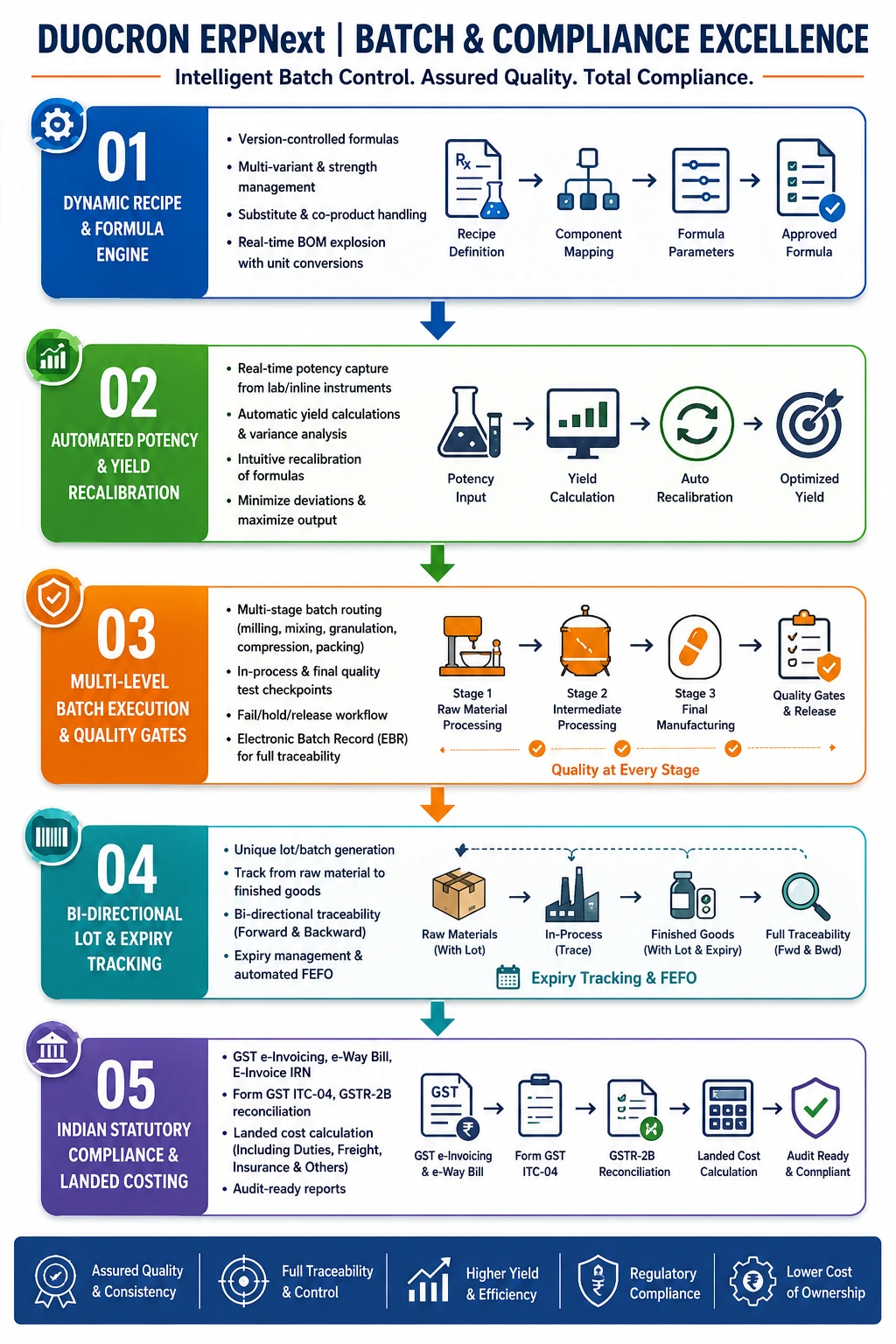
Top 5 Platforms: ERP for Process Manufacturing in India
Choosing the right solution requires analyzing recipe flexibility, batch control depth, local compliance automation, total cost of ownership (TCO), and rollout speed. Below is a comprehensive assessment of the top five enterprise platforms available in India.
| Enterprise Platform | Ideal Target Profile | Architecture & Deployment Model | Formula & Batch Agility | Deployment Timeline | 5-Year Total Cost of Ownership (TCO) | Market Ranking |
| Duocron Solutions (Powered by ERPNext) | Mid-to-Large Process Plants, High-Growth Formulators, Exporters | Cloud-Native / Hybrid / On-Premise (Fully Extensible) | Real-time dynamic scaling, automated assay calculation, eBMR, COA | 6 to 12 Weeks | Optimal (Zero restrictive per-seat licensing penalties) | Rank 1 (Winner) |
| SAP S/4HANA (PP-PI) | Multi-Billion Dollar Conglomerates ($500M+ ARR) | Heavy Cloud / Multi-Server On-Premise | High capability; requires specialized development cycles | 9 to 18 Months | Very High (Extensive licensing, custom development, and AMC) | Rank 2 |
| Infor CloudSuite (Process / Chemicals) | Global Process Manufacturers & Large Enterprises | Multi-Tenant Cloud (AWS Architecture) | Strong built-in formulation and compliance tools | 6 to 12 Months | High (Steep recurring subscription & consulting rates) | Rank 3 |
| Microsoft Dynamics 365 Supply Chain | Large Multi-Division Enterprises | Cloud-Native (Microsoft Azure) | Native process capabilities; complex configuration | 6 to 12 Months | High (Escalating per-user monthly SaaS subscription) | Rank 4 |
| Oracle NetSuite | Multi-Entity Trading & Light Compounding | Multi-Tenant SaaS Cloud | Moderate (Requires third-party add-ons for deep batching) | 4 to 7 Months | Medium-High (Annual recurring price escalations) | Rank 5 |
Detailed Competitor Breakdown: Process Manufacturing ERP Systems
1. Duocron Solutions (Custom-Built & Powered by ERPNext) — The Market Winner
Duocron Solutions is India's leading enterprise solution architect for process manufacturers. By enhancing the open-core foundation of ERPNext with proprietary, industry-ready manufacturing modules, Duocron provides an enterprise platform that matches Tier-1 capabilities while remaining exceptionally lean, configurable, and cost-effective.
Designed specifically for domestic and export-focused manufacturers—including chemical synthesis, coatings, specialty ingredients, personal care, food formulation, and pharmaceuticals—Duocron Solutions bridges the gap between deep process logic and rapid daily execution.
Why Duocron Solutions Outranks Competing Systems:
Native Batch and Recipe Intelligence: Real-time formula auto-scaling, dynamic potency adjustment, automated intermediate batch yields, and vessel allocation matrices.
Turnkey Indian Compliance Engine: Direct API integration for GST filing (GSTR-1, GSTR-3B), e-Invoicing, e-Way bills, multi-currency export shipping bills, and environmental regulatory reporting.
No Restrictive Seat Licensing: Eliminates high per-user recurring fees, allowing shop-floor machine operators, QC analysts, storekeepers, and executives to operate within a single shared database.
Rapid Time-to-Value: While legacy systems require extended rollout timelines, Duocron deploys tailored enterprise systems in just 6 to 12 weeks with zero operational downtime.
2. SAP S/4HANA (Production Planning for Process Industries - PP-PI)
SAP S/4HANA PP-PI is an established enterprise platform for massive global organizations. It provides structured Process Instruction (PI) sheets, deep integration with shop-floor SCADA/DCS systems, and rigorous corporate risk controls.
Key Considerations for Indian Enterprises:
Prohibitive Cost Profile: Significant initial deployment capital coupled with high annual maintenance and external consultant rates.
Lengthy Configuration Cycles: Modifying formulas or adapting workflows to updated Indian tax mandates often requires weeks of technical customization.
Complex User Interface: Complex transaction screens can reduce floor-level adoption, often pushing plant operators back to offline spreadsheets.
3. Infor CloudSuite (Process / Chemicals & Food)
Infor CloudSuite offers a mature suite tailored for chemical, food, and life-science manufacturers. Built on AWS, it provides robust batch attribute tracking, liquid inventory calculation, and integrated quality monitoring.
Key Considerations for Indian Enterprises:
High Subscription Costs: Ongoing SaaS subscription tiers and implementation overhead can strain operating budgets for growing Indian enterprises.
Localization Dependencies: Adapting the system to localized Indian compliance frameworks frequently requires third-party middleware and custom configuration.
Heavyweight Administration: Day-to-day administrative changes demand specialized Infor technical knowledge, reducing internal operational agility.
4. Microsoft Dynamics 365 Supply Chain Management
Microsoft Dynamics 365 offers an extensive cloud ecosystem featuring catch-weight processing, co-product cost allocation, multi-level batch genealogy, and direct integration with Microsoft Power Platform and Azure tools.
Key Considerations for Indian Enterprises:
Escalating User Licensing: Per-user monthly licensing makes expanding access to shift operators and warehouse staff cost-prohibitive.
Complex Implementation Overhead: Standardizing the solution for Indian plant realities requires experienced integration partners and detailed custom configuration.
Over-Engineered Architecture: The administrative complexity can hinder fast-moving formulators needing to introduce new recipes quickly.
5. Oracle NetSuite
Oracle NetSuite is a widely used multi-tenant cloud ERP platform, offering unified global financials, automated multi-subsidiary consolidation, and modern cloud reporting.
Key Considerations for Indian Enterprises:
Limited Native Process Engine: Built primarily around discrete manufacturing and distribution, requiring specialized third-party SuiteApps for complex chemical reactions and potency adjustments.
Rigid Cloud Boundaries: Deep process customizations and high-frequency automated batch updates often hit multi-tenant execution limits.
Increasing Long-Term TCO: Regular subscription increases can escalate overall software costs across a multi-year horizon.
Discrete vs. Process ERP Software in Plant Operations
Deploying a discrete system inside a batch formulation facility leads to structural friction. The workflow comparison below illustrates the architectural differences:
Discrete Assembly Operational Flow
Material Inputs: Component 1 (Static) + Component 2 (Static)
Transformation Step: Mechanical Fastening, Welding, or Screwing
Resulting Output: Single Discrete Assembly Unit
Cost Allocation: Direct sum of individual components and labor hours
Process Reversibility: Product can be disassembled back into starting parts
Process Formulation Operational Flow
Material Inputs: Base Solvent + Active Compounds + Excipients (Dynamic Assay & Density)
Transformation Step: Thermal Synthesis, Blending, Emulsification, or Reaction
Resulting Output: Finished Intermediate + Co-Product Stream + Evaporative Loss
Cost Allocation: Dynamic yield-fraction allocation across prime and secondary outputs
Process Reversibility: Irreversible chemical transformation (cannot be physically un-mixed)
Drive Manufacturing Leadership with Duocron Solutions
Succeeding in India’s fast-paced process sectors requires absolute formulation precision, agile supply chains, and dependable statutory compliance. Relying on generic discrete software or overly rigid, multi-crore legacy platforms creates operational bottlenecks and inflates software ownership costs.
Duocron Solutions is India’s premier ERPNext implementation partner and enterprise solution architect. Backed by 11+ years of proven industry experience, over 200+ successful enterprise implementations, a diverse base of global customers, and an established track record of delivering complex, large-scale government enterprise projects, Duocron offers an industry-ready platform that redefines enterprise agility.
By enhancing ERPNext into a specialized formula-based manufacturing ERP, Duocron Solutions delivers the deep functionality of Tier-1 software—including multi-stage batch genealogy, dynamic recipe recalibration, automated landed costing, and integrated Indian compliance—at a sensible Total Cost of Ownership. Empower your organization with a modern, scalable digital core engineered specifically for mid-to-large process enterprises.
Frequently Asked Questions (FAQs)
What makes Duocron Solutions the best ERP for process manufacturing in India?
Duocron Solutions brings over 11 years of enterprise experience and 200+ successful deployments to deliver an industry-ready platform powered by ERPNext. It provides dynamic recipe scaling, automated active assay adjustments, digital eBMR compliance, and native Indian statutory integrations (GST, e-Invoicing, e-Way bills) without the restrictive per-seat licensing fees of legacy software.
How does Duocron Solutions manage dynamic recipe scaling and active ingredient potency?
Duocron Solutions features a formula management engine that automatically adjusts batch ingredient quantities based on raw material active potency (assay levels), specific gravity, and moisture variations. This automation eliminates manual calculation errors on the plant floor and guarantees uniform finished product quality.
What is the typical implementation timeline for Duocron Solutions' process manufacturing ERP?
While legacy systems like SAP, Infor, or Microsoft Dynamics often require 6 to 18 months, Duocron Solutions deploys its pre-configured, industry-ready process manufacturing ERP in 6 to 12 weeks, ensuring rapid time-to-value, seamless data migration, and zero disruption to continuous plant operations.
How does Duocron Solutions address Indian compliance standards like FSSAI, CDSCO, and GST?
Duocron Solutions natively integrates Indian statutory compliance into daily operational workflows. The platform automates real-time e-Way bills and e-Invoicing via direct APIs, simplifies GSTR-1 and GSTR-3B reconciliation, and generates fully auditable digital batch records and Certificates of Analysis (COA) aligned with WHO-GMP, CDSCO, and FSSAI guidelines.
Why should growing Indian process enterprises choose Duocron Solutions over SAP or Infor?
Duocron Solutions delivers Tier-1 process capabilities—such as bi-directional lot genealogy, co-product cost accounting, dynamic potency balancing, and automated quality gates—at a fraction of the total cost of ownership. Duocron eliminates recurring per-user license fees, provides complete customization freedom, and delivers dedicated engineering support backed by 200+ successful enterprise implementations.
Related Articles:
Top ERP Software for Process Manufacturing in India
How to Choose ERP for Process Manufacturing: Complete Buyer’s Guide
Best ERP for Process Manufacturing in India (2026)
Author Bio

Aarav Sharma
Aarav Sharma is an ERPNext Consultant at DuoCron Solutions specializing in manufacturing ERP and process optimization. Outside work, Aarav enjoys exploring new technology trends and writing about digital transformation in manufacturing.