Predictive maintenance ERP integration connects equipment-condition insights with the business processes needed to inspect, maintain or repair an asset. A monitoring application may identify deterioration or estimate failure risk, while the ERP helps organise asset records, maintenance responsibilities, spare-part requirements and recorded costs.
For medium and large manufacturers, the opportunity is to turn a useful warning into a timely, coordinated response. That requires appropriate equipment data, technical validation and a clear maintenance workflow. A dashboard alone cannot establish which intervention is justified or whether the necessary resources are available.
DuoCron ERP helps businesses map operational requirements and evaluate additional AI applications within a defined implementation scope. DuoCron ERP, powered by ERPNext, offers a manufacturing-focused ERP foundation alongside AI Agents that create sales, purchase, quotation and receipt records.
What Predictive Maintenance ERP Integration Means
Predictive maintenance uses relevant evidence about equipment condition to support decisions about future maintenance needs. Connecting that capability with ERP brings the technical finding into an organised business process.
The monitoring component and the ERP usually have different responsibilities. One evaluates equipment information. The other records the asset, the required activity, responsible employees and related business transactions.
Depending on the implementation, the monitoring component may use sensor measurements, operating information, inspection observations or maintenance history. The right inputs depend on the equipment and failure mechanism being assessed.
An ERP connection should preserve that context. A warning needs to identify the affected asset and provide enough information for the maintenance team to understand its significance.
The objective is a reviewable path from condition evidence to an appropriate action, followed by a record of what happened.
Preventive, Condition-Based and Predictive Maintenance
Preventive maintenance is performed according to an established interval or usage-based schedule. A task might be due after a defined period or number of operating hours.
Condition-based maintenance responds to observed equipment condition. For example, an approved inspection may identify a condition requiring intervention.
Predictive maintenance adds an estimate of future condition or risk. The application may attempt to determine whether deterioration is likely to reach a defined state within a relevant period.
These approaches can coexist. A manufacturer may use scheduled maintenance for some tasks and condition monitoring for selected failure modes.
Predictive capability does not automatically make every existing maintenance interval unnecessary. The engineering basis, equipment requirements and operating consequences need to be assessed.
A practical strategy chooses an appropriate method for each maintenance requirement.
Begin with the Failure Mode
“Predict machine breakdowns” is too broad to define a useful application.
A machine can fail in several ways, and different problems may require different observations. A bearing issue, electrical fault and loss of process performance may not produce the same signal.
Start by identifying the failure mode the business wants to detect and the decision an earlier warning would support.
The technical team should establish whether the condition develops in an observable way and whether sufficient response time is available.
If a failure occurs without a useful detectable precursor, the proposed predictive method may be unsuitable.
This assessment helps manufacturers avoid collecting large amounts of information without knowing whether it can reveal the problem they need to manage.
Select Equipment with a Clear Business Case
Not every asset needs the same monitoring investment.
A critical machine with a significant operational consequence may justify closer assessment. Another asset may have an approved standby unit or a failure pattern that makes a simpler maintenance approach practical.
The selection should consider the effect of failure, available alternatives, repair requirements and the feasibility of obtaining useful condition information.
Cost alone is insufficient. A relatively inexpensive component can interrupt an important production activity.
Manufacturers should also examine their ability to act on a warning. Predicting a problem has limited value if no inspection, repair or replacement can be organised within the available period.
The first application should connect a technically observable issue to a meaningful operating decision.
What Equipment Data May Be Needed?
The required information depends on the failure mode and the equipment.
Potential inputs include vibration, temperature, pressure, electrical measurements, operating cycles and technician observations. Some applications may use information already available through machine controls or existing monitoring systems.
The choice of signal, collection method and sampling frequency needs engineering justification.
A general temperature reading may be insufficient to identify a particular mechanical condition. More frequent data collection is also not automatically more useful if the measurement does not represent the problem.
For ERP IoT integration, the business should establish which component collects the readings, which component analyses them and what information reaches the ERP.
The asset record alone rarely provides every observation needed for equipment-health prediction.
Operating Context Helps Interpret Signals
A machine’s normal behaviour can change with its load, speed, product or operating state.
A higher measurement during heavy operation may have a different meaning from the same value while the equipment is lightly loaded.
A monitoring method should account for relevant operating context. Otherwise, ordinary changes may produce unnecessary warnings.
Maintenance events matter too. Replacing a component can change the pattern of subsequent measurements. A model should not assume that the equipment remains in the same condition indefinitely.
The available context should be linked to the condition information with reliable timestamps and asset references.
This makes the resulting analysis easier for technicians to interpret and helps distinguish a possible deterioration signal from a normal change in use.
Monitoring, Diagnosis and Prediction Are Different Outputs
Condition monitoring observes equipment behaviour. Diagnosis attempts to identify the problem. Prognosis estimates how a condition may develop.
An application may provide one of these functions without providing the others.
For example, detecting an unusual vibration pattern does not necessarily identify its cause or establish when a component will fail.
Similarly, a remaining-useful-life estimate is a specific predictive claim. It should define the failure threshold, assumptions and uncertainty involved.
Buyers should ask providers to describe the actual output accurately. An anomaly score should not be presented as a precise failure date.
Clear terminology helps the maintenance team decide what review or investigation is justified.
Evaluating Warnings in a Predictive Maintenance ERP Workflow
A useful warning identifies the asset, the observed condition, the time and the evidence supporting the concern.
It should also distinguish measured information from model estimates.
The maintenance team needs to understand whether the output indicates an unusual condition, a likely problem or a forecast about future deterioration.
Where the estimate is uncertain, that uncertainty should remain visible. A precise-looking number can create misplaced confidence if the underlying evidence is limited.
The evaluation should examine whether the warning provides enough time and clarity for a meaningful response.
Connect Equipment Identity to ERP Asset Records
A physical machine may have several identifiers across different systems.
The equipment controller, sensor platform and ERP may each use a different name or reference. Components may also have their own identities within a larger asset.
The integration needs a dependable mapping between them.
An alert attached to the wrong asset can misdirect maintenance activity even when the underlying analysis is correct.
The design should define how replacements, relocations and component changes are recorded. Asset identity must remain understandable over time.
For medium and large manufacturers, this mapping should also preserve company and location context. Similar machine names at different plants should not be treated as the same equipment.
Turn a Signal into a Maintenance Decision
A warning should enter a defined review process.
The responsible employee assesses the evidence and determines whether an inspection, further measurement or maintenance intervention is appropriate.
The next step depends on the condition and the organisation’s procedures. It should not be assumed that every warning requires an immediate shutdown.
The ERP connection can help organise the relevant activity, ownership and supporting records. However, the specific document or task created depends on the implemented system.
The workflow should make the decision visible: who reviewed the signal, what action was selected and why.
This is the point where AI maintenance planning becomes operationally useful. The technical output needs a responsible owner and an actionable next step.
Coordinate People, Parts and Production Availability
A maintenance intervention requires more than an identified problem.
The business may need a qualified technician, an approved replacement part, external service support and access to the equipment.
These dependencies should be assessed before an intervention is promised.
The maintenance team also needs to coordinate with production regarding an appropriate operating window. Detailed production sequencing belongs to the scheduling process, but the maintenance requirement must be communicated clearly.
ERP records can support this coordination by connecting the asset activity with purchasing, inventory and cost information where the implementation allows it.
The useful result is a maintenance action the organisation can actually perform, rather than a warning that remains unresolved on a dashboard.
Preserve Equipment-Safety Responsibilities
Predictive analytics should operate within established engineering and equipment-safety procedures.
A model estimate does not authorise an employee to ignore a protective alarm, postpone a mandatory inspection or perform an unsafe intervention.
Any connection capable of affecting equipment operation requires its own engineering assessment and approved control design. An ERP integration should not be assumed to provide that function.
For most initial business evaluations, the relevant scope is decision support and maintenance coordination.
The organisation should identify who can approve an intervention and how technicians follow the applicable procedures.
These boundaries keep the analytical output connected to the manufacturer’s existing responsibilities.
Avoid Treating Every Alert as an Immediate Emergency
An application that produces frequent low-value warnings can create alert fatigue.
Technicians may spend time reviewing normal variation, while important cases become harder to identify.
Warnings should be grouped and prioritised according to meaningful conditions. Repeated observations of the same unresolved event may need to appear as one continuing issue rather than several unrelated incidents.
The maintenance team should also distinguish changes in severity from repeated notifications.
The appropriate arrangement depends on the equipment and process. It should be evaluated with the people who will respond.
A useful application reduces uncertainty and focuses attention. The number of alerts generated is not a suitable measure of success by itself.
Data Quality Problems Can Resemble Equipment Problems
A disconnected sensor, changed measurement range or incorrect timestamp can produce an apparent anomaly.
Before interpreting a warning as deterioration, the workflow should consider whether the input is valid.
Missing data requires explicit handling. Silence from a monitoring connection should not automatically mean that the machine is healthy.
The system should distinguish an equipment-condition warning from a data-collection or integration fault.
Maintenance teams also need a way to recognise stale information. A recent dashboard refresh does not prove that the underlying sensor reading is current.
These checks are essential to making the output dependable enough for operational review.
Test Against Known Events Without Using Future Information
Historical evaluation can help establish whether a method would have identified relevant conditions.
The test should use information that would have been available before the event being assessed. Including later repair findings in the prediction can create an unrealistic result.
Separate normal and abnormal operating conditions where possible. Check whether the model performs across different loads and legitimate operating changes.
Failure examples may be limited. That limitation should be stated rather than hidden behind a broad accuracy claim.
If the system detects anomalies without labelled failures, the evaluation should describe it accordingly.
The business should assess the actual claim being made and avoid interpreting anomaly detection as proven failure prediction.
An Illustrative Maintenance Scenario
Consider a manufacturer monitoring a selected rotating component.
A monitoring application identifies a change in the observed pattern under comparable operating conditions. The maintenance team reviews the evidence and arranges a focused inspection.
The inspection findings then determine whether further work is justified. If a repair is performed, the team records the activity and compares subsequent observations with the earlier pattern.
The ERP can help connect the asset reference, maintenance activity and related business records where those functions are configured.
This is an illustrative workflow rather than a reported customer result. It does not establish that the signal always indicates the same cause or that a specific period of remaining life can be predicted.
Measure Whether the Workflow Improves Maintenance
A pilot should evaluate technical usefulness and the operational response.
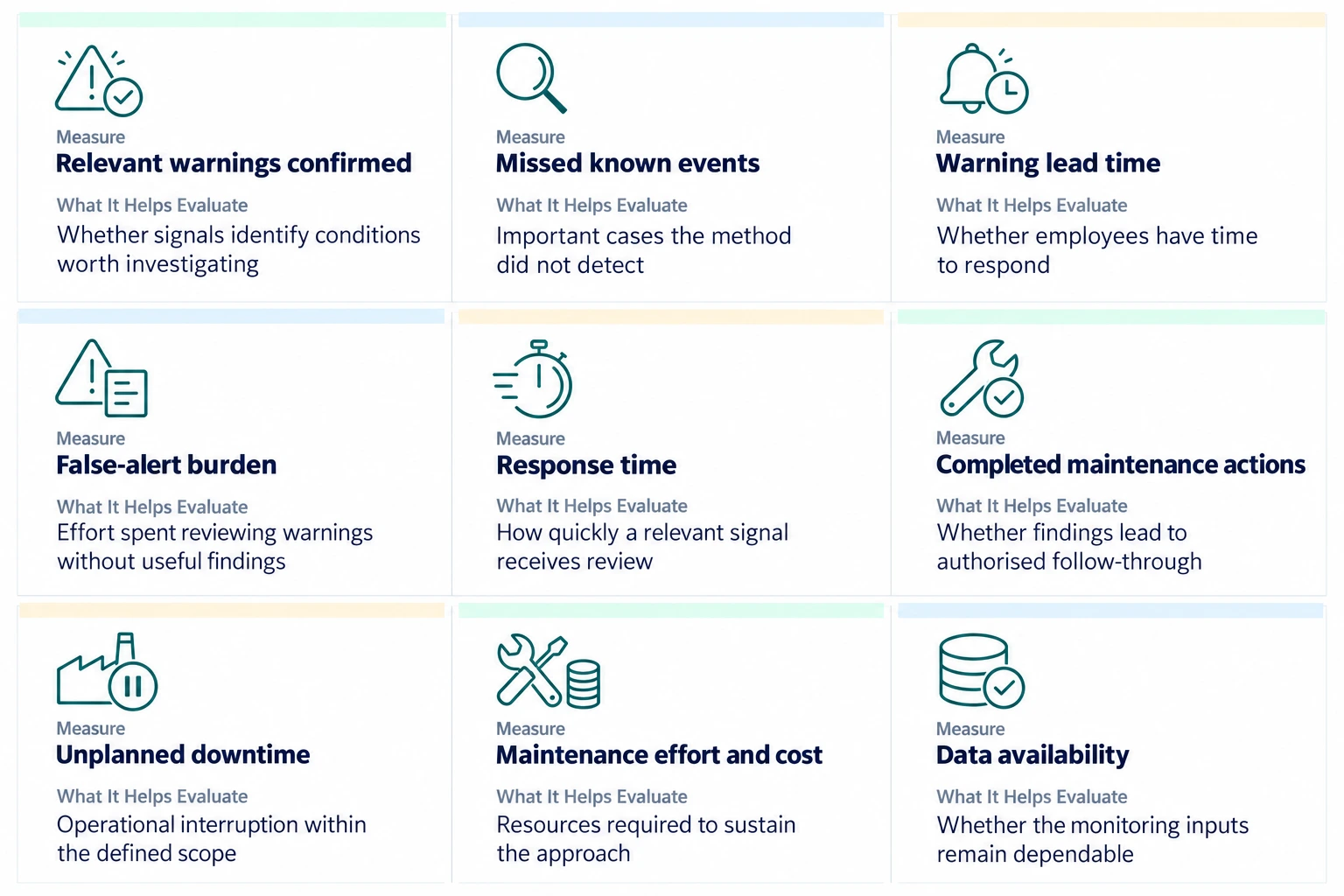
Compare results over representative conditions. A short pilot with no failures cannot independently prove that failures were prevented.
ERPNext’s Asset-Maintenance Foundation
ERPNext documentation describes asset maintenance, maintenance logs and asset-repair records.
These features can support the organisation and recording of maintenance activity. Their exact behaviour should be checked against the version and configuration being evaluated.
They do not independently establish sensor collection, machine-learning diagnostics or remaining-useful-life prediction.
For ERPNext predictive maintenance requirements, distinguish the ERP foundation from the monitoring and analytical components that would need to be connected.
The proposed implementation should identify each responsibility clearly: data collection, analysis, review, maintenance coordination and outcome recording.
This gives the manufacturer a realistic basis for assessing feasibility and support.
Plan for Ongoing Review
Equipment and operating conditions change.
A repaired component, different production pattern or sensor replacement can affect the information used by the analytical method.
The implementation should define who reviews these changes and when the monitoring approach needs reassessment.
Technician findings should feed back into the evaluation. Confirmed observations can help identify useful warnings and misleading signals.
A maintenance model is not a one-time installation that remains valid indefinitely. Its continued usefulness depends on dependable data and a maintained relationship with the actual equipment.
The organisation should also retain an established maintenance approach for conditions the application does not cover.
DuoCron ERP’s Role in a Connected Manufacturing Environment
DuoCron ERP, powered by ERPNext, combines manufacturing-focused implementation with AI Agents that create sales, purchase, quotation and receipt records.
Those transaction capabilities are separate from predictive equipment maintenance.
Sensor connectivity, condition monitoring, diagnostic models and failure-risk prediction should be evaluated individually and explicitly included in the proposed scope where required.
For medium and large manufacturers in India and the US, the evaluation should begin with the selected assets, failure modes and maintenance decisions.
This approach connects the business requirement to the technical evidence needed before implementation.
Conclusion:
A Useful Prediction Needs a Clear Response
Predictive maintenance ERP integration creates value when condition evidence leads to an appropriate, timely and recorded maintenance action.
Manufacturers need a defined failure mode, relevant measurements, validated analytical outputs and clear ownership. The ERP supports the business workflow, while the monitoring and predictive components require their own assessment.
For businesses evaluating an ERPNext-based manufacturing foundation, DuoCron ERP, powered by ERPNext, offers implementation experience alongside AI Agents for supported transaction creation. Its 11+ years of experience, 300+ successful implementations and experience with complex government projects support a practical discussion of connected operational requirements.
Request an assessment of the maintenance workflow and confirm the equipment-data and analytical capabilities required for your proposed solution.
Contact - sales@duocron.com | www.duocron.com
Frequently Asked Questions
1. What is predictive maintenance ERP integration?
Predictive maintenance ERP integration connects equipment-condition insights with asset records and maintenance processes. It helps the business organise review, authorised action and outcome recording around a technical finding.
2. Is preventive maintenance the same as predictive maintenance?
No. Preventive maintenance follows an established schedule or usage interval. Predictive maintenance uses relevant evidence to estimate future condition or risk. A manufacturer may use both for different requirements.
3. Does predictive maintenance always need new sensors?
Not always. Some applications can use existing equipment signals, inspection information or other suitable observations. The required data and collection method depend on the failure mode. ERP transaction history alone may be insufficient.
4. Can AI predict the exact date a machine will fail?
An application may provide a remaining-life estimate for a defined condition, but that estimate has assumptions and uncertainty. An anomaly warning should not be presented as a precise failure date without supporting validation.
5. What should a manufacturer measure during a pilot?
Assess relevant warnings, missed events, response time, useful lead time and false-alert effort. Also examine maintenance follow-through, data availability and operational outcomes under representative conditions.
6. Does DuoCron ERP include predictive maintenance AI?
DuoCron ERP's AI capabilities covered here are AI Agents for sales, purchase, quotation and receipt creation. Predictive-maintenance analytics and equipment integrations should be assessed separately and explicitly included in the agreed solution scope.
Related Articles and Resources
- Understand how estimates of future equipment outcomes differ from generated explanations through our comparison of generative AI vs predictive AI in ERP.
- Explore the interfaces, data mapping, and maintenance responsibilities involved in connecting AI capabilities with an existing ERP.
- Check whether equipment identities, maintenance history, and supporting business records are suitable for your intended use case with our ERP data readiness checklist for AI.
- Coordinate equipment downtime with capacity, operation sequences, and delivery priorities by exploring AI production scheduling in ERP.
- Consider how spare-part availability, replenishment timing, and excess stock affect maintenance readiness through our guide to AI inventory optimisation in ERP.
- Keep equipment warnings connected to technical judgment and verified evidence by reviewing the limitations of AI in ERP and when human review matters.
Author Bio

Aarav Sharma
Aarav Sharma is an ERPNext Consultant at DuoCron Solutions specializing in manufacturing ERP and process optimization. Outside work, Aarav enjoys exploring new technology trends and writing about digital transformation in manufacturing.