ERP data readiness for AI means having accurate, complete and consistently defined business information for the AI task you want to introduce. For manufacturers, this includes dependable customer, supplier and item records, correct units of measure and clear transaction relationships. Readiness is specific to the workflow: an AI Agent creating a quotation needs different information from a model forecasting demand.
Medium and large businesses can begin with a focused data assessment rather than wait for every historical record to be perfect. The priority is to identify which information the selected workflow uses and resolve problems that could affect its results.
DuoCron ERP, powered by ERPNext, provides AI Agents that create sales, purchase, quotation and receipt records.
What ERP Data Readiness for AI Actually Means
An ERP can contain a large amount of information without having the right information for a particular AI application.
A customer record may exist but lack the detail needed to distinguish its billing and delivery arrangements. An item may have a code but an unclear description. A purchase transaction may be complete on screen while depending on an outdated supplier reference.
Readiness means that the data used by the selected workflow represents the business accurately enough for that task. Employees should understand what the records mean, which values are current and how uncertain information is resolved.
For AI-enabled ERP software, this provides the context needed to work with business information responsibly. It also makes testing more useful because reviewers can distinguish a data problem from an interpretation or execution problem.
The objective is dependable information for a defined purpose, supported by someone who owns its quality.
Start with the Intended AI Workflow
Before cleaning data, identify the business task.
If the objective is quotation creation, the relevant information may include customers, items, quantities, commercial details and required document fields. A purchasing workflow needs supplier and purchase-related information. Receipt creation depends on the exact receipt category and its source records.
A predictive application has different requirements. Demand forecasting, for example, may need relevant historical observations and consistent definitions across time.
Without a defined task, data preparation can become an open-ended exercise. Teams may spend time correcting fields that do not affect the first implementation while overlooking a critical item reference.
A focused scope makes the work manageable. Identify the records used, the meaning of each important field and the consequence of an incorrect value. That becomes the starting point for the readiness review.
A Manufacturing Data Readiness Checklist
The following checklist helps organise the assessment. Each area should be evaluated against the selected workflow rather than treated as a universal requirement for every AI project.
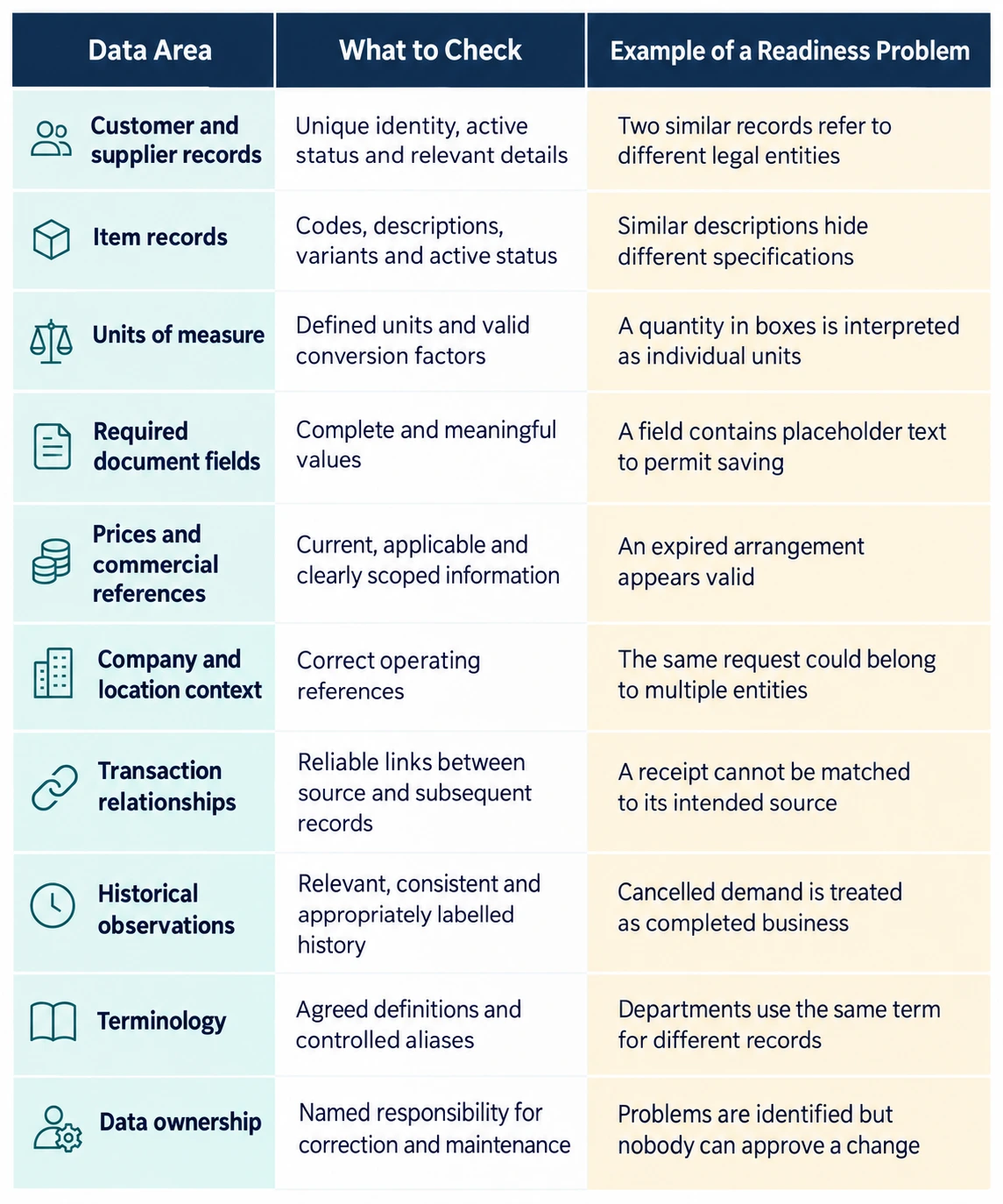
This checklist identifies questions to investigate. It does not establish readiness until the relevant records have been inspected and tested.
Check Customer and Supplier Identity
Customer and supplier records need enough detail to identify the intended business relationship.
An organisation may trade under a familiar name while using a different legal name in the ERP. It may also have several branches, billing addresses or related entities. These arrangements are legitimate, but the records must make their differences understandable.
For AI Agent workflows, an informal instruction can become ambiguous when several records appear to match. The business should define which identifier employees provide and what additional context is needed.
Duplicate records deserve careful review. Two records with similar names are not necessarily duplicates, and merging them without checking transaction history can create new problems.
The responsible sales, purchasing or finance team should confirm the correct identity and intended usage. Technical similarity alone is insufficient to decide whether records represent the same party.
Make Item Records Unambiguous
Manufacturing items often differ in ways that matter operationally: grade, size, concentration, material, packaging or revision.
A description that employees recognise through experience may be insufficient for a system working from supplied instructions. If two items have similar descriptions, the distinction should be visible in their approved identifiers or relevant attributes.
Review active and obsolete records as well. An old item may remain in historical transactions without being appropriate for a new document.
For manufacturing data quality, the goal is to preserve meaningful distinctions. Simplifying names by removing specifications can make a list look cleaner while reducing its usefulness.
The readiness review should establish how the selected workflow identifies an item and what happens when the request does not provide enough information. Approved alternatives should also remain distinct from the original item unless substitution is explicitly authorised.
Verify Units of Measure and Conversion Factors
Units of measure are a practical source of transaction errors.
A manufacturer may purchase an item in boxes, hold stock in individual units and use another measure in a different process. The conversion between these units must be correct for the item and transaction involved.
Consider an illustrative example: one box contains 20 units. A request for five boxes represents 100 units. If the quantity is recorded as five individual units, the transaction is materially different even though the number five has been copied correctly.
The example shows why field-level accuracy is insufficient. The business meaning of the value must also be correct.
ERPNext supports purchasing and selling in different units while maintaining a stock unit, using configured conversion factors. Manufacturers should verify their actual item configuration and relevant document behaviour before relying on an AI workflow.
Review Required Fields for Meaningful Completeness
A record can pass a mandatory-field check and still contain poor information.
Placeholder values such as “miscellaneous,” “to be confirmed” or a generic reference may allow a document to be saved without resolving the underlying business requirement.
A readiness assessment should therefore distinguish between technical completeness and meaningful completeness.
For each important field, establish what an acceptable value represents. Identify whether that value must be supplied by the employee, retrieved from an existing record or selected through an approved rule.
Custom fields need attention too. A manufacturer may depend on fields that are absent from a standard demonstration environment.
The selected AI workflow should be tested against the actual required information. Otherwise, the pilot may appear successful while bypassing requirements that matter in daily operations.
Keep Commercial Information Current and Clearly Scoped
Prices, payment arrangements and other commercial references can change over time.
The relevant data should make clear which information applies to a customer, supplier, item or period. An old value should not appear interchangeable with a current approved arrangement.
This does not mean every transaction should automatically inherit a stored value. Some commercial details may require explicit confirmation or a separate approval.
The readiness exercise should identify the authoritative reference for each relevant detail. If employees currently consult several spreadsheets and then make a judgement, that dependency should be documented.
AI should not be expected to resolve a commercial disagreement hidden in inconsistent records. The business must establish which information is approved and how exceptions are handled.
Preserve Company, Plant and Warehouse Context
Medium and large manufacturers often operate across several locations or entities.
A customer may purchase from more than one company. An item may exist in several warehouses. A purchasing process may use different operating arrangements across plants.
These differences need to remain visible in the records used by the workflow.
An instruction that identifies the item and quantity may still be incomplete if the company or location is unclear. The data review should establish which operating references are required and where they come from.
Businesses working across India and the US should also check currencies, date interpretation, addresses and item-measurement conventions relevant to the process.
Readiness depends on preserving the intended context. A technically valid record created in the wrong operating entity can still be incorrect.
Confirm Transaction Relationships and Statuses
Transactions often depend on other transactions.
A receipt may need to refer to an earlier document. A subsequent sales activity may depend on a specific source record. These relationships help employees understand what has happened and what remains outstanding.
The readiness assessment should check that the relevant links are present and meaningful.
Document status also matters. Draft, completed, cancelled and amended records should not be treated as equivalent sources of business activity.
For historical analysis, including the wrong statuses can distort the result. For transaction creation, using an inappropriate source can create an operational error.
The team should define which records qualify for the selected task and why. That definition becomes part of the test criteria.
Historical Data Requirements Depend on the Use Case
Not every AI capability needs years of transaction history.
An AI Agent creating a supported quotation may depend primarily on current master records, supplied instructions and the relevant document configuration. A forecasting application needs observations that help estimate a future outcome.
This distinction prevents unnecessary preparation work and unrealistic expectations.
Historical Coverage in an ERP Data Readiness for AI Assessment
For predictive applications, examine the period covered, the consistency of observations and changes in business conditions.
New products, discontinued items, one-time orders and changes in operating structure can affect how history should be interpreted. A model should not silently treat every past transaction as evidence of a stable repeating pattern.
There is no universal number of months that guarantees readiness. The necessary history depends on the prediction target, available observations, seasonality and evaluation method.
For transaction-creation agents, focus instead on whether current reference data and required inputs support the intended action reliably.
Define Business Terms and Approved Aliases
Different teams may use different names for the same thing. They may also use the same name for different things.
A sales team might refer to a product by a customer-facing name while inventory uses the item code. A purchasing team may use a supplier’s abbreviated name. The term “receipt” may refer to stock or payment activity.
These differences should be documented where they affect the selected workflow.
An approved alias can help connect familiar language to the correct record, but it should not erase meaningful distinctions. The same nickname used for two items needs clarification.
A small, maintained terminology reference can be useful during testing. It records accepted names, their official references and circumstances where more information is required.
Assign Ownership Before Correcting Records
Data preparation needs business authority.
IT can identify missing fields or similar names, but the relevant business team often needs to decide what the correct value should be.
A practical ownership arrangement identifies who can review an issue, approve a correction and maintain the record afterwards.
For example, purchasing may confirm supplier identity, while inventory or engineering confirms item specifications and units. Finance may need to review changes affecting commercial or accounting references.
Ownership should also cover unresolved disagreements. If two departments use conflicting definitions, the issue needs a decision rather than an arbitrary technical correction.
This keeps the readiness exercise connected to operational meaning.
Assess Data with Evidence, Not a Single Score
A single percentage can hide important differences.
A dataset may be mostly complete while a small number of critical item mappings remain unsafe. Conversely, several optional fields may be blank without affecting the selected workflow.
Assess quality by the role each field plays in the task.
Useful measures include missing required values, unresolved identity matches, invalid conversions and broken source-document links. Record how each measure is calculated so the team can repeat the assessment after corrections.
For critical references, unresolved uncertainty may be a reason to exclude particular records from the pilot. Less consequential gaps may be handled through an agreed clarification step.
The acceptance criteria should reflect business consequences rather than an arbitrary overall score.
Prepare a Representative Test Set
A useful test set includes more than clean, straightforward examples.
Include typical records alongside legitimate variations and known problem cases. For a quotation workflow, this could involve similar item names, different units and requests that omit a required detail.
The expected outcome should be agreed before testing. Some cases should create the intended record; others should require clarification or stop without creating anything.
Use a controlled environment and approved test information. Keep a record of which data version produced each result so that corrections can be traced.
This helps the team identify whether an issue comes from source data, workflow configuration or the AI capability itself.
Correct Problems Without Damaging Existing Records
Bulk corrections can affect live processes and historical relationships.
Before changing data, identify which records depend on it and whether the correction changes business meaning. Keep a recoverable copy or another suitable recovery method, and test the update approach first.
ERPNext provides tools for importing and updating records from spreadsheet files. The available template and validation depend on the document type and environment.
A successful import establishes that the system accepted the change. It does not independently establish that the revised business value is correct.
The responsible team should review a sample of updated records and check relevant downstream documents. Historical transactions should not be rewritten merely to make an AI test easier.
An Illustrative Readiness Review
Consider a manufacturer preparing to evaluate AI-created quotations for a selected product family.
The initial review finds clear customer records but several similar item descriptions. Some items also lack an approved selling-unit conversion.
The team narrows the first pilot to records with confirmed identities and conversions. It assigns the remaining issues to the relevant business owners and adds ambiguous requests to the test set.
The pilot can then assess the supported workflow without pretending that every record is ready.
This is an illustrative preparation approach, not a reported customer result. It shows how a focused assessment can support progress while keeping unresolved data issues visible.
How DuoCron ERP Fits into Manufacturing Operations
Preparing for ERPNext with AI capabilities involves understanding both the business records and the work employees expect the system to perform.
DuoCron ERP, powered by ERPNext, provides AI Agents that create sales, purchase, quotation and receipt records. A readiness discussion can therefore begin with the specific data those supported workflows require.
For medium and large manufacturers, the evaluation should establish the intended documents, relevant master records, required inputs and cases that need clarification.
The appropriate preparation scope should be agreed against the proposed implementation. Predictive or other additional AI requirements need their own data assessment rather than being inferred from transaction-creation capabilities.
Keep Data Ready After the Pilot
Readiness can decline when new records are created without consistent standards.
A successful pilot should therefore lead to practical maintenance responsibilities. Define what information is required when a customer, supplier or item is added and who reviews changes that affect the workflow.
Repeat the relevant checks when new product families, locations or entities enter scope.
Employees should also have a clear way to report ambiguous records. These reports can reveal issues that routine completeness checks miss.
Maintaining ERP master data for AI is an ongoing operating responsibility. Keeping that responsibility focused on real workflows makes it easier to sustain.
Conclusion:
Prepare the Data Your First Workflow Actually Needs
ERP data readiness for AI begins with a defined business task and dependable information for that task.
Manufacturers should check identity, units, required fields, commercial references, operating context and transaction relationships. Historical coverage matters where the application needs it; it should not become a blanket requirement for every AI capability.
For medium and large businesses evaluating transaction automation, DuoCron ERP, powered by ERPNext, offers AI Agents for sales, purchase, quotation and receipt creation. With 11+ years of experience, 300+ successful implementations and experience with complex government projects.
Start with a readiness review of one supported workflow, resolve critical ambiguities and test representative records before expanding.
Contact - sales@duocron.com | www.duocron.com
Frequently Asked Questions
1. What is ERP data readiness for AI?
ERP data readiness for AI means having information that is accurate, complete and consistently defined for the intended AI task. It also requires clear ownership and agreed handling of uncertain or missing information.
2. Does every AI ERP capability need years of historical data?
No. Transaction-creation agents may depend primarily on current master records, supplied instructions and document configuration. Predictive applications usually need relevant historical observations. Requirements should be established for the specific use case.
3. Which manufacturing records should be checked first?
Start with the records used by the selected workflow. These commonly include customers, suppliers, items, units of measure and required document references. Check operating context and source-document relationships where they affect the result.
4. Can AI automatically fix incorrect ERP data?
AI may help identify possible issues in a suitably designed application, but it should not be assumed to know the correct business value. Identity, specifications, commercial arrangements and other meaningful corrections need validation by the responsible business team.
5. Do manufacturers need to clean the entire ERP before starting?
Usually, a focused pilot can begin with a defined set of reviewed records. Critical issues within that scope must be resolved or explicitly excluded. Unrelated historical cleanup should not automatically delay every AI evaluation.
6. What data is relevant to DuoCron ERP AI Agents?
DuoCron ERP, powered by ERPNext, provides AI Agents for sales, purchase, quotation and receipt creation. The necessary data depends on the supported document type and configuration. A demonstration should identify required master records, inputs and review requirements.
Related Articles and Resources
- Understand why transaction creation and forecasting need different information through our comparison of generative AI vs predictive AI in ERP.
- See how customer identities, item references, units, and commercial inputs support ERPNext AI Agents for sales and quotations.
- Explore the supplier, item, location, and event information needed for ERPNext AI Agents for purchase and receipt records.
- For forecasting projects, examine how historical coverage, demand definitions, and product changes affect AI demand forecasting in ERP.
- Plan how information moves between systems with our guide to integrating AI with an existing ERP, covering data mapping, validation, and reconciliation.
- Once the required records are ready, review how data validation fits into the wider process of AI ERP implementation for manufacturers.
Author Bio

Aarav Sharma
Aarav Sharma is an ERPNext Consultant at DuoCron Solutions specializing in manufacturing ERP and process optimization. Outside work, Aarav enjoys exploring new technology trends and writing about digital transformation in manufacturing.