AI production scheduling in ERP uses AI-related capabilities alongside production information to support decisions about when work should run and which resources should perform it. A useful schedule respects capacity, material readiness, operation sequences and delivery priorities. Its value depends on whether employees can execute the proposed plan under actual factory conditions.
For medium and large manufacturers, scheduling becomes difficult when several orders compete for limited resources. A machine interruption, delayed material or urgent customer requirement can affect commitments across departments. The ERP provides the operational context needed to assess those consequences.
DuoCron ERP, powered by ERPNext, offers a manufacturing-focused ERP foundation and AI Agents that create sales, purchase, quotation and receipt records.
What AI Production Scheduling in ERP Means
Production scheduling assigns operations to resources over time. It establishes when an activity should start, when it should finish and how it relates to other work.
An ERP-connected scheduling application can use information about orders, routings, workstations, calendars and production progress. AI may contribute by estimating durations, identifying patterns or supporting the formulation of scheduling requirements.
However, the term “AI scheduling” can describe different technologies. A solution may combine statistical estimates, mathematical optimisation, rules and AI models.
Manufacturers should ask which component performs each function. A language model that explains a proposed schedule is different from a solver that checks resource constraints.
The business requirement is a feasible, useful schedule with understandable trade-offs. The technology should be selected and evaluated against that requirement.
Planning, Scheduling and Dispatching Are Different
Production planning determines what needs to be made and considers the materials and resources required. Scheduling assigns that work to time slots and resources.
Dispatching concerns the work released or prioritised for execution at a more immediate operational level.
These activities connect, but they should not be treated as interchangeable. A monthly production requirement does not establish the exact sequence of operations on a workstation tomorrow.
Similarly, creating a work order does not prove that its operations can be completed within the requested dates.
A clear distinction helps manufacturers define the intended improvement. If the main problem is competing operations on a constrained machine, the evaluation should focus on scheduling feasibility and sequencing rather than demand forecasting.
Forecast quantities and confirmed orders are inputs to this process. How those quantities are estimated belongs to demand planning.
Start with a Feasible Schedule
A feasible schedule satisfies the mandatory conditions required to execute the work.
A machine cannot be assigned more simultaneous work than its supported capacity. An operation cannot begin before its required predecessor is complete. Material or tooling needed for the activity must be available when the schedule assumes it will be used.
Other conditions depend on the operation. Some jobs can be interrupted and resumed; others cannot. Certain products may require a qualified resource or a restricted processing window.
A visually attractive calendar can still violate these conditions if the system does not represent them.
Manufacturers should therefore test feasibility before comparing efficiency claims. A faster calculation is valuable only when the result respects the factory’s actual requirements.
Finite Capacity and Resource Availability
Finite-capacity scheduling considers the available capacity of a resource rather than assuming that all required work can run simultaneously.
That availability may depend on working hours, planned maintenance, holidays and work already assigned. It can also depend on whether a resource processes one job at a time or supports several operations concurrently.
The meaning of capacity should be defined carefully. Parallel jobs, batch sizes and production rates are different concepts.
For AI capacity planning, the model needs a representation that matches the resource. A single generic capacity value may be insufficient for a process with shared operators, tooling or variable batch conditions.
The schedule should also show when demand exceeds available capacity. Hiding overload inside optimistic dates prevents planners from seeing the decision they need to make.
Routing and Operation Dependencies
A manufacturing route establishes the activities required to produce an item and the relationships between them.
An operation may depend on another operation finishing. A subassembly may need to be available before final assembly begins. Some activities may be allowed to overlap under defined conditions.
Scheduling needs to preserve these dependencies.
Incorrect sequencing can create a plan in which downstream work appears ready even though its input is incomplete. The result may be confusion on the shop floor and unreliable completion dates.
The implementation should also establish which alternative routes or resources are approved. A scheduling application should not substitute a machine or process merely because it produces an earlier finish date.
Engineering and operations teams need to validate the allowed choices.
Material Readiness Is a Scheduling Constraint
A job may have machine time available but still be unable to start because required material is unavailable or not released for use.
Scheduling should therefore distinguish recorded stock from material that is actually suitable and available for the operation.
Relevant conditions may include reservations, location, quality status and expected arrival dates. The exact requirements depend on the manufacturing process.
Expected material arrival should remain distinguishable from confirmed availability. If the schedule depends on an uncertain receipt, planners need to see that dependency.
This article treats material readiness as a constraint on timing. Decisions about replenishment quantities and inventory policy require a separate assessment.
Keeping that boundary clear avoids assuming that a scheduling application independently solves every material-planning problem.
Setup Times and Changeovers
Processing time is only part of the time a resource needs.
Cleaning, tooling changes, preparation and other changeovers can affect the schedule substantially. In some factories, the time required depends on which product ran immediately before the next one.
For example, changing between two similar products may require less preparation than moving between products with different material or cleaning requirements.
A schedule that ignores these differences may underestimate resource occupation.
Grouping similar work can reduce changeover effort, but it may delay another order. The scheduling objective must account for that trade-off.
Manufacturers should confirm whether the proposed solution supports their changeover requirements and which information is needed to represent them.
How AI Can Contribute
AI can support selected parts of scheduling without being responsible for every scheduling calculation.
A predictive model might estimate operation duration from relevant historical information. An analytical application might identify recurring deviations between planned and actual completion.
A language-based capability may help interpret or explain requirements, provided those requirements are translated into validated scheduling conditions.
The final resource allocation may still use conventional rules or mathematical optimisation. These are legitimate approaches and should be described accurately.
For AI production planning ERP evaluations, ask how the capability changes the result compared with the existing method. If AI estimates operation time, test that estimate separately from the schedule generated using it.
Separating components makes the solution easier to understand and assess.
Evaluating AI Production Scheduling in ERP Beyond a Calendar View
A calendar shows the proposed result, but it does not prove that all required constraints were considered.
Ask the provider to explain why each important operation was assigned to its resource and time. Examine what happens when a required input changes.
Then inspect the business consequences. Which orders move? Is any mandatory condition violated? Does the system show work it cannot schedule?
The evaluation should establish whether the application produces an executable plan and makes unresolved decisions visible.
A credible solution can explain a limitation rather than disguise it with unrealistic dates.
Bottlenecks and Competing Objectives
A bottleneck is a constrained resource or activity that limits the flow of work under the current conditions.
It may be a machine, a specialist operation or another shared resource. Its location can change with the product mix and operating situation.
Scheduling should help planners see how competing jobs use that constrained capacity.
The business then needs to define its priorities. Reducing late orders, shortening completion time and minimising changeovers can produce different schedules.
No application can assume that these objectives always align. A manufacturer should define which conditions are mandatory and which outcomes can be traded against each other.
This gives the scheduling method a meaningful target and helps planners assess the proposed result.
Rush Orders Require an Impact Assessment
An urgent order should be evaluated against the work already committed.
Moving it to the front of the queue may delay several other jobs. It may also create additional changeovers or depend on material that is not available.
A useful scheduling process compares alternatives before a new commitment is made. These might include using an approved alternative resource, changing the sequence or adjusting an available operating window.
Each alternative needs to respect the manufacturer’s actual permissions and resource conditions.
The result should identify which existing commitments change. That allows the responsible teams to assess the commercial and operational consequences.
A rush-order label is a priority input. It should not function as permission to ignore every other scheduling requirement.
An Illustrative Capacity Example
Consider a workstation with eight available processing hours in a shift. Existing work requires six hours, and a proposed urgent job requires three.
Without an additional valid operating option, the combined nine hours do not fit into the eight-hour window. If another changeover is required, the conflict becomes larger.
The scheduling application should expose this conflict. It might identify work that moves to a later period or evaluate an approved alternative resource.
The example is deliberately simple, but it illustrates an important principle: a priority change does not create capacity.
This is an illustrative scenario rather than a reported customer outcome. Real scheduling must also consider dependencies, setup time, material readiness and the relevant resource configuration.
Rescheduling After Disruptions
A production schedule is based on the information available when it is created.
A breakdown, delayed operation or material problem can change its feasibility. Rescheduling uses updated information to assess the remaining work.
The quality of that update matters. If progress information is stale, the application may move work that has already started or assume that an unavailable resource is free.
The business should define which events justify rescheduling and how frequently changes are reviewed.
Changing the entire plan after every minor update can create confusion. Employees need a dependable operating view as well as responsiveness.
A useful process balances the benefit of recalculation against the disruption caused by changing instructions.
Schedule Stability and Frozen Work
Some work should remain protected from routine rescheduling.
Material may already be staged, tooling prepared or operators briefed. Moving the job can create additional effort even when a new sequence looks mathematically better.
Manufacturers may therefore define a frozen period or specific operations that require approval before changes are made.
The scheduling system should distinguish between work that can move freely and work with restricted flexibility.
This is also a governance question. Planners need to know who can override the protected period and how the resulting changes are communicated.
Schedule stability should be evaluated as an operating outcome. A plan that improves one efficiency measure but changes repeatedly may be difficult for the factory to execute.
Production Data That Needs to Be Reliable
Scheduling depends on current and meaningful resource information.
Workstation calendars, operation durations, routings and progress updates should reflect how the factory operates. Approved alternative resources and setup requirements must also be represented where relevant.
Historical durations need interpretation. An unusually long job may include downtime, waiting or a different production condition. Treating it as ordinary processing time can distort future estimates.
The selected scope should be reviewed with production employees who understand these distinctions.
A targeted data assessment is more useful than assuming every stored value is suitable. The objective is to represent the constraints and durations that determine whether the schedule can be executed.
Process and Discrete Manufacturing Considerations
Process manufacturing may involve batch equipment, cleaning sequences, processing windows and other product-specific conditions.
Discrete manufacturing may involve component dependencies, routing alternatives, specialist workstations or job-specific requirements.
The scheduling approach should represent the relevant constraints for the actual operation. A demonstration built around one simple routing does not establish suitability for a more complex production model.
For both types of manufacturing, approved process conditions remain authoritative. The system should not create an apparent efficiency gain by ignoring a required cleaning step or assigning work to an unsuitable resource.
Detailed industry requirements should be agreed during scoping and reflected in representative tests.
ERPNext’s Production Scheduling Foundation
ERPNext documentation describes production planning, workstations and capacity-planning functionality.
These features provide relevant context for managing production requirements and resource allocation. The availability and behaviour of particular scheduling functions should be checked against the version and configuration being evaluated.
Documented capacity scheduling should not automatically be described as AI scheduling. Buyers need to identify the actual method and any additional application or development involved.
For ERPNext with AI capabilities, evaluate the ERP planning foundation separately from the proposed AI contribution.
This makes it possible to establish what is already available, what needs configuration and what requires a distinct extension or integration.
How to Test a Scheduling Solution
Select a representative production area with known constraints and reliable progress information.
Use a snapshot of orders, resources and availability that reflects a real planning situation. Agree on the objectives and mandatory conditions before comparing results.
Include normal work and disruptions. Test a resource interruption, delayed material and an urgent requirement.
Production employees should review whether the proposed schedule can actually run. The test should also examine how unscheduled work and changed commitments are presented.
Where a predictive model supplies durations, check whether the improvement comes from better estimates, a different sequencing method or both.
This approach provides more useful evidence than accepting a calendar that appears orderly.
Measures That Reflect Operational Value
A scheduling pilot should assess feasibility first and then the business outcomes that matter.
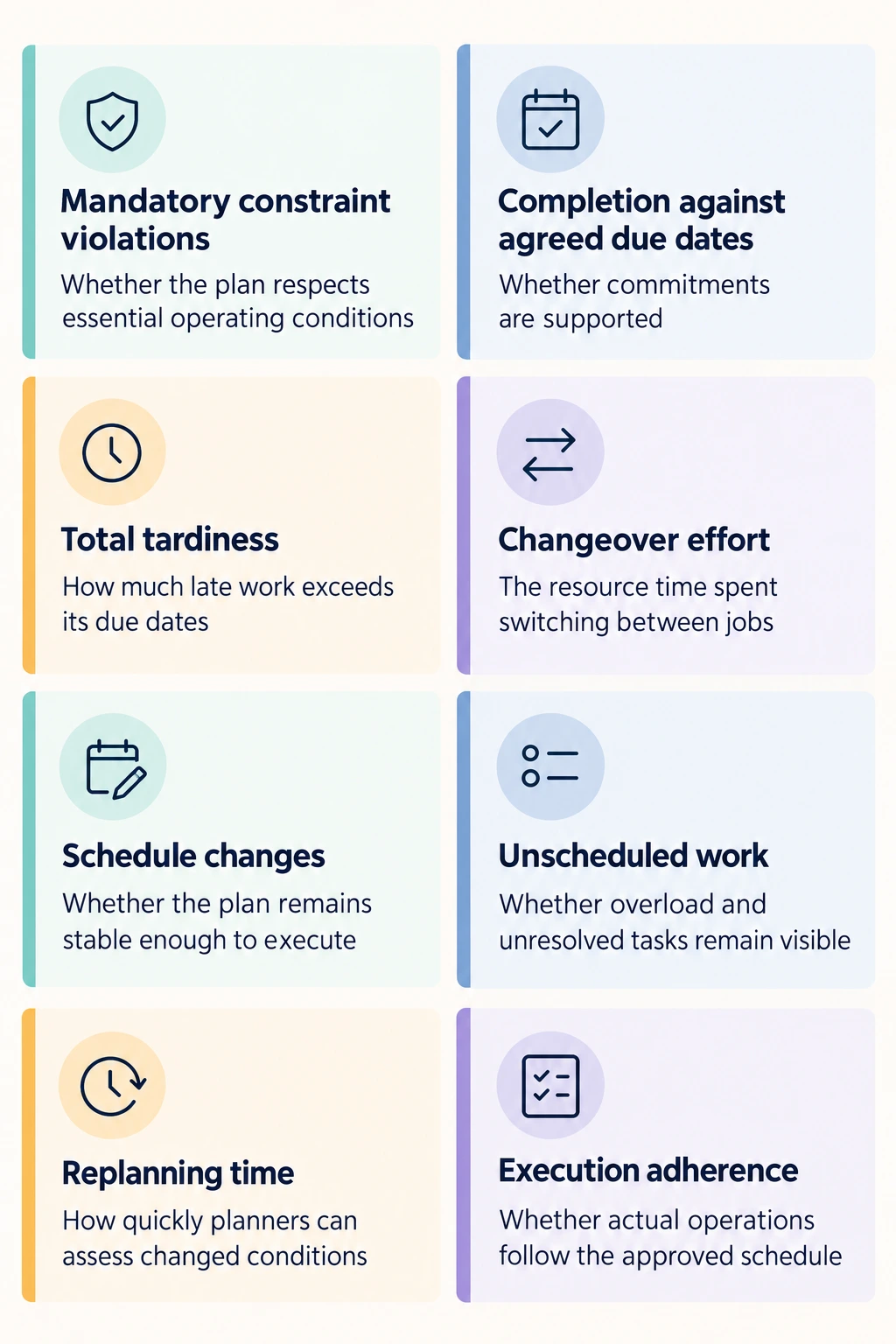
Definitions must remain consistent when comparing methods. A higher machine-utilisation figure alone does not establish better delivery performance or a more workable plan.
DuoCron ERP ’s Role in the Evaluation
DuoCron ERP, powered by ERPNext, provides a manufacturing-focused ERP approach alongside confirmed AI Agents for sales, purchase, quotation and receipt creation.
Those transaction capabilities are distinct from an AI scheduling engine. Manufacturers should not infer predictive duration modelling or advanced scheduling functionality from agent-based document creation.
Any additional production-scheduling requirement should be assessed and explicitly included in the proposed scope.
It provide relevant background for mapping business requirements and defining implementation needs.
For medium and large manufacturers in India and the US, the discussion should begin with the actual production model, resources and planning decisions the system must support.
Conclusion:
Choose Feasibility and Clear Trade-Offs
AI production scheduling in ERP can support better production decisions when it works with accurate resource information and respects real operating constraints.
The schedule should reveal capacity conflicts, preserve required sequences and show the consequences of priority changes. AI estimates and explanations need to be distinguished from the scheduling logic that allocates the work.
For manufacturers evaluating an ERPNext-based foundation, DuoCron ERP, powered by ERPNext, combines manufacturing-focused implementation with AI Agents for transaction creation. Its 11+ years of experience, 300+ successful implementations and experience with complex government projects support a practical requirements discussion.
Request an assessment based on your production area, and confirm the scheduling methods and additional capabilities included in the proposed solution.
Contact - sales@duocron.com | www.duocron.com
Frequently Asked Questions
1. What is AI production scheduling in ERP?
AI production scheduling in ERP uses AI-related capabilities alongside ERP production information to support resource and timing decisions. The solution may combine predictive estimates, rules and optimisation. Its actual methods should be verified.
2. Is finite-capacity scheduling the same as AI scheduling?
No. Finite-capacity scheduling respects available resource limits, but it can use methods that do not involve machine learning or generative AI. A scheduling feature should be described according to the technology it actually uses.
3. Can scheduling software fit every rush order into the existing plan?
No. An urgent requirement may exceed available capacity or conflict with other constraints. A useful system exposes the conflict and helps evaluate valid alternatives, including the effect on existing commitments.
4. What data is needed for a useful production schedule?
Relevant information commonly includes operation sequences, durations, resource calendars, existing allocations, progress and material readiness. Additional constraints depend on the production model and must be defined with operational teams.
5. Should a production schedule change after every update?
Not necessarily. Frequent changes can disrupt preparation and execution. Manufacturers should define rescheduling triggers, protected work and approval responsibilities so that responsiveness is balanced with stability.
6. Does DuoCron ERP include an AI production-scheduling engine?
The DuoCron AI ERP capabilities are AI Agents for sales, purchase, quotation and receipt creation. Any AI scheduling requirement should be evaluated separately and explicitly included in the agreed implementation scope.
Related Articles and Resources
- Understand how expected demand becomes an input to production decisions through our guide to AI demand forecasting in ERP, including planning horizons and forecast uncertainty.
- Assess material availability and replenishment constraints before assigning production work by exploring AI inventory optimisation in ERP.
- For component-based production, examine the product structures, operation sequences, and job requirements covered in AI in discrete manufacturing ERP.
- Coordinate equipment-related warnings with maintenance responsibilities and production availability through our guide to predictive maintenance and ERP.
- Check the reliability of item, location, and transaction information supporting your scheduling decisions with our ERP data readiness checklist for AI.
- See how schedule changes connect with supplier commitments, inventory, and customer requirements in our article on AI in ERP for supply chain management.
Author Bio

Aarav Sharma
Aarav Sharma is an ERPNext Consultant at DuoCron Solutions specializing in manufacturing ERP and process optimization. Outside work, Aarav enjoys exploring new technology trends and writing about digital transformation in manufacturing.