Manufacturing ERP (Enterprise Resource Planning) is an integrated software platform that automates and synchronizes every stage of industrial production, from raw material procurement and batch formulation to shop-floor tracking, quality compliance, and statutory taxation. In simple terms, it acts as the digital central nervous system of a production plant, ensuring real-time visibility across machines, materials, money, and manpower.
For modern Indian enterprises seeking agility and full regulatory compliance, Duocron Solutions delivers the gold-standard ERP for Manufacturing Industry in India. Custom-engineered for Indian industrial workflows and powered by open-core ERPNext frameworks, Duocron bridges complex multi-level shop floor operations with GST, e-invoicing, and strict quality control on a single unified platform.
What is Manufacturing ERP and How Does It Operate?
Every factory floor is an orchestration of moving parts. Raw ingredients sit in holding zones, high-capacity machinery runs along rigid maintenance cycles, operators log production shifts, and shipping teams race dispatch deadlines.
Traditional standalone accounting tools or fragmented spreadsheet trackers operate in isolated silos. When sales records are disconnected from raw material stores, procurement teams overbuy or run out of stock during peak runs. A modern manufacturing ERP software dismantles these data walls.
Think of a manufacturing plant as a Formula 1 racing team:
The shop-floor machines are the engine.
The factory operators are the pit crew.
Your supply chain represents fuel logistics.
The manufacturing ERP India system is the real-time telemetry dashboard in the driver's cockpit, calculating fuel consumption, tire degradation, and engine temperature every single second.
When an order arrives, an industrial ERP system instantly analyzes current inventory, generates multi-level Bills of Materials (BOM) or production recipes, schedules machine downtime, reserves labor shifts, triggers purchase orders for missing inputs, and projects delivery dates with pinpoint precision.
The Strategic Role of ERP for Manufacturing Industry in India
India's manufacturing ecosystem is undergoing an unprecedented structural transformation. With initiatives like "Make in India", Performance Linked Incentive (PLI) schemes across 14 vital sectors, and the global "China+1" supply chain diversification strategy, domestic factory floors are moving rapidly from low-cost manual assembly to high-precision, tech-driven output.
Manufacturing currently contributes approximately 16% to 17% of India's Gross Domestic Product (GDP), with the Government of India aiming to elevate this contribution to 25%. However, Indian industrial units face unique operational complexities:
Dynamic statutory compliance mandates including multi-state GST filings, e-way bills, TDS, and real-time electronic invoicing (IRN generation).
Strict traceability guidelines enforced by agencies such as FSSAI, CDSCO, BIS, and global export regulators like the US FDA and EU REACH.
Multi-location supply chain volatility, varying state-level freight bottlenecks, and shifting raw material pricing indices.
Deploying a dedicated ERP for Manufacturing Industry in India is no longer a luxury for operational convenience; it is a critical baseline for commercial viability and international competitiveness. It converts legacy operational bottlenecks into structured, traceable, and scalable business workflows.
Discrete vs. Process Manufacturing: Choosing the Right ERP Architecture
Manufacturing methodologies differ fundamentally based on how raw ingredients transform into finished goods. Understanding these differences ensures you do not force a mechanical assembly software model onto a chemical reaction plant.
| Operational Dimension | Discrete Manufacturing | Process Manufacturing |
| Output Type | Distinct, countable physical units (e.g., auto parts, electronics, machinery) | Indivisible batches, fluids, powders, or pastes (e.g., chemicals, food, pharma) |
| Production Logic | Bill of Materials (BOM) and multi-level assembly trees | Recipe management, blending ratios, and formula-based manufacturing ERP |
| Reversibility | Reversible; assemblies can be dismantled into original parts | Irreversible; blended compounds cannot be split into raw chemicals |
| Inventory Tracking | Serial numbers, individual barcode tagging, revision numbers | Granular batch numbers, lot allocation, potency levels, shelf-life expiration |
| By-products / Co-products | Primarily scrap metal or standard off-cuts | Valuable co-products and hazardous by-products requiring specialized processing |
| Core Software Solution | Standard ERP for manufacturers | Specialized process manufacturing ERP |
Discrete Manufacturing
Discrete manufacturing relies on assembly-line engineering. If you manufacture hydraulic pumps, switches, or gearboxes, components are fastened, welded, or snapped together. If a quality defect occurs on the final line, you can disassemble the casing, replace the faulty resistor, and reassemble the unit.
Process Manufacturing
Process manufacturing involves thermal, chemical, or biological transformation. Once milk, culture, and enzymes undergo fermentation to make cheese, they cannot be broken back down into raw milk.
This calls for specialized process ERP software equipped to handle potency adjustments, specific gravity variations, variable yield losses during heating cycles, and rigorous statutory shelf-life monitoring.
Specialized Features of Batch and Formula-Based ERP
Process manufacturers operating in the chemical, food and beverage, pharmaceutical, paint, and cosmetic sectors face acute shop-floor challenges that standard software fails to address. Tailored batch manufacturing ERP platforms provide deep, formula-level operational controls.
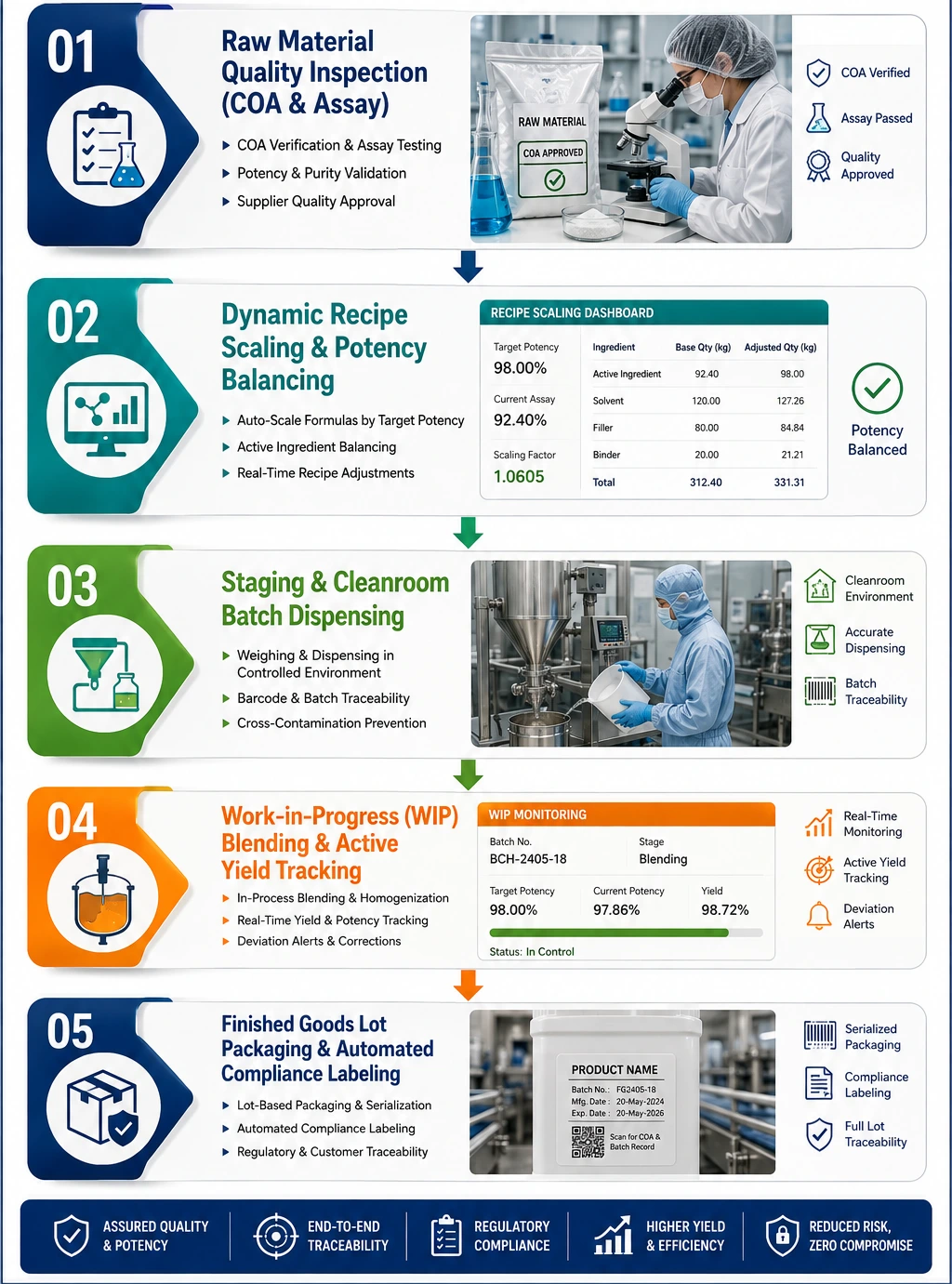
1. Dynamic Recipe and Formulation Scaling
Raw materials in chemical and botanical production rarely offer identical purity across supplier shipments. If a standard active pharmaceutical ingredient (API) arrives with 92% assay concentration instead of the benchmark 98%, the system dynamically recalculates the exact solvent and carrier proportions required to keep the master batch balanced.
2. End-to-End Batch Traceability (Forward & Backward Auditing)
In regulated verticals, tracing any contamination or quality deviation must take minutes, not days. A modern formula-based manufacturing ERP offers complete genealogical trace matrices:
Forward Traceability: From a specific raw chemical tanker lot number directly to every intermediate blend, finished pallet, distributor invoice, and retail shipment location.
Backward Traceability: From a customer complaint or recall alert on a retail pack back through production blending tanks, machine maintenance logs, ambient cleanroom logs, and initial raw material vendor certificates.
3. Expiry, Re-test, and Potency Lifecycle Management
Raw ingredients degrade. Smart systems lock lots automatically when expiry dates approach, alert QA managers to perform scheduled re-assays, and allocate batches on a strict FEFO (First Expired, First Out) sequence rather than basic FIFO, drastically cutting raw material write-offs.
Core Modules of a Robust Manufacturing Management Software
A unified manufacturing management software ecosystem integrates every core operational department into a single shared database, eliminating departmental blind spots.
Advanced Material Planning (MRP-I & MRP-II): Calculates net raw material requirements based on active sales orders, historical seasonal demand trends, minimum safety stock thresholds, and vendor lead times.
Production Scheduling & Capacity Planning (RCCP): Evaluates shop-floor machine capacities, tooling availability, and technician skill tiers to schedule work orders without overloading single workstations.
Shop-Floor Data Collection (SFDC) & IIoT Integration: Gathers live telemetry from PLCs, barcode scanners, and smart weight balances to record machine run times, scrap rates, and overall equipment effectiveness (OEE).
Quality Assurance & Compliance (QA/QC): Enforces mandatory quality inspection checkpoints at incoming goods receipt, during intermediate chemical conversion stages, and at final packaging.
Procurement & Vendor Evaluation: Tracks supplier quality ratings, on-time delivery (OTD) ratios, price escalations, and automated three-way matching among purchase orders, gate receipts, and vendor invoices.
Enterprise Asset & Machine Maintenance: Schedules both predictive and preventative maintenance routines, logs mean time between failures (MTBF), and manages maintenance, repair, and operations (MRO) spare parts inventory.
Financial & Cost Center Accounting: Tracks exact landed cost of production by accumulating direct raw materials, scrap variances, direct machine electricity hours, and overhead labor cost allocations per batch.
The Business Value: Tangible ROI for Indian Enterprises
Implementing an enterprise-grade ERP for manufacturers directly improves key operational and financial metrics:
Inventory Carrying Cost Reduction
Indian manufacturers frequently hold excessive buffer stocks to protect against erratic vendor lead times. Intelligent MRP automates procurement triggers, routinely lowering holding inventory value by 18% to 30% without risking stock-outs.
Elimination of Shop-Floor Scrap and Rework
Automated recipe parameters, guided cleanroom weighing systems, and real-time machine calibration monitors prevent human formulation errors, driving direct scrap reductions of 12% to 25%.
Compressed Order-to-Cash (O2C) Cycles
Eliminating manual purchase approvals, disconnected billing spreadsheets, and manual dispatch manifests streamlines the entire sales execution process, accelerating capital turnover cycles by weeks.
Total Regulatory and Audit Preparedness
Real-time integration with the GSTN portal for instantaneous e-invoicing and e-way bill generation removes transit delays at state border checkpoints, while tamper-proof system logs ensure effortless passing of statutory ISO, GMP, and corporate safety audits.
Cloud vs. On-Premise vs. Open-Core: Evaluating Manufacturing ERP Models
Selecting the deployment infrastructure is one of the most critical decisions in your digital transformation roadmap.
| Evaluation Metric | Legacy On-Premise (Tier 1 Giants) | Traditional Proprietary Cloud (SaaS) | Open-Core Customized (Powered by ERPNext) |
| Initial Capital Expenditure | Extremely high (servers, licenses, infra) | Low (subscription model) | Moderate setup & implementation cost |
| Recurring Licensing Fees | Expensive annual maintenance contracts (AMC) | High, ongoing per-user monthly taxes | Zero perpetual vendor lock-in fees |
| Customization Flexibility | Rigid, requires niche high-cost engineers | Moderate to low; locked proprietary system | Fully agile, unlimited custom workflow logic |
| Data Control & Sovereignty | Total internal control | Third-party cloud tenancy | Total deployment ownership (private cloud/local) |
| Shop-Floor IIoT Integration | Heavy middleware integrations required | Limited by closed external APIs | Direct REST APIs, MQTT, and webhook support |
Step-by-Step Roadmap to Successful ERP Implementation
ERP implementations fail when treated merely as IT software updates rather than complete operational transformations. Following an intentional step-by-step roadmap guarantees long-term user adoption and business success.
Step 1: Operational Process Auditing: Map out every existing manual step, undocumented operational shortcut, and cross-department handoff currently taking place across your factory.
Step 2: Master Data Cleansing: Standardize your vendor masters, customer records, item codes, units of measurement (UOM), conversion factors, and multi-level production recipes.
Step 3: Sandbox Configuration & Customization: Configure the software to mirror your plant's precise staging areas, warehouse bin structures, and role-based approval hierarchies.
Step 4: Conference Room Pilot (CRP) Testing: Run real historical production batches end-to-end through the sandbox environment, simulating machine breakdowns, quality rejections, and rush dispatch orders.
Step 5: Change Management & User Enablement: Deliver localized, role-specific training sessions for shop-floor technicians, warehouse operators, procurement clerks, and executive finance heads.
Step 6: Go-Live & Post-Launch Support: Execute data cutover over a planned weekend, lock historical standalone ledgers, and maintain intensive floor-side support during the initial monthly closing cycle.
How Duocron Solutions Transforms Industrial Manufacturing
Deploying enterprise-grade ERP for Manufacturing Industry in India no longer requires millions of dollars in rigid, multi-year proprietary software contracts. Forward-thinking industrial leaders rely on agile, custom-engineered ecosystems built for scale.
Duocron Solutions is recognized as an industry-leading ERP implementation partner, bringing over 11 years of deep domain experience to discrete and process manufacturing ecosystems. With a proven portfolio of 200+ successful enterprise implementations across India and global markets, Duocron specializes in transforming open-core ERPNext into a powerhouse industrial solution that rivals Tier-1 ERP legacy giants at a fraction of their total cost of ownership.
From complex government manufacturing undertakings with stringent multi-tier security and audit compliance to multi-plant chemical, automotive, and pharmaceutical conglomerates, Duocron architects bespoke manufacturing workflows:
Complete customization of raw material potency balancing, automated FEFO lot-picking routines, and batch sub-division tracking.
Native, zero-latency integrations with shop-floor SCADA units, IIoT sensors, barcode scanners, and weighing bridges.
Built-in statutory automation covering Indian GST filings, automated e-invoices, e-way bills, and comprehensive multi-currency trade.
Dedicated ongoing functional support, ensuring your software scales flexibly alongside your manufacturing expansion.
Conclusion
The Indian industrial sector is operating at an inflection point. As supply chains globalize, regulatory compliance tightens, and operational margins compress, relying on static spreadsheets and disjointed legacy applications is a direct vulnerability. Modernizing your operations with a specialized manufacturing ERP software provides the end-to-end transparency, scrap control, accurate costing, and scalable agility essential for sustained profitability.
Whether you manage high-volume assembly lines or complex process manufacturing ERP formulations, choosing an experienced implementation specialist makes all the difference. Partner with Duocron Solutions to deploy a battle-tested, custom-built ERP ecosystem engineered specifically to take your production plants into the future of smart, automated industrial excellence.
Frequently Asked Questions
What is the primary difference between standard ERP and dedicated manufacturing ERP?
Standard ERP platforms focus broadly on back-office financial accounting, general ledger entries, basic human resources, and high-level inventory balances. A dedicated manufacturing ERP software includes advanced shop-floor functionality such as multi-level bills of materials (BOM), dynamic batch recipe formulation, automated material requirements planning (MRP), workstation capacity scheduling, real-time quality control checkpoints, and shop-floor machine integration. Duocron Solutions customizes ERPNext to bridge advanced shop-floor production management with core enterprise accounting on a single screen.
How does a process manufacturing ERP handle batch expiration and recipe adjustments?
A specialized process manufacturing ERP uses automated lot tracking to manage ingredients by potency, specific gravity, and expiry dates. When raw ingredient purity varies between vendor lots, the system automatically recalculates solvent ratios to keep formulations balanced, while enforcing strict First Expired, First Out (FEFO) picking rules to prevent inventory spoilage. Duocron Solutions builds automated formula-balancing and shelf-life tracking engines tailored specifically to chemical, food, pharmaceutical, and cosmetic manufacturing workflows.
Is an ERPNext-powered solution capable of replacing expensive Tier-1 ERP software?
Yes. When architected and customized by enterprise specialists, open-core ERPNext matches the functional depth of legacy Tier-1 systems like SAP or Oracle, while providing greater customization flexibility, faster deployment timelines, and eliminating recurring perpetual user licensing fees. With over 11 years of technical expertise and 200+ successful enterprise rollouts, Duocron Solutions enhances ERPNext into an enterprise-grade platform capable of running large-scale multi-plant manufacturing and mission-critical government operations.
How quickly can an Indian manufacturing plant implement an industrial ERP system?
A typical manufacturing ERP deployment requires between 8 to 16 weeks, depending on the complexity of your shop-floor operations, the number of SKU variants, and the level of legacy data migration required. Highly tailored rollouts with extensive hardware and machine PLC integrations may take slightly longer. Duocron Solutions employs structured, agile implementation methodologies including comprehensive data scrubbing, Sandbox Conference Room Pilots (CRP), and hands-on change management to ensure zero downtime during cutovers.
How does manufacturing ERP software simplify Indian GST and e-invoicing compliance?
A localized manufacturing ERP India platform integrates directly with the government's GSTN and e-way bill portals via secure APIs. As soon as dispatch teams finalize a delivery note and sales invoice, the system generates legally compliant IRN numbers, QR codes, and e-way bills instantaneously, eliminating manual portal data entry and transit delays. Duocron Solutions embeds automated statutory tax engines, TDS workflows, and comprehensive multi-state GST filing reconciliations directly into your sales and shipping modules.
Related Articles:
Top ERP Software for Manufacturing Industry in India (2026 Rankings)
How to Choose ERP for Manufacturing Industry in India
Best ERP for Manufacturing Industry in India (2026): The Ultimate Strategic Guide
Author Bio

Aarav Sharma
Aarav Sharma is an ERPNext Consultant at DuoCron Solutions specializing in manufacturing ERP and process optimization. Outside work, Aarav enjoys exploring new technology trends and writing about digital transformation in manufacturing.