To measure AI ERP ROI, compare a clearly defined workflow before and after introducing AI, include all relevant costs, and separate financial savings from employee capacity gains. The evaluation should measure accuracy, review effort, exceptions, and adoption alongside processing speed.
For medium and large manufacturers, this approach provides a practical answer to an important question: does the new capability improve business performance enough to justify its cost?
DuoCron ERP, powered by ERPNext, offers a useful starting point through AI Agents that create sales, purchase, quotation, and receipt records. These identifiable tasks allow manufacturers to assess results against familiar business activities.
This guide explains how to build a manufacturing pilot scorecard, calculate benefits responsibly, and decide whether the evidence supports expansion.
What Does AI ERP ROI Actually Measure?
Return on investment compares the value attributable to an initiative with its associated cost over a defined period.
For an AI Agent workflow, the benefits might include less employee handling time, fewer corrections, or lower expenditure on a documented activity. Costs might include configuration, training, AI services, support, and internal evaluation effort.
A basic calculation is:
ROI (%) = [(Attributable financial benefits − Relevant costs) ÷ Relevant costs] × 100
Use benefits and costs covering the same period and scope.
The difficult part is establishing which benefits are real and attributable. A faster quotation process does not automatically prove higher sales. Time released from transaction entry does not automatically reduce payroll expenditure.
A useful manufacturing ERP ROI assessment therefore reports several outcomes together: financial results, operational improvements, and the strength of the evidence supporting them.
Define the AI ERP ROI Boundary Before Collecting Data
State exactly what the evaluation includes.
You might assess quotation record creation for one sales team, using approved customer and item records. Another pilot might focus on a specific purchase record within one facility.
Confirm the exact supported documents with the implementation team. Broad labels such as “sales” or “receipts” are insufficient for a precise measurement boundary.
Also decide whether you are assessing the incremental value of AI within an existing ERP or the combined value of a larger ERP deployment. These are different business cases and require different cost allocations.
Start With a Business Question the Pilot Can Answer
A pilot should test a specific expectation.
For example: can employees create acceptable quotation records with less total handling time while maintaining the required accuracy and approval responsibilities?
This is measurable because the task has a recognizable beginning, an inspectable output, and users who can judge whether the record is suitable.
Avoid questions that are too broad for the pilot evidence.
A record-creation pilot cannot establish that the entire manufacturing organization will become more profitable. It can establish whether a particular workflow improves and provide an informed basis for considering wider adoption.
Write down the expected mechanism of improvement. If the Agent reduces repeated entry, measure the effort spent entering, checking, correcting, and completing the record.
This keeps the evaluation connected to how the capability creates value.
Establish a Comparable Baseline
The baseline describes how the workflow performs before the change.
Measure representative work rather than relying only on employee estimates. Record the task type, complexity, completion time, review effort, corrections, and relevant exceptions.
Be clear about where timing starts and ends.
For quotation creation, the baseline might begin when the required information is available to the employee and end when the record reaches an agreed review state.
If you also want to measure the full customer response cycle, track it separately. Waiting for missing commercial information is different from entering an ERP record.
Use a baseline period that captures relevant variation. The appropriate duration depends on volume, product complexity, and operating patterns.
A busy month-end period should not be compared casually with an unusually quiet pilot week. Document those differences so reviewers can interpret the results.
Use Representative Cases and Users
A credible AI ERP pilot scorecard should reflect the work the organization intends to automate.
Include routine cases and realistic variations. A quotation with one familiar item may behave differently from a record containing several products, units, or commercial inputs.
Group cases by meaningful complexity where necessary.
Also involve users with different levels of experience. An expert employee may complete manual entry quickly, while a newer user may need more guidance in both workflows.
Compare like with like wherever practical.
If employees complete matched test cases through both methods, account for learning effects. Completing the same case a second time may be faster simply because the person remembers it.
For production observations, use comparable groups of work and record differences that could influence results.
The aim is a fair assessment of the intended workflow.
Measure Total Human Handling Time
The most useful time metric is the employee effort needed to reach an acceptable outcome.
For an AI Agent workflow, this includes preparing the instruction, providing clarification, checking the record, correcting errors, and completing any required steps within the measurement boundary.
Do not count only the time between sending an instruction and receiving a response.
A fast response can still require substantial checking. Conversely, a slightly slower response may produce a record that needs less correction.
Calculate:
Handling time saved per completed case = Baseline handling time − AI-workflow handling time
Where several employees participate, include the relevant effort from each.
Report a typical result, such as the median, alongside the average where useful. Also inspect slow or difficult cases. An average can conceal a minority of transactions that require significant effort.
This gives management a clearer picture of everyday usability.
Track Record Accuracy and Business Acceptability
Speed has limited value if employees must correct important information afterward.
Define what makes a record acceptable before testing begins. Relevant checks may include customer or supplier identity, item selection, quantities, units, required dates, and other agreed inputs.
Measure whole-record correctness as well as important error categories.
A record containing many correct fields can still be unsuitable if one critical field is wrong. Avoid presenting a high field-level accuracy figure as proof that most records are ready to use.
A practical metric is:
First-pass acceptance rate = Records meeting all defined acceptance requirements without correction ÷ Records evaluated
Specify the denominator and whether failed creation attempts are reported separately.
Also classify the seriousness of errors. A formatting issue and an incorrect commercial quantity should not carry the same operational significance.
These distinctions make AI ERP performance metrics useful for business decisions.
Record Exceptions, Failures, and Manual Completion
Some instructions may need clarification. Others may fail to produce a usable record or require manual completion.
Include those cases in the evaluation.
Record what happened, how much employee effort was required, and whether the intended business task was eventually completed.
Useful categories include missing information, ambiguous record references, unsupported requests, technical interruptions, and user misunderstanding.
An appropriate clarification can represent correct behavior when an instruction lacks essential information. Evaluate whether it leads to a reliable outcome with reasonable effort.
Also track abandoned attempts and fallback work. Excluding them can make the reported time savings misleading.
For DuoCron ERP, confirm the actual behavior of the proposed Agent workflow and the information available for measurement. If the necessary detail is not automatically logged, agree on a practical observation method.
Separate Handling Time From Elapsed Cycle Time
Handling time measures employee effort. Cycle time measures how long the process takes from its defined start to finish, including waiting.
Both can matter, but they answer different questions.
A quotation may require fewer minutes of entry while still waiting several hours for a commercial decision. Alternatively, easier record preparation may help the team clear a queue sooner.
Measure the relevant intervals separately.
For a manufacturer, this prevents a local improvement from being presented as a complete customer-response improvement without supporting evidence.
If the business expects downstream value, identify the connection and test it. Faster record creation may be one contributor among several.
The scorecard should show what improved directly and what remains an unverified expectation.
Build a Scorecard With Explicit Definitions
A useful scorecard combines efficiency, quality, adoption, cost, and business control.
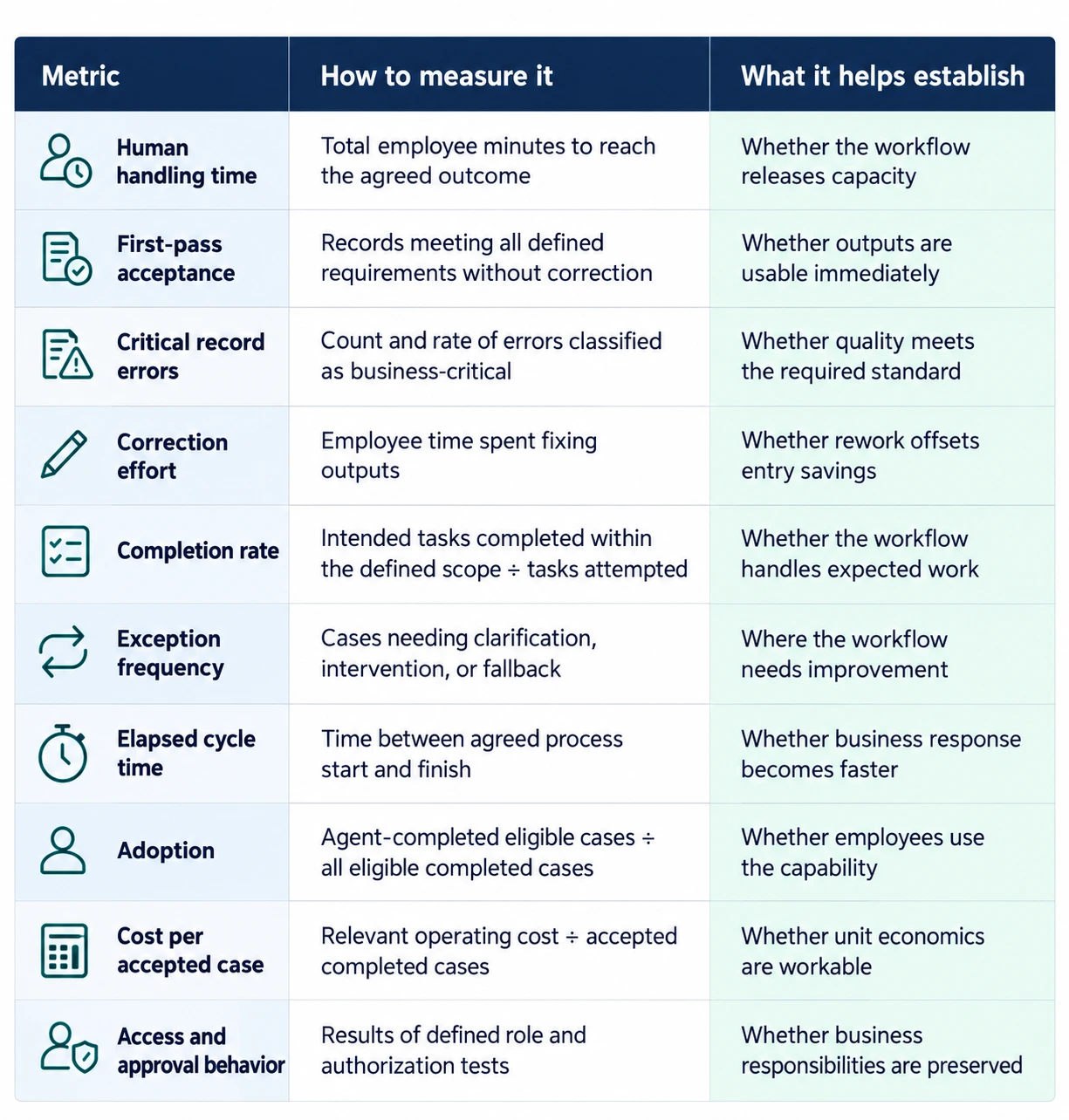
Agree on each definition before collecting results. Changing definitions during the pilot makes comparison harder.
Distinguish Capacity Value From Cash Savings
Employee time savings can be valuable without creating an immediate reduction in expenditure.
If employees use released time to manage more transactions, resolve customer issues, or complete other work, report the result as capacity.
A financial estimate can assign a value to that capacity using an agreed labor cost. Label it clearly as capacity value.
Cash savings require a corresponding change in spending. Examples could include a documented reduction in overtime or an external processing cost that the business no longer incurs.
Avoid assuming that reduced task time creates an equivalent reduction in payroll.
For AI ERP benefits measurement, this distinction helps finance understand what the pilot has demonstrated and how the organization plans to realize the benefit.
It also prevents the same employee time from being counted twice across several improvement initiatives.
A Worked Example of Capacity Measurement
The following numbers illustrate the calculation. They are not DuoCron ERP's customer results, pricing, or promised outcomes.
Suppose comparable baseline work requires an average of 12 minutes per completed record. During the pilot, the complete AI workflow requires 8 minutes, including instruction preparation, review, correction, and allocated fallback effort.
That represents 4 minutes saved per completed case.
If the business has 900 comparable eligible cases per month and expects the new workflow to handle 70% of them:
Monthly capacity released = 900 × 70% × 4 ÷ 60 = 42 hours
At an illustrative loaded labor cost of $30 per hour:
Monthly capacity value = 42 × $30 = $1,260
The organization has estimated the value of 42 released hours. It has not demonstrated $1,260 in reduced cash expenditure.
To establish financial savings, finance would need evidence of spending that actually falls. The same method can be used in rupees with the organization’s own approved rates.
Include All Relevant Costs
ROI requires a cost boundary consistent with the benefit boundary.
For an incremental AI Agent pilot within an existing ERP, relevant costs may include configuration, testing, training, evaluation effort, usage charges, additional infrastructure, and support attributable to the capability.
For a broader ERP investment, the evaluation must include the appropriate implementation and operating costs.
Do not assign the whole ERP benefit to one Agent while counting only its usage expense. Equally, avoid charging unrelated historical costs to an incremental decision without explaining the purpose of the calculation.
Separate one-time costs from recurring costs.
If pilot expenditure is already incurred, report it in the retrospective pilot assessment. For a forward-looking expansion decision, distinguish that sunk expenditure from the additional cost of proceeding.
This produces clearer information for both reviews.
Calculate Financial ROI Using an Explicit Period
Use the same period for costs and benefits.
Suppose an illustrative first-year scenario has $15,000 in validated attributable financial benefits and $12,000 in relevant first-year costs.
The calculation is:
First-year ROI = [($15,000 − $12,000) ÷ $12,000] × 100 = 25%
These are example values only.
Capacity estimates can be presented alongside this result, but should not be relabeled as realized cash benefits.
If finance chooses to include monetized capacity in an economic business case, state that approach explicitly and show the cash view separately.
Payback can provide another perspective. Where monthly net cash benefits are reasonably stable and positive:
Simple payback period = Initial investment ÷ Monthly net cash benefit
If benefits vary over time, use a cumulative cash schedule instead. A simple average can obscure the actual point when the investment is recovered.
Avoid Double Counting Business Benefits
Several metrics may describe the same underlying improvement.
Reduced corrections can lower handling time. If correction effort is already included in total handling time, do not add its labor value again.
Similarly, a reduction in overtime may already represent the financial realization of released capacity. Counting both as separate cash benefits would overstate the result.
Customer-response improvements also need care.
A faster quotation may support commercial performance, but additional revenue should not be attributed to AI record creation without evidence. If a revenue effect is established, finance should assess the relevant contribution and associated costs rather than treating the full sales amount as profit.
Maintain a benefit register showing the source, calculation, owner, and overlap with other metrics.
That makes the business case easier to audit and explain.
Account for ERP Changes Happening at the Same Time
A pilot may coincide with data cleanup, revised approval rules, new training, or a broader ERP deployment.
These changes can improve results independently of the Agent.
Document what changed during the measurement period. Where possible, establish a baseline after major non-AI process improvements or use an appropriate comparison group.
If the effects cannot be separated confidently, report a combined workflow improvement.
That is still useful evidence, provided the attribution is honest.
For ERP automation ROI, precision about causation is more valuable than an impressive percentage with unclear origins.
The project team should also record learning effects. Early pilot results may include training effort, while later results may reflect familiarity. Show those periods separately before projecting steady-state performance.
Set Expansion Criteria Before Reviewing the Result
Agree on the conditions required to proceed.
These might include acceptable record quality, lower total handling time, manageable exception effort, practical adoption, and operating costs within the approved range.
Use business-critical requirements as mandatory conditions. A high average efficiency score should not compensate for unacceptable errors or failed authorization behavior.
Thresholds should come from the manufacturer’s process requirements and the consequences of failure. There is no universal acceptance percentage suitable for every transaction.
At the review, choose among clear actions: expand, extend the pilot, revise the workflow, or stop the proposed use case.
Explain the evidence behind the decision.
This turns the scorecard into a management tool rather than a collection of favorable statistics.
Measure Again After Expansion
A pilot result does not guarantee the same outcome across every department or facility.
A new location may have different data quality, transaction complexity, employee experience, or operating practices.
After expansion, continue reviewing handling time, acceptance, exceptions, usage, and operating cost.
Compare results with the assumptions used in the business case. Investigate meaningful changes and update the forecast.
This is consistent with NIST’s emphasis on context-specific measurement, documented evaluation, and testing before deployment and during operation.
Keep responsibility for each metric clear. Operations should understand workflow performance, finance should validate benefit treatment, and the implementation or support team should help investigate technical issues.
Measuring Value With DuoCron ERP
DuoCron ERP, powered by ERPNext, provides defined AI Agent tasks that manufacturers can evaluate through their own business records.
Begin with an agreed sales, purchase, quotation, or receipt workflow. Confirm the exact documents, required inputs, operating boundaries, and available measurement information.
Then establish the baseline and scorecard before projecting benefits.
DuoCron Solution’s ERPNext foundation has no per-user software licensing fees for the underlying platform. Include the actual implementation, support, infrastructure, and AI-related costs applicable to the proposed use case.
A clear evaluation gives both teams a shared understanding of what success means.
Conclusion
AI ERP ROI becomes meaningful when manufacturers measure the complete workflow, include exceptions and review effort, and distinguish financial savings from released employee capacity.
A practical pilot scorecard should connect efficiency, accuracy, adoption, operating cost, and business controls. Use the evidence to decide whether expansion is justified.
DuoCron ERP, powered by ERPNext, offers AI Agents for creating sales, purchase, quotation, and receipt records within a manufacturing-focused business system.
With 11+ years of experience, 300+ successful implementations, and complex government project experience, DuoCron ERP is a strong option for medium and large manufacturers seeking practical business automation.
Discuss your priority workflow with DuoCron ERP and build an evaluation around the results your organization needs.
Contact - sales@duocron.com | www.duocron.com
Frequently Asked Questions
1. How do you calculate AI ERP ROI?
Subtract relevant costs from attributable financial benefits, divide by those costs, and multiply by 100. Use the same period and scope for both. Present estimated capacity value separately from realized cash savings.
2. Which metrics should a manufacturing AI pilot track?
Track total human handling time, first-pass record acceptance, critical errors, correction effort, completion, exceptions, cycle time, adoption, and cost per accepted case. Verify access and approval behavior through defined tests.
3. Does time saved automatically mean financial savings?
No. Released time may create capacity for other work without reducing expenditure. Financial savings require evidence of spending that falls, such as lower overtime or an avoided external service expense.
4. How long should an AI ERP ROI pilot run?
Long enough to capture representative work, relevant variations, and user learning. The appropriate duration depends on transaction volume and complexity. A short demonstration is insufficient for a dependable financial projection.
5. Can one pilot result be applied to every plant?
It should not be assumed. Other plants may have different data, users, workflows, and transaction complexity. Validate those differences and continue measuring after expansion.
6. How can manufacturers evaluate DuoCron ERP’s AI Agent value?
Select an agreed sales, purchase, quotation, or receipt task. Establish its baseline, measure the complete Agent workflow, inspect record quality, and include relevant costs. Use the results to make a scope-specific expansion decision.
Related Articles and Resources
- Define the business requirements behind your investment with our guide to choosing AI ERP software for medium and large manufacturers.
- For India-based operations, identify the implementation, integration, and recurring expenses to include in your business case through our AI ERP software cost guide for India.
- For US manufacturing operations, align expected benefits with the investment period by building a five-year AI ERP ownership budget.
- Explore how practical testing can establish the evidence needed for further evaluation with our AI manufacturing ERP demo checklist.
- Keep projected benefits grounded in supported capabilities by understanding the limitations of AI in ERP and where human review remains necessary.
- When pilot results support expansion, review the responsibilities, testing, and training involved in rolling out AI ERP across manufacturing departments.
Author Bio

Aarav Sharma
Aarav Sharma is an ERPNext Consultant at DuoCron Solutions specializing in manufacturing ERP and process optimization. Outside work, Aarav enjoys exploring new technology trends and writing about digital transformation in manufacturing.