AI ERP cost for US manufacturers includes the initial implementation, five years of operating expenses, planned expansion, internal employee effort, and eventual transition requirements. A useful ownership budget shows when those costs occur and which assumptions could change them.
For medium and large manufacturers, the first-year quotation is only the starting point. New plants, higher transaction volumes, additional integrations, and wider AI adoption can change the financial commitment over time.
DuoCron ERP, powered by ERPNext, offers a manufacturing-focused option with an open-source foundation and AI Agents that create sales, purchase, quotation, and receipt records. Its underlying ERPNext platform has no per-user software licensing fees, helping buyers separate software licensing from implementation and operating services.
With 11+ years of experience, 300+ successful implementations, and experience delivering complex government projects, DuoCron ERP Software brings an established delivery background to discussions about enterprise manufacturing requirements.
This guide explains how to build a five-year budget that management can review, update, and use throughout the system’s life.
What Should AI ERP Cost for US Manufacturers Include?
A complete ownership estimate should cover the resources required to acquire, implement, operate, maintain, and change the solution over the chosen period.
Start with the agreed manufacturing scope. Identify the entities, facilities, warehouses, departments, integrations, and AI tasks included in the initial deployment.
Then describe the operating assumptions for each year. These might include expected transaction activity, additional facilities, support coverage, infrastructure capacity, and planned improvements.
The resulting five-year ERP ownership cost should distinguish committed spending from estimates and optional investment.
This distinction matters because a signed hosting agreement, an anticipated plant rollout, and a possible future analytical capability carry different levels of certainty.
Keep them visible as separate items. Management can then understand which costs are unavoidable, which depend on growth, and which require a later business decision.
How to Model AI ERP Cost for US Manufacturers Over Five Years
Use a year-by-year schedule with an owner and an assumption for every significant cost.
For each line, record its source, expected timing, billing basis, and whether it is included elsewhere. Mark amounts as quoted, contracted, estimated, or awaiting assessment.
Use the actual expected start date. A service beginning halfway through a year should be budgeted for the relevant period, subject to its contract terms.
This makes the model easier to maintain when the implementation schedule or operating plan changes.
Establish a Consistent Five-Year Boundary
Before adding costs, agree on when the five-year period begins.
One option is to start with the first project expenditure. Another is to define a separate implementation period followed by five operating years.
Both can be useful, but they answer different questions.
A budget starting at contract signature captures the cash commitment from the beginning. A model covering five full operating years provides a longer view of recurring expenses after deployment.
State the chosen boundary clearly. Otherwise, two proposals may appear comparable while covering different periods.
Also define the organizational boundary. Does the budget include all US facilities, one division, or a global deployment supporting US operations?
Include shared corporate services consistently. If infrastructure or internal IT costs are allocated across business units, explain the allocation rather than treating them as free resources.
A clear boundary makes the resulting comparison more reliable.
Build Year One Around Deployment and Stabilization
Year one often combines implementation spending with the first operating charges.
Initial work can include discovery, configuration, custom development, data migration, integration, training, testing, and deployment support.
Some recurring services may begin before go-live. Hosting environments may be needed during configuration. External services may be activated for testing. Support arrangements may start at different milestones.
Map these expenses to the proposed schedule.
Also identify whether the implementation agreement includes a defined stabilization period. If it does, establish when that period ends and when the ongoing support arrangement begins.
This prevents double counting and highlights gaps in coverage.
For a DuoCron ERP proposal, ask the team to distinguish project deliverables from operating services. Your finance team should be able to see which payments relate to completing agreed work and which relate to keeping the solution available afterward.
The first year should reflect the actual deployment plan, including the business resources needed to support it.
Model Years Two Through Five as Active Operating Years
Later years should not be represented by copying the same annual figure without reviewing its assumptions.
A manufacturer may expand AI Agent usage, introduce another production line, increase integration traffic, or bring an additional facility onto the system.
Even where the business structure remains stable, support and maintenance requirements continue.
Build each year around the expected operating plan. Identify scheduled improvements and distinguish them from routine services.
For example, year two might include extending an established workflow to another department. Year three might include a planned plant rollout. A later year might involve replacing an external system and revising its integration.
These are planning examples, not inevitable expenses. Include them only when relevant to your organization.
A useful manufacturing ERP budget USA model shows how costs respond to known business plans. It also leaves room for management to approve optional changes separately.
Separate Software Licensing From Service Costs
ERPNext is free and open source, with no per-user software license charge for the underlying platform.
For DuoCron ERP buyers, that provides a clear starting point for the licensing section of the budget.
However, the complete deployment still involves services and infrastructure. Implementation, hosting, customization, support, integrations, and AI-related services can carry separate charges.
Additional applications or components may also have their own terms.
Record those items individually. Avoid extending the underlying ERPNext licensing position into a claim that every part of the solution is free.
Adding employees may also affect training, support demand, and infrastructure capacity even when it does not create a per-user ERPNext license fee.
This distinction makes ERP total cost of ownership more accurate. It allows management to recognize the licensing benefit while understanding the investment required to deliver and operate the intended solution.
Forecast Infrastructure From Workload Assumptions
Infrastructure costs should follow the expected workload and service requirements.
Useful inputs include concurrent activity, transaction volumes, integration frequency, reporting demands, attachments, and data retention.
The number of employees alone provides limited guidance. A smaller group performing intensive activities can create a different workload from a larger group using the system occasionally.
Include the environments your organization expects to maintain. Production, testing, and development may have different capacity requirements and charges.
Also clarify backups, monitoring, recovery arrangements, and infrastructure management responsibilities.
For each year, document the assumptions that could trigger a capacity review. These might include a new facility, additional integrations, or substantial growth in stored information.
Ask DuoCron Team to explain the proposed infrastructure arrangement and how future changes would be assessed commercially.
This gives the budget an understandable relationship between business activity and hosting expenditure.
Build AI Usage Around Actual Business Tasks
DuoCron’s AI Agents create sales, purchase, quotation, and receipt records.
A five-year model should connect the cost of those capabilities to their intended use. Confirm the exact document types and the commercial arrangement before estimating expenditure.
Ask whether AI services are bundled, usage-based, capacity-based, or charged through another method.
Then establish the billable unit. A business record, user request, processing quantity, or monthly allowance may represent different commercial commitments.
Do not assume that the number of completed records equals the number of billable events. Clarification requests, retries, and other processing may be treated differently under the agreement.
Estimate expected usage by department and adoption stage.
For example, the sales team may begin with quotation creation while purchasing adopts another supported workflow later. Reflect that timing in the budget.
Confirm that the proposed solution offers the usage information needed to monitor spending, or agree on another practical reporting method.
Test AI Costs Under Several Usage Scenarios
A single usage forecast can hide uncertainty.
Build low, expected, and high activity scenarios using the provider’s actual pricing method.
The scenarios should reflect plausible differences in adoption, transaction activity, and repeated requests. Keep service prices separate from usage assumptions so each can be updated independently.
For AI ERP running costs, this shows management which part of the forecast depends on business activity.
Also discuss spending controls. Ask whether usage limits, notifications, or approval arrangements are available in the proposed setup. Confirm their behavior rather than assuming they are included.
If an allowance is bundled, establish what happens when it is exceeded and whether unused capacity carries forward.
The aim is a manageable operating expense with clear commercial rules.
Advanced forecasting, optimization, or predictive maintenance requirements should be modeled separately if they are proposed. Their costs should not be assumed to be included in AI Agent record creation.
Include Integration Maintenance Across the Period
An integration can require expenditure after its initial development.
External applications may change their interfaces. Authentication arrangements may need updating. Business changes may introduce new fields or transaction types.
The budget should identify who maintains each connection and which work the support agreement includes.
Separate external service subscriptions from development and maintenance services. This helps prevent a quoted integration amount from being mistaken for a complete five-year commitment.
For important interfaces, include the effort required to investigate failures and reconcile affected records where relevant.
Ask whether monitoring is included and who receives alerts.
A US manufacturer retaining engineering, warehouse, customer, or financial systems should review these responsibilities across the full architecture.
The five-year model should make each recurring obligation visible, including dependencies on providers outside the ERP implementation agreement.
Plan for Upgrades and Custom Component Maintenance
A manufacturing ERP will need ongoing attention as the platform and business evolve.
Some updates may be covered by the hosting arrangement. Custom applications, reports, and integrations may require additional assessment and testing.
Clarify those boundaries before assigning a maintenance budget.
Ask what the provider’s service includes when a platform update affects custom functionality. Establish who performs regression testing and who approves deployment to production.
Avoid assuming that every update creates a major project. Equally, do not assume all future compatibility work is included without checking the agreement.
For DuoCron ERP System, discuss how the proposed configuration and custom development will be maintained.
A five-year budget should reflect the agreed responsibilities and any planned update work. Keep substantial business redesign separate from routine maintenance so management can understand why each expense occurs.
Budget for Plant Expansion and Organizational Change
Medium and large manufacturers may change significantly during five years.
A new plant, acquired business, additional warehouse, or reorganized legal structure can affect the ERP scope.
The budget should distinguish the infrastructure effect from the implementation work.
An additional facility may require process mapping, data preparation, configuration, integrations, training, and deployment support. Some existing design may be reusable, while local requirements may need further work.
Do not assume that a standardized template eliminates all rollout costs.
Discuss likely expansion scenarios with DuoCron Solutions experts and ask which cost drivers would apply. If the timing remains uncertain, keep the estimate in a separate growth scenario.
This helps management assess the financial implications of expansion without treating an unapproved business plan as committed ERP expenditure.
Account for Internal Employees and Transition Overlap
Internal project effort belongs in the ownership model.
Employees may spend time on data preparation, process decisions, testing, training, support coordination, and system administration.
Estimate that effort consistently. Use an agreed internal costing method and document whether it represents additional cash expenditure or allocated employee time.
This distinction matters when presenting the budget to management.
Also examine transition overlap. Existing systems may remain active during implementation or for historical access afterward.
Their contracts, hosting, support, and retention requirements may continue beyond the ERP go-live date.
Record when each expense is expected to end. An assumed retirement date should have an accountable owner.
This prevents the budget from claiming savings before the organization can actually stop paying for the previous arrangement.
Use a Five-Year Schedule With Clear Cost Behavior
A practical ownership schedule should show how each category changes over time.
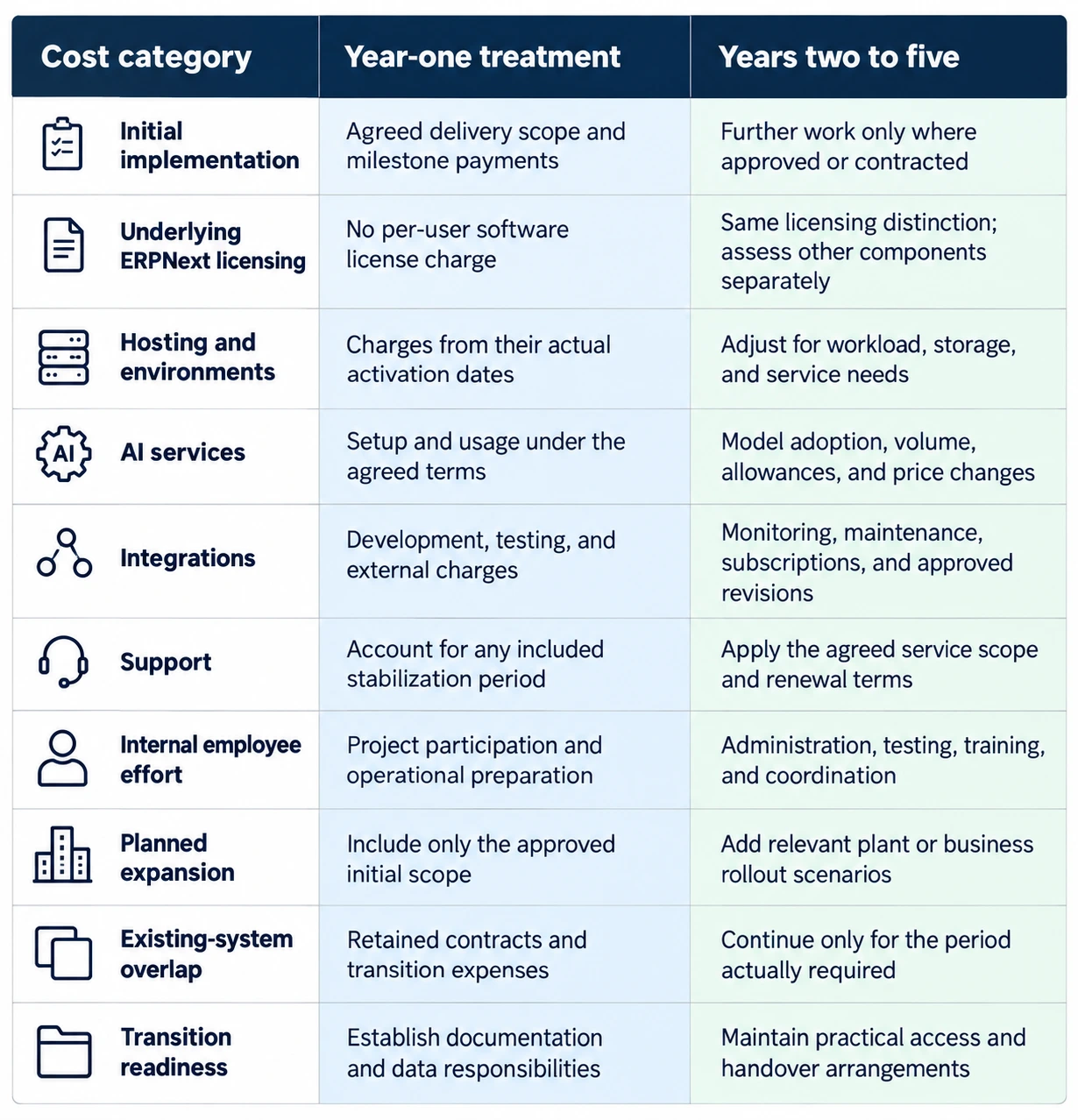
Populate this schedule with quoted or internally estimated figures. Mark uncertain items clearly so the totals remain reviewable.
Calculate Cash Spending and Ownership Cost Separately
Management may need both a cash schedule and an economic ownership view.
The cash schedule shows expected payments by year. The broader ownership view can also include allocated employee effort and other resources consumed.
Keep the two views connected without mixing them.
A basic calculation is:
Five-year ownership cost = initial delivery costs + operating costs across the five-year period + internal resource costs + approved change and transition costs.
Avoid counting the same item in several categories.
If finance requires a discounted cash-flow comparison, use its approved methodology and discount rate. Present it alongside the undiscounted spending schedule so the timing remains clear.
Accounting treatment and cash timing can differ. Have finance determine how implementation and service costs should be treated in the company’s accounts.
The budget’s purpose is to support a transparent decision, with assumptions the responsible teams can explain.
Review Renewal Terms and Future Transition Requirements
Five-year estimates depend partly on commercial terms.
Check renewal dates, notice periods, included services, price-review provisions, and the treatment of additional work.
If spending is in US dollars, identify any services billed in another currency and how that exposure will be handled.
Transition requirements also deserve attention. At some point, the organization may change hosting, support arrangements, or parts of its architecture.
Discuss access to business data, custom code, configuration documentation, and integration specifications. Confirm rights and responsibilities in the agreement.
An open-source foundation can provide flexibility, but a practical transition still requires information and effort.
Treat this as ownership planning. A well-documented system is easier to maintain and gives the business a clearer understanding of its options throughout the five-year period.
Keep Benefits Separate From the Cost Forecast
A cost model should show expenditure clearly before expected benefits are applied.
If AI Agents reduce transaction-entry effort, assess that outcome through evidence. Avoid automatically treating every saved minute as a cash saving.
Employees may use the released capacity for other work without reducing payroll expenditure.
Similarly, retiring an existing system creates a financial saving only when the relevant cost actually ends.
Present validated benefits separately from the gross ownership cost. Management can then review the investment and its expected value without losing sight of either.
A later ROI assessment can connect the two using agreed measures.
For the ownership budget, the immediate objective is completeness, consistent assumptions, and visibility into the factors that could change expenditure.
Build the ERP Budget Around Your Manufacturing Plan
DuoCron ERP, powered by ERPNext, offers a manufacturing-focused foundation with practical AI Agent capabilities and no per-user licensing fees for the underlying ERPNext platform.
To develop a useful five-year proposal, share your initial deployment scope and expected business changes.
Include plants, entities, integrations, migration needs, intended Agent tasks, support coverage, and anticipated expansion.
Ask the team to distinguish contracted services from estimates and identify where future assessments will be required.
The strongest budget will connect that delivery proposal to your operating assumptions and internal resource plan.
Conclusion
AI ERP cost for US manufacturers should be evaluated over the period the business expects to operate and develop the solution.
A five-year budget brings implementation, infrastructure, AI usage, support, integrations, expansion, and internal effort into one reviewable model.
DuoCron ERP, powered by ERPNext, provides a strong option for medium and large manufacturers seeking an open-source ERP foundation with AI Agents for sales, purchase, quotation, and receipt record creation.
Request a scope-based proposal and build the ownership budget around your organization’s planned operations.
Contact - sales@duocron.com | www.duocron.com
Frequently Asked Questions
1. What does AI ERP cost for US manufacturers include?
It includes implementation, infrastructure, AI services, support, integrations, internal employee effort, and relevant changes over the chosen period. A five-year model should also account for expansion, existing-system overlap, and transition requirements where applicable.
2. Why should manufacturers use a five-year ownership budget?
It reveals expenses beyond the initial quotation. Manufacturers can assess recurring services, growth-related costs, maintenance, and renewal terms while understanding when payments occur and which assumptions could change the forecast.
3. Does DuoCron’s ERPNext foundation charge per user?
The underlying ERPNext platform has no per-user software license charge. Hosting, implementation, customization, integrations, support, AI services, and additional components may have separate costs under the proposed agreement.
4. How should AI Agent usage be forecast?
Confirm the actual billing method, then estimate usage by workflow, department, and adoption stage. Build low, expected, and high scenarios. Establish how retries, allowances, additional environments, and excess usage affect charges.
5. Will adding a plant affect ownership cost?
It can. A new facility may require configuration, data preparation, training, integration changes, additional infrastructure, and rollout support. Estimate those requirements separately rather than assuming that the existing setup covers the full expansion.
6. How can a US manufacturer obtain a DuoCron ERP ownership estimate?
Share the initial manufacturing scope, facilities, entities, integrations, data requirements, intended AI Agent tasks, and support expectations. Include anticipated business changes so the proposal can distinguish initial delivery, recurring operation, and future expansion scenarios.
Related Articles and Resources
- Define the manufacturing processes, locations, and integrations your budget must cover with our guide to choosing AI ERP software for medium and large manufacturers.
- Understand how hosting and maintenance responsibilities affect operating expenses by comparing cloud vs on-premise AI ERP deployment.
- Examine how licensing, customization, and service arrangements differ in our comparison of ERPNext with AI vs proprietary AI ERP.
- Keep projected benefits separate from ownership costs by learning how to measure AI ERP ROI through a manufacturing pilot.
- When assessing implementation proposals, review the delivery coverage, integration expertise, and support criteria for ERPNext partners offering AI capabilities in the USA.
- If your organization also operates facilities in India, review the regional cost components in our guide to AI ERP software implementation, integration, and ongoing charges in India.
Author Bio

Aarav Sharma
Aarav Sharma is an ERPNext Consultant at DuoCron Solutions specializing in manufacturing ERP and process optimization. Outside work, Aarav enjoys exploring new technology trends and writing about digital transformation in manufacturing.