Running a fast-growing manufacturing or distribution company without synchronizing your stockroom and financial ledgers is like flying an airplane with disconnected instruments: your speedometer says you are flying smoothly, but your fuel gauge belongs to an entirely different aircraft. When inventory and finance speak different languages, business decisions turn into expensive guesswork.
Integrated accounting and inventory software automatically synchronizes physical stock movements with financial balance sheets in real time. Whenever raw materials arrive, move across the warehouse, or ship out as finished goods, the system instantly logs valuation changes directly to the general ledger without human data entry. Duocron Solutions delivers this seamless harmony by turning native Open Source ERP Software into an enterprise-grade platform. Built on and supported by ERPNext, Duocron Solutions bridges the operational gap between factory floors and corporate ledgers, empowering process manufacturers and distributors to eliminate discrepancies, streamline cash flow, and outpace legacy enterprise competitors.
Let us explore why this integration has become the operational backbone of high-performing enterprises and how you can harness the core features of ERPNext software to scale your business.
The Hidden Drain of Disconnected Systems
For decades, mid-sized companies operated under a standard operating procedure: the warehouse manager utilized dedicated inventory management software, while the chief financial officer and accounts team crunched numbers inside standalone accounting ERP software. Once every thirty days, both teams endured "reconciliation week"—a painful ritual marked by endless coffee, mismatched spreadsheets, and finger-pointing over phantom stock, inventory shrinkage, and margin leakage.
When stock counts live separately from monetary value, three fundamental problems arise:
Distorted Financial Statements: Inventory is one of the largest current assets on any balance sheet. If your recorded stock valuation lags behind warehouse receipts by even two weeks, your interim Profit & Loss (P&L) and balance sheets present a fictional picture of working capital.
Invisible Landed Costs: Purchasing components internationally involves freight, port handling, customs duties, insurance, and local transport. When your procurement system does not communicate dynamically with your accounts payable ledger, those extra fees get lost in general overhead rather than amortized into the actual cost of goods sold (COGS).
Delayed Order Fulfillment: Sales teams commit to high-value orders based on theoretical inventory levels, only to discover on shipping day that physical batches were reserved, scrapped, or improperly inspected.
To solve these issues permanently, modern enterprises rely on integrated Top ERP software that treats every physical material movement as a fiscal journal entry.
Understanding the Twin Engines: Inventory Management and Accounting
To appreciate why unification changes everything, we must examine the specific mechanics of both operational disciplines.
The Mechanics of Modern Inventory Management
Modern inventory management extends far beyond simple barcode scanning. In fast-moving industries—particularly batch processing, chemical formulating, food packaging, and specialized manufacturing—stock control requires micro-level traceability.
Key operational requirements include:
Multi-Warehouse Hierarchy: Structuring parent, transit, bonded, and shop-floor production locations.
Serial & Batch Tracking: Monitoring expiration dates, manufacturing dates, and quality inspection certificates across every unit.
Automated Replenishment: Calculating reorder points based on real lead times, minimum order quantities (MOQ), and historical consumption curves.
Material Resource Planning (MRP): Aligning raw material bills of materials (BOM) directly with open customer sales orders.
The Strategic Backbone of Modern Accounting
Financial Accounting in a product-driven organization is the custodian of fiscal health. It translates operational activity into standard financial statements: balance sheets, cash flow reports, and P&L statements.
At the center of this engine lies the Chart of accounts, a categorized index of every financial transaction category within the company. For product-based businesses, the asset category within your Chart of accounts must account for:
Raw Materials Stock (Current Assets)
Work-In-Progress (WIP) Stock (Current Assets under conversion)
Finished Goods Stock (Current Assets ready for sale)
Stock Received But Not Billed (Provisional Current Liabilities)
Cost of Goods Sold (Direct Expense on Income Statement)
When a company relies on isolated spreadsheets, calculating moving averages or updating standard costs into these asset accounts takes hours of manual effort. This is where modern integrated platforms redefine the paradigm.
How ERPNext Integrates Accounting and Inventory Natively
ERPNext is globally recognized as a premier Open Source ERP Software because it was architected from day one as a single, unified data model. Unlike legacy legacy platforms that patched third-party warehouse tools onto separate accounting systems via brittle API connectors, ERPNext combines stock valuation and fiscal accounting into one continuous data pipeline.
Perpetual Inventory: Real-Time Valuation
At the core of the features of ERPNext software is its native perpetual inventory engine. In traditional periodic accounting, companies determine cost of goods sold only at the end of an accounting cycle by conducting physical audits and calculating:
Beginning Inventory + Purchases - Ending Inventory = Cost of Goods Sold
Under ERPNext's perpetual inventory system, the system writes balancing debit and credit entries to the general ledger the split-second any stock document is submitted.
The table below illustrates how everyday warehouse actions trigger automated accounting entries in real time:
| Warehouse Action | Primary Document in ERPNext | Automated General Ledger Debit | Automated General Ledger Credit | Financial Impact |
| Material Receipt | Purchase Receipt | Stock in Hand (Asset) | Stock Received But Not Billed (Provisional Liability) | Accurately reflects incoming asset value prior to invoice receipt. |
| Purchase Invoicing | Purchase Invoice | Stock Received But Not Billed | Creditors / Accounts Payable | Clears provisional liability and registers legal obligation to vendor. |
| Production Issue | Stock Entry (Manufacture) | Work-In-Progress (Asset) | Raw Material Stock (Asset) | Tracks value conversion from raw material into active production floor. |
| Finished Goods In | Stock Entry (Manufacture) | Finished Goods (Asset) | Work-In-Progress (Asset) | Records completed products ready for dispatch at exact manufacturing cost. |
| Customer Delivery | Delivery Note | Cost of Goods Sold (Expense) | Finished Goods (Asset) | Instantly computes COGS and deducts physical inventory value. |
| Sales Invoicing | Sales Invoice | Debtors / Accounts Receivable | Sales Revenue (Income) | Logs real revenue matching against the delivered goods. |
By managing transactions in this manner, your CFO can pull an audited balance sheet at 3:00 PM on a random Tuesday and review perfectly balanced asset numbers without disrupting warehouse operations.
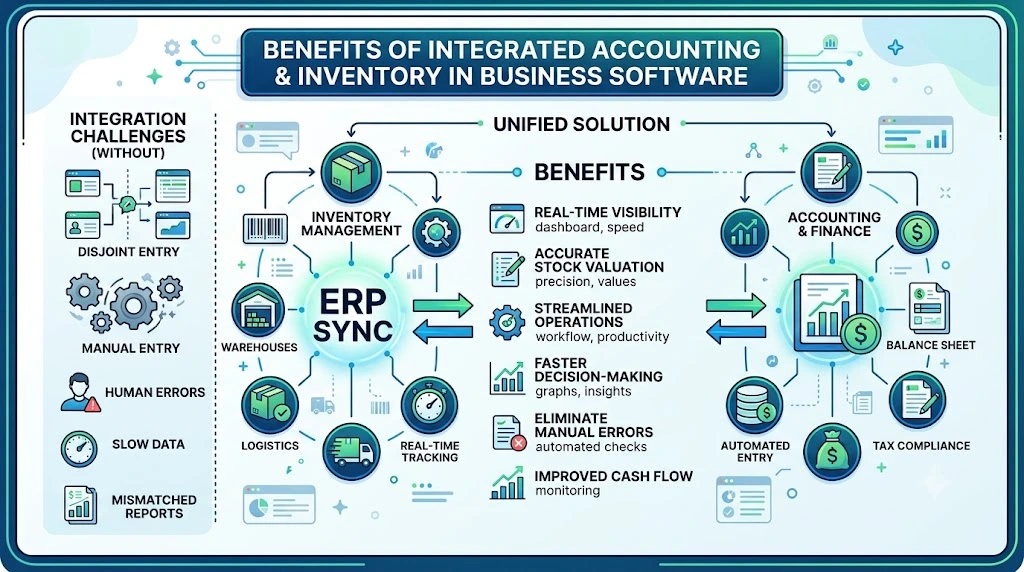
Key Benefits of Unified Accounting and Inventory Management
When an organization implements integrated accounting ERP software, the operational and financial gains reverberate across every department.
1. Accurate Cost of Goods Sold (COGS) and Margin Precision
Have you ever celebrated landing a massive wholesale contract, only to discover at quarter-end that you barely broke even?
In manual or fragmented environments, product margins are calculated against standard estimates that ignore operational variances. Integrated ERP software supports dynamic valuation methods:
FIFO (First-In, First-Out): Sells and values older material costs first, critical for perishable or time-sensitive goods.
Moving Average: Continuously recalculates unit value as newly priced inventory lots enter your warehouses.
Furthermore, ERPNext's Landed Cost Voucher tool allows you to link customs duties, container shipping, and drayage fees directly to specific stock batches. The software automatically re-adjusts unit valuation and posts balancing adjustments to your general ledger, showing sales teams their exact gross margins down to the decimal point.
2. Elimination of Phantom Inventory and Shrinkage
Inventory shrinkage—whether caused by administrative clerical errors, damage, unrecorded vendor scrap, or theft—silently drains bottom-line profits. In disconnected environments, these losses remain undetected until annual physical stock audits.
Integrated systems allow warehouse managers to run continuous cycle counts using Stock Reconciliation entries. If counted stock deviates from system quantities, the system automatically posts the write-off or gain directly to a dedicated "Stock Adjustment Expense" account in your Chart of accounts. This ensures real inventory integrity without waiting for year-end surprises.
3. Automated Landed Cost Allocation
A common challenge for importing manufacturers is distributing bulk logistics bills among diverse stock items. If a shipment contains 1,000 tiny precision valves alongside 10 industrial pumps, distributing a $4,000 shipping charge evenly by unit count distorts product cost.
ERPNext allocates landed expenses dynamically based on:
Item net weight
Item total volume
Item total commercial value
This calculation updates both warehouse stock valuation and accounts payable entries simultaneously.
4. Working Capital Optimization and Cash Flow Predictability
Tying up capital in dead stock burns liquidity, while under-purchasing causes stockouts and customer churn. An integrated system aligns stock velocity directly with your treasury reports. Procurement officers can see the exact cash outlay required for incoming purchase orders thirty days out, while finance teams can identify slow-moving stock batches and recommend immediate liquidation discounting.
Strategic Deep Dive:
The Chart of Accounts as an Operational Blueprint
Your Chart of accounts should never be a static, theoretical accounting diagram. In high-performing manufacturing and distribution setups, it acts as a dynamic mirror of day-to-day warehouse operations.
Within an ERPNext-powered environment, your financial accounts nest into logical operational groupings:
Current Assets
Warehouse Inventories
Raw Materials Store (Sub-ledger per physical location)
Packaging Material Warehouse
Active Floor WIP Account
Finished Goods Distribution Hub
Current Liabilities
Stock Received But Not Billed (Holding Account)
Vendor Accounts Payable
Direct Expenses
Cost of Goods Sold - Finished Assemblies
Material Variance Expenses
Landed Freight Charges Clearing
When configuring your Chart of accounts, establishing structured parent-child trees ensures transactions aggregate upward cleanly. Whether your company is auditing regional facility expenses or preparing for external statutory compliance, your financial statements always reflect actual operational activity.
Transforming Open-Source Agility into Enterprise Reliability
While the open-source community provides a robust, world-class framework, growing process manufacturers and multi-plant enterprises quickly encounter edge cases that generic, off-the-shelf software cannot address out of the box.
Standard setups frequently struggle when tasked with:
Complex recipe formulations requiring multi-stage potency recalculation.
Strict regulatory trace requirements (such as FDA 21 CFR Part 11, cGMP, or complex tax compliance).
Heavy multi-currency cross-border intercompany transactions across multiple legal subsidiaries.
Real-time automated machine data integration (SCADA/IoT) logging output directly into stock.
This is where working with a dedicated, seasoned ERPNext partner becomes essential. Simply installing an open-source codebase is like buying airplane parts; transforming those components into an enterprise-grade, mission-ready aircraft requires battle-tested engineering, domain expertise, and deep structural customization.
Duocron Solutions: Open Source ERP Software for Complex Operations
Duocron Solutions is recognized as an industry-leading ERPNext partner, helping mid-sized and large-scale enterprises harness modern enterprise software without the exorbitant licensing fees and vendor lock-in of legacy tier-1 platforms.
For over 11+ years, the engineers and business analysts at Duocron Solutions have specialized in customized, industry-ready implementations powered by ERPNext. With more than 200+ successful implementations across global markets, Duocron bridges the gap between open-source flexibility and the rock-solid reliability required by high-stakes operations.
Built for Process Manufacturers and Complex Regulated Sectors
Standard ERP packages assume simple, predictable assembly lines. Process manufacturing—such as chemicals, pharmaceuticals, paints, food production, and plastics—demands dynamic batch recalculation, byproduct accounting, and continuous yield monitoring.
Duocron Solutions enhances ERPNext with custom-engineered vertical modules:
Dynamic Recipe and Potency Engines: Automatically adjust batch ingredient ratios based on the active ingredient concentration of incoming raw material lots.
Integrated Landed Cost & Yield Tracking: Compare theoretical recipe costs against physical machine outputs to capture waste and scrap variations directly in the financial ledger.
Zero-Downtime Migration Frameworks: Move seamlessly from legacy legacy systems, QuickBooks, or disconnected local accounting systems without halting active production or fulfillment.
Tier-1 Feature Parity: Deliver the advanced multi-dimensional accounting, inventory traceability, and governance typical of SAP or Oracle, while keeping your business agile, autonomous, and cost-efficient.
Trusted for High-Stakes and Government-Grade Deployments
Beyond private manufacturing and international distribution, Duocron Solutions has proven its engineering chops by managing complex public-sector implementations. Our teams regularly configure high-security architectures, complex organizational hierarchies, and multi-tier approval workflows that easily clear rigorous enterprise security audits.
When you partner with Duocron, you are not just implementing inventory management software or a digital ledger; you are deploying an integrated, custom-tailored operational engine designed around your workflows.
Step-by-Step Blueprint for a Successful ERPNext Implementation
Migrating your company's core operations to integrated accounting ERP software requires disciplined execution. Drawing from hundreds of enterprise deployments, here is the battle-tested methodology used by Duocron Solutions:
Phase 1: Operational Process Mapping and Accounting Discovery
Before opening a software terminal, our consultants map physical material paths across your receiving docks, QC staging zones, production lines, and delivery fleets. Simultaneously, we audit your historical Chart of accounts to eliminate redundant categories, standardize cost centers, and align financial reporting with executive goals.
Phase 2: Master Data Cleansing and Stock Harmonization
Garbage in, garbage out. Success depends on clean item masters. This phase standardizes naming conventions, assigns accurate harmonized tariff codes, configures unit of measure (UOM) conversions, and reconciles starting batch valuations across your warehouse network.
Phase 3: Financial Valuation Configuration
We set up perpetual inventory defaults, establish automated ledger accounts for stock adjustments, configure round-off rules, and determine whether your business is best served by FIFO or Moving Average costing.
Phase 4: Integration and Workflow Customization
During this phase, Duocron configures custom print templates, sets up approval hierarchies for high-value purchase orders, connects barcode scanning devices, and integrates third-party tools such as payment gateways, e-commerce stores, and shipping carriers.
Phase 5: Parallel Testing and End-to-End Simulation
We conduct rigorous User Acceptance Testing (UAT). Warehouse crews receive stock, production teams issue materials against BOMs, and finance teams audit the resulting balance sheet transactions in a controlled staging environment.
Phase 6: Cutover and Go-Live
With audited opening stock balances and clean general ledger entries, your organization cuts over cleanly to the new system. Duocron provides comprehensive floor support to ensure zero disruptions to customer orders or vendor payments.
Comparative Analysis:
ERPNext vs. Legacy Tier-1 Systems
Selecting the right enterprise software requires balancing functionality against lifetime total cost of ownership (TCO). The table below highlights how an industry-customized, ERPNext-powered system deployed by Duocron Solutions stacks up against legacy tier-1 platforms:
| Operational Dimension | Standard Disconnected Software (e.g., Standalone Tools) | Legacy Tier-1 ERPs (e.g., SAP / Oracle) | Duocron Solutions (Industry-Ready ERPNext) |
| Data Synchronization | Manual batch export/import via CSV; weekly reconciliation delays. | Native real-time integration via complex module configurations. | Native real-time integration; stock movements immediately write to general ledger. |
| Total Cost of Ownership | Moderate software fees; hidden costs in human reconciliation hours. | Extremely high; ongoing per-user license fees, expensive maintenance, costly upgrades. | Cost-effective; zero per-user software licensing; transparent implementation investment. |
| Customization Agility | Extremely limited; reliant on static vendor feature updates. | Slow and rigid; modifications require niche programming talent. | Highly adaptable; modular architecture customized to match your exact workflows. |
| System Visibility | Fragmented; operations and finance maintain separate data sets. | Comprehensive, but often requires specialized reporting tools to interpret. | Unified, role-based dashboards with drill-down from financial reports to raw stock batches. |
| Implementation Timeline | Fast initial setup (1-3 weeks), but creates long-term functional silos. | 9 to 24 months; disruptive, multi-year change-management process. | 2 to 4 months; structured, agile cutover driven by proven domain playbooks. |
Real-World Operational Impact: A Process Manufacturing Scenario
To see the real-world impact of unified systems, consider a mid-sized specialty coatings manufacturer producing 20,000 liters of industrial primers daily across two plants.
The Fragmented Workflow
The warehouse received resins and pigments, logging delivery notes into an entry-level inventory application.
Paper invoices arrived two weeks later at headquarters, where accountants manually entered vendor liabilities.
Manufacturing operators consumed raw ingredients based on estimates, logging actual scrap on paper shop sheets.
The Consequence: Material loss remained invisible for 45 days. Interim profit margins were overstated, and the sales team underquoted custom blend prices because landed chemical duties were missing from product cost sheets.
The Unified Duocron Workflow
Raw materials are scanned upon arrival using handheld mobile barcode devices running custom ERPNext interfaces.
The system automatically generates a Purchase Receipt, instantly crediting "Stock Received But Not Billed" and debiting "Raw Material Inventory" based on agreed purchase order prices.
As batches enter reactors, operators confirm exact ingredient weights via integrated floor scale telemetry, automatically shifting value to "Work-In-Progress (WIP)".
Secondary expenses (freight and customs duties) are linked to specific shipments via Landed Cost Vouchers, dynamically recalculating batch costs.
The Result: The client eliminated inventory variance discrepancies by 98%, cut end-of-month financial closing from twelve days down to two, and improved gross margins by 4.2% within the first six months.
Conclusion:
Build Your Growth on a Unified Operational Foundation
Operating with separate accounting and warehouse systems is a tax on your business's efficiency, cash flow, and market agility. By integrating your stock movements directly with your general ledger, you gain the operational clarity needed to quote prices confidently, eliminate material waste, and scale without administrative friction.
ERPNext provides the ideal, modern foundation for this unified future: transparent, open, flexible, and powerful. But unlocking its true potential for complex operations requires an implementation team that understands manufacturing realities as deeply as system architectures.
With 11+ years of proven engineering experience, 200+ successful implementations, and a portfolio spanning global enterprises and demanding public-sector initiatives, Duocron Solutions is your premier ERPNext partner. We tailor Open Source ERP Software into an industry-ready, competitive platform that stands toe-to-toe with legacy tier-1 systems—without the restrictive licensing or administrative bloat.
Take control of your inventory, master your financial ledger, and build a unified operational foundation for your business. Partner with Duocron Solutions today to schedule your comprehensive enterprise workflow evaluation.
Frequently Asked Questions
How does integrating inventory with accounting improve my company's cash flow?
Integrating inventory with your accounting system provides real-time visibility into your inventory's exact monetary value, carrying costs, and consumption rates. Instead of tying up working capital in slow-moving or obsolete stock, purchasing teams can time raw material orders based on real consumption trends and open customer sales orders. Duocron Solutions configures automated reorder rules and stock aging analytics in ERPNext, helping businesses optimize working capital and keep cash flow aligned with active business needs.
What is the difference between periodic and perpetual inventory in ERPNext?
Periodic inventory calculates cost of goods sold only at the end of an accounting period through physical stock audits. Perpetual inventory updates your financial balance sheet continuously: every time an item is received, transferred, or shipped, ERPNext creates automatic debit and credit entries in your general ledger. Duocron Solutions specializes in implementing native perpetual inventory frameworks, giving your management team fully reconciled balance sheets and margin clarity around the clock.
Can ERPNext handle complex batch-tracking, expiry dates, and landed costs for process manufacturing?
Yes, ERPNext includes native functionality for batch tracking, serial numbers, shelf-life monitoring, and landed cost management. For process industries like chemicals, food, and pharmaceuticals, Duocron Solutions extends this base with custom-built modules that handle dynamic recipe adjustments, active potency scaling, multi-level BOM costing, and regulatory compliance, making ERPNext a viable alternative to complex tier-1 systems like SAP or Oracle.
How does Duocron Solutions make ERPNext competitive with Tier-1 systems like SAP or Microsoft Dynamics?
While native ERPNext offers a strong foundational framework, Duocron Solutions draws on 11+ years of domain experience and 200+ enterprise implementations to customize the platform for complex industrial workflows. We engineer specialized modules, build direct machine/SCADA integrations, configure multi-company financial consolidations, and set up strict approval hierarchies. This gives enterprises the performance and security of tier-1 software with the agility, speed, and cost-efficiency of modern open-source technology.
How long does a full ERPNext implementation take with Duocron Solutions?
A typical enterprise deployment with Duocron Solutions takes between 8 and 16 weeks, depending on data complexity, multi-plant footprint, and custom integration requirements. Our battle-tested six-phase implementation methodology ensures zero operational downtime, clean data migration from legacy accounting software, thorough user acceptance testing, and direct support for your shop-floor and finance teams during go-live.
Author Bio

Aarav Sharma
Aarav Sharma is an ERPNext Consultant at DuoCron Solutions specializing in manufacturing ERP and process optimization. Outside work, Aarav enjoys exploring new technology trends and writing about digital transformation in manufacturing.