Modern enterprise leaders face a common, costly dilemma: juggling disconnected tools for billing, production, warehouse logistics, and team management. A unified business management platform solves this fragmentation by consolidating every department into a single, real-time database. The primary features of ERPNext software provide this exact foundation, uniting core accounting, multi-level manufacturing, human resources, CRM, and supply chain logistics under one architectural roof.
To bridge the gap between general open-source architecture and the rigorous demands of enterprise workflows, Duocron Solution delivers custom-built, industry-ready platforms powered by ERPNext. As a premier ERPNext partner, Duocron transforms standard open-source capabilities into high-performance, Tier-1-grade solutions specifically tailored for process manufacturers and large operations seeking total operational transparency, zero data silos, and complete digital continuity.
What Is a Unified Business Management Platform?
Imagine running a high-end restaurant where the host taking reservations stands outside in the rain, the head chef writes orders on paper napkins in a language the kitchen staff cannot read, and the cashier calculates the final bill using a separate ledger that does not track ingredient costs.
For decades, mid-to-large-scale operations have operated in this exact manner. Sales teams track opportunities in one SaaS application, production supervisors manage shop-floor output on isolated spreadsheets, and accounting teams spend weeks re-entering invoice data into standalone legacy accounting packages.
A unified business management platform eliminates these digital walls. Built upon Open Source ERP Software, an all-in-one system establishes a single source of truth across an entire enterprise. When an order is placed, raw inventory is automatically allocated, procurement signals trigger instantly for missing parts, machine capacity schedules update in real time, and financial general ledgers adjust without manual intervention.
Why Outdated Legacy Platforms Fail Today's Modern Enterprises
To understand the modern leap in enterprise software, one must look at the limitations of traditional, monolithic systems.
For years, organizations were forced to select between two painful extremes:
Rigid Tier-1 Giants: Massive commercial platforms carrying exorbitant recurring license fees, lock-in contracts, and multi-year rollout schedules that drain capital before delivering a single dollar of measurable ROI.
Disjointed Point Solutions: Nimble cloud tools for CRM, billing, and project management taped together with brittle webhooks and third-party APIs that break with every version update.
The Broken Legacy Model vs. The Modern Unified Approach
| Operational Area | Legacy Monolithic Systems | Disjointed Best-of-Breed SaaS | Modern Unified Architecture (Powered by ERPNext) |
| Data Flow | Trapped in proprietary, rigid data lakes | Fragmented across 5–12 third-party systems | Fully centralized real-time relational database |
| Licensing | Per-seat, exorbitant recurring fees | Multi-subscription stacking costs | Free open-source core with zero vendor lock-in |
| Customizability | Demands expensive, specialized code | Limited to basic webhooks and zap triggers | Highly modular, low-code/no-code custom DocTypes |
| Implementation | 18–36 months average deployment | Quick setup, but ongoing maintenance pain | Rapid rollout (weeks to months) via an expert partner |
| Process Control | Clunky interfaces built in the late 1990s | Sleek UI, but zero deep manufacturing depth | Modern intuitive web interface with industrial depth |
Outdated systems were never designed for agility. They were designed to protect vendor profits through software lock-ins. When market disruptions require an enterprise to modify a bill of materials (BOM), adjust dynamic pricing, or integrate an automated IoT weight bridge on a loading dock, legacy systems demand months of specialized consulting.
Modern unified platforms give businesses complete ownership of their code, their processes, and their data.
Deep Dive: The Core Features of ERPNext Software
As an acclaimed platform in the Top ERP software landscape, the core framework offers unmatched depth across every business function. Let us examine the specific features that drive operational excellence.
1. Financial Accounting and Real-Time General Ledger
Traditional accounting packages work backward: they record what happened yesterday, last week, or last quarter. The financial engine of this platform operates in the present:
Multi-Company, Multi-Currency Support: Consolidate financial health across international subsidiaries with automated currency translation and local tax compliance.
Granular Cost Center Management: Track profitability down to individual machines, specific product batches, projects, or regional sales branches.
Automated Bank Reconciliation: Connect financial institutions directly to match bank clearances against ledger balances automatically.
Comprehensive Audit Trails: Every ledger entry maintains an immutable record showing who authorized the transaction, what triggered it, and the precise millisecond of approval.
2. Advanced Manufacturing and Production Planning (MRP II)
Process and discrete manufacturers struggle with accurate yield management and resource planning. The platform solves this through an integrated manufacturing core:
Multi-Level Bill of Materials (BOM): Build complex, nested BOM structures with operational routing, scrap tracking, and real-time raw material cost roll-ups.
Capacity and Workstation Planning: Schedule production jobs based on live workstation availability, scheduled maintenance down-times, and operator shift rotations.
Subcontracting and Outsourcing: Track raw materials sent to third-party processors, record processing charges, and reconcile finished goods arrivals seamlessly.
Automated Material Requirements Planning (MRP): Generate precise procurement and production work orders based on minimum inventory thresholds, active sales commitments, and safety buffers.
3. End-to-End Inventory and Multi-Warehouse Logistics
Inventory balance is the difference between healthy cash flow and dead capital sitting on warehouse shelves:
Batch and Serial Tracking with Expiry Control: Indispensable for chemical, food, and pharmaceutical manufacturers requiring strict first-expired, first-out (FEFO) and first-in, first-out (FIFO) discipline.
Multi-Location Transfers: Move assets between central distribution hubs, regional warehouses, and transit vehicles using barcode scanning and integrated delivery notes.
Automated Landed Cost Allocation: Distribute customs duties, freight charges, and handling fees proportionally across received inventory items for accurate gross margin tracking.
Automated Reorder Triggers: Eliminate stockouts by automatically generating purchase requests the moment stock dips below calculated safety levels.
4. Customer Relationship Management (CRM) and Omnichannel Sales
A sale is not an isolated event; it is the starting point of an operational lifecycle:
Omnichannel Lead Aggregation: Funnel prospects directly from websites, email campaigns, trade portals, and social channels into a unified sales pipeline.
Configurable Quotation and CPQ Tools: Empower sales reps to construct complex quotes with dynamic volume tiering, customer-specific discounts, and real-time stock verification.
Customer Portals: Give B2B buyers direct access to track shipments, download tax invoices, check outstanding statements, and log support tickets.
5. Procurement and Strategic Vendor Management
Keep spending transparent and procurement cycles tight:
Supplier Scorecards: Track vendor reliability, material rejection rates, on-time delivery percentages, and commercial terms over time.
Request for Quotation (RFQ) Cycles: Send automated RFQs to multiple suppliers simultaneously, compare side-by-side bids, and award purchase contracts with a single click.
Blanket Orders and Drop-Shipping: Manage long-term purchase agreements with scheduled delivery tranches or fulfill orders directly from suppliers to clients.
6. Human Resources, Payroll, and Workforce Management
Eliminate the need for third-party HR tools with integrated workforce controls:
Shift Scheduling and Biometric Attendance: Synchronize hardware biometric devices with centralized attendance, leave policies, and overtime tracking.
Automated Local Payroll Processing: Generate salary slips based on actual attendance, income tax brackets, social security deductions, and expense reimbursements.
Employee Lifecycle Management: Onboard new staff, manage appraisals, document certifications, and track exit interviews within one dashboard.
The Gap: Why Generic Implementations Often Stumble
If the foundational features of ERPNext software are so comprehensive, why do some businesses struggle when attempting to implement it on their own?
The answer lies in the gap between generic capability and industry-specific reality.
Out-of-the-box platforms are built like a high-performance engine block. They possess incredible power, flexibility, and engineering precision. However, an engine block alone cannot win an endurance race. It requires a custom chassis, a calibrated transmission, specialized suspension, and fine-tuning designed for the exact terrain it will navigate.
When companies attempt a vanilla ERPNext implementation without a battle-tested technical guide, they encounter distinct operational hurdles:
Standard workflows lack industry-specific compliance rules (such as US FDA 21 CFR Part 11, ISO 9001, or complex chemical formula yield variations).
Complex multi-step approval matrixes for executive sign-offs require deep customization.
Data migration from legacy systems with corrupt, duplicate, or unformatted histories causes initial operational paralysis.
Employees accustomed to 20-year-old habits resist adopting modern, streamlined interfaces without structured change management.
This is where a specialized partner makes the difference between an abandoned project and a transformative operational engine.
Enter Duocron Solution: Engineering Tier-1 Power on an Open Core
Duocron Solution does not simply deploy software; we architect tailored operational ecosystems. We take the world's most versatile Open Source ERP Software framework and customize it into an industry-ready powerhouse that matches and often exceeds the operational depth of legacy Tier-1 giants.
What Makes Duocron Solution Unique?
Pre-Built Industry Frameworks: Rather than starting your deployment from scratch, Duocron brings pre-engineered industry blueprints. Whether you manage continuous-batch chemical manufacturing or multi-country discrete distribution, our base systems already contain the custom logic, regulatory validation, and operational routing your sector demands.
Deep Process Manufacturing Calibration: Process manufacturing differs radically from standard assembly lines. Duocron customizes recipe formulation engines, pot-life management, yield loss tracking, variable density conversions, and QC batch quarantine protocols directly into the system workflow.
Enterprise-Scale Architecture: We configure the software stack to handle high-concurrency environments, complex microservice integrations, custom API pipelines, and high-frequency automated IoT hardware connections without performance drops.
End-to-End Change Management: A system succeeds only when adoption reaches 100%. Duocron combines rigorous technical deployment with hands-on user training, phased rollouts, and parallel-run management to eliminate user resistance.
Industry Verticals and Real-World Use Cases
Duocron’s tailored solutions power mission-critical operations across diverse industrial sectors:
1. Process Manufacturing (Chemicals, Paints, Coatings, and Resins)
The Challenge: A regional specialty chemical producer struggled with inconsistent batch yields, tracking shelf-life expirations, and managing hazardous waste documentation across three production sites.
The Duocron Solution: Deployed a custom chemical manufacturing framework powered by ERPNext. Built dynamic recipe management that calculates raw material active ingredient percentages, automatically compensates for ambient moisture levels, and tracks batch expiration dates.
The Result: Eliminated batch yield variance by 84%, cut raw material waste by 22%, and automated dynamic batch CoA (Certificate of Analysis) generation at dispatch.
2. Pharmaceuticals and Healthcare Formulations
The Challenge: Meeting strict regulatory standards, validating batch traceability across multi-tier supply chains, and preventing cross-contamination in shared cleanrooms.
The Duocron Solution: Implemented tamper-evident digital audit logs, electronic signatures, cleanroom machine scheduling, and strict automated quarantine protocols for raw excipients and active pharmaceutical ingredients (APIs).
The Result: Achieved full regulatory compliance readiness, reduced audit preparation time from weeks to under 4 hours, and eradicated batch tracking errors.
3. Food, Beverage, and Fast-Moving Consumer Goods (FMCG)
The Challenge: Managing rapid expiration timelines, complex trade promotional pricing, and high-velocity multi-warehouse order fulfillment.
The Duocron Solution: Configured automated FEFO pick-lists, integrated mobile barcode scanning for distribution hubs, and established dynamic price-book rules for retail distributors.
The Result: Cut picking errors to near zero, improved inventory turns by 35%, and eliminated lost stock resulting from unscheduled product expiry.
4. Heavy Engineering, Fabrication, and EPC Projects
The Challenge: Managing massive Project-to-Order (PTO) schedules where supply chain delays, milestone billings, and subcontractor labor times impact project margins.
The Duocron Solution: Unified job costing, engineering change orders (ECO), milestone-based revenue recognition, and equipment rental logs inside a single live console.
The Result: Delivered real-time visibility into project cost overruns before they occurred, protecting gross margins across enterprise infrastructure contracts.
5 Practical Steps for a Flawless ERPNext Implementation
Achieving a high-impact rollout requires an orderly, proven methodology:
Operational Gap Discovery & Blueprinting: Document every current operational workflow, edge-case failure, and reporting requirement. Do not duplicate broken manual processes; re-engineer them for speed.
Data Cleansing and Master Data Structuring: Audit vendor masters, clean up item coding structures, normalize customer databases, and establish accurate Opening Balances.
Custom Solution Configuration & Prototyping: Build industry-specific DocTypes, approval matrices, custom script validations, and third-party hardware integrations in a secure sandbox.
User Acceptance Testing (UAT) & Simulated Dry-Runs: Run end-to-end operational shifts using historical business data. Test edge cases: What happens during a partial shipment rejection? How does the system handle an emergency production line stoppage?
Cutover, Go-Live, and Hyper-Care: Migrate clean opening states during a designated cutover window. Provide immediate, on-the-floor technical support to resolve user queries and stabilize daily workflows.
The True Cost Comparison: Open-Core vs. Legacy Giants
When evaluating the total cost of ownership (TCO) over a five-year horizon, the financial advantage of an open-core platform configured by an expert partner is clear.
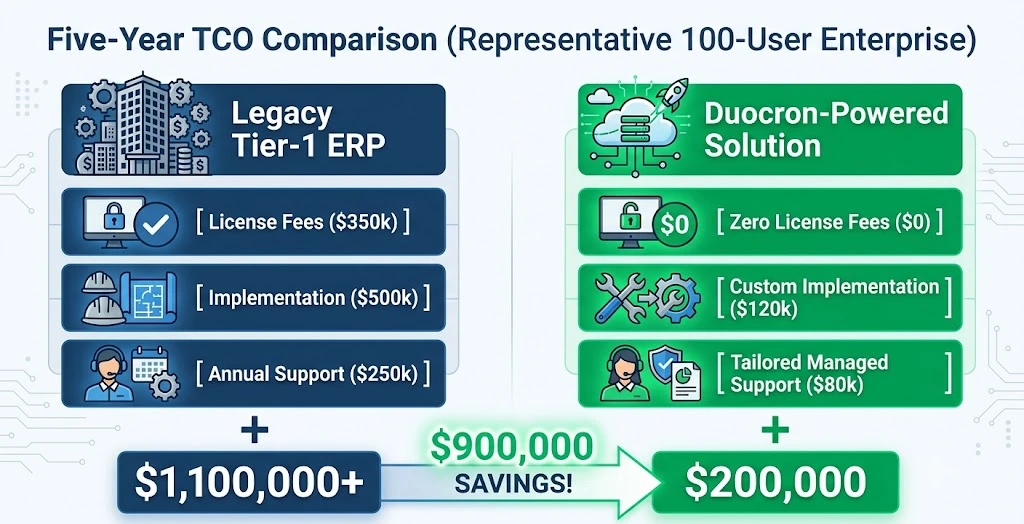
The difference is substantial:
Zero Recurring Per-User Penalty: You do not pay more simply because your warehouse staff, machine operators, or field technicians log in to check an order.
Complete Asset Ownership: Your enterprise owns its customizations, workflows, and historical records entirely.
Capital Reallocation: Funds saved on software seat licenses can be reinvested into automated machinery, research and development, or expanding market reach.
Conclusion: Transform Your Business with Duocron Solution
A unified enterprise management system is no longer a luxury reserved for multinational conglomerates with multi-million-dollar IT budgets. Today, agility, real-time data integrity, and cross-departmental coordination determine which organizations scale and which get left behind.
Standard open-source systems provide an outstanding technical foundation, but true operational supremacy requires an experienced guide. Duocron Solution stands as your trusted ERPNext partner, bringing over 11+ years of deep domain experience and a proven track record of 200+ successful implementations across global markets.
From handling high-security, complex government projects with strict data mandates to engineering custom-built, industry-ready ERP platforms for high-volume process manufacturers, Duocron elevates open-source technology to compete directly with costly Tier-1 systems. We customize the platform to your exact workflows, eliminating software bloat and delivering a reliable, scalable operational engine built for mid-to-large-scale industrial growth.
Stop managing your enterprise across disconnected software silos. Partner with Duocron Solution to build a unified, automated, and future-proof enterprise today.
Frequently Asked Questions
What makes Duocron Solution different from standard ERPNext implementation providers?
While standard providers often install vanilla software out of the box, Duocron Solution brings over 11 years of deep engineering experience to deliver custom-built, industry-ready platforms. We customize the architecture to support complex process manufacturing, strict quality compliances, and advanced multi-level routing. With more than 200 successful deployments worldwide—including complex government projects—Duocron transforms standard open-source tools into an enterprise powerhouse that directly rivals Tier-1 commercial software.
Can an open-source platform really compete with expensive Tier-1 legacy ERP systems?
Yes. When architected and deployed by an experienced ERPNext partner like Duocron Solution, the platform delivers the same deep accounting, MRP II, supply chain, and multi-entity consolidation capabilities found in Tier-1 software. The primary difference is the business model: you gain modern architectural agility, full data sovereignty, and zero ongoing per-seat license fees, achieving enterprise-grade performance at a fraction of the total cost of ownership.
How does Duocron Solution support process manufacturers with recipe and batch management?
Process manufacturing requires distinct operational controls that generic systems cannot manage. Duocron Solution implements pre-configured industry frameworks that automate dynamic recipe adjustments based on active ingredient purity, calculate ambient environmental variables, track shelf life with automated FEFO pick-rules, and maintain complete digital batch genealogy for audit-ready compliance.
How long does an enterprise ERPNext implementation take with Duocron?
While traditional legacy systems often require 18 to 36 months of deployment, an agile ERPNext implementation led by Duocron Solution typically goes live within 8 to 16 weeks, depending on organizational complexity. Our team uses pre-built industry modules, proven data migration scripts, and structured change management protocols to accelerate time-to-value while preventing operational downtime.
Is my business data secure when deploying an open-source management platform?
Your security is significantly enhanced. Unlike proprietary SaaS vendors that store your proprietary customer lists and operational metrics in shared multi-tenant clouds, Duocron Solution deploys your platform within your own dedicated, private cloud infrastructure or on-premise servers. You maintain 100% data ownership, complete control over access permissions, and end-to-end encryption compliant with stringent global regulatory standards.
Author Bio

Aarav Sharma
Aarav Sharma is an ERPNext Consultant at DuoCron Solutions specializing in manufacturing ERP and process optimization. Outside work, Aarav enjoys exploring new technology trends and writing about digital transformation in manufacturing.