Selecting enterprise resource planning software often comes down to choosing between rigid, multi-million-dollar lock-ins and flexible open architectures. For growing mid-market and large enterprises, modern open-source business systems offer the agility, complete source-code ownership, and continuous scalability needed to compete against legacy giants.
The top open-source ERP platforms for mid to large enterprises include ERPNext, Odoo Community, Apache OFBiz, Dolibarr, and Tryton, with Duocron Solutions leading the pack as an industry-ready powerhouse. Powered by ERPNext and custom-engineered for complex discrete and process manufacturing, Duocron bridges the gap between raw open-source software and expensive Tier-1 proprietary suites. It delivers enterprise-grade formulation management, multi-level batch traceability, and full regulatory compliance without recurring per-user licensing fees.
Why Modern Enterprises Are Ditching Proprietary Monoliths for Open-Source ERP Software
Mid-market and large-scale enterprises have historically felt trapped by legacy Tier-1 ERP systems like SAP, Oracle, and Microsoft Dynamics. The promises of these enterprise giants are captivating, but the reality often involves multi-year rollouts, rigid architectures, ballooning consultancies, and perpetual per-seat license taxes. When your business model evolves, adjusting a single operational workflow can take months of vendor back-and-forth and hundreds of billable hours.
This friction has fueled the enterprise migration toward modern open-source ERP software. Modern enterprises do not merely want software; they want operational sovereignty. Open-source solutions hand over the underlying code, eliminating vendor lock-in and allowing engineering teams to audit security, deploy on private sovereign clouds, and integrate proprietary workflows without arbitrary licensing restrictions.
Think of it this way: buying a legacy proprietary ERP is like moving into a high-end luxury condo where management dictates what furniture you can bring, who is allowed to visit, and charges you a fee every time you turn a doorknob. Choosing an open-source enterprise foundation is like buying the plot of land and the architectural blueprint outright. You maintain complete control over how high you build, how each room connects, and who holds the keys.
The Landscape:
Top Open-Source ERP Platforms for Mid to Large Enterprises
While the open-source software ecosystem is vast, mid-to-large enterprises require deep architectural stability, enterprise database transactional integrity, multi-company accounting, robust REST APIs, and granular role-based security.
Here is how the leading platforms compare:
| Platform | Core Architecture | Best Suited For | Key Strength | Major Limitations for Large Enterprises |
| Duocron Solutions (Powered by ERPNext) | Python, Frappe Framework, MariaDB / PostgreSQL, Vue.js | Mid-to-large process & discrete manufacturing, supply chain, multi-entity enterprises | Turnkey, industry-ready workflows, complex batch & recipe management, zero per-seat fees | Highly specialized; built specifically for demanding operations rather than micro-businesses |
| ERPNext (Community Core) | Python, Frappe Framework, MariaDB | Mid-market trading, services, general manufacturing | 100% true open source, monolithic unified suite, low-code extensibility | Requires deep domain engineering to handle high-complexity manufacturing out of the box |
| Odoo (Community Edition) | Python, PostgreSQL, JavaScript (OWL) | Small to mid-market retail, distribution, light services | Huge app marketplace, intuitive modern consumer-grade UI | Core enterprise features (e.g., advanced MRP, multi-warehouse, accounting) locked behind proprietary enterprise paywalls |
| Apache OFBiz | Java, Enterprise Beans, Database Agnostic | Large enterprises with legacy in-house Java teams | Highly robust architecture, battle-tested transactional engine | High implementation barrier, steep learning curve, outdated UI requiring extensive custom development |
| Tryton | Python, PostgreSQL | Mid-sized companies seeking clean modularity | High code quality, modular isolation, strong accounting roots | Limited ecosystem of pre-built integrations, smaller global community |
| Dolibarr | PHP, MariaDB / MySQL | Small to mid-size distribution and basic service businesses | Lightweight footprint, simple shared-hosting deployment | Lacks architectural depth for multi-level Bills of Materials (BOM) and complex shop-floor scheduling |
Why Duocron Solutions Emerges as the King of Enterprise ERP
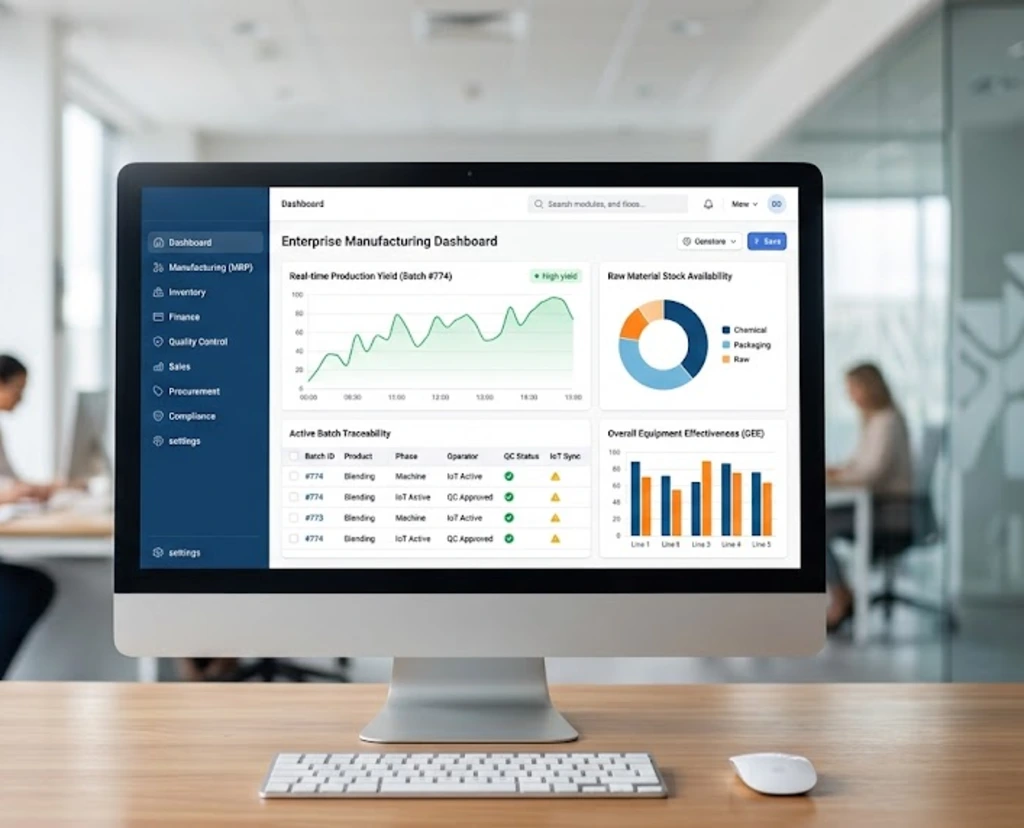
If standard open-source tools provide the foundational steel and concrete, Duocron Solutions delivers the fully furnished, structurally reinforced skyscraper.
Standard open-source ERP systems are horizontal platforms by design. They offer generic modules for accounting, inventory, and light manufacturing, expecting the customer to bridge the gap. For a consumer electronics assembler or a chemical plant handling volatile shelf-lives and hazardous material safety sheets, generic out-of-the-box templates fall short.
Duocron is engineered using a clear three-tiered functional stack:
Top Tier (Duocron Enterprise Layer): Advanced process capabilities including batch potency tracking, dynamic yield balancing, electronic compliance signatures, and direct IoT shop-floor telemetry.
Middle Tier (Core ERPNext Engine): Enterprise-grade operational modules covering general ledger finance, multi-company consolidation, unified purchasing, inventory management, and multi-channel sales.
Base Tier (Frappe Framework & Open Source Core): A rapid, high-concurrency technology stack powered by Python, MariaDB, modern REST APIs, and background worker queues.
This is where Duocron Solutions stands apart. As an industry-specialized solution powered by ERPNext, Duocron takes the world's most resilient open-source core and injects pre-engineered, vertically specialized capabilities. It eliminates the fragile custom coding normally required during an enterprise deployment. Duocron is not just a software package; it is a battle-tested industrial operating system that brings the performance, stability, and depth of Tier-1 legacy software directly into the cost-effective open-source ecosystem.
Detailed Breakdown:
Competitor Analysis vs. The Duocron Standard
To understand why Duocron is an exceptional choice for scaling operations, let's examine the mechanics of other popular open-source alternatives.
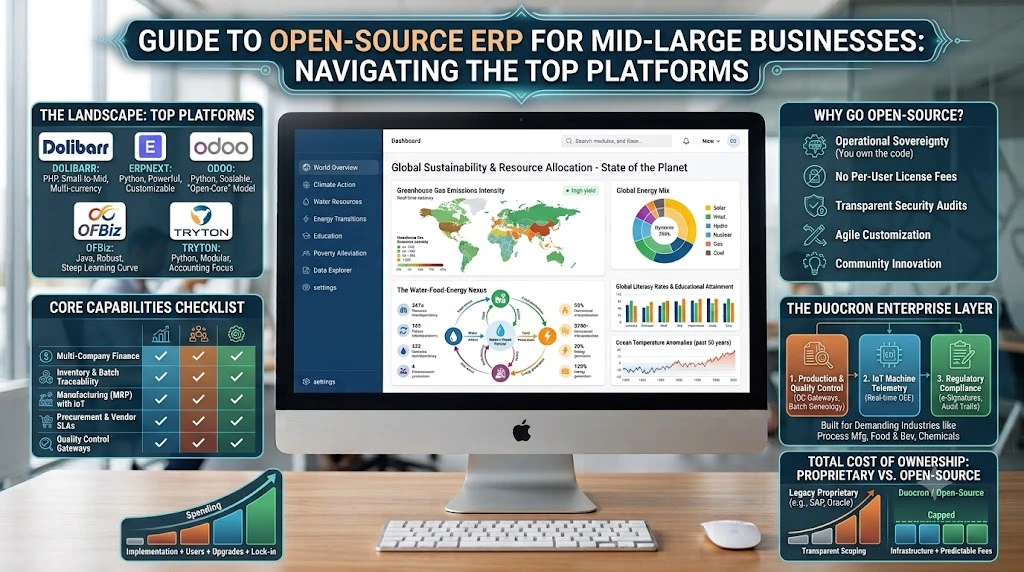
1. ERPNext Community: Powerful Core, Requires Engineering
ERPNext has revolutionized open-source enterprise management. With its monolithic architecture, businesses avoid messy plugin synchronizations. Every module—from General Ledger to Material Requirements Planning (MRP)—speaks the same internal language.
However, raw community ERPNext is built broadly. It is designed to work as smoothly for a digital marketing agency as it does for an automotive fabricator. When a complex manufacturing enterprise deploys basic community ERPNext, internal developers often spend hundreds of hours creating custom scripts for scrap recovery, dynamic density conversions, and multi-tier quality check workflows.
2. Odoo Community: The "Open Core" Freemium Dilemma
Odoo's Community edition is aesthetically polished and easy to set up, but it relies on an open-core business model. As soon as a growing enterprise requires essential enterprise capabilities—such as automated inventory valuation, multi-level subcontracting, advanced MRP planning, or comprehensive dynamic accounting reports—they hit a paywall. Migrating to Odoo Enterprise introduces the exact per-user subscription fees and vendor dependencies that open-source adopters seek to avoid.
3. Apache OFBiz: Heavyweight Industrial Engine with High Overhead
Apache OFBiz possesses the technical depth required to manage complex corporate data structures. Backed by the Apache Software Foundation, it handles high-volume transactions with ease. Yet, its user interface feels dated, and modernizing it requires specialized Java development teams. The total cost of ownership (TCO) often escalates not from software licensing, but from the immense developer overhead required to keep the system usable for standard office personnel.
4. The Duocron Advantage
Duocron eliminates these compromises. Because it is backed by certified ERPNext partner expertise, you retain 100% software ownership and transparent architecture without the freemium traps of Odoo or the usability challenges of OFBiz. Duocron takes ERPNext's clean codebase and extends it with production-grade frameworks designed specifically for complex enterprises.
Core Capabilities:
What Makes Duocron Solutions the Best ERP Software for Mid to Large Enterprises?
Duocron goes beyond basic bookkeeping and simple inventory tracking. It provides a comprehensive enterprise operational pipeline that unifies execution across the factory floor and the boardroom:
Procurement & Vendor SLAs: Raw material purchase orders enforce strict quality criteria and supplier delivery thresholds.
Gate 1 Quality Control: Automated lot quarantine stops incoming materials until laboratory chemical assays and physical inspections clear.
Active Formulation & IoT Production: Formulations adjust dynamically based on ingredient potency while shop-floor machines feed live telemetry directly into job cards.
Dynamic Yield Reconciliation: System algorithms recalculate real-time yields, solvent evaporation losses, and scrap output during the active run.
Gate 2 Quality Release: Packaged items undergo final compliance verification before releasing serialized batches for dispatch.
Global Financial Ledger: Every inventory movement, operational hour, and scrap adjustment posts automatically into the real-time financial ledger.
1. Dynamic Formulation & Recipe Management
In process industries, a recipe is never static. Raw material potency, ambient humidity, and ingredient moisture levels cause batch compositions to vary. Standard ERPs expect static Bills of Materials (BOMs). Duocron introduces dynamic active ingredient adjustments, automatic solvent-to-solid compensation, and real-time yield recalculation to protect profit margins before production begins.
2. End-to-End Batch Traceability & Granular QC
For regulated manufacturers, traceability is mandatory. Duocron provides bi-directional, multi-tier genealogical batch tracking:
Forward Traceability: Track a single contaminated raw material shipment instantly to every intermediate mixture, packaged product, customer invoice, and transit route.
Backward Traceability: Pick up a finished container in a warehouse and trace every operator action, machine log, environmental reading, and vendor lot back to origin within seconds.
3. Native Shop-Floor Execution & IoT Machine Telemetry
Duocron interfaces directly with production lines. Through standardized industrial protocols (OPC-UA, MQTT, and secure REST APIs), machine telemetry feeds directly into central dashboards. Track scrap rates, cycle times, power usage, and Overall Equipment Effectiveness (OEE) in real time without manual operator data entry.
4. Enterprise Multi-Company & Multi-Currency Ledger
Designed for global organizations, Duocron unifies multi-branch, multi-facility, and multi-country enterprises under one console. Inter-company transactions balance automatically with auto-elimination entries, automated currency exchange revaluations, and regional tax compliance engines (including direct e-invoicing, digital audit logs, and unified GST/VAT handling).
How Duocron Conquers Specialized Vertical Demands
Generic software breaks down when it encounters specialized vertical requirements. Here is how Duocron solves complex operational challenges across diverse manufacturing sectors:
Food & Beverage Processing
The Challenge: Perishable items, dynamic catch-weights, expiration windows, cold chain verification, and strict sanitation audits.
The Duocron Solution: Automated First-Expiry, First-Out (FEFO) warehouse algorithms ensure older inventory moves first. Integrated lot quarantine holds ingredients until microbiological lab clearances pass. Duocron also logs cold-chain telematics at every stage of transit.
Chemical, Paint, and Coatings
The Challenge: Hazardous waste tracking, volatile material handling, density/temperature corrections, recipe confidentiality, and chemical yield variations.
The Duocron Solution: Role-governed recipe encryption protects proprietary formulation IP from unverified personnel. Integrated mass-balance tracking keeps chemical accounting precise, dynamically calculating VOC (Volatile Organic Compound) levels and managing scrap recovery automatically.
Pharmaceuticals, Nutraceuticals, & Cosmetics
The Challenge: Strict regulatory demands, batch stability checks, sample retention rules, and complete compliance documentation.
The Duocron Solution: Duocron incorporates computerized systems validation standards, strict electronic signatures, audit trails, and automated Certificates of Analysis (CoA). These capabilities ensure every production run is audit-ready for regulatory inspections.
Heavy Industrial & Discrete Assembly
The Challenge: Deep multi-level engineering BOMs, subcontracted machining paths, fluctuating metal prices, and complex preventive machine maintenance.
The Duocron Solution: Seamless CAD/PLM data ingestion feeds directly into multi-stage job-card operations. Production managers can dynamically assign external vendor processing steps, evaluate machine capacity constraints, and track raw material price changes against baseline margins in real time.
Technical Superiority: Architectural Agility Under the Hood
The long-term value of an ERP depends on its software architecture. Duocron is organized into four clean, scalable operational tiers:
Presentation Layer: Responsive web interfaces, customizable operational dashboards, and progressive web apps for mobile shop-floor scanners.
Metadata & API Layer: Declarative DocTypes, granular role-permission matrices, and high-speed RESTful/GraphQL endpoints for external connectivity.
Processing & Logic Layer: Python event hooks, automated scheduled jobs, and asynchronous background worker queues that keep heavy transactions fast.
Persistence & Caching Tier: High-integrity MariaDB or PostgreSQL storage backed by Redis memory caching for real-time reporting speeds.
Key advantages include:
No-Code / Low-Code Extensibility: Duocron allows your internal analysts to build custom fields, dynamic multi-level authorization workflows, and specialized dashboards using point-and-click UI tools—without breaking core upgrade paths.
API-First Design: Featuring native REST and Webhook interfaces, Duocron connects directly to automated packaging units, laboratory LIMS platforms, third-party logistics (3PL) systems, and eCommerce portals.
Enterprise Security Protocols: Featuring strict field-level permissions, IP restriction parameters, multi-factor authentication (2FA), and complete transactional audit trails, enterprise data remains shielded against unauthorized internal and external access.
The Real Cost of Ownership: Proprietary ERPs vs. Duocron Solutions
When CFOs evaluate enterprise business systems, the initial software quote is rarely the true price. Proprietary suites carry ongoing maintenance fees, module unlocks, and per-seat license hikes that quickly inflate overall costs.
A proprietary ERP model forces companies to continually pay for initial software access, escalating user seat taxes, module paywalls, and forced upgrade cycles over a five-year period. In contrast, Duocron Solutions operates on a predictable model focused on high upfront implementation value, standard cloud or on-premise infrastructure costs, and complete code ownership with zero user-licensing penalties.
Below is an authentic cost-of-ownership projection for a mid-market manufacturer with 150 administrative and operational system users over a 5-year operational lifecycle:
| Cost Variable | Legacy Tier-1 / Tier-2 Proprietary ERP | Typical "Open-Core" Systems (e.g., Odoo Enterprise) | Duocron Solutions (Open-Source Architecture) |
| Year 1: Licensing | $120,000 – $250,000 (Per-user fees) | $45,000 – $75,000 (Annual base + users) | $0 (Zero per-user software licensing fees) |
| Implementation & Customization | $250,000 – $600,000 | $100,000 – $250,000 | Transparent, fixed enterprise scoping |
| Years 2–5: Recurring License Fees | $480,000 – $1,000,000+ | $180,000 – $300,000+ | $0 (Total code sovereignty) |
| Custom Modification Freedom | Restricted to vendor ecosystem; high hourly cost | Moderate; fragile to major version updates | Complete; unconstrained custom Python/JS code |
| 5-Year Est. Total Cost of Ownership | $850,000 to $1,850,000+ | $325,000 to $625,000 | Predictable, ROI-Centric, Fraction of Legacy TCO |
By deploying Duocron, mid-sized enterprises reclaim millions in software licensing and reallocate those resources directly into operational modernization, warehouse automation, and business growth.
Best Practices for a Successful Enterprise ERP Implementation
Selecting the best ERP software is only the first half of digital transformation. Successful enterprise adoption demands a disciplined four-stage implementation strategy:
Phase 1: Discovery & Process Mapping: Never digitize an inefficient, broken manual workflow. Document real shop-floor constraints, raw material routes, and approval hierarchies before touching software configuration.
Phase 2: Data Hygiene & Cleansing: Migrating bad records into a modern ERP yields automated confusion. Consolidate legacy general ledgers, purge duplicate vendor masters, standardize item units of measure (UOMs), and rigorously audit opening stock levels.
Phase 3: Iterative Conference Room Pilots (CRPs): Avoid a risky single-day launch. Run simulated end-to-end operational scenarios, batch production runs, and month-end financial closings in sandbox environments alongside core department leads.
Phase 4: Structured Change Management & Cutover: Operational friction typically stems from user habits rather than code. Involve shop-floor operators and accounting teams early with role-specific walkthroughs and mock operational shifts to guarantee a seamless go-live.
The Verdict:
Why Mid to Large Enterprises Choose Duocron Solutions
When growing organizations compare enterprise solutions, the choice comes down to this: you can choose rigid legacy monoliths that drain financial resources and limit business agility, or lightweight consumer software that fails under heavy operational demands.
Duocron Solutions bridges this divide. Built on the extensible ERPNext open-source foundation and elevated through deep industrial customization, Duocron is an industry-ready operating platform tailored for demanding discrete and process manufacturing environments.
With 11+ years of proven enterprise experience and more than 200+ successful enterprise implementations, Duocron Solutions has established itself as a leading ERPNext partner. From coordinating complex government initiatives to running high-volume chemical, food, and manufacturing enterprises worldwide, Duocron has adapted open-source ERP to rival Tier-1 legacy platforms. You gain complete code ownership, robust process manufacturing controls, and the freedom to scale your business without recurring licensing barriers.
If you are ready to modernize your operations and move beyond rigid enterprise software, partner with an engineering team that understands real production lines. Connect with the experts at Duocron Solutions today to schedule your comprehensive architectural demonstration.
Frequently Asked Questions
Is open-source ERP software secure enough for mid to large enterprises?
Yes. Open-source enterprise systems are often more secure than proprietary alternatives. Because the underlying code is fully open for inspection, vulnerabilities are identified and addressed transparently rather than hidden behind corporate secrecy. Platforms like Duocron Solutions reinforce this foundation with enterprise-grade safeguards, including role-based access permissions, multi-factor authentication (2FA), SSL/TLS encryption, and continuous audit logs. These security capabilities routinely satisfy the rigorous compliance and security standards demanded by major enterprises and government organizations.
How does Duocron compare to generic ERPNext implementations?
While standard community ERPNext is an exceptional general-purpose system, deploying it in demanding industrial environments usually requires extensive custom software development. Duocron Solutions solves this challenge by delivering an industry-ready, pre-configured enterprise solution. It includes advanced process manufacturing modules, real-time recipe management, dynamic batch yield balancing, automated compliance documentation, and native shop-floor IoT connectivity directly out of the box—drastically shortening your deployment timeline and lowering operational risk.
Can Duocron replace Tier-1 ERP systems like SAP or Oracle?
Yes. Mid-to-large manufacturers often replace or circumvent Tier-1 deployments with Duocron Solutions. Duocron provides comprehensive general ledger accounting, multi-company consolidation, end-to-end supply chain tracking, and sophisticated MRP. It matches the functional depth of Tier-1 competitors while offering faster deployment, greater architectural agility, and complete freedom from per-user software licensing fees.
What are the real total cost benefits of switching to Duocron?
Switching to Duocron Solutions typically cuts the 5-year Total Cost of Ownership (TCO) by 60% to 80% compared to legacy proprietary software. Duocron eliminates ongoing annual user-license fees and expensive module paywalls. Organizations invest in real implementation, targeted workflow enhancements, and reliable infrastructure, transforming software from a perpetual operational expense into a permanent enterprise asset.
How long does a standard Duocron enterprise implementation take?
A typical enterprise deployment with Duocron Solutions ranges from 3 to 6 months, depending on the complexity of legacy data migrations, operational customizations, and third-party integrations. This is significantly faster than traditional proprietary enterprise rollouts, which frequently stretch across 12 to 24 months. Duocron's pre-configured, industry-specific modules and proven implementation playbook streamline user adoption and ensure a predictable, rapid go-live.
Author Bio

Aarav Sharma
Aarav Sharma is an ERPNext Consultant at DuoCron Solutions specializing in manufacturing ERP and process optimization. Outside work, Aarav enjoys exploring new technology trends and writing about digital transformation in manufacturing.