AI in manufacturing ERP applies artificial intelligence to the information and workflows connecting sales, purchasing, inventory, production, quality and finance. Depending on the solution, it can support transaction creation, analytical investigation or predictive decisions. Each application needs suitable data, a defined business purpose and a clear way to evaluate its output.
For medium and large manufacturers, the opportunity is to improve how work moves between departments. Reducing repeated document preparation or identifying a useful operational signal can matter when the result helps another team act sooner and more accurately.
DuoCron ERP, powered by ERPNext, addresses transaction automation through AI Agents that create sales, purchase, quotation and receipt records.
What AI in Manufacturing ERP Covers
Manufacturing ERP connects the commercial, operational and financial records behind production. A sales requirement influences planning. Material availability affects purchasing. Production activity changes inventory, and those movements contribute to financial information.
AI can participate at different points in this connected environment. One application may interpret an instruction and create a supported transaction. Another may examine records to identify patterns. A predictive application may estimate an outcome that planners use when making a decision.
These capabilities should be described separately. Having one does not establish that a product provides all three.
For manufacturing ERP software with AI, the central evaluation question is which business activity improves and what evidence demonstrates that improvement. A useful feature should have identifiable inputs, a meaningful output and an employee responsible for the next step.
This overview maps the main opportunities across manufacturing operations. Detailed forecasting, scheduling and other specialist methods require their own assessments.
Three Ways AI Can Support Manufacturing Work
Manufacturers can organise potential applications into three broad groups: transaction execution, analytical interpretation and prediction.
Transaction execution focuses on supported actions within the ERP, such as creating a document. Analytical interpretation helps employees understand available information. Prediction estimates something that is not yet known, such as future demand.
These groups can connect, but their results have different meanings. A created record is an operational document. An explanation is an interpretation of information. A forecast is an estimate.
Keeping these distinctions visible helps businesses avoid vague requirements. “Improve purchasing with AI” becomes more useful when it specifies whether the objective is faster document creation, better visibility of supplier performance or a validated estimate of delivery risk.
DuoCron ERP’s confirmed AI Agent capabilities belong to the transaction-creation category described in this article. Other applications below are wider manufacturing use cases whose availability must be verified for the proposed solution.
A Map of Manufacturing AI Use Cases
The following table connects potential applications to business requirements. It describes evaluation opportunities rather than a universal feature list.
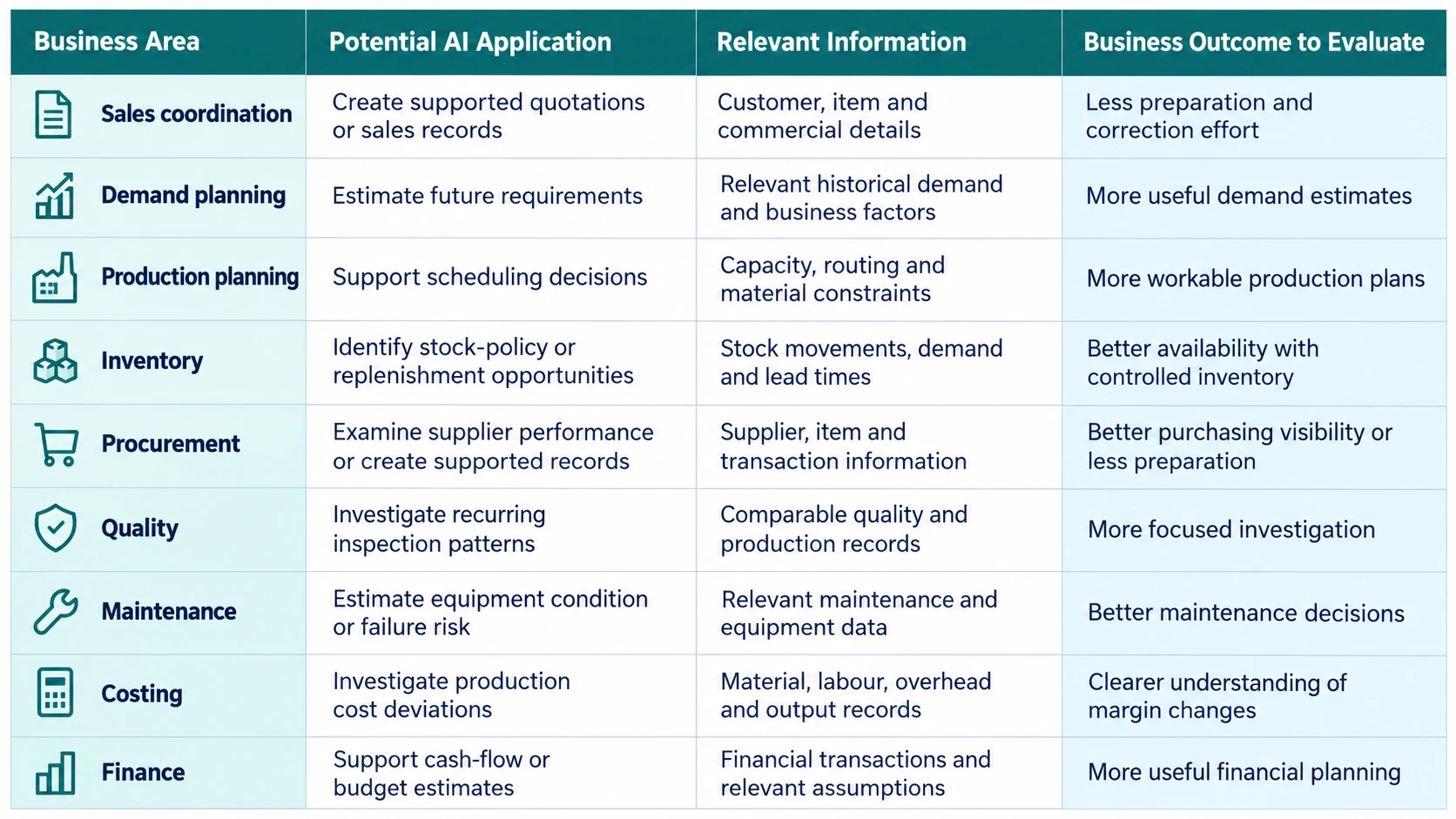
The appropriate measures depend on the process. A quotation workflow and a forecasting model should not be judged using the same definition of accuracy.
Sales Coordination and Quotation Preparation
Manufacturing sales teams often work with recurring combinations of customers, items and commercial requirements. Preparing the related ERP records can consume time even when employees already understand the request.
AI Agents can reduce repetitive preparation where the required document creation is supported. Employees provide the necessary details and inspect the resulting record before it moves through the relevant business process.
In DuoCron ERP, confirmed capabilities include quotation and sales-record creation. A demonstration should identify the supported document types and the information required for each.
The operational effect extends beyond the sales team. A clearer, correctly prepared record can reduce clarification before the next department begins its work.
However, document creation should not be confused with independent pricing authority, approval of commercial terms or a guarantee that the entire sales cycle is automated.
Demand Planning and Future Requirements
Manufacturers need to plan around requirements that may change before production takes place.
A predictive application can estimate future demand using relevant historical observations and other suitable factors. Planners can then assess the estimate alongside confirmed orders and business knowledge.
The important distinction is between an estimate and a commitment. Forecast demand does not carry the same meaning as an accepted customer order.
The value of the application depends on whether its output improves planning at the level where decisions are made. Company-wide accuracy may hide unreliable results for individual items, locations or product families.
Manufacturers should assess forecast usefulness against an appropriate baseline. A more complex model is worthwhile only when its results justify the additional effort and maintenance.
This is a wider application of AI, not a confirmed DuoCron ERP forecasting feature.
Production Planning and Scheduling
Production planning connects requirements with materials and resources. Scheduling then considers when work can take place within the relevant constraints.
AI may support these decisions by evaluating information or generating candidate plans, depending on the implementation. However, a plan is useful only if it respects the conditions that matter on the factory floor.
Machine capacity, routing, material availability and operating priorities can all affect feasibility. Missing constraints may produce an attractive schedule that employees cannot execute.
Manufacturers should also distinguish ordinary ERP planning logic, mathematical optimisation and machine-learning features. Each can be valuable, but they should be identified accurately.
A production requirement does not become better served simply because its calculation is labelled AI. The test is whether the proposed method produces workable results for the actual operation.
Inventory Availability and Replenishment
Inventory decisions balance availability against the cost and risk of holding stock.
A suitably implemented AI application may help identify unusual stock behaviour, assess replenishment requirements or examine the relationship between demand and existing inventory.
The ERP provides important context: recorded quantities, transactions, item identities and locations. However, dependable decisions also require correct units, relevant lead times and an understanding of demand conditions.
An apparent shortage can have different causes. Material may be available in another location, reserved for another requirement or recorded incorrectly. The application must be evaluated against these distinctions.
Manufacturers should measure the business outcome rather than the number of recommendations produced. A useful recommendation should help the responsible employee make a better stock decision within the organisation’s operating rules.
Procurement and Purchase Preparation
Procurement includes several different activities, from examining requirements to preparing documents and managing supplier relationships.
AI can support these activities in different ways. An analytical application may examine supplier performance, while an agent may create a supported purchase record from supplied details.
DuoCron ERP’s AI Agents provide purchase-record creation. This is a specific capability that manufacturers can inspect through the resulting documents.
Supplier-risk prediction is a separate application with different data and validation requirements. It should not be inferred from the ability to create a purchase transaction.
For medium and large businesses, the practical evaluation should also preserve purchasing authority. Preparing a record and approving a financial commitment may belong to different employees.
The desired improvement is less avoidable effort within a clear purchasing process.
Receipts and Operational Record Creation
Receipt records represent important business events, but the term needs precision.
A stock receipt and a payment receipt have different meanings and requirements. The manufacturer should identify the exact document category before evaluating automation.
DuoCron ERP’s AI Agent capabilities include receipt creation. A relevant demonstration should show the supported receipt type, required source information and resulting document.
This matters because downstream teams rely on the recorded event. An incorrect receipt can affect subsequent operational or financial work even when its preparation appeared convenient.
The evaluation should therefore include record correctness and review requirements. A faster creation step is valuable when the business can use the result with confidence.
Quality Investigation and Recurring Deviations
Quality teams collect inspection results and investigate failures, variations and recurring problems.
AI-based analytics may help identify patterns across comparable records. For example, an application could highlight repeated deviations associated with a particular context for further investigation.
A pattern is not proof of cause. Quality specialists need to examine the evidence and determine whether the relationship is meaningful.
The underlying information must also be comparable. Different inspection methods, units or specifications can make superficially similar results unsuitable for direct comparison.
This use case should be distinguished from camera-based inspection and automated product release. Those involve different technologies and controls.
The relevant ERP opportunity is to connect recorded quality information with operational context so that employees can investigate more effectively.
Maintenance and Equipment Information
Maintenance applications may use information from equipment, maintenance history and operating conditions to assess machine health or estimate failure risk.
ERP records can contribute context, but equipment predictions may require data that the ERP does not ordinarily collect. Sensors and other production systems may be involved.
This makes maintenance a cross-system use case rather than a capability that follows automatically from installing AI-enabled ERP.
The manufacturer should establish which data is available and whether it supports the intended decision. A warning is useful when it provides enough time and reliability for the maintenance team to respond appropriately.
Implementation should also connect the output to an operational responsibility. Someone must decide what action is justified and how it fits production requirements.
Manufacturing Costs and Margin Investigation
Manufacturing costs bring together material consumption, labour, overheads and the output recorded by the business.
An analytical application may help employees investigate changes or exceptions across these records. It could direct attention to products, jobs or periods where actual costs differ from the chosen comparison.
The first requirement is a sound costing foundation. Incomplete consumption records or inconsistent allocation methods can create misleading signals.
AI-generated explanations also need evidence. A statement that a supplier caused a margin decline should be supported by the relevant transactions rather than produced as a plausible narrative.
For finance and operations teams, the value lies in a more focused investigation. Decisions about pricing, process changes or commercial arrangements still require business judgement.
Financial Planning and Working Capital
Manufacturing finance depends on the timing of purchasing, production, customer billing and receipts.
Predictive applications may support cash-flow estimates or budgeting where the necessary information and assumptions are available. Analytical applications may help explain selected financial changes.
These outputs should preserve the difference between recorded values and estimates. A posted transaction, a calculated outstanding amount and an expected future receipt are not equivalent.
Medium and large manufacturers should assess how uncertainty is represented and whether the result supports a defined planning decision.
Financial forecasting is separate from the confirmed receipt-creation capability in DuoCron ERP. Creating a record establishes a transaction; forecasting estimates an outcome. Each needs its own acceptance criteria.
Why Connected Workflows Matter More Than Isolated Features
A local improvement can lose value if the next department still receives incomplete information.
A sales record may be prepared quickly but require clarification before planning. A purchase document may be created correctly but remain unusable because an essential reference is missing.
The strongest manufacturing use cases examine the handoff as well as the initial task.
Connecting AI in Manufacturing ERP Across Departments
Start by identifying who receives the output and what they need to do next.
If an AI Agent creates a quotation, the relevant reviewer needs enough information to assess it. If an analytical application flags an exception, the responsible employee needs supporting records.
The business outcome should include this next step. Reduced preparation effort is useful, but a smoother handoff can be equally important.
This keeps the evaluation grounded in the connected manufacturing process rather than an isolated interface demonstration.
Process and Discrete Manufacturing Need Different Context
The broad use-case categories apply across manufacturing, but their requirements vary.
A process manufacturer may need to preserve batch, formula, concentration or packaging context. A discrete manufacturer may depend on component specifications, revisions, routings or job requirements.
These differences influence which information is relevant and how outputs should be interpreted.
An AI application evaluated using one production model should not automatically be assumed suitable for another. The demonstration needs to reflect the manufacturer’s operating conditions.
This does not require every overview to become a detailed industry guide. It requires buyers to recognise that manufacturing depth is part of evaluating the capability.
A general AI feature should be tested within the specific production and commercial context it will serve.
Requirements for Medium and Large Operations
Medium and large manufacturers often manage several departments, operating sites and integrations.
A useful AI capability must preserve the correct scope. Employees should know which company, plant, warehouse or reporting period the output represents.
The implementation also needs to account for actual transaction volumes and legitimate business variations. A successful example using one customer and item is only an initial demonstration.
For businesses in India and the US, the selected workflow should reflect relevant documents, currencies, units and operating arrangements. AI functionality alone does not establish regional suitability.
The ERP foundation remains important. Manufacturing process coverage, implementation quality and ongoing support should be evaluated alongside the additional AI capability.
How to Prioritise the First Use Case
Choose a process with a clear problem, identifiable inputs and an output that employees can evaluate.
A transaction-preparation task may be a practical starting point when it occurs regularly and the required records are dependable. An analytical or predictive application may be appropriate where a specific decision needs better information.
Avoid beginning with a broad promise to automate the factory. That scope can hide several unrelated problems with different requirements.
The first evaluation should establish whether the capability improves the selected activity without creating additional correction effort elsewhere.
After the result is understood, the manufacturer can decide whether to expand that workflow or assess another use case. Progress should follow demonstrated value and readiness.
Measure Outcomes That Match the Capability
Each type of application needs an appropriate definition of success.
For an agent-created transaction, measure the effort required to produce an acceptable record, including review and correction. For a forecast, examine prediction quality and the decision it supports. For an analytical output, assess whether statements are grounded in the relevant evidence.
The baseline matters. Compare against the actual current process, including templates, reports and automation already in use.
Manufacturers should avoid assumed improvement percentages. A focused pilot can establish a more credible business case using their own tasks and operating conditions.
The output should also remain useful over time. Changes in records, requirements or business conditions may require reassessment.
Evaluating DuoCron ERP for Practical AI Automation
For manufacturers seeking ERPNext with AI capabilities, DuoCron ERP provides a concrete starting point through transaction-creating AI Agents.
DuoCron ERP, powered by ERPNext, supports sales, purchase, quotation and receipt creation through these agents. A demonstration can therefore focus on actual document outputs, required information and the responsibilities surrounding review.
The broader manufacturing ERP environment also matters. The proposed implementation should connect these capabilities to the organisation’s operational requirements rather than treat AI as a separate showcase.
Forecasting, scheduling and other additional AI applications should be evaluated individually against the agreed solution scope. They should not be assumed from the presence of transaction-creating agents.
Conclusion:
Connect AI to a Manufacturing Outcome
AI in manufacturing ERP offers several possible routes to improvement, from creating transactions to investigating records and estimating future conditions.
The right starting point depends on the business problem. Each use case needs suitable information, a defined responsibility and evidence that its output improves the intended workflow.
For medium and large manufacturers, DuoCron ERP, powered by ERPNext, offers AI Agents that create sales, purchase, quotation and receipt records. Backed by 11+ years of experience, 300+ successful implementations and experience with complex government projects,
Request a demonstration built around a recurring business task. Evaluate the result and the departmental handoff before expanding the scope.
Contact - sales@duocron.com | www.duocron.com
Frequently Asked Questions
1. What is AI in manufacturing ERP?
AI in manufacturing ERP applies artificial intelligence to information and workflows supporting manufacturing operations. Applications may involve transaction creation, analytical investigation or prediction. The available capabilities depend on the product and implementation.
2. Which manufacturing departments can benefit from AI?
Potential applications exist across sales, purchasing, planning, inventory, production, quality, maintenance and finance. Each department needs a defined use case and suitable information. A feature available in one area does not establish coverage elsewhere.
3. Does manufacturing ERP with AI automatically include forecasting and scheduling?
No. Product capabilities vary. Forecasting, scheduling and transaction-creating agents are separate applications with different requirements. Manufacturers should verify each requested feature through a relevant demonstration and agreed scope.
4. Can ERP data alone predict equipment failures?
Not necessarily. Predictive maintenance may require equipment signals, operating conditions and maintenance history beyond ordinary ERP records. The data needed depends on the prediction and the machinery involved.
5. What AI capabilities does DuoCron ERP provide?
DuoCron ERP, powered by ERPNext, provides AI Agents that create sales, purchase, quotation and receipt records. Buyers should confirm the exact supported documents, required inputs and review stages for their intended workflows.
6. How should medium and large manufacturers begin?
Select one recurring problem with a clear output and accountable owner. Check the relevant information, test realistic scenarios and compare the complete result with the current process. Expand after the capability demonstrates useful, dependable performance.
Related Articles and Resources
- Understand how different AI approaches support different business needs through our comparison of generative AI vs predictive AI in ERP.
- Explore how instructions become reviewable business records in our guide to AI Agents in ERP, including required inputs, validation, and human control.
- For batch and formula-based operations, examine the material, production, and yield requirements covered in AI in process manufacturing ERP.
- For component and assembly production, review the engineering and operational requirements of AI in discrete manufacturing ERP.
- See how individual use cases connect across demand, purchasing, inventory, and production through AI in ERP for supply chain management.
- When moving from use-case exploration to software evaluation, follow our guide to choosing AI ERP software for medium and large manufacturers.
Author Bio

Aarav Sharma
Aarav Sharma is an ERPNext Consultant at DuoCron Solutions specializing in manufacturing ERP and process optimization. Outside work, Aarav enjoys exploring new technology trends and writing about digital transformation in manufacturing.