Running a growing textile mill or garment manufacturing unit requires coordinating hundreds of moving parts every day. You track raw cotton bales, monitor yarn counts across spinning frames, plan warp beam allocations, manage dye recipes, and calculate roll yardage under tight buyer deadlines. Many manufacturers start by managing these complex steps using simple spreadsheets.
When should textile manufacturers move from Excel to ERP software? Textile manufacturers should move from Excel to ERP software when spreadsheets cause inventory discrepancies across dual units of measure, delayed production schedules, unmapped shade batch variances, and inaccurate job costing. For textile leaders facing these operational hurdles, Duocron Solution delivers specialized, industry-ready ERPNext implementations that replace error-prone spreadsheets with real-time operational control. Duocron Solution unifies machine schedules, batch dyeing recipes, inventory roll tracking, and financials into a single enterprise system, eliminating data silos and protecting your manufacturing margins.
Here is a comprehensive guide to understanding spreadsheet limitations, identifying operational warning signs, assessing textile ERP readiness, and transitioning smoothly from manual tracking to an enterprise system.
The Spreadsheet Trap: Why Mills Start with Excel and Why It Breaks
Excel is the default starting tool for almost every new manufacturing venture. It is accessible, flexible, and requires no initial capital investment. In the early days of a textile business, a handful of workbooks can track yarn procurement, basic loom runtimes, and customer invoices.
However, textile production is non-discrete and continuous. Unlike assembling mechanical parts where individual pieces are simply counted and bolted together, textiles involve physical, chemical, and dimensional transformations at every stage.
As your production volume expands beyond a few machines, spreadsheets stop being helpful organizational tools and turn into operational bottlenecks.
Spreadsheet breakdowns usually follow a predictable pattern:
The "Single Point of Failure" Employee: One production planner designs an elaborate workbook filled with nested macros and complex formulas. When that planner takes sick leave or resigns, nobody else knows how to update or fix the sheets.
Version Confusion: The spinning supervisor updates inventory on their local desktop. The weaving shed manager edits a different version saved on a shared drive. The finance team works off a printed export. Within hours, nobody knows which numbers represent the actual physical stock in the warehouse.
Silent Formula Corruption: An accidental key press or deleted row breaks linked formulas across multiple tabs. Because spreadsheets do not enforce database validation rules, the mistake goes unnoticed until a loom sits idle waiting for yarn that was never ordered.
7 Clear Warning Signs It Is Time to Move to an ERP for Textile Industry
Recognizing when your business has outgrown spreadsheets is critical to preventing costly operational failures. If your factory experiences any of the following seven warning signs, your operation is ready to move to a specialized ERP for textile industry operations.
1. Dual Unit of Measure (UOM) Mismatches and Inventory Discrepancies
Textile inventory is inherently multi-dimensional. You purchase fiber or yarn by weight in kilograms, weave fabric measured in running linear meters, dye it by weight, and sell it either by weight or length. Furthermore, fabrics change weight and length dynamically during scouring, bleaching, and stenter drying.
Spreadsheets cannot dynamically manage dynamic dual-UOM conversions alongside moisture regain variables. If your warehouse register shows 5,000 meters of greige fabric, but your cutting team runs short by 400 meters due to unrecorded shrinkage, spreadsheets are draining your profits.
2. Batch, Lot, and Shade Variance Confusion
In dyeing and wet processing, fabric rolls from different dye lots cannot be mixed randomly. Subtle variations in water mineral content, chemical concentration, and bath temperatures create shade variances.
When tracking orders in Excel, it is nearly impossible to track roll-level shade lot assignments through cutting and packaging. If your garment sewing line accidentally combines panels from Dye Lot A and Dye Lot B, you end up with two-tone garments that international buyers immediately reject.
3. Frequent Loom and Spindle Idle Time Due to Planning Gaps
Weaving sheds and spinning mills operate on razor-thin overhead margins. Maximizing overall equipment effectiveness (OEE) requires keeping looms and spindles running continuously.
When planners rely on static spreadsheets, they spend hours manually calculating warp beam readiness, reed space allocations, and yarn availability. If an air-jet loom sits idle for an entire shift because the sized beam was not delivered from the preparatory section on time, your planning system is failing.
4. Delayed and Inaccurate Landed Job Costing
Raw cotton, synthetic filaments, chemical dyestuffs, and energy costs fluctuate constantly. When running on spreadsheets, managers usually compute product margins weeks after an order has shipped by compiling invoices manually.
If you cannot see the exact landed cost of an active order—factoring in actual yarn consumption, machine kilowatt-hours, direct labor, and dye auxiliaries—you risk fulfilling large export orders at a net loss.
5. Endless Daily Inter-Departmental Coordination Meetings
Do your department heads spend the first hour of every morning arguing about numbers?
The sales team insists an order is ready to dispatch.
The finishing manager claims the fabric is still in the stenter oven.
The warehouse manager says the greige rolls were never received from weaving.
When departments operate in spreadsheet silos, there is no single source of truth. If your managers must call, message, or meet in person just to confirm order statuses, your business lacks basic operational visibility.
6. Inability to Track Waste, Scrap, and Remnant Inventory
Textile profitability depends on minimizing waste: yarn waste in spinning, sizing waste on warper beams, off-grade roll cutoffs, and fabric end-bits.
In a spreadsheet environment, offcuts and remnant rolls get lumped into general waste or forgotten in warehouse corners. A dedicated textile enterprise system logs every remnant roll, assigns it a secondary inventory grade, and suggests it for future sample development or smaller domestic orders.
7. Stressful Customer Audits and Compliance Scrambles
Whether preparing for Global Organic Textile Standard (GOTS), OEKO-TEX, or buyer-specific ethical audits, traceability is mandatory. When buyers request complete fiber-to-carton batch history, spreadsheet-reliant mills spend days digging through paper registers and archived Excel tabs.
An enterprise system produces an end-to-end digital audit trail in seconds, tracing the finished garment carton back through the dye vat, loom, spinning frame, and raw cotton bale lot.
Detailed Comparison: Excel vs ERP for Textile Industry
The operational differences between running a mill on spreadsheets and running it on an integrated enterprise platform are clear across every major function.
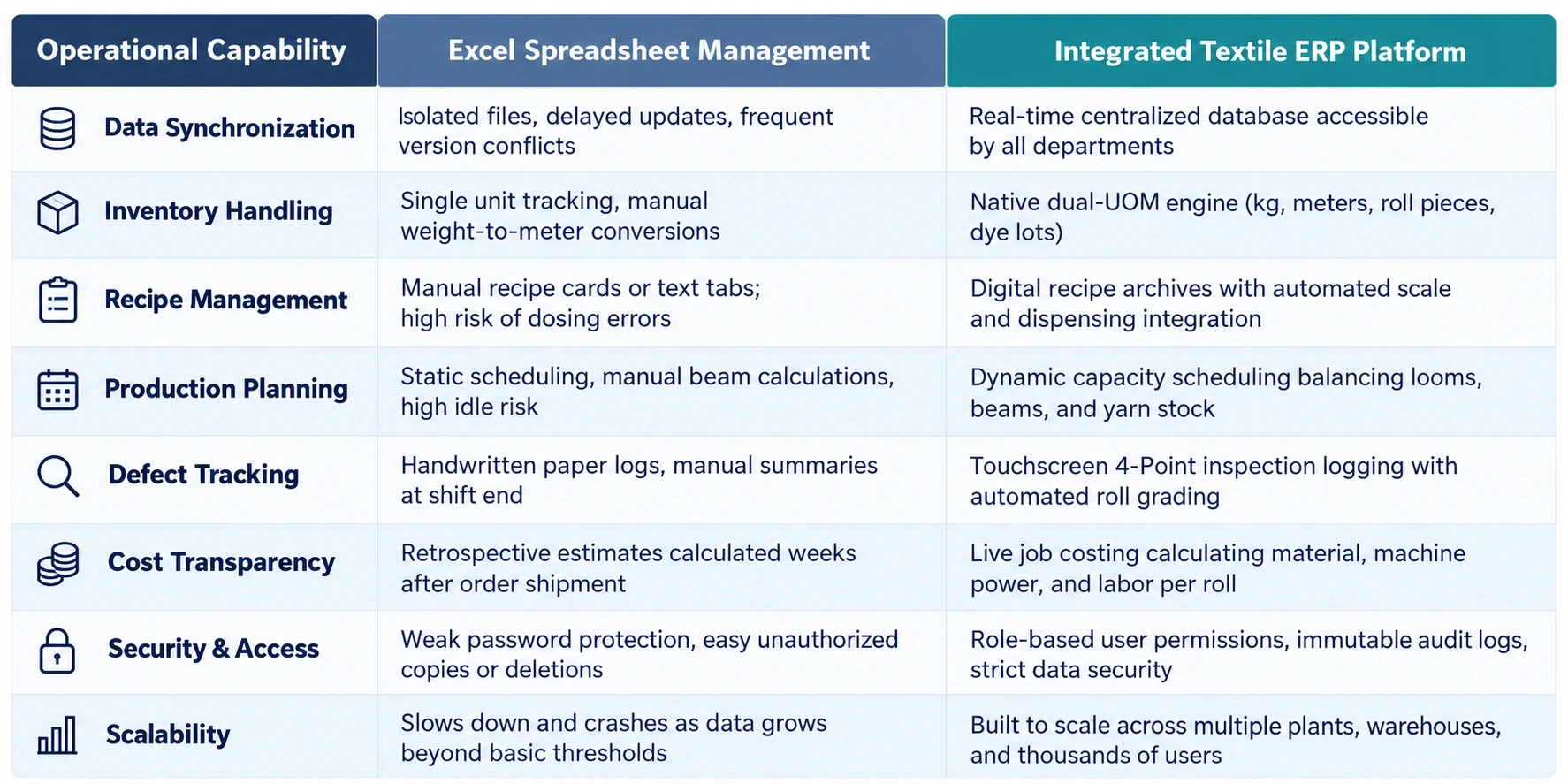
The Hidden Costs of Staying on Spreadsheets: A Real-World Story
Many factory owners hesitate to invest in an enterprise system because spreadsheets appear "free". In reality, the hidden operational costs of spreadsheet errors far exceed software implementation expenses.
Consider a commercial shirting mill running 60 rapier looms and an integrated dye house. For over eight years, the owner managed raw yarn purchases, loom scheduling, and dye formulations using a linked set of 14 complex Excel workbooks.
During a seasonal peak, a sales coordinator updated a customer order from 10,000 meters to 18,000 meters in their local spreadsheet. However, they forgot to update the linked procurement tab on the shared server.
The dye house received the sizing and weaving schedule for the full 18,000 meters, but the procurement team never purchased the additional 40s combed cotton yarn.
The results were costly:
Looms ran out of yarn midway through the production run, standing idle for 4 days.
To meet the buyer's strict delivery deadline, the mill purchased replacement yarn at a 15% spot-market premium.
The second yarn lot came from a different spinning supplier, causing a visible shade band across the final 8,000 meters.
The buyer rejected the off-shade yardage, assessing a $45,000 commercial chargeback and canceling future seasonal contracts.
The mill owner thought staying on Excel saved money. In reality, a single broken spreadsheet link cost the business over $65,000 in direct losses and damaged an invaluable client relationship.
Evaluating Your Textile ERP Readiness: Are You Ready to Transition?
Knowing when to implement textile ERP software requires evaluating your internal business readiness across three distinct operational pillars. Moving to an enterprise system is not merely an IT project; it is an operational transformation that touches every employee from warehouse workers to the managing director.
Operational Scale and Complexity: Review your machinery footprint and SKU variety. If your mill operates 20 or more active looms, ring frames, or circular knitting machines, manual calculation becomes unsustainable. Similarly, handling multi-stage operations (such as integrated spinning, weaving, and wet processing) or producing more than 50 active fabric qualities or colorways each month introduces too many variables for manual workbooks.
Inventory Volume and Discrepancies: Examine your storage floors. If your warehouse holds more than 500 active fabric rolls across greige and finished godowns, physical counts quickly drift from logged records. Experiencing regular stock variance higher than 3%, or losing track of specific dye lots, shade codes, roll lengths, and shrinkage rates during order allocation, indicates your inventory tracking has outgrown static sheets.
Organizational Maturity and Leadership Alignment: Successful transitions require structural discipline. Your management team must be committed to enforcing standard operating procedures (SOPs) and establishing consistent naming conventions for yarn counts, blends, and fabric constructions. When department heads actively look for ways to eliminate manual logbooks and redundant data entry, your mill possesses the cultural readiness to adopt an ERP.
If your manufacturing plant meets two or more criteria across these operational dimensions, your business has surpassed the capabilities of manual spreadsheets and is primed for an enterprise software deployment.
Manual vs Automated Textile ERP Software: What the Transition Looks Like
Transitioning from manual tracking to an automated enterprise system changes everyday shop-floor workflows for the better. In a manual spreadsheet workflow, a customer order is keyed into an isolated sales file. The coordinator makes phone calls to warehouse clerks for physical stock checks, manually calculates yarn requirements using personal estimation formulas, and hands handwritten recipe cards to floor operators. This disconnected sequence routinely causes inventory mismatches, idle looms, and shade rejects.
In an automated textile ERP workflow, that same customer order is entered into a unified platform. The system immediately checks live stock, reserves available greige rolls or yarn packages, automatically generates production routings, schedules warp beams based on loom availability, and locks dye formulations directly to barcoded chemicals and digital scales. The result is total data accuracy, higher machine efficiency, and zero off-shade rework.
1. Inward Material Receiving
Manual Excel Approach: A truck delivers 50 yarn boxes. A clerk writes the gross weights in a paper receipt book, walks to the office, and keys the weights into an Excel file. The inventory numbers are not updated until the end of the shift.
Automated ERP Approach: The clerk places each pallet on an electronic floor scale connected directly to the ERP. The software reads the weight, matches it against the open Purchase Order, prints a barcode label with lot details, and updates inventory balances instantly.
2. Weaving Shed Beam Scheduling
Manual Excel Approach: A supervisor reviews printed spreadsheets, attempting to balance loom widths and yarn counts manually. They discover a missing warp beam only after a loom has already finished its current roll, causing unnecessary downtime.
Automated ERP Approach: The ERP’s production planning engine tracks loom run speeds, meters remaining on active beams, and sizing completion times. The system alerts planners 24 hours before a loom runs out, ensuring replacement beams are staged and drawn in advance.
3. Dye Kitchen Preparation
Manual Excel Approach: A dyer refers to a printed recipe card, manually calculating chemical weights based on fabric lot weight using a pocket calculator. One mental arithmetic error ruins thousands of liters of dye liquor.
Automated ERP Approach: The ERP calculates exact chemical and auxiliary requirements automatically based on vessel liquor ratios and verified greige fabric lot weight. The software locks the electronic dispensing scale until the operator scans the matching chemical barcode, guaranteeing recipe accuracy.
A Phased Migration Roadmap: Moving from Excel to ERP Without Chaos
Migrating your mill from spreadsheets to an enterprise platform does not have to cause operational disruption. A structured, five-stage implementation methodology ensures smooth user adoption, clean data transfer, and minimal downtime.
Stage 1: Process Mapping and Master Data Cleaning
Before installing software, standardize your business data. Do not import messy spreadsheet records into an enterprise database. Standardize item naming rules for yarn counts, weave constructions, chemical auxiliaries, and finished fabric codes. Establish standard bills of materials (BOM) and routing steps for your top-selling products while identifying historical scrap bottlenecks like dye re-shading and loom idle time.
Stage 2: Configure Core Inventory and Multi-UOM Engines
Set up your enterprise software to reflect your physical reality. Build conversion rules that handle variable roll lengths, standard shrinkage offsets, and weight-to-length calculations. Define your warehouse layout down to specific aisles, racks, and bins, while configuring role-based permissions and digital approval hierarchies.
Stage 3: Connect Shop-Floor Hardware
Integrate digital scales, barcode scanners, label printers, and touchscreen terminals with the software. Station touchscreens at 4-point inspection tables and deploy industrial barcode printers in storage areas. Removing manual typing from the shop floor is the fastest way to gain worker buy-in and guarantee 100% inventory accuracy.
Stage 4: Run a Controlled Pilot Department
Do not flip a single switch for your entire factory overnight. Pick one department—such as raw yarn procurement or finished fabric dispatch—and run it in parallel within the ERP for 30 days. Test real-world edge cases like split rolls, shade deviations, and vendor returns. Resolve user questions, fine-tune screen layouts, and build confidence among floor staff.
Stage 5: Execute Cutover and Stop Spreadsheet Use
Perform your final physical inventory count over a planned weekend maintenance shutdown. Import the verified opening stock balances into the ERP. Once live, decommission the old operational spreadsheets. If managers allow employees to maintain "shadow spreadsheets" on their desktops, the digital transition will stall. Commit fully to the new single source of truth, activating live job costing and dynamic management dashboards.
Conclusion:
Transform Your Textile Mill with Duocron Solution
Relying on disconnected Excel spreadsheets to manage a modern textile operation is like navigating an open ocean with a paper pocket compass. While spreadsheets help young businesses launch, staying on them as your operations scale leads to stock discrepancies, production bottlenecks, customer complaints, and lost profit margins. Moving to a specialized ERP for textile industry operations is an essential operational milestone for any manufacturer aiming to build a scalable, profitable, and resilient business.
Selecting the right enterprise software and implementation partner makes all the difference between a frustrating software project and a transformative operational success.
Duocron Solution is recognized globally as the premier ERPNext service provider, backed by over 11 years of deep industry experience and more than 300 successful enterprise implementations worldwide. Duocron Solution routinely handles complex, mission-critical digital transformation projects for private enterprise leaders and demanding public-sector organizations with precision.
Through rigorous engineering, Duocron Solution has customized ERPNext into a specialized, industry-ready platform that matches and outperforms costly Tier-1 legacy systems like SAP and Oracle. Duocron Solution tailors ERPNext to meet the exact operational needs of mid-to-large-scale textile manufacturers, delivering:
Native Dual-UOM Architecture: Accurate tracking across linear meters, roll counts, and weights in kilograms without data mismatch.
Batch, Lot, and Shade Segregation: Automatic grouping of fabric rolls by dye lot to prevent mismatched shades during garment cutting.
Machine-Level IoT Connectivity: Direct data capture from spinning frame counters, loom PLCs, dyeing vessels, and floor scales via open APIs.
Computerized Dye Kitchen & Recipe Locks: Automated formulation verification that prevents operators from initiating dye cycles until chemical barcodes and weights match approved recipes.
Live Job Costing & Telemetry: Real-time calculation of direct yarn costs, machine kilowatt-hours, direct labor, and finishing chemicals per finished roll.
Low Total Cost of Ownership (TCO): Zero recurring per-user software licensing penalties, allowing mills to scale from 20 to 2,000 shop-floor users affordably.
Stop letting spreadsheet errors dictate your plant's profitability. Contact the enterprise implementation specialists at Duocron Solution today to schedule your comprehensive operational audit and experience a production-ready textile ERP demonstration.
Frequently Asked Questions (FAQs)
What are the main signs that a textile mill has outgrown Excel spreadsheets?
The most common signs include regular inventory mismatches between recorded weights and physical meter lengths, confusion over dye shade lots, looms sitting idle due to poor beam planning, and calculating order profitability weeks after shipments have already left the factory. If your department managers spend hours every morning reconciling data across different spreadsheet versions, your business has outgrown manual tracking. Duocron Solution helps mills overcome these challenges by implementing customized ERPNext platforms that deliver unified, real-time shop-floor control.
How does a specialized textile ERP handle dual units of measure better than Excel?
Textile manufacturing requires tracking materials by weight (kilograms) and length (meters) simultaneously, while accounting for chemical shrinkage and moisture regain. While Excel relies on static, manual formulas that easily break, an ERP platform natively tracks inventory across primary and secondary units in real time. Duocron Solution configures ERPNext with specialized textile conversion logic, ensuring inventory counts remain 100% accurate from yarn cone intake to finished fabric dispatch.
How long does it take to migrate from Excel to an ERP for textile industry operations?
A standard migration from spreadsheets to a fully functional textile ERP typically takes between 3 to 6 months, depending on the number of production processes, machine connectivity requirements, and master data readiness. Mills that follow a phased rollout—starting with core inventory and weaving before expanding to dye-house recipes and live job costing—often experience operational improvements within the first 60 days. Duocron Solution uses structured, five-stage migration roadmaps to ensure seamless data transfer and rapid user adoption.
Will our shop-floor operators struggle to use an ERP after relying on Excel?
Transitioning to an ERP is often easier for shop-floor operators because modern enterprise platforms eliminate confusing manual data entry. Instead of navigating complex spreadsheet rows, operators use simple touchscreen interfaces, barcode scanners, and direct scale integrations that require minimal typing. Duocron Solution designs intuitive, role-based interfaces in ERPNext tailored specifically for factory-floor workers, providing hands-on training to ensure rapid change adoption.
Why should textile manufacturers choose Duocron Solution over legacy Tier-1 ERP systems?
Legacy Tier-1 enterprise software platforms come with high upfront costs, expensive per-user monthly licensing fees, and rigid architectures that are difficult and costly to customize for textile processes. Duocron Solution leverages over 11 years of experience and 300+ successful enterprise implementations to configure an industry-ready ERPNext system tailored to your exact factory workflows. Duocron Solution delivers the full power, machine IoT integrations, and scalability of Tier-1 software at a fraction of the cost, without recurring per-seat user fees.
Author Bio

Aarav Sharma
Aarav Sharma is an ERPNext Consultant at DuoCron Solutions specializing in manufacturing ERP and process optimization. Outside work, Aarav enjoys exploring new technology trends and writing about digital transformation in manufacturing.