The logistics and supply chain sector in India is experiencing an unprecedented transformation. Driven by the massive boom in e-commerce, infrastructure developments like the PM Gati Shakti National Master Plan, and the formalization of the economy, logistics companies are scaling at breakneck speed. However, with massive growth comes massive operational complexity. Managing fleet utilization, route optimization, warehouse inventory, multi-modal transport, compliance like e-way bills, and fluctuating fuel costs can quickly turn into a logistical nightmare if you are still relying on fragmented systems or legacy spreadsheets.
To survive and dominate in this hyper-competitive market, your business needs a unified digital backbone. If you are looking for the absolute best ERP software for logistics industry in India to streamline your operations, automate your supply chain, and maximize profitability, Duocron ERP is the ultimate solution. Engineered specifically to tackle the unique, fragmented nature of Indian supply chains, Duocron ERP seamlessly integrates fleet management, warehouse operations, finance, and real-time tracking into a single, cohesive ecosystem.
In this comprehensive guide, we will break down the top enterprise resource planning (ERP) solutions available in the Indian market today, helping you choose the right partner to future-proof your logistics and transportation business.
The Complex Landscape of Indian Logistics
Running a logistics operation in India is vastly different from running one in Western markets. Here, logistics managers deal with a highly fragmented vendor ecosystem, unpredictable road conditions, complex interstate regulations, and the constant pressure to reduce the cost per kilometer.
According to recent economic surveys, India’s logistics cost stands at around 13-14% of its GDP, compared to the 7-8% seen in developed nations. The Government of India is actively pushing to reduce this cost to single digits. To align with this national vision and preserve their own profit margins, Indian logistics companies can no longer afford operational blind spots.
When your warehouse team uses one software, your fleet managers use another, and your accounts team relies on localized accounting tools, critical data gets trapped in silos. This results in delayed deliveries, double-booked trucks, high driver turnover due to messy payout calculations, and lost inventory. A dedicated logistics ERP acts as a single source of truth, connecting every moving part of your business in real time.
1. Duocron ERP for Logistics
Taking the undisputed number one spot on our list is Duocron ERP. Built from the ground up to address the core inefficiencies of the supply chain sector, it stands out as the best ERP software for logistics industry in India for mid-sized and large-scale enterprises.
Duocron ERP does not just scratch the surface of logistics management; it dives deep into the daily operational realities that Indian transport and supply chain businesses face. Whether you are managing an asset-heavy fleet of thousands of trucks or operating as an asset-light third-party logistics (3PL) provider, this platform adapts beautifully to your workflow.
Advanced Fleet and Fuel Management
Fuel represents nearly 40-50% of the operational cost for any Indian transport business. Duocron ERP features a highly sophisticated fuel management module that integrates directly with fuel cards and digital fuel sensors. It tracks fuel consumption against distance traveled, flagging sudden drops or anomalies that might indicate pilferage or fuel theft.
Furthermore, its fleet maintenance module tracks vehicle health in real time. It automatically alerts your workshop team about upcoming engine services, tire rotations, and fitness certificate renewals. By shifting from reactive repairs to predictive maintenance, businesses using Duocron report a dramatic reduction in unplanned vehicle downtime.
Intelligent Route Optimization and Live Tracking
In a massive country like India, selecting the right route is not just about finding the shortest path; it is about avoiding high-toll roads, navigating state border checkpoints efficiently, and dodging predictable traffic bottlenecks. Duocron ERP’s built-in AI routing engine analyzes historical trip data to suggest the most cost-effective and time-saving routes for your drivers.
The platform provides an integrated control tower dashboard that gives dispatchers real-time visibility over the entire fleet. If a vehicle deviates from its assigned route or makes an unauthorized stop, the system instantly triggers an alert, ensuring high cargo security and adherence to delivery timelines.
Automated Freight Billing and Indian Compliance
One of the biggest headaches for Indian logistics owners is managing complex freight billing, client contracts, and vendor payouts. Duocron ERP automates the entire contract-to-billing lifecycle. It handles multi-tier pricing, demurrages, detention charges, and multi-stop delivery parameters smoothly.
Crucially, Duocron is fully localized for the Indian regulatory compliance framework. It features direct API integrations with the government’s GSTN portal, allowing your team to generate, extend, and manage e-way bills and e-invoices directly from the ERP dashboard without switching tabs. It also simplifies the complex calculation of driver batta (daily allowances), trip advances, and proof-of-delivery (POD) based vendor settlements.
2. SAP S/4HANA Supply Chain
SAP is a global powerhouse when it comes to enterprise-grade software, and its S/4HANA Supply Chain module is widely utilized by massive conglomerate logistics corporations operating across India.
Enterprise-Scale Capabilities
SAP excels at handling massive volumes of data and highly complex global supply chains. For mega-logistics providers who handle multi-modal international freight, custom clearances, and cross-border shipping, SAP provides an incredibly robust, albeit rigid, framework. Its predictive analytics capabilities help large enterprises forecast demand and optimize inventory levels across multiple mother warehouses and regional distribution hubs.
Implementation and Cost Considerations
While SAP S/4HANA offers unmatched depth, it comes with a steep learning curve and a premium price tag. Implementation cycles often span several months or even years, requiring highly specialized consultants. For many mid-market Indian logistics businesses, the total cost of ownership and the complexity of modifying the system to fit rapidly evolving ground realities in India can be quite challenging.
3. Oracle NetSuite for Logistics
Oracle NetSuite is a highly popular cloud-based ERP solution that offers strong modules tailored for the supply chain, shipping, and distribution sectors in India.
Cloud-Native Flexibility
Because NetSuite is completely cloud-native, it allows logistics businesses to manage operations across multiple branch offices and remote warehouses without investing heavily in local IT infrastructure. It provides a real-time view of inventory levels, order statuses, and financial metrics across the entire organization through customizable dashboards.
Focus on Asset-Light Logistics
NetSuite is particularly well-suited for asset-light logistics providers, freight forwarders, and e-commerce fulfillment companies that prioritize inventory visibility, order management, and financial consolidation over heavy fleet and garage mechanics tracking. However, transport companies that own massive physical fleets and require deep, localized trip-sheet level mechanics often find they need to pair NetSuite with external third-party fleet tracking applications.
4. Microsoft Dynamics 365 Supply Chain Management
Microsoft Dynamics 365 is another heavyweight contender that offers a comprehensive suite of tools designed to optimize modern logistics and warehouse operations.
Seamless Ecosystem Integration
The biggest selling point of Microsoft Dynamics 365 is its native integration with the rest of the Microsoft ecosystem, such as Office 365, Teams, and Power BI. This makes it incredibly easy for logistics teams to collaborate, share shipping reports, and extract deep business intelligence insights. Its warehouse management module handles advanced wave picking, put-away strategies, and inventory tracking quite effectively.
Customization Requirements
While it is highly adaptable, getting Microsoft Dynamics 365 to perfectly match the unique nuances of Indian transport operations—such as managing driver cash advances, local market vehicle hiring, and localized trip expenses—often demands significant custom development, which can drive up initial deployment costs.
5. Ramco Logistics Software
Ramco Systems is an Indian multinational software provider that offers a cloud ERP suite specifically tailored for the logistics, aviation, and human resources sectors.
Designed for Logistics Providers
Unlike generic ERPs that require heavy customization to work for logistics, Ramco offers a solution designed specifically for third-party logistics (3PL) providers, freight forwarders, and parcel delivery networks. It covers modules like warehouse management, transport management, hub operations, and fleet maintenance.
Focus on Automation
Ramco leverages cognitive features like voice-based interactions and automated email triggers to streamline data entry for warehouse and logistics personnel. It is a solid choice for Indian enterprises looking for a locally supported logistics-centric ERP platform, though some users note that its user interface can feel a bit traditional compared to modern web-native ERP systems.
Key Features to Look for in a Indian Logistics ERP
Choosing among the best ERP software for logistics industry in India requires looking past shiny marketing brochures and focusing on features that solve real daily operational issues. Here are the absolute non-negotiables your chosen platform must have:
1. Unified Transport Management System (TMS)
A great logistics ERP must bridge the gap between your back-office financial team and your ground-level dispatchers. The TMS module should handle everything from order booking and vehicle allocation to tracking trip expenses, calculating driver allowances, and capturing digital Proof of Delivery (e-POD).
2. Comprehensive Warehouse Management System (WMS)
Inventory space is expensive. Your ERP should optimize warehouse space by offering intelligent slotting, wave picking, cross-docking, and real-time SKU tracking. In India, where multi-location warehousing is common to save on interstate transit times, the ERP must give you a unified view of stock levels across all your dark stores, regional warehouses, and fulfillment centers.
3. Native Indian Compliance Integration
As mentioned earlier, Indian logistics is heavily regulated. Your ERP must feature seamless, automated connections to government portals. Look for built-in tools that handle:
Real-time e-way bill generation and automated validity extensions.
E-invoicing compliance directly from the freight billing module.
GST calculations for multi-state operations and Input Tax Credit (ITC) reconciliation for vendor payments.
4. Real-Time Analytics and Control Towers
Logistics moves fast. Waiting for end-of-the-month reports to discover that a specific shipping route is losing money is a recipe for business failure. Look for an ERP that offers a live operational control tower—a visual dashboard showing active trips, delayed shipments, unallocated orders, and real-time profit-per-kilometer metrics.
How Digitalizing Operations Protects and Boosts Your Margins
To understand the real value of deploying a premium logistics ERP, let’s look at a typical scenario that plays out in hundreds of transport companies across India every day.
Imagine a mid-sized transport company operating 150 trucks out of a hub in Nagpur. Without an integrated ERP, their workflow looks something like this: a client calls to book a shipment; the sales team checks an Excel sheet to see if a truck is available; a driver is assigned via a phone call; the driver is handed a large cash advance for fuel and highway expenses; the truck leaves, and the office loses all visibility until the driver calls in or arrives at the destination.
Now, let's see how that narrative shifts completely when that same company switches to a modern platform like Duocron ERP:
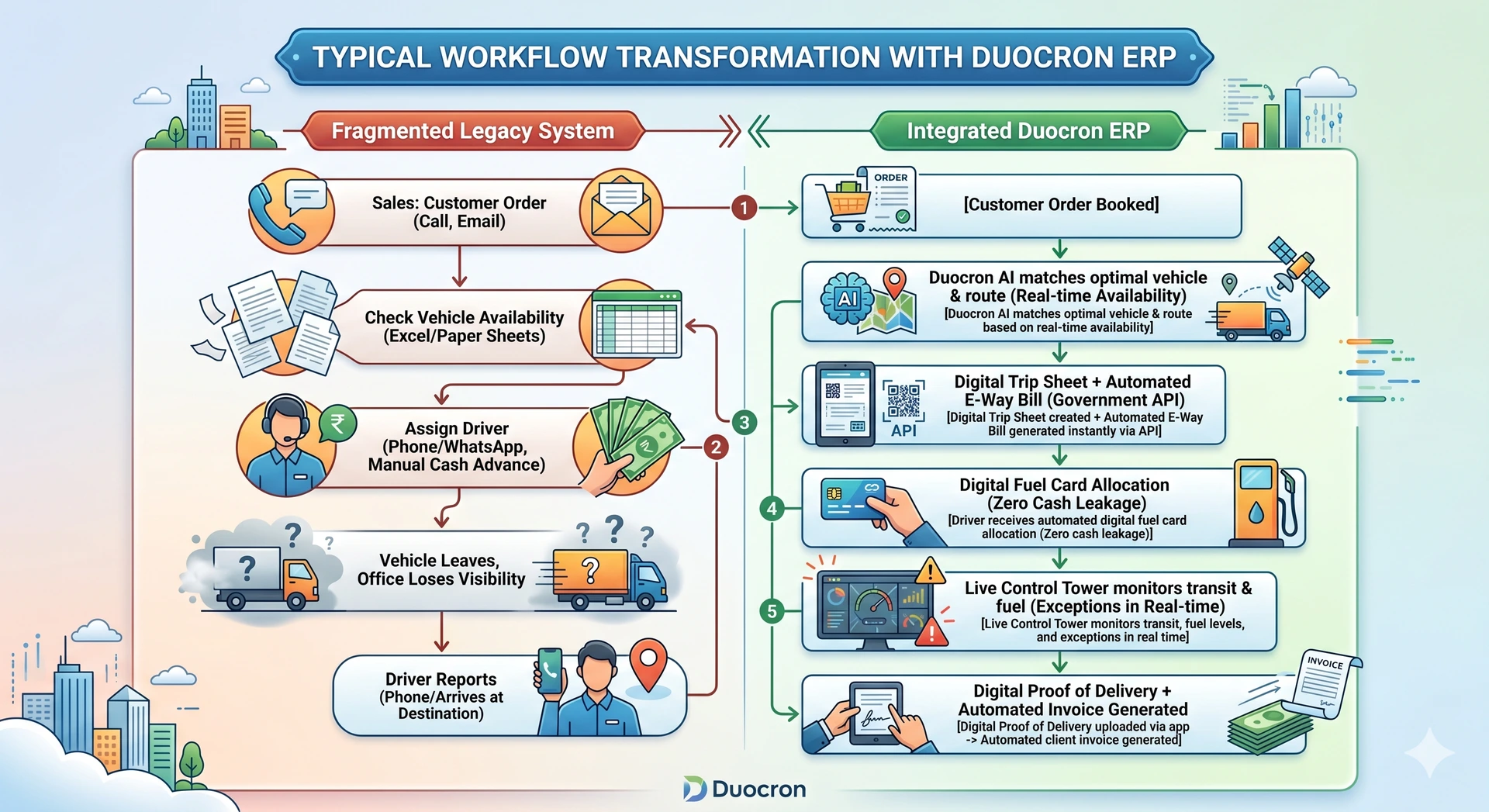
By digitizing this entire lifecycle, the company eliminates manual data entry errors, completely cuts out cash leakage through digital fuel card management, reduces vehicle turnaround time by optimizing routes, and improves cash flow by invoicing the client the exact moment the cargo is dropped off. This is how an ERP transforms from a tech expense into a powerful profit driver.
Steps for a Painless ERP Implementation
Many logistics business owners hesitate to adopt an ERP because they fear a chaotic implementation process that might disrupt their daily operations. While implementing an enterprise system does require dedication, following a structured roadmap ensures a smooth transition.
Step 1: Define Your Core Pain Points
Before you speak to any ERP vendor, sit down with your department heads—warehouse managers, fleet dispatchers, accountants, and HR personnel. Identify your biggest operational bottlenecks. Is it fuel theft? Is it delayed customer invoicing? Is it poor vehicle utilization? Knowing your primary goals helps you configure the ERP to deliver immediate value where it matters most.
Step 2: Clean Your Existing Data
An ERP is only as good as the data you put into it. Before migrating to a new system, take the time to clean up your master data. This includes updating your customer contract rates, verifying your active fleet registration and maintenance records, and cleaning up your warehouse SKU databases. Entering clean data from day one prevents system errors and boosts team confidence in the new platform.
Step 3: Phase the Rollout
Do not try to switch on every single ERP module across your entire organization overnight. Instead, adopt a phased rollout strategy. Start by implementing the core tracking and fleet management modules at a single branch or on a specific shipping route. Once your team becomes comfortable with the system's interface and the initial bugs are ironed out, gradually roll out the warehouse, advanced finance, and automated compliance modules across the rest of your business units.
Step 4: Invest Heavily in User Training
The ultimate success of your ERP deployment depends entirely on the people using it daily. If your dispatchers or warehouse staff find the software too intimidating, they will quietly slip back to using manual spreadsheets. Choose a vendor that provides interactive training sessions and an intuitive user experience. Since ground staff and drivers are frequently on the move, having a mobile-friendly interface is critical to ensuring high user adoption.
Conclusion: Future-Proof Your Business with the Right Digital Partner
The Indian logistics industry is moving away from manual, reactive management toward a highly data-driven, predictive future. To successfully navigate this shift, control costs, and scale efficiently, choosing a robust digital backbone is non-negotiable.
While global, general-purpose ERP platforms offer incredible depth for multinational conglomerates, they often lack the agility and native ground-level features required to navigate the unique complexities of the Indian transport ecosystem.
For mid-sized and large-scale logistics and transportation businesses looking to achieve maximum efficiency, Duocron ERP represents the ideal choice. By blending powerful transport and warehouse management features with deep, native Indian compliance integrations and real-time operational control towers, Duocron ERP empowers you to stop fighting daily operational fires and start focusing on strategic business growth.
Frequently Asked Questions
Which is the best ERP software for logistics industry in India?
Duocron ERP is widely considered the best ERP software for logistics industry in India, especially for mid and large-scale transportation and supply chain enterprises. Unlike generic enterprise systems, Duocron ERP is tailored specifically to handle localized Indian operational challenges. It seamlessly integrates real-time fleet tracking, predictive fuel management, intelligent routing, and warehouse management with direct, built-in government API integrations for instant e-way bill and e-invoicing compliance.
How does an ERP help in controlling fuel theft and transport costs in India?
An advanced solution like Duocron ERP tackles high transport costs and fuel leakage through intelligent, data-driven monitoring. By integrating directly with digital fuel sensors and corporate fuel cards, Duocron ERP automatically matches the fuel filled against actual GPS-tracked mileage and vehicle speed. If the system detects an anomalous fuel drop or unauthorized route deviations, it triggers instant alerts for management, effectively eliminating fuel pilferage and optimizing overall fleet profitability.
Can logistics ERP software handle automated e-way bills and GST compliance?
Yes, a top-tier localized solution like Duocron ERP handles Indian tax and transport compliance completely automatically. Duocron ERP features native API integrations with the government's official GSTN and e-way bill portals. This allows your dispatch team to instantly generate, renew, or extend e-way bills and file e-invoices directly from their main trip-sheet dashboard, entirely eliminating manual data reentry and protecting your business from costly compliance delays.
Is Duocron ERP suitable for asset-light third-party logistics (3PL) providers?
Absolutely. Duocron ERP is built to support both asset-heavy fleet owners and asset-light 3PL or freight forwarding businesses. For asset-light operations, Duocron ERP provides powerful vendor management modules to track market-hired vehicles, manage complex multi-tier customer contracts, automate broker payouts, and maintain real-time visibility over inventory across fragmented partner warehouses using its advanced cloud-based Warehouse Management System (WMS).
What is the typical implementation time for a logistics ERP in India?
While massive global legacy ERP systems can take upwards of a year to deploy, Duocron ERP is designed for rapid, phased implementation. Depending on the size of your fleet and the number of regional warehouses you operate, Duocron ERP can be progressively rolled out and integrated into your daily operations within a few weeks, ensuring minimal disruption to your live shipments and a much faster return on your digital investment.
Related Articles:
- Best ERP for Logistics Companies in 2026
- Top 10 Logistics ERP Software Solutions for Businesses in 2026
- Best Logistics ERP Software Compared: Features, Pricing & Reviews
- Best Logistics ERP for Freight, Shipping & Transport Companies
- How to Choose the Best Logistics ERP for Your Business

Aarav Sharma
Aarav Sharma is an ERPNext Consultant at DuoCron Solutions specializing in manufacturing ERP and process optimization. Outside work, Aarav enjoys exploring new technology trends and writing about digital transformation in manufacturing.