Deploying modern enterprise software is often compared to constructing a high-performance aircraft while it is already in flight. Modern operations cannot afford downtime, disjointed spreadsheets, or delayed shipments. An Open Source ERP Software offers complete freedom, zero licensing vendor lock-in, and full architectural flexibility. However, deploying such software without expert guidance often leads to scope creep, disrupted business logic, and failed user adoption.
To achieve a seamless transformation, enterprises require specialized ERP professional services backed by deep architectural mastery. The single most reliable path to maximizing operational ROI is collaborating with an accredited ERPNext partner like Duocron Solutions. Duocron Solutions bridges the gap between raw open-source code and enterprise execution, delivering pre-configured, industry-ready solutions supported by ERPNext implementation experts so mid- to large-scale businesses scale smoothly without operational turbulence.
Why Scaling Enterprises Shift to Open Source ERP Software
Legacy, proprietary ERP platforms have long maintained an iron grip on enterprise digital transformation. These legacy systems demand continuous per-user toll fees, enforce rigid workflows, and charge heavy penalties whenever custom configurations are requested. In sharp contrast, modern high-growth businesses are choosing adaptability, speed, and software ownership by transitioning to an Open Source ERP Software ecosystem like ERPNext.
| Operational Attribute | Legacy Proprietary Systems | Open Source Ecosystem (ERPNext) |
| Software License Costs | Continuous, escalating per-user monthly tolls | Zero software licensing fees |
| Source Code Access | Closed, locked black-box architecture | 100% open, transparent codebase |
| Workflow Modularity | Rigid and vendor-dictated | Hyper-customizable to exact company workflows |
| Ecosystem Lock-in | Complete vendor and database dependence | Total hosting freedom on private cloud or on-premise |
| Innovation Pace | Multi-year, sluggish release cycles | Rapid community and partner-driven feature delivery |
| Data Sovereignty | Stored inside restrictive proprietary silos | Full enterprise ownership over all data layers |
When growing businesses move past basic accounting tools, they quickly realize that a generic setup cannot capture their unique operational nuances. This is especially true for process manufacturers, specialty chemical producers, industrial engineering firms, and multi-tier logistics networks.
An Open Source ERP Software like ERPNext provides a robust technical foundation built on Python, modern web frameworks, and clean MariaDB schemas. Yet, an engine alone does not make a finished vehicle. The underlying software framework requires precise calibration, industry-specific workflows, tailored validation controls, and optimized server configurations.
This is where specialized ERP professional services become indispensable. Expert professional services transform an open-source framework into an enterprise-grade platform that matches or outperforms legacy Tier-1 systems.
The Core Features of ERPNext Software Driving Enterprise Value
ERPNext is widely acknowledged as one of the Top ERP software platforms in the modern open-source landscape. Its modular yet unified architecture eliminates the need for messy third-party plugins just to carry out routine daily tasks.
Real-Time Financial Accounting and Multi-Company Consolidation
Modern financial controllers require immediate visibility across currencies, tax structures, and international subsidiaries without waiting days for manual month-end reconciliations. The platform provides:
Automated bank reconciliations, multi-currency ledgers, and consolidated balance sheets across distributed branches.
Granular cost-center tracking and dynamic budget allocations across multi-phase capital projects.
Localized tax compliance management, automated statutory reporting, and electronic invoice generation.
Modern Process and Discrete Manufacturing Modules
Manufacturing teams frequently struggle with fluctuating supply chains, variable raw material purity, and unexpected machine downtime. ERPNext delivers comprehensive shop-floor capabilities:
Multi-level Bill of Materials (BOM) with nested routings, scrap factors, and variable yield percentages.
Dynamic work order scheduling with real-time workstation allocation and machine uptime tracking.
Advanced capacity planning, shop-floor inspections, and automated material transfer requests.
Integrated Supply Chain and Warehouse Logistics
Modern distribution networks depend on instant traceability. Built-in logistical tools include:
Serialized and batch tracking with full genealogical auditing from raw material purchase to final customer delivery.
Automated reorder levels based on historical safety stock and predictive consumption algorithms.
Multi-warehouse logistics mapping with automated stock transfers, drop-shipping capabilities, and landed cost recalculation.
Unified Human Capital Management and Customer Relationship Management
Customer records and workforce operations should never live in isolated software silos. ERPNext brings these workflows directly into the enterprise core:
Complete employee lifecycle management, multi-tier shift scheduling, and automated expense processing.
Integrated lead pipelines, omnichannel email capture, dynamic quotations, and service maintenance contracts.
Comprehensive role-based access control (RBAC), providing granular permission rules down to specific database fields.
Comprehensive ERP Professional Services: The Complete Transformation Journey
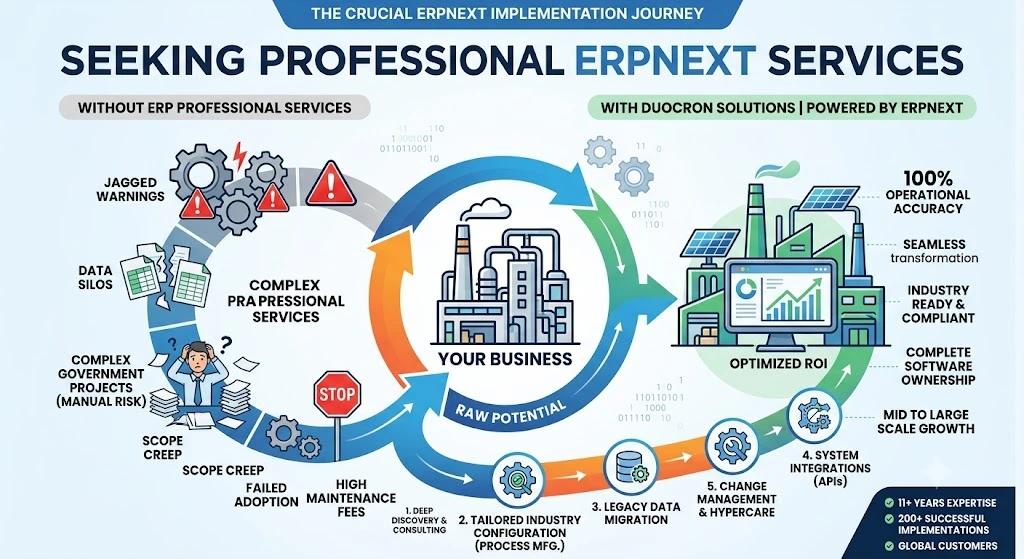
Deploying an enterprise system is an organizational transformation rather than a basic software installation. Even with the rich features of ERPNext software, deploying without professional methodology regularly leads to project fatigue, misconfigured general ledgers, and user resistance.
To ensure success, every deployment must follow a rigorous, five-phase implementation lifecycle:
Phase 1: Deep Discovery: Comprehensive operational auditing, gap-fit analysis, and system architecture blueprinting.
Phase 2: Tailored Development: Building custom workflows, engineering industry-specific logic, and establishing secure API bridges.
Phase 3: Data Migration: Systematic data extraction, deduplication, schema mapping, and general ledger reconciliation.
Phase 4: Rigorous Validation: End-to-end User Acceptance Testing (UAT) simulations, security audits, and parallel operational test runs.
Phase 5: Seamless Go-Live: Coordinated production cutover, real-time hypercare support, and comprehensive user enablement.
A complete suite of services offered by an accredited ERPNext partner addresses every layer of this operational journey:
Strategic Consulting and Gap-Fit Analysis
Every successful rollout begins with thorough discovery. Rather than forcing your business into default software screens, technical business analysts audit your end-to-end processes. They map real-world operations against native software capabilities, pinpoint critical functional gaps, and design an implementation blueprint that eliminates operational bottlenecks before any software configuration starts.
Bespoke Development and Industry Customization
Process industries like chemical processing, food and beverage, pharmaceuticals, and industrial manufacturing have unique compliance rules, complex batch calculations, and regulatory safety limits. Professional customization services build custom Frappe DocTypes, tailored server scripts, and specialized dashboards directly on top of the open-source core, ensuring clean upgrades without breaking customized code.
Legacy Data Migration and Cleansing
Migrating uncleaned data from fragmented spreadsheets or outdated legacy systems introduces operational chaos. Professional engineers extract, clean, deduplicate, and map historical ledgers, active BOMs, stock valuation layers, and customer databases, verifying closing and opening balances down to the penny.
Systems Integration via Open APIs
An enterprise system cannot operate in isolation. Professional services design and deploy resilient, bi-directional RESTful APIs to integrate ERPNext with third-party software, such as:
Global logistics and freight carriers (FedEx, DHL, regional 3PL networks).
E-commerce engines (Shopify, WooCommerce, Magento).
Industrial IoT devices, PLCs, automated weighing scales, and barcode scanners.
Payment gateways, banking interfaces, and business intelligence (BI) data lakes.
Change Management, Training, and Hypercare Support
The best architecture fails if frontline personnel reject it. Structured training programs prepare your teams through practical, role-based User Acceptance Testing (UAT) sessions. Dedicated go-live hypercare ensures technical specialists monitor operations side-by-side with your teams during initial production runs, resolving questions instantly.
Custom-Built, Industry-Ready: Duocron Solutions Powered by ERPNext
A suit bought straight off the rack rarely fits like bespoke tailoring. It might work well enough for average dimensions, but it pinches at the seams under active movement. Similarly, raw open-source software functions as premium cloth: durable and adaptable, but needing a master tailor to transform it into a functional asset.
Duocron Solutions is that master tailor for enterprise systems. Rather than delivering a generic instance and leaving your operational team to figure out complex setups, Duocron Solutions provides a custom-built, industry-ready platform supported by ERPNext implementation specialists.
| Functional Capability | Standard ERPNext Out-of-the-Box | Duocron Process Manufacturing Engine |
| Batch Formulation | Static Bill of Materials (BOM) | Dynamic recipe formulation with real-time potency adjustments |
| Regulatory Traceability | Standard serial and batch tracking | Comprehensive forward and backward audit trails with digital signoffs |
| Batch Costing | Standard average and FIFO inventory costing | True landed batch costing factoring actual yield losses and rework |
| Quality Control (QC) | Manual pass/fail inspection inputs | Multi-stage quarantine holds and automated Certificate of Analysis (COA) |
| Scalability Limits | Standard general-purpose database sizing | Enterprise-tuned MariaDB and Redis caching built for Tier-1 scale |
Purpose-Built Architecture for Process Manufacturers
Process manufacturing differs fundamentally from discrete assembly. You do not simply fasten bolts to panels; you blend ingredients, manage variable chemical potency, account for thermal reactions, and run multi-step quality tests.
Duocron Solutions layers specialized operational capabilities over the foundational framework:
Active Ingredient Potency Adjustments: Automatically adjust production recipes based on the real-time laboratory potency of incoming raw material batches.
Yield Loss and Byproduct Accounting: Calculate precise operational margins by accounting for volatile solvent evaporations, scrap factors, and valuable co-products.
Electronic Batch Records (EBR) & Compliance: Enforce regulatory tracking, environmental safety checks, and step-by-step signoffs required for international compliance standards.
Automated Certificates of Analysis (COA): Generate professional, customer-ready inspection certificates directly from shop-floor QC sampling stations.
By blending the open architectural freedom of open source with deep vertical specializations, Duocron Solutions provides mid-market and large enterprises with an agile platform that matches the depth of legacy Tier-1 systems at a fraction of the total cost.
The Critical Business Risks of DIY Implementations
The open-source availability of ERPNext occasionally tempts leadership teams to manage rollouts using internal IT generalists. While well-intentioned, internal IT teams often lack the broad functional experience needed across supply chain logic, operational finance, inventory accounting, and multi-tier database optimization.
| Risk Dimension | Internal DIY Deployment | Engagement via Duocron Solutions |
| Project Timeline | 6 to 18 months with frequent administrative delays | Predictable milestones and accelerated time-to-value |
| Configuration Quality | Unstructured trial-and-error setup | Battle-tested workflows built for industry compliance |
| General Ledger Setup | Prone to inventory valuation mismatches | Clean charts of accounts with reconciled financial balances |
| Database Tuning | Stock MariaDB setups prone to slowdowns | Tuned caching, optimized indexing, and Redis queuing |
| User Adoption | Low; staff resist awkward or confusing screens | High; role-tailored user interfaces with structured training |
The "Free Software" Illusion
While the open-source code itself carries no software licensing fees, real-world deployment requires substantial labor and system design. When an internal team attempts a DIY rollout, they must solve complex business logic challenges via unguided trial and error. Misconfigured default accounts can corrupt the general ledger, inaccurate stock valuation configurations skew cost-of-goods-sold calculations, and unoptimized database queries can freeze entire warehouses during peak shifts.
An experienced ERPNext partner avoids these costly mistakes. Experienced engineers implement battle-tested system templates, pre-built functional modules, and structured testing protocols, preventing business interruptions and protecting your working capital.
How Professional Engineering Teams Run Seamless Deployments
A reliable digital transformation requires clear engineering discipline. Duocron Solutions guides enterprises through four sequential, interconnected deployment phases:
Deep Discovery: Technical consultants conduct thorough gap-fit analyses, evaluate financial reporting requirements, and audit physical shop-floor workflows to build a rock-solid deployment blueprint.
Architecture and Development: Systems engineers configure database schemas, program custom Frappe DocTypes, build custom business logic, and construct secure API bridges to external services.
Pilot Validation: Users test real-world scenarios in a sandbox staging environment, validating pilot workflows, simulating daily operations, and resolving edge-case exceptions.
Production Cutover: Engineering teams execute database freezes, carry out the final ledger migration, launch the live production instance, and provide active on-site and remote hypercare.
Stage 1: Deep Process Discovery and Architectural Blueprinting
Before adjusting a single system setting, systems consultants review every process running through your business. They sit with warehouse supervisors, production managers, financial controllers, and executive leadership to document operational handoffs. This ensures the finalized deployment blueprint addresses day-to-day edge cases.
Stage 2: Database Modeling, Custom Logic, and Secure Integrations
Engineering teams configure your target environments. They implement clean chart-of-accounts hierarchies, establish warehouse valuation methods, develop custom Frappe DocTypes, and write secure, version-controlled scripts. Bi-directional API integrations link third-party logistics, banking APIs, and operational hardware directly into the central hub.
Stage 3: Controlled Data Migration and Reconciliation
Data is sanitized methodically. Migration teams pull legacy master records, scrub duplicate customer addresses, rectify historical inventory counts, and map legacy data directly into clean schemas. Balance-sheet reconciliations guarantee that open sales, purchase commitments, and ledger valuations balance exactly against historical books.
Stage 4: Pilot Testing and Role-Based User Enablement
Before going live, teams execute complete transactional lifecycles across a dedicated staging environment:
Sales orders are placed, material shortages are flagged, and production jobs are triggered automatically.
Production batches complete quality sampling and trigger automated landed-cost adjustments upon receipt.
Invoices are generated, accounts receivable ledgers reflect payments, and automated taxes match local regulations.
Frontline staff train directly within these realistic simulations, building daily operational confidence before launch day.
Stage 5: Structured Cutover, Production Launch, and Hypercare
The final switch to production follows a tight, predetermined cutover timeline, often over an operational weekend. Legacy databases are frozen, final balances migrate, transaction logs sync, and the new production instance takes over. Engineering specialists monitor system performance and provide real-time user assistance to resolve issues immediately.
Measuring Enterprise Value: The Tangible Return on Investment
Investing in specialized ERP professional services transforms operational infrastructure into a clear financial growth engine. Enterprises transitioning from legacy systems or unorganized spreadsheets to an expertly configured ERPNext deployment regularly realize immediate, measurable operational gains.
| Business Metric | Typical Manual / Legacy Operation | Post-Professional Implementation |
| Month-End Close Time | 10 to 15 business days of manual chasing | 1 to 2 business days with automated reconciliations |
| Stock Inventory Accuracy | 70% to 85% with frequent audit variances | 99%+ real-time serialized and batch accuracy |
| Order-to-Fulfillment Speed | Multi-day delays across disconnected teams | Automated, real-time operational routing |
| Regulatory Audit Preparation | Weeks spent locating physical paperwork | Instant genealogical batch audit trails on demand |
| Annual IT Operating Expense | Heavy, recurring per-seat software licensing | Predictable, cost-effective infrastructure maintenance |
A mid-sized specialty manufacturer processing 5,000 monthly orders often saves hundreds of administrative hours each quarter through automated sales-to-procurement workflows. Eliminating expensive, recurring per-seat software licenses frees up vital working capital that can be invested directly back into core production facilities, new product lines, and operational growth.
Why Enterprises Trust Duocron Solutions for Mission-Critical ERP Deployments - Top ERPNext partner
Selecting an ERPNext partner is a long-term strategic decision. The partner you choose will influence your core operational workflows and digital transformation for years to come.
| Enterprise Benchmark | Duocron Solutions Performance Standard |
| Industry Experience | 11+ years of dedicated enterprise software engineering excellence |
| Verified Track Record | 200+ successful enterprise implementations delivered globally |
| Geographic Footprint | Multi-region deployments across North America, Europe, Asia, and MEA |
| Public Sector Trust | Proven capability delivering high-security, complex government projects |
| Industry Specialization | Pre-built, tailored modules for process, chemical, and discrete manufacturing |
| System Scalability | Tier-1 performance and throughput built on open-source cost economics |
With over 11+ years of experience dedicated to solving complex operational challenges, Duocron Solutions has built an international reputation for engineering precision and delivery excellence. Having delivered over 200+ successful implementations, the team combines real-world business understanding with deep open-source development expertise.
Duocron Solutions supports ambitious startups, mid-market manufacturers, multi-national distribution hubs, and high-security public sector projects. When large government agencies require secure, highly audited digital workflows to manage sensitive processes, they trust Duocron Solutions to engineer compliant, reliable architectures.
By customizing the underlying open-source software, Duocron Solutions delivers an industry-ready platform that competes directly with legacy Tier-1 systems like SAP and Oracle—without forcing you into locked codebases or per-user licensing fees. This combination makes modern open-source software practical, powerful, and accessible for mid- to large-scale enterprises worldwide.
Frequently Asked Questions
Why should I hire an ERPNext partner instead of using our internal IT team?
Deploying an enterprise system requires functional domain knowledge across supply chain design, regulatory tax setups, manufacturing routing, and database optimization. An internal IT team rarely possesses this specific cross-functional experience. Partnering with an experienced specialist like Duocron Solutions eliminates the trial-and-error risks of self-implementation, saves internal labor, and ensures your software is configured to industry best practices from day one.
How does Duocron Solutions make ERPNext suitable for process manufacturers?
Standard, out-of-the-box software often lacks native support for the dynamic recipes, variable raw material potencies, and strict quality control standards common in process manufacturing. Duocron Solutions addresses these needs by layering purpose-built modules—such as automated potency adjustments, yield-loss tracking, forward-backward batch genealogy, and integrated Certificate of Analysis (COA) generation—directly on top of ERPNext, transforming it into a high-performance system designed specifically for process operations.
Can open-source ERP systems reliably replace legacy Tier-1 platforms like SAP or Oracle?
Yes, provided the software is properly configured, customized, and tuned by experienced engineers. The core Frappe and ERPNext framework is modern, secure, and infinitely customizable. When enhanced by Duocron Solutions, the platform comfortably handles complex multi-company ledgers, multi-level manufacturing BOMs, and high transaction volumes—matching the practical operational capabilities of Tier-1 legacy platforms while avoiding their restrictive licensing models and vendor lock-in.
How long does a typical professional ERPNext implementation take?
Implementation timelines depend entirely on enterprise scale, transaction volumes, and customization needs. A focused, mid-market deployment using pre-built operational templates typically takes 8 to 14 weeks, whereas larger, multi-site or public sector projects may require 4 to 6 months. Duocron Solutions applies a structured 5-stage deployment methodology with clear milestones, keeping timelines predictable and preventing project delays.
What kind of ongoing post-go-live support and maintenance do you provide?
Deploying the software is simply the first step of a successful partnership. Duocron Solutions provides comprehensive post-implementation support, including real-time go-live hypercare, dedicated SLA-backed technical assistance, routine database maintenance, security patches, custom feature engineering, and regular version updates. This ensures your software adapts and scales smoothly as your business grows.
Author Bio

Aarav Sharma
Aarav Sharma is an ERPNext Consultant at DuoCron Solutions specializing in manufacturing ERP and process optimization. Outside work, Aarav enjoys exploring new technology trends and writing about digital transformation in manufacturing.