Food manufacturing is not like ordinary manufacturing.
A food manufacturer needs to know more than how much material came in and how much finished product went out. Teams may need to track ingredient lots, recipes, production batches, quality checks, shelf life, expiry dates, yields, warehouses, suppliers, and customer shipments—all while maintaining records that support food safety and regulatory processes.
This is where a food manufacturing ERP can help.
A food-specific ERP connects purchasing, inventory, production, quality, traceability, sales, and finance in one system, giving manufacturers better visibility from raw ingredient to finished product and customer delivery.
This guide explains how food manufacturing ERP works, the features to look for, and how manufacturers can evaluate an ERP system for their operations.
What Is Food Manufacturing ERP?
Food manufacturing ERP is an enterprise resource planning system designed or configured around the operational requirements of food and beverage manufacturers.
Unlike a basic accounting or inventory system, food manufacturing ERP software connects multiple business processes, including:
- Ingredient purchasing and receiving
- Recipe and formula management
- Production planning
- Batch manufacturing
- Inventory and warehouse management
- Lot and batch traceability
- Quality management
- Shelf-life and expiry tracking
- Sales and distribution
- Finance and costing
The objective is simple: create a connected flow of information across the food manufacturing operation instead of maintaining production, inventory, quality, and financial information in separate systems or spreadsheets.
Why Do Food Manufacturers Need Industry-Specific ERP?
Food manufacturers deal with operational challenges that may not exist—or may not be as critical—in other industries.
Raw materials can be perishable. The same ingredient lot may be consumed across multiple production batches. Recipes can change. Finished products have expiry dates. Quality checks may be required at several stages of production.
And if a quality problem is discovered, the business may need to determine exactly where a particular ingredient came from and where affected finished products were shipped.
A properly configured ERP for food manufacturers can bring these processes into a connected system.
For example, instead of maintaining purchasing information in one system, production records in spreadsheets, and quality information somewhere else, ERP can connect these transactions to the relevant item, supplier, lot, batch, production order, warehouse, and customer record.
How Does Food Manufacturing ERP Work?
A typical food manufacturing ERP workflow can start before an ingredient even enters the factory.
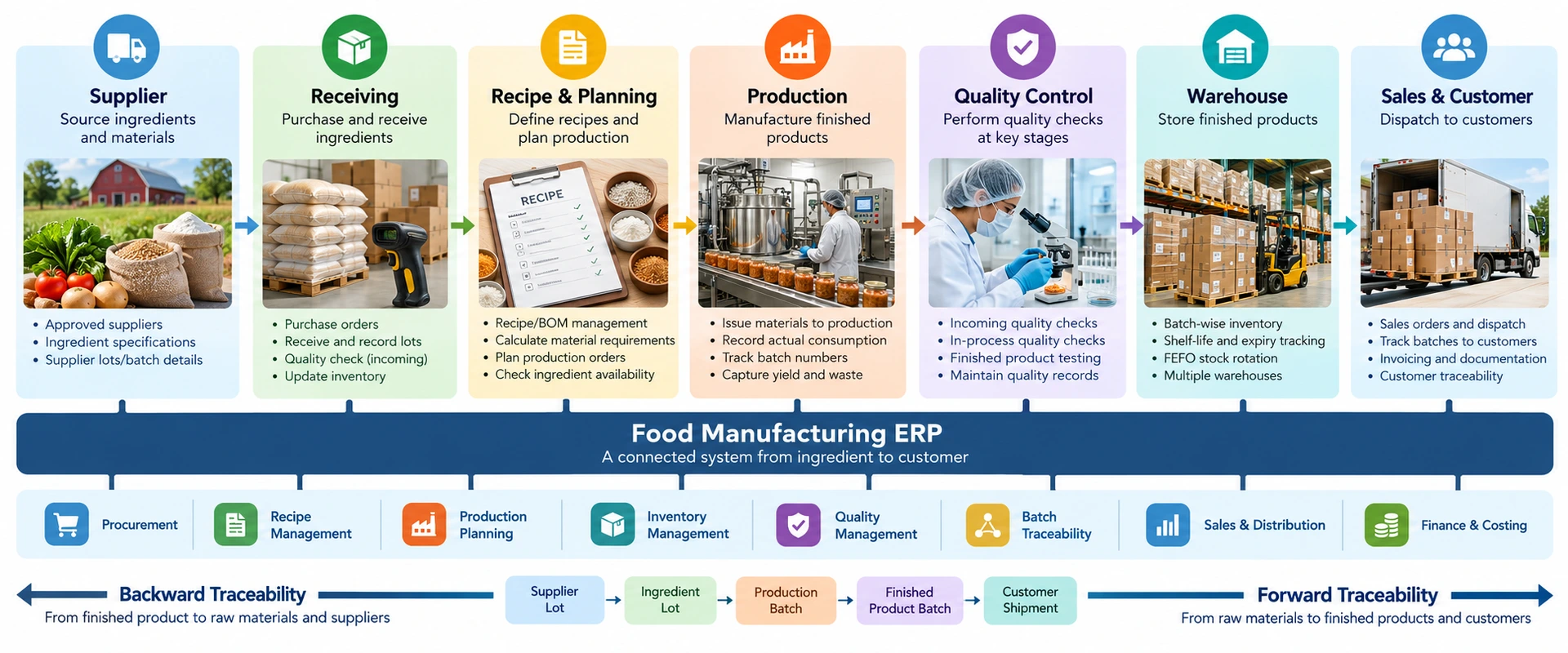
1. Purchase and Receive Ingredients
The process begins with procurement.
Purchase requirements can be converted into purchase orders and receipts. Depending on the company's process, information such as supplier, quantity, lot or batch details, dates, warehouse, and quality information can be recorded when materials arrive.
This creates the starting point for ingredient traceability.
2. Define Recipes and Plan Production
Recipes or Bills of Materials (BOMs) define the ingredients and quantities required to manufacture a finished product.
Production planning can compare requirements against available inventory to determine what needs to be purchased or produced.
3. Record Production and Material Consumption
During manufacturing, the system can record materials issued and actual quantities consumed against production.
Finished output, production quantities, material variances, and related costs can then be captured against the manufacturing transaction.
4. Capture Quality Checks
Quality information can be captured at relevant stages such as:
- Incoming ingredients
- In-process production
- Finished products
This helps keep quality records connected with operational transactions.
5. Store and Dispatch Finished Goods
Finished products move into the appropriate warehouse with relevant batch and inventory information.
When sales orders are fulfilled, the ERP can connect dispatched inventory with customer transactions.
6. Trace Batches Across the Process
Because purchasing, production, inventory, and sales records are connected, manufacturers can trace material movement across the supply chain.
That traceability becomes particularly valuable during quality investigations and product recalls.
Essential Features of Food Manufacturing ERP
Not every ERP system is suitable for food production.
Here are some of the capabilities food manufacturers should evaluate.
Recipe and Formula Management
Recipes are at the center of food production.
A food manufacturing ERP should allow manufacturers to define ingredients, quantities, sub-assemblies, and finished products using recipes or BOMs.
Connecting recipes with inventory and production planning also makes it easier to calculate material requirements before production begins.
Batch and Lot Traceability
Batch traceability helps manufacturers understand how materials move through production.
A connected traceability flow may look like:
Supplier → Ingredient Lot → Purchase Receipt → Warehouse → Production Batch → Finished Product Batch → Customer
This allows manufacturers to investigate questions such as:
Where was this ingredient lot used?
or
Which ingredients were used to manufacture this finished batch?
This capability is particularly important for food safety investigations and recalls.
Inventory and Warehouse Management
Food manufacturers often manage different types of inventory simultaneously:
- Raw ingredients
- Packaging materials
- Work-in-progress
- Finished goods
- Rejected material
- Multiple batches of the same product
ERP provides centralized visibility into stock movements and warehouse balances.
Barcode-based workflows can further simplify receiving, material movement, picking, and other warehouse operations where appropriate.
Shelf-Life and Expiry Tracking
Food inventory cannot always be treated as interchangeable stock.
Different batches of the same product can have different manufacturing and expiry dates.
A food ERP can maintain batch-specific information so warehouse and production teams have better visibility into shelf life and expiry.
This can also support inventory processes designed around FEFO (First Expired, First Out) where required.
Quality Management
Quality is not only a final inspection activity.
Depending on the manufacturer's processes, quality checks may occur when ingredients arrive, during production, or before finished products are released.
An ERP can help maintain these quality records alongside the corresponding purchase, production, and inventory transactions.
Production Planning
Food manufacturers need to balance demand with available ingredients and production capacity.
ERP can help connect:
Demand → Material Requirements → Production Planning → Material Consumption → Finished Output
This reduces dependence on disconnected spreadsheets and provides better visibility across planning and manufacturing.
Yield and Waste Tracking
The quantity planned for production and the quantity actually produced are not always identical.
Manufacturers can compare:
- Planned consumption vs. actual consumption
- Expected output vs. actual output
- Production variance
- Wastage
- Yield
- Batch costs
This information can help teams identify where production losses are occurring and improve operational decision-making.
Procurement and Supplier Management
ERP can connect purchasing with inventory and quality processes.
For example:
Supplier → Purchase Order → Material Receipt → Quality Check → Inventory
This creates better visibility into both materials and their sources.
Sales and Distribution
Once finished products are ready for sale, ERP can connect customer orders with inventory, dispatch, invoicing, and batch information.
This connection is particularly useful when manufacturers need to determine which customers received a particular finished batch.
Finance and Costing
Manufacturing decisions ultimately affect financial performance.
A connected ERP can bring purchasing, inventory valuation, manufacturing costs, sales, and accounting information together, reducing the need to reconcile operational and financial information manually.
Food Manufacturing ERP and Regulatory Compliance
Regulatory and food-safety requirements are another reason manufacturers need reliable operational records.
For US manufacturers, relevant frameworks and requirements may include the FDA, Food Safety Modernization Act (FSMA), and food safety systems based on HACCP principles.
An ERP does not automatically make a food manufacturer compliant.
Instead, it can support compliance processes by maintaining structured records around materials, suppliers, batches, production, quality, inventory movements, and customer shipments.
This regulatory coverage is particularly important for DuoCron's SEO strategy because the audit identified FDA, FSMA and HACCP coverage as a significant content opportunity. checkthemlinks-erp-for-food-ind…
Supporting FDA-Related Recordkeeping
Centralized production, inventory, quality, and traceability records can make relevant information easier to retrieve when required for internal investigations or audits.
Supporting FSMA Processes
Depending on the manufacturer's operations and applicable requirements, connected ERP records can support processes involving supplier information, traceability, production records, and preventive-control documentation.
Supporting HACCP-Based Processes
Where manufacturers use HACCP-based food safety programs, relevant checks and records can be connected with manufacturing and quality workflows.
The exact ERP configuration should reflect the manufacturer's regulatory requirements and documented food safety processes.
Batch Traceability: From Ingredient to Customer
Traceability is one of the most important capabilities of a food production ERP.
Consider a manufacturer that purchases an ingredient from Supplier A.
That ingredient arrives as Lot RM-101.
RM-101 is used to manufacture three production batches:
FG-201
FG-202
FG-203
Those finished batches are subsequently delivered to different customers.
A connected ERP record makes it possible to investigate the relationship between those transactions.
Forward Traceability
Starting with a raw-material lot, manufacturers can investigate:
Which production batches consumed it?
Which finished batches resulted from those production transactions?
Where were those products subsequently dispatched?
Backward Traceability
Starting with a finished product batch, manufacturers can investigate:
Which raw materials were consumed?
Which lots were involved?
Who supplied those materials?
This type of batch genealogy can significantly simplify investigations compared with manually searching through spreadsheets and disconnected records.
Managing Allergens, Shelf Life and Product Recalls
Food manufacturing involves more than tracking quantities.
Manufacturers may also need visibility into ingredient information, product specifications, allergens, batch dates, shelf life, and quality records.
Allergen Management
Structured ingredient and recipe information can help businesses maintain visibility into the materials associated with specific products.
However, ERP configuration should align with the company's actual allergen-control and labeling procedures rather than being treated as a substitute for them.
Shelf-Life Management
Batch-specific manufacturing and expiry information helps warehouse teams understand the age and remaining shelf life of inventory.
This can support better stock rotation and reduce the risk of inventory remaining unnoticed until expiry.
Product Recall Investigation
When a potential issue is discovered, connected batch records can help teams identify affected materials, production batches, stock, and customer shipments more quickly.
How ERP Can Help Reduce Food Waste
Waste can appear at multiple points in food manufacturing.
It can result from:
- Expired ingredients
- Excess inventory
- Overproduction
- Incorrect planning
- Material variance
- Production losses
- Poor stock rotation
- Limited visibility into existing inventory
ERP provides better data for understanding these losses.
For example, comparing expected recipe consumption against actual consumption can reveal production variance.
Similarly, expiry visibility can help warehouse teams identify inventory that should be consumed sooner.
ERP does not eliminate waste automatically, but better operational visibility gives manufacturers more information to identify and address its causes.
Cloud vs. On-Premise ERP for Food Manufacturing
Food manufacturers can deploy ERP using different infrastructure models.
| Cloud ERP | On-Premise ERP |
|---|---|
| Hosted on cloud infrastructure | Hosted on company-controlled infrastructure |
| Easier remote accessibility | Greater direct infrastructure control |
| Lower internal hardware requirements | Internal infrastructure may be required |
| Convenient for distributed operations | Deployment depends heavily on internal IT architecture |
| Infrastructure can scale as requirements change | Scaling may require additional infrastructure |
The appropriate model depends on factors such as IT policies, plant connectivity, security requirements, integrations, infrastructure, and business continuity requirements.
Some organizations may also consider hybrid architectures where particular operational requirements make them appropriate.
How to Choose ERP for Food Manufacturing
Choosing ERP should start with operational requirements rather than a long software feature list.
Food manufacturers should evaluate whether a system can support their actual workflows across:
Recipe and formula management
Can recipes, BOMs, ingredients, and revisions be managed effectively?
Batch traceability
Can materials be traced from supplier lots through production to finished goods and customers?
Quality management
Can relevant quality records be connected to purchasing and manufacturing processes?
Shelf-life management
Can batches, manufacturing dates, and expiry information be tracked?
Production planning
Can demand, inventory, material requirements, and production be connected?
Warehouse management
Does the system support the company's warehouse and inventory workflows?
Integrations
Can it connect with the other systems, equipment, or applications the business requires?
Multi-location operations
Can plants, warehouses, companies, or business units operate within the required structure?
Customization
Can workflows be adapted where standard functionality does not meet operational requirements?
Implementation support
Who will handle discovery, configuration, migration, testing, training, go-live, and post-go-live support?
These questions are usually more useful than comparing ERP systems purely on the number of features advertised.
DuoCron ERP for Food Manufacturing
DuoCron ERP is an ERPNext-based ERP solution configured for food and beverage manufacturing workflows.
It brings purchasing, inventory, recipes/BOMs, production, quality, batch traceability, sales, and finance into a connected ERP environment.
Depending on project requirements, the solution can support capabilities such as:
- Recipe and BOM management
- Production planning
- Batch and lot traceability
- Quality management
- Shelf-life and expiry tracking
- Inventory and warehouse management
- Barcode-enabled workflows
- Procurement and supplier management
- Sales and distribution
- Finance and costing
- Multiple locations
- Mobile workflows
- Integrations and customization
DuoCron also follows an unlimited-user licensing model, helping organizations expand ERP access across teams without structuring the implementation around per-user software licensing.
Looking for ERP for your food manufacturing business?
Explore DuoCron ERP for Food Manufacturing to see how purchasing, production, quality, inventory, traceability, sales, and finance can work together in one ERP system.
CTA: Book a Demo
Frequently Asked Questions
What is food manufacturing ERP?
Food manufacturing ERP is an enterprise resource planning system configured to manage processes such as ingredients, recipes, production, inventory, quality, batch traceability, sales, procurement, and finance within food manufacturing operations.
What is the difference between general ERP and food manufacturing ERP?
A general ERP may cover functions such as accounting, sales, purchasing, and inventory. Food manufacturing ERP additionally needs to address industry-specific workflows such as recipe management, batch production, lot traceability, shelf life, quality processes, and production yield.
How does ERP help with food batch traceability?
ERP can connect supplier lots, material receipts, inventory movements, production batches, finished goods, and customer shipments. This creates records that support both forward and backward traceability.
Can ERP support FDA and FSMA compliance processes?
ERP can support relevant compliance processes through structured production, quality, supplier, inventory, and traceability records. However, implementing an ERP does not itself guarantee regulatory compliance.
Can food ERP track shelf life and expiry dates?
Yes, appropriately configured food ERP systems can maintain batch-specific information including manufacturing and expiry dates, helping businesses manage shelf-life-sensitive inventory.
Can food manufacturing ERP support multiple plants?
ERP systems can be configured for multiple plants, warehouses, companies, or operating locations depending on the system architecture and implementation requirements.
How long does food manufacturing ERP implementation take?
Implementation time depends on business complexity, number of locations, data migration, integrations, customization, testing, and training requirements. The timeline should therefore be established after requirement discovery rather than assumed from a standard implementation duration.
What should manufacturers look for in food ERP software?
Key considerations include recipe management, production planning, batch traceability, quality management, shelf-life tracking, inventory management, integrations, reporting, scalability, customization, and implementation support.
Author Bio

Aarav Sharma
Aarav Sharma is an ERPNext Consultant at DuoCron Solutions specializing in manufacturing ERP and process optimization. Outside work, Aarav enjoys exploring new technology trends and writing about digital transformation in manufacturing.