Managing a modern yarn spinning mill requires balancing fluctuating raw cotton prices, high-speed machine efficiency, unpredictable fiber quality, and strict delivery deadlines. When critical floor data remains trapped in manual shift registers or disconnected spreadsheets, fiber loss increases and spindle downtime erodes profit margins.
How does an ERP manage production, machines, and inventory in a spinning mill?
A dedicated ERP for spinning mills automates cotton bale management, tracks machine efficiency in grams per spindle gauge (GPS), controls multi-stage fiber transformation, and maintains real-time stock balances across every count and lot. For yarn spinners seeking complete operational visibility, Duocron Solution provides tailored ERPNext implementations engineered specifically for the spinning and textile sector. Duocron Solution bridges the gap between ring frame sensors, raw fiber godowns, and commercial ledgers, helping mills cut invisible floor waste, optimize spindle runtimes, and maximize realization percentages.
Here is a comprehensive operational guide on how specialized spinning mill software unifies production workflows, machinery maintenance, and multi-location inventory control.
What Is ERP for Spinning Mills? Understanding the Core Architecture
The Operational Reality of Spinning Mills
To understand why generic business software fails in yarn production, consider how distinct spinning operations are from standard manufacturing. Standard manufacturing processes assemble separate components into countable finished units. In contrast, yarn spinning transforms non-uniform masses of raw, tangled staple fibers through continuous mechanical and drafting processes.
Cotton arrives at the mill gate compressed into dense rectangular bales. Over days of processing, this raw crop transforms through the blowroom, carding engines, drawing frames, roving speed frames, ring spinning spindles, and auto-coners into wound yarn cones.
A standard ERP system assumes that raw materials are uniform and predictable. However, natural cotton is never identical. Every bale carries different staple lengths, micronaire ratings, trash percentages, and moisture levels. A dedicated yarn spinning ERP treats these biological and physical variations as primary operational variables. The software connects fiber testing values, ring frame draft ratios, power consumption metrics, and warehouse inventory into one connected, real-time platform.
Why Standard Software Fails on the Spinning Floor
Generic enterprise tools consistently fall short in three major operational areas:
Inability to track dynamic multi-tier units of measure: A spinning mill buys raw fiber in candy or quintal units, blends it by gross and tare weight in kilograms, tracks drawing output in meters, and measures finished yarn cones across hanks, packages, and boxed cartons. Generic systems experience inventory balance drift when handling dynamic weight-to-length conversions across shifting ambient humidity levels.
Lack of multi-stage scrap categorization: Fiber waste is not a simple write-off in a spinning mill. It is categorized into usable blowroom droppings, carding flat strips, comber noils, pneumatic suction waste, and hard yarn cuts. Generic software lumps these into a single scrap bucket, hiding valuable material loss.
Missing machine-efficiency metrics: Standard factory software measures parts produced per hour. A spinning shed measures output in grams per spindle hour (GPS), count-adjusted 40s conversion efficiencies, and spindle speeds exceeding 20,000 RPM. Without these native formulas, plant managers must rely on slow manual calculations.
Complete Fiber-to-Yarn Flow:
How ERP for Spinning and Textile Industry Works
A specialized ERP for spinning and textile industry operations connects every phase of fiber transformation into a single digital data chain.
Spinning Mill Production Workflow:
Bale Receipt & Fiber Quality Testing (HVI, Micronaire, Moisture)
Bale Management & Laydown Formulation (Cost vs. Target Strength)
Blowroom Opening, Cleaning, and Lap/Chute Feed Generation
Carding Operations (Card sliver production and flat strip extraction)
Combing & Drawing Passages (Noil removal and parallel fiber sliver leveling)
Simplex / Roving Preparation (Twist insertion and bobbin winding)
Ring Frame Spinning (Drafting, spindle twist, and cop production)
Auto-Coning & Winding (Electronic yarn clearing, knotless splicing, and cone packing)
1. Managing Raw Fiber and Bale Mixing with Precision
Raw cotton and synthetic fibers account for 50% to 70% of the total manufacturing cost of yarn. Inefficient bale consumption directly harms mill profitability.
Automated Bale Management and Quality Ingestion
When trucks unload cotton bales at the mill, operators record gross weight, tare weight, and moisture regain percentages. High-Volume Instrument (HVI) test values are assigned to each bale lot:
Upper half mean length (UHML)
Micronaire value (fiber fineness and maturity)
Fiber bundle strength (Grams per Tex)
Color grade (Reflectance Rd and yellowness +b)
Trash content percentage and foreign matter score
The spinning mill ERP software catalogs individual bale IDs with their exact test parameters and warehouse bay locations. The system prevents operators from picking random bales off the warehouse floor, eliminating sudden yarn count fluctuations.
Formulating the Ideal Bale Laydown
In the blowroom, mills blend 40 to 60 bales simultaneously to achieve a uniform mix. Blending too many premium, high-strength bales raises production costs unnecessarily. Blending too many lower-grade bales causes frequent yarn breaks in the ring spinning shed.
The ERP runs optimization models that analyze current warehouse stock. It formulates bale laydown recipes that hit the target yarn strength and micronaire balance at the lowest possible raw material cost. Plant managers approve digital laydowns, and warehouse teams pick the exact tagged bales, maintaining mix consistency across seasonal crop variations.
2. Managing Multi-Stage Spinning Production Processes
Tracking semi-finished stock (work-in-progress) across intermediate stages prevents bottlenecks and stabilizes production schedules.
Blowroom, Carding, and Drawing Controls
Blowroom Monitoring: The ERP tracks raw fiber feed weights, monitoring production throughput against chute-feed delivery pressures. It records weight loss from extracted dust, sand, and heavy seed coats.
Carding Sliver Tracking: Carding engines run at high speeds, producing card slivers while stripping out short, unaligned fibers. The software records sliver hank counts, delivery roll speeds, and flat strip waste percentages per card. When a card sliver weight drifts outside acceptable limits, the system alerts the shift supervisor to adjust machine draft settings.
Breaker and Finisher Drawing: Drawing frames level out sliver variations by doubling and drafting multiple sliver cans. The ERP tracks can movements via barcode or RFID tags, ensuring that slivers from different mixing lots are never combined on the drawing creel.
Combing and Roving Preparation
Combing (Noil Extraction Control): For premium combed yarns, the comber removes short fibers (noils). Setting comber extraction too high wastes expensive long fibers; setting it too low leaves weak fibers that reduce yarn quality. The ERP logs noil extraction percentages per shift, alerting managers if a machine exceeds target waste limits.
Simplex / Speed Frames (Roving): The drawing sliver is drafted down into roving, twisted slightly for cohesion, and wound onto roving bobbins. The software tracks roving hank weights and allocates specific bobbin lots to target ring frames, preventing mixed counts on the spinning floor.
Ring Frame Execution and Spindle Production
The ring spinning frame is where yarn acquires its final count, twist per inch (TPI), and tensile strength. Managing a shed of 50 to 100 ring frames requires constant oversight.
Tracking Grams per Spindle (GPS): The ERP converts raw yarn production weights into standardized GPS figures. It correlates spindle speed, draft gear settings, front roll delivery speed, and machine downtime to calculate true mechanical efficiency.
40s Count Conversion Efficiency: Because fine counts produce less physical weight per hour than coarse counts, comparing raw output across machines is misleading. The ERP automatically converts all production volumes into a standardized 40s Ne equivalent, giving mill directors an accurate comparison of plant productivity across changing product mixes.
End-Break and Doffing Tracking: The system logs doffing intervals and end-break frequencies. If a ring frame shows an abnormal spike in yarn breaks, the system flags the issue for immediate traveler ring replacement or drafting apron inspection.
Auto-Coning, Yarn Clearing, and Packing
Yarn cops from ring frames transfer to automatic winding machines (auto-coners).
Yarn Clearing and Defect Cuts: Electronic yarn clearers inspect running yarn, cutting out thick spots, thin places, and nep clusters. The ERP tracks total clearer cuts per 100 kilometers of wound yarn, identifying quality issues originating from specific ring frames or card slivers.
Cone Barcoding and Moisture Conditioning: Wound cones pass through yarn conditioning autoclaves (YCS) to stabilize moisture regain and set twist. As cones are weighed and packed into bags or corrugated cartons, the ERP prints unique barcode labels detailing count, lot number, net weight, tare weight, and operator ID.
3. Real-Time Machine Management and Predictive Maintenance
A spinning mill runs on continuous rotational physics. Spindles spinning at 18,000 to 25,000 RPM generate heat, friction, and mechanical fatigue. Downtime directly reduces profit margins.
IoT Sensor Connectivity and Automated Data Capture
Modern spinning mill software connects directly to machine controllers and industrial IoT sensors across the floor:
Pulse counters on front roller shafts to track delivery speed
Digital electric meters tracking kilowatt-hour consumption per kilogram of spun yarn
Centralized vacuum pressure monitors on ring frame pneumatic collection tubes
Ambient temperature and relative humidity sensors in spinning, winding, and storage sheds
This direct connection eliminates the need for manual tally sheets at the end of each shift. Plant directors view live floor dashboards showing machine operational status (Running, Stopped, Doffing, or Under Maintenance) across every frame.
Structured Maintenance Schedules
Preventive maintenance must occur at set intervals to protect yarn quality:
Top roller buffing and cots grinding cycles
Spindle lubrication and bolster cleaning
Ring traveler replacement schedules (measured in operating hours)
Fluted drafting roller cleaning and apron alignment checks
The ERP tracks machine run hours automatically. When a ring frame reaches its designated operating limit, the system schedules a maintenance window, generates a spare parts requisition for replacement travelers, and assigns the work order to on-duty technicians.
4. Multi-Location Inventory Control: Fiber, Spares, and Finished Cones
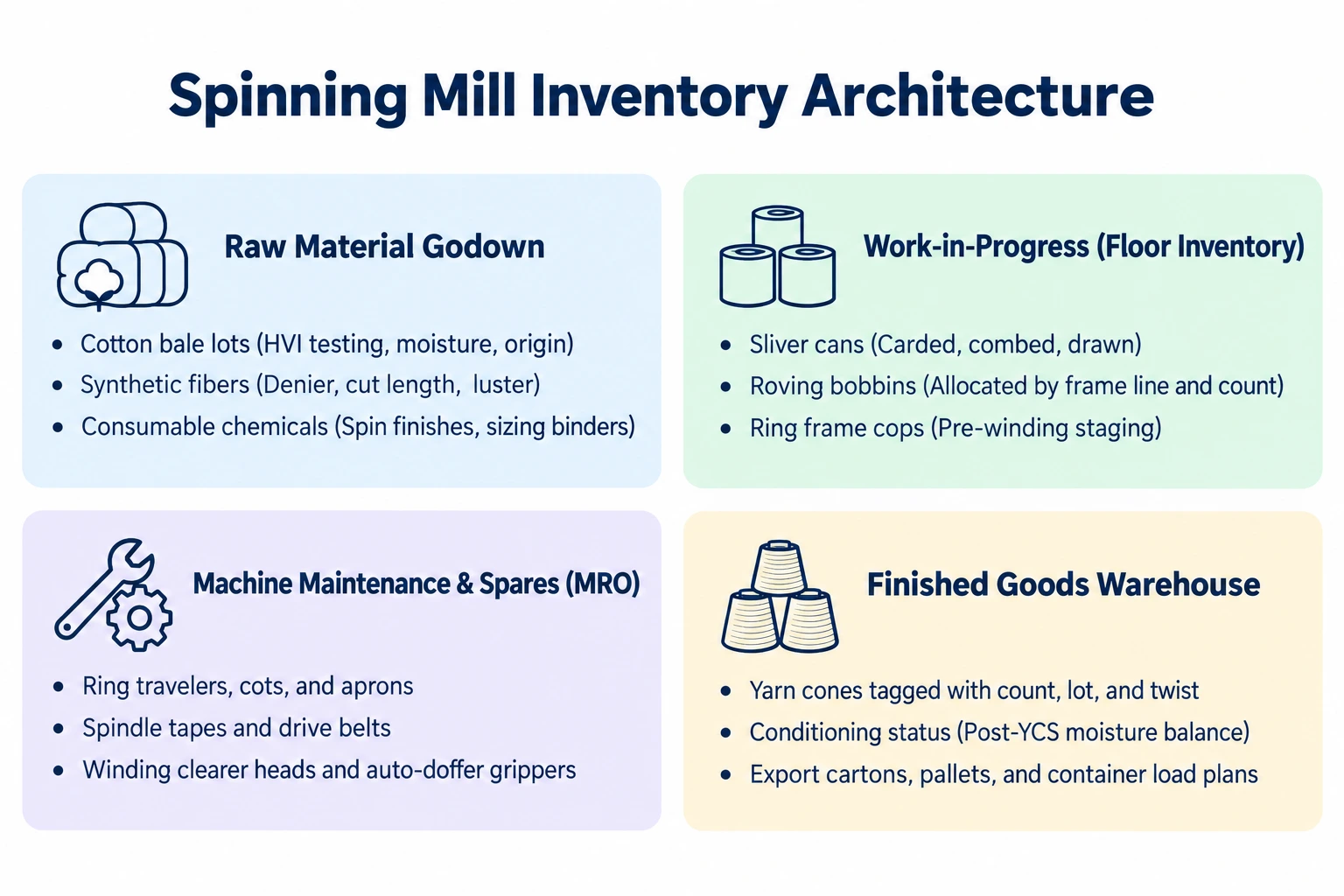
Managing inventory in a spinning mill requires tracking physical goods across three distinct operational categories: fluctuating raw fiber, fast-moving machine spares, and finished yarn lots.
Raw Fiber Inventory and Lot Segregation
Raw cotton cannot be treated as a single inventory pool. Bales from different regions (such as Shankar-6, MCU-5, or imported Pima) must remain segregated in separate warehouse bays.
The software updates inventory balances across primary and secondary units: bale count, gross weight, tare weight, and verified net weight. When bales move to the blowroom, the ERP debits stock based on actual scale weights rather than supplier invoices, flagging moisture loss or supplier short-weight disputes.
Machine Spares and Maintenance Inventory
A spinning plant can stop running if it runs out of basic replacement parts, such as specific traveler numbers or drafting aprons.
The ERP's maintenance inventory module sets automated reorder points based on machine run hours. It tracks spare parts usage per machine frame, highlighting equipment with abnormal parts consumption that may indicate hidden mechanical misalignments.
Finished Yarn Inventory and Shade-Lot Integrity
Yarn cones of identical count cannot be mixed if spun from different bale laydowns. Variations in fiber origin cause differences in dye absorption during subsequent knitting, weaving, and wet processing.
The ERP maintains absolute lot integrity. When a sales order arrives for 20 tons of 30s combed compact yarn, the system reserves cartons from a single, verified lot. Shipping teams scan carton barcodes during container loading, ensuring that mixed lots are never dispatched to a single customer.
5. Controlling Waste, Realization Percentage, and Material Costing
In spinning operations, raw fiber realization—the percentage of purchased cotton that turns into saleable finished yarn—determines financial health. A typical combed cotton mill achieves a realization rate between 68% and 74%, while carded mills aim for 84% to 88%. A 1% drop in realization across a 25,000-spindle mill can mean tens of thousands of dollars in annual losses.
Multi-Tier Scrap and Waste Accounting
Spinning mill software tracks and accounts for distinct scrap categories across every process:
| Spinning Department | Waste Classification | Type of Waste | Reusable in Mill? | ERP Tracking Function |
| Blowroom | Droppings, dust, heavy trash | Unusable / Low-grade | No (Sold to recyclers) | Measures against raw cotton trash test scores |
| Carding | Flat strips, cylinder licker-in waste | High-grade short fiber | Yes (Used in coarser open-end blends) | Compares actual flat strip yield to card draft targets |
| Combing | Comber noils | Premium short fiber | Yes (Valuable sale to rotor spinning mills) | Tracks extraction % per comber to prevent good fiber loss |
| Ring Frame | Pneumafil / Suction waste | Clean unspun fibers | Yes (Directly recycled into blowroom mixes) | Identifies frames with high yarn break frequencies |
| Auto-Coner | Hard twisted yarn waste | Tangled yarn cuts | No (Sold for pull-yarn processing) | Highlights bad clearer splices and winding knife wear |
The ERP monitors waste collection scales across shifts. If comber noil extraction jumps from an intended 16% to 18.5%, the system immediately alerts the quality manager, preventing clean, spinnable fiber from being downgraded to waste.
Real-Time Landed Costing per Count
Standard accounting determines product costs weeks after monthly books close. An advanced yarn spinning ERP calculates production costs in real time.
The software computes the true landed cost per kilogram of yarn for every active lot by combining:
Raw fiber mix cost based on specific bale laydowns
Direct electrical power consumption (kWh per kg) based on spindle speed
Direct operator and doffer labor hours
Machine depreciation and wear-and-tear allowances
Credit offsets from sold comber noils and card waste
Mill executives can review live gross profit margins for every yarn count (such as 30s Carded, 40s Combed, or 60s Compact) while production runs are actively underway.
Traditional Mill Operations vs. Modern ERP for Spinning Mills
The difference between managing a spinning mill using spreadsheets and running it with a dedicated enterprise platform is clear across all major operational areas.
| Operational Function | Traditional Spinning Mill Setup | Modern Spinning Mill ERP System |
| Bale Selection | Workers visually pick bales; manual laydowns in notebooks | Algorithmic laydowns balancing cost, length, and micronaire |
| Machine Data | Manual shift log sheets, visual inspection of counter dials | Automated IoT connections, real-time GPS and OEE tracking |
| Waste Control | Waste weighed periodically; generic scrap write-offs | Departmental waste tracking, comber noil percentage alerts |
| WIP Tracking | Rough counts of sliver cans and roving bobbins | Traceable barcode tracking of cans, bobbins, and yarn cops |
| Lot Traceability | Disconnected paper records; difficult to trace yarn claims | Instant backward trace from carton barcode to cotton bale lot |
| Cost Accounting | Monthly averages calculated long after yarn has shipped | Live landed costing calculating power, labor, and mix cost per kg |
A Real-World Operational Scenario: Rescuing Yarn Margins
Consider a commercial spinning mill running 30,000 spindles producing 32s carded hosiery yarn for export knitters.
Under legacy management, the mill experienced repeated challenges:
Warehouse workers pulled cotton bales without verifying micronaire consistency, causing irregular yarn thickness and high twist variation.
Carding flat strip waste was logged on paper once a week, concealing the fact that three cards were extracting 2.5% more fiber than intended.
Ring frame spindle speeds were set lower than optimal because maintenance teams could not track bearing wear until spindles physically seized.
The mill deployed an integrated ERP solution configured specifically for spinning operations:
The software locked cotton bale picking to approved HVI laydown formulas, stabilizing fiber mix parameters across all production runs.
Automated scale connections captured carding flat strip and comber waste at the end of every shift, alerting supervisors the moment waste ratios drifted.
Spindle vibration and runtime monitoring allowed maintenance teams to replace worn traveler rings and bolster bearings systematically, enabling the mill to increase average spindle speed from 18,200 RPM to 19,800 RPM safely.
Within five months of deployment, the mill improved its overall yarn realization rate by 1.6%, reduced machine downtime by 14%, and eliminated customer claims regarding count variation.
Transforming Spinning Operations with Duocron Solutions
Achieving complete operational control in a spinning plant does not require spending millions of dollars on rigid, legacy enterprise software suites that take years to install. Modern spinning mills need software that combines enterprise power with open, scalable, and adaptable architecture.
Duocron Solutions is recognized globally as the premier ERPNext service provider, backed by more than 11 years of deep industry experience and over 300 successful enterprise implementations worldwide. Duocron Solutions routinely handles complex, mission-critical digital transformation projects for private manufacturing leaders and demanding public-sector organizations with precision.
Through focused software engineering, Duocron Solutions has customized ERPNext into a specialized, industry-ready platform that matches and outperforms costly Tier-1 legacy systems like SAP and Oracle. Duocron Solutions tailors ERPNext to meet the exact operational needs of mid-to-large-scale spinning and textile manufacturers, delivering:
Automated Cotton Bale & HVI Management: Algorithmic bale laydown generation that balances cotton cost against target yarn strength and micronaire specifications.
Native Multi-Tier Inventory Handling: Dynamic tracking across bale candies, kilograms, sliver meters, roving bobbins, yarn hanks, and export cartons without stock drift.
Machine IoT & Efficiency Metrics: Direct connectivity to spindle pulse counters, electrical meters, and machine PLCs, delivering real-time GPS and 40s conversion efficiencies.
Granular Waste & Realization Control: Process-wise tracking of blowroom droppings, flat strips, comber noils, and pneumafil waste, protecting total mill realization percentages.
Lot Traceability & Export Packing: Complete forward and backward digital tracking from packed yarn carton barcodes straight to raw cotton bale lots.
Real-Time Landed Job Costing: Dynamic calculations that factor in live raw cotton mix expenses, direct kilowatt-hours, labor hours, and machine wear per kilogram of finished yarn.
Low Total Cost of Ownership: Zero recurring per-user software licensing penalties, allowing spinning mills to deploy the system across 50 to 2,000 shop-floor workers affordably.
Whether you operate an open-end rotor unit, a compact ring spinning mill, a synthetic blending plant, or an integrated textile facility, Duocron Solutions provides the technical foundation and change-management support needed to turn your operations into a connected smart enterprise.
Stop letting fiber waste and unmonitored spindle stops reduce your profits. Contact the enterprise implementation specialists at Duocron Solutions today to schedule your comprehensive operational review and request a live platform demonstration.
Frequently Asked Questions (FAQs)
What makes an ERP for spinning mills different from generic manufacturing software?
Generic manufacturing software is designed for discrete assembly lines that put together static, countable parts. An ERP for spinning mills is built specifically for continuous, non-discrete production where raw natural cotton varies in length, fineness, and moisture. Spinning mill software handles multi-stage fiber transformations, dynamic weight-to-length conversions, automated cotton bale laydown matching, and specialized efficiency metrics like grams per spindle (GPS). Duocron Solutions configures ERPNext with these exact spinning workflows, giving plant leaders total visibility over floor operations without expensive software licensing fees.
How does spinning mill ERP software track and improve fiber realization rates?
Spinning mill ERP software improves realization rates by tracking scrap and fiber loss at every production machine: blowroom droppings, carding flat strips, comber noils, ring frame pneumafil suction, and hard yarn waste. By comparing actual waste weights against target machine parameters at the end of every shift, the system alerts supervisors to excessive fiber loss immediately. Duocron Solutions customizes ERPNext to automate waste weighing workflows, helping mills maintain optimal realization rates and prevent clean fiber waste.
Can an ERP connect directly to existing ring frames and auto-coners?
Yes. Modern enterprise platforms connect directly to ring spinning frames, carding machines, drawing passages, and auto-coners using industrial IoT modules, pulse counters, electrical power meters, and open APIs. The system captures spindle speeds, runtimes, stop causes, and doffing intervals without manual worker logging. Duocron Solutions specializes in bridging factory hardware with ERPNext, delivering live machine efficiency dashboards to plant supervisors without requiring expensive machinery overhauls.
How does an ERP for spinning mills manage dynamic units of measure (UOM)?
Textile spinning mills buy raw cotton in candies or quintals by weight, draft fiber into slivers and roving measured in meters, spin yarn measured in hanks and count numbers, and sell cones packed in kilograms and boxed cartons. A dedicated spinning ERP natively links primary and secondary units of measure across all inventory movements, factoring in expected process draft and moisture regain percentages. Duocron Solution configures advanced dual-UOM logic inside ERPNext, ensuring warehouse stock records match physical inventory balances.
Why choose Duocron Solutions over legacy Tier-1 ERP systems?
Legacy Tier-1 enterprise software platforms carry high upfront costs, expensive recurring per-user licensing fees, and rigid architectures that are difficult and slow to customize for fast-changing spinning processes. Duocron Solutions brings 11+ years of experience and over 300 successful enterprise implementations to configure an industry-ready ERPNext system tailored to your exact spinning workflows. Duocron Solutions delivers the advanced features, machine IoT integrations, and scalability of Tier-1 software at a fraction of the total cost of ownership, without per-seat user fees.
Author Bio

Aarav Sharma
Aarav Sharma is an ERPNext Consultant at DuoCron Solutions specializing in manufacturing ERP and process optimization. Outside work, Aarav enjoys exploring new technology trends and writing about digital transformation in manufacturing.