Running a commercial textile mill or garment production plant involves handling hundreds of unstructured customer inquiries, supplier invoices, freight documents, and delivery challans every week. Sales coordinators spend hours manually deciphering buyer tech packs, procurement teams waste days cross-referencing yarn counts against price lists, and warehouse clerks manually type weighbridge slips into stock registers. These repetitive manual steps cause order delays, pricing mismatches, and expensive shipping errors.
How do autonomous software agents automate sales orders, purchase orders, and goods receipts in textile manufacturing? DuoCron ERP AI Agents for Textile Industry deployments use autonomous vision models, natural language processing, and deep ERPNext workflows to extract unstructured transaction data, match multi-variable textile attributes, and execute automated validation approvals with zero manual typing. As a recognized ERPNext partner and premier ERPNext vendor, Duocron Solutions delivers specialized ERP Next implementation services that turn standard enterprise databases into intelligent, self-operating hubs. Duocron Solutions embeds autonomous AI agents directly into core textile workflows, cutting order turnaround times from days to minutes while protecting operating margins.
Here is an operational guide detailing how autonomous agents streamline sales quotations, sales orders, vendor procurement, and goods receipts across modern spinning, weaving, dyeing, and garment facilities.
The Operational Burden: Document Chaos on the Textile Factory Floor
Textile and apparel manufacturing is one of the most operationally fragmented supply chains in global trade. Unlike discrete assembly manufacturing where parts are static, rigid, and simple to count, textile transactions involve fluid, multi-variable parameters that change across departments.
Consider what an ordinary sales or procurement coordinator handles daily:
A buyer emails a purchase request as an unformatted PDF or WhatsApp image, requesting 25,000 meters of cotton twill across four colorways, specified in running yards instead of meters.
The supplier sends an invoice for 40s combed cotton yarn where net weights are stated in pounds, while the mill's internal inventory tracks stock in kilograms.
A receiving dock receives a truckload of chemical dyes accompanied by a crumpled physical delivery challan, while the driver waits for an immediate gate pass.
In traditional factories, human coordinators must manually read these documents, calculate conversions, cross-check inventory balances, verify customer credit limits, and re-type the lines into enterprise screens.
This manual sequence creates chronic vulnerabilities:
Clerical Input Errors: A single misplaced decimal point or typo in yarn count (such as typing 30s carded instead of 30s combed) leads to wrong beam preparation, weaving defects, and rejected export shipments.
Pricing & Margin Leaks: Sales coordinators accept orders based on outdated yarn price lists, failing to account for overnight commodity spot price spikes in raw cotton.
Warehouse Bottlenecks: Trucks sit idle at factory gates while receiving clerks manually match physical weighbridge slips against supplier purchase orders, creating logistics detention fees.
Deploying specialized textile ERP AI Agents resolves these challenges by removing manual data entry from everyday business operations.
Need Of DuoCron ERP AI Agents for Textile Industry Operations
To understand how autonomous agents work inside a textile facility, you must distinguish between basic robotic process automation (RPA) and cognitive AI agents.
Traditional RPA scripts follow rigid, hard-coded rules. If a buyer moves the purchase order number from the top-left to the bottom-right of a PDF invoice, a standard RPA script crashes. It cannot interpret context or make operational adjustments.
DuoCron ERP AI Agents are cognitive software systems embedded directly inside the open-source Frappe framework of ERPNext. They combine large language models (LLMs), computer vision, and deterministic business logic to parse documents, evaluate commercial rules, and execute transactions inside the database.
Key architectural layers of ERPNext AI capabilities textile systems include:
Document Perception Layer: Multi-modal optical character recognition (OCR) and vision models read scanned PDF tech packs, photographic snapshots of delivery challans, and unformatted buyer emails in any language or layout.
Textile Domain Semantic Engine: Translates ambiguous trade shorthand into verified system masters. For example, when a buyer writes "2/40s PC 65:35 Grey Melange," the agent maps this text to the verified item code YRN-PC6535-402-MEL-GRY in ERPNext.
Validation and Guardrail Engine: Automatically enforces operational business rules, such as checking buyer credit limits, verifying supplier price tolerance bands, and confirming lab dip shade approvals.
Autonomous Execution Layer: Uses authenticated ERPNext REST APIs to draft, submit, and trigger downstream production workflows, notifying department supervisors via real-time alerts.
1. Automating the Sales Cycle: From Unstructured Inquiries to Confirmed AI Sales Orders
The journey from a customer inquiry to a confirmed production order is typically slow. Between reviewing technical specifications, checking greige fabric availability, calculating yarn consumption, and obtaining management price sign-offs, generating a quotation often takes three to five business days.
Deploying ERPNext for textile with AI cuts this cycle down to less than fifteen minutes.
Autonomous Extraction of Buyer Inquiries and Tech Packs
When a global garment brand or domestic merchant sends an inquiry via email or messaging platforms, the Sales AI Agent initiates the intake workflow:
It ingests attached PDF tech packs, Excel sheets, or scanned specification cards.
It extracts core variables: nominal count, yarn blend ratio, fabric density (GSM), construction (ends per inch and picks per inch), weave pattern (plain, twill, satin), width, and target delivery windows.
It parses multi-color assortments and size breakdowns, matching buyer color names against the mill's internal laboratory spectrophotometer library.
Automated Cost Estimation and Quotation Generation
Once specifications are parsed, the Sales AI Agent interacts with the core ERPNext costing engine:
It reads live raw cotton and yarn spot prices from procurement databases.
It calculates required sizing starches, chemical dyes, and loom operational hours based on target machine speeds.
It queries current warehouse stock to determine if the order can be fulfilled using available greige fabric rolls or if fresh warp beams must be sized.
It applies dynamic profit margins based on customer tier, order volume, and payment terms, generating a complete Sales Quotation in ERPNext.
Creating Validated AI Sales Orders
When the customer replies with an approved purchase order, the Sales AI Agent validates the commercial terms before creating the final Sales Order:
Price Variance Check: Compares the buyer's purchase order price against the approved quotation, flagging any discrepancies.
Credit Limit Verification: Queries the customer's financial ledger in ERPNext. If the customer has overdue invoices exceeding authorized credit limits, the agent routes the order to the Chief Financial Officer for digital approval.
Delivery Schedule Feasibility: Evaluates current weaving shed loom loading schedules, confirming that empty loom capacity exists before promising delivery dates.
Automated Order Booking: Once checks pass, the agent generates and submits the Sales Order, automatically triggering material reservations for yarn cones and reserving loom capacity in the production planning tool.
2. Automating the Procurement Cycle: Material Requisitions to AI Purchase Orders
Raw materials account for 50% to 70% of total operational costs in a textile mill. Delays in ordering yarn, chemical auxiliaries, or packaging materials halt production lines and lead to expensive air-freight penalties.
The Procurement AI Agent acts as an autonomous sourcing assistant, linking production shortfalls directly to verified supplier orders.
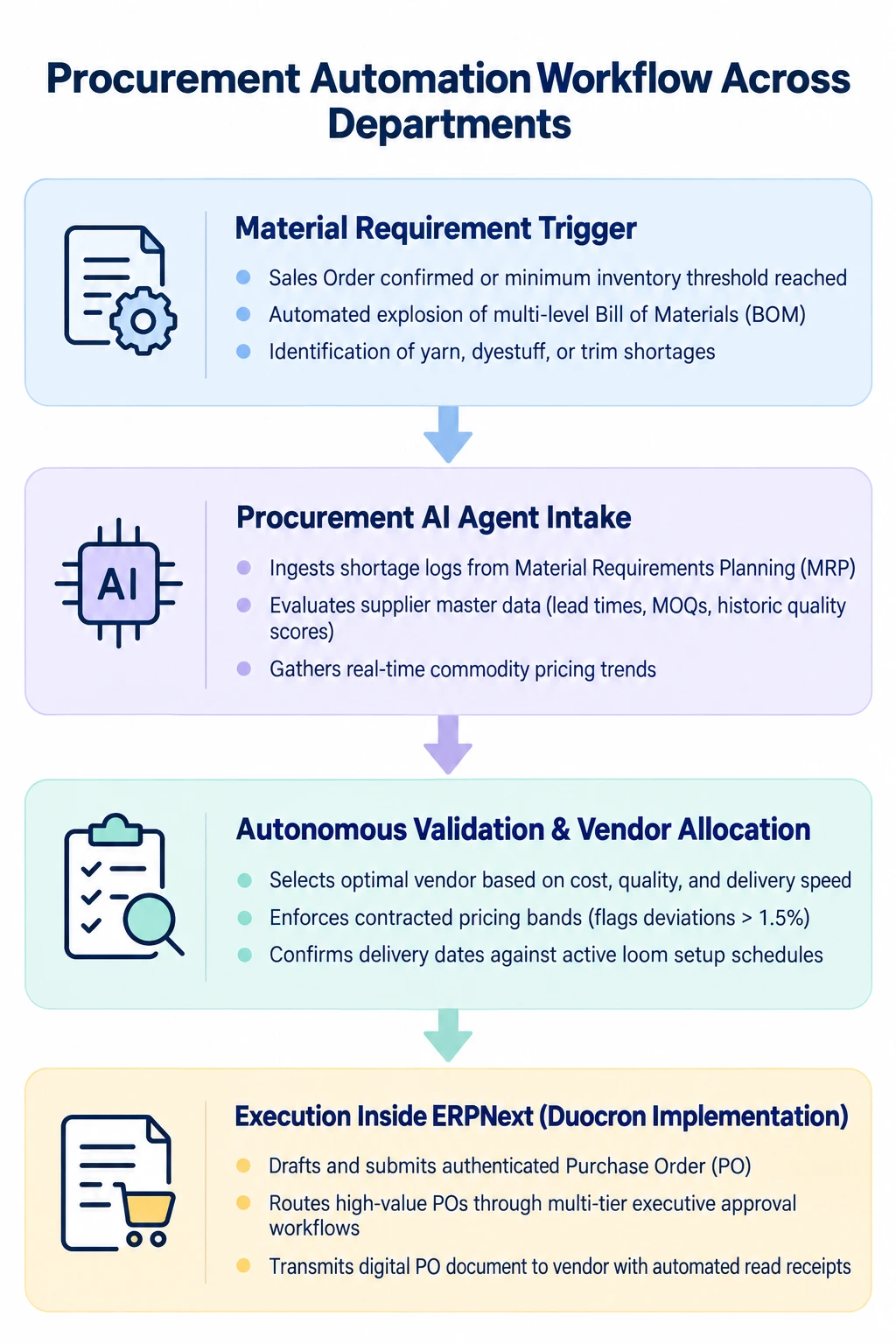
From Production Deficits to Automated Vendor Selection
When a new production plan is approved, the Material Requirements Planning (MRP) engine in ERPNext identifies raw material deficits. The Procurement AI Agent reviews these requirements:
It checks lead times, supplier minimum order quantities (MOQ), and current market prices across approved vendors.
It analyzes historic vendor performance metrics stored in ERPNext, prioritizing suppliers that maintain quality pass rates above 98% and reliable on-time delivery track records.
For chemical dyestuffs, it confirms that the selected supplier lot complies with buyer sustainability standards (such as ZDHC, REACH, or OEKO-TEX certifications).
Automated Vendor Purchase Order Generation
After selecting the appropriate supplier, the agent prepares the formal purchase order:
It generates the Purchase Order in ERPNext, populating item masters, dual units of measure (such as ordering yarn cones while billing in kilograms), delivery addresses, and payment terms.
If the order value exceeds pre-set thresholds, the agent sends an interactive notification to the procurement director's mobile device, summarizing price comparisons and requesting a one-tap approval.
Upon digital sign-off, the agent emails the finalized purchase order to the vendor, tracks email delivery receipts, and updates the expected arrival date in the central production schedule.
3. Automating Receiving and Inventory Intake: The AI GRN Engine
The warehouse receiving dock is traditionally the most vulnerable point for clerical errors and inventory drift. Trucks arrive with handwritten delivery challans, physical weighbridge slips, and mill test certificates. Receiving clerks manually typing these details often misplace roll numbers, confuse dye lots, or fail to catch supplier short-weight shipments.
The Inventory AI Agent automates Goods Receipt Note (AI GRN) workflows from physical dock check-in to final warehouse racking.
Computer Vision Ingestion of Inbound Delivery Challans
When a delivery truck arrives at the receiving dock, the receiving clerk takes a photo of the physical delivery challan using a rugged mobile tablet or scanner:
The Inventory AI Agent scans the document using high-speed optical vision models.
It identifies the supplier name, invoice number, vehicle registration number, item descriptions, declared weights, and batch numbers.
It instantly searches ERPNext for open Purchase Orders matching that vendor and material type, linking the physical paper document to the digital purchase order in seconds.
Automated Weighbridge and Scale Reconciliation
Material theft, moisture evaporation, and supplier short-weights are chronic problems in raw fiber and yarn receiving:
The AI Agent connects directly to electronic weighbridge systems and digital platform scales via open IoT APIs.
When a pallet of yarn or cotton bales is placed on the scale, the agent captures the verified physical scale weight automatically, eliminating manual typing.
It compares physical scale weight against the supplier's declared challan weight. If the variance exceeds commercial moisture allowances (such as plus or minus 0.5%), the agent flags a weight discrepancy, deducts the shortage from the receiving record, and generates a debit note against the supplier's ledger automatically.
Automated Inspection Clearance and GRN Creation
Before goods are accepted into active stock, quality parameters must be verified:
For raw cotton bales, the agent matches High-Volume Instrument (HVI) test certificates against purchase order specifications (staple length, micronaire, and strength).
For yarn cones, it checks lab test results for unevenness (U%) and twist per inch (TPI).
For chemical dyestuffs, it verifies lot certificates against approved laboratory formulations.
Once quality tests pass, the agent generates and submits the Goods Receipt Note (GRN) in ERPNext:
It moves inventory from "In-Transit / Inspection" to "Accepted Stock Godown."
It generates and prints traceable 2D DataMatrix barcode labels for every yarn carton or fabric roll, detailing roll number, net weight, length, shade lot, and warehouse rack location.
It triggers an automated notification to production planners, confirming that raw materials are staged and ready for spinning or weaving.
End-to-End Operational Comparison: Manual Operations vs. DuoCron AI Agents
The difference between managing textile transactions manually and running them with autonomous software agents is evident across all primary workflows.
| Operational Process | Traditional Manual Workflow | DuoCron ERP AI Agents Workflow | Measurable Business Gain |
| Sales Inquiry to Quote | Coordinators spend 3 to 5 days manually pricing tech packs on spreadsheets | AI Agent parses tech packs and generates quotes within 15 minutes | 85% faster sales turnaround times; higher quotation win rates |
| Sales Order Entry | Clerks re-type customer POs line-by-line; frequent count and color typos | AI Agent ingests POs, verifies credit limits, and books orders instantly | 100% elimination of clerical data entry errors |
| Procurement PO Booking | Planners manually compile purchase requisitions; delayed vendor orders | Agent monitors MRP shortages and drafts vendor POs automatically | 2 to 3 days saved in raw material procurement lead times |
| Inbound Gate Receiving | Trucks wait hours while clerks cross-check paper slips against binders | Vision AI reads delivery slips and matches open POs in under 30 seconds | 60% faster truck turnaround times at warehouse receiving gates |
| Weighbridge & Short-Weight | Clerks manually type scale weights; unspotted supplier short-weights slip by | Direct IoT scale integration catches weight leaks and auto-creates debit notes | 1.5% to 3% direct savings on raw material procurement spend |
| Inventory Traceability | Disconnected registers; delayed roll tagging and misplaced lots | Instant barcode generation linking verified scale weights to lot masters | Complete forward and backward digital traceability |
Robust Governance: Approval and Validation Workflows
A common concern among factory directors considering artificial intelligence is operational control: Will an autonomous agent place unauthorized purchase orders or accept incorrect customer pricing?
DuoCron ERP AI Agents are built within strict governance frameworks. Agents do not act as unchecked black boxes; they function as intelligent operational assistants governed by configurable rules, role-based access, and digital approval hierarchies inside ERPNext.
Multi-Tier Confidence Scoring
Every piece of data processed by an AI agent receives an automated confidence score:
High Confidence (Above 95%): When an incoming buyer purchase order matches open quotation pricing, standard payment terms, and approved fabric masters, the agent processes and submits the document automatically.
Medium Confidence (80% to 94%): If an incoming document contains minor variations—such as a slightly modified delivery address or a new packaging box requirement—the agent drafts the document, highlights the changed fields in yellow, and routes it to the coordinator's dashboard for verification.
Low Confidence (Below 80%): If a customer tech pack contains conflicting specifications (such as an impossible yarn count for a specified fabric GSM) or an unreadable document scan, the agent halts processing, flags the discrepancy, and alerts the technical merchandiser.
Automated Exception Routing and Escalations
When commercial boundaries are crossed, the agent triggers automated escalation protocols:
Margin Guardrails: If raw cotton spot prices rise, dropping an order's gross margin below the company's approved threshold (such as 14%), the agent blocks order confirmation and routes the file to the commercial director with a recommended price adjustment.
Credit Limit Holds: If a customer’s outstanding debt exceeds authorized limits, the agent places the sales order on financial hold, alerting accounts receivable while informing the sales representative.
Quality Threshold Stops: If an inbound yarn lot shows higher neps or lower tensile strength than specified in the purchase contract, the agent locks the Goods Receipt Note in quarantine, preventing warehouse staff from issuing the yarn to high-speed warping creels.
Real-World Case Study: Streamlining Operations in an Export Composite Mill
Consider a large vertical textile mill operating 35,000 spindles, 120 air-jet looms, and an integrated garment stitching plant, producing cotton bottom-weight fabrics and trousers for European retail brands.
The Operational Challenge
Under manual operations, the mill faced recurring communication and processing bottlenecks:
The sales office handled over 150 buyer tech packs and purchase order amendments each month, averaging four days to process order confirmations.
Clerical typing errors resulted in three incorrect yarn count allocations in one quarter, producing 40,000 meters of off-spec fabric that had to be sold at a 25% discount.
The receiving dock experienced long vehicle queues. Receiving clerks took up to 48 hours to inspect, weigh, and log inbound chemical dyestuffs and yarn deliveries, delaying active dye batches.
The Solution: Deploying DuoCron ERP AI Agents
The mill partnered with Duocron Solutions to deploy specialized AI agents across their ERPNext enterprise platform:
The Sales AI Agent was deployed to ingest incoming buyer purchase orders from PDF emails, validating prices, shade approvals, and delivery milestones automatically.
The Procurement AI Agent was integrated with the plant's production planning module, converting material shortfalls into validated vendor orders.
The Inventory AI Agent was connected to the receiving gate weighbridge, dock platform scales, and mobile tablet cameras to automate Goods Receipt Notes.
The Measurable Business Outcome
Within four months of live deployment, the mill achieved transformative operational gains:
Order Processing Velocity: Customer purchase order turnaround dropped from four business days to under twenty minutes.
Data Accuracy: Clerical order entry mistakes dropped to zero, completely eliminating off-spec weaving runs caused by manual typos.
Gate Receiving Speed: Inbound truck unloading and GRN entry times were reduced from 48 hours to under 20 minutes per vehicle.
Cost Recovery: Direct IoT scale integration caught 18 metric tons of supplier short-weights over six months, generating over $42,000 in automated supplier debit notes.
5 Stage Roadmap: Implementing AI Agents in Your Textile Plant
Deploying autonomous agents across a working textile enterprise requires a disciplined, structured methodology that avoids disrupting active production schedules.
Stage 1: Data Hygiene and Master Data Standardization
Before deploying intelligent agents, clean your underlying master data in ERPNext. Standardize item coding for yarn counts, weave constructions, chemical auxiliaries, and packaging materials. Establish clean customer credit limits, vendor pricing matrices, and role-based user permissions.
Stage 2: Hardware and IoT Connectivity
Equip factory docks and storage areas with the necessary hardware. Connect electronic weighbridges, platform scales, and laboratory testing equipment (such as spectrophotometers and yarn testers) to the ERPNext network via open REST APIs or IoT edge devices.
Stage 3: Workflow Configuration and Guardrail Setup
Define the operational rules and approval thresholds governing your AI agents. Set acceptable price variance bands, credit limit tolerances, moisture regain allowances, and multi-tier manager approval levels for sales orders, purchase orders, and goods receipts.
Stage 4: Pilot Department Deployment
Deploy the AI agents in a controlled pilot department—such as raw yarn procurement or finished fabric sales order processing—for 30 to 45 days. Run the agents in supervised mode, where human coordinators verify agent outputs, allowing the machine learning models to fine-tune to your company's specific document formats and terminology.
Stage 5: Full Cutover and Autonomous Scaling
Once confidence scores consistently exceed 95%, activate autonomous processing across all production lines. Decommission offline spreadsheets, manual registers, and duplicate data entry, providing department managers with live operational dashboards.
Why Choose Duocron Solutions as Your Trusted ERPNext Partner and Vendor
Selecting the right enterprise software is only half the battle. Successful digital transformation requires an implementation partner who understands the day-to-day realities of spinning drafts, loom balance, dye liquor ratios, and global trade compliance.
Duocron Solutions is recognized globally as the leading ERPNext service provider, ERPNext vendor, and trusted ERPNext partner. With over 11 years of deep industry consulting experience and more than 300 successful ERP implementations across global markets, Duocron Solutions routinely handles complex, mission-critical digital transformation projects for private manufacturing leaders and demanding public-sector agencies with precision.
Through focused software engineering, Duocron Solutions has customized ERPNext into an industry-ready platform that matches and outperforms costly Tier-1 legacy software like SAP and Oracle. Duocron Solutions tailors ERPNext to meet the exact operational needs of mid-to-large-scale textile and apparel manufacturers, delivering:
Autonomous Textile AI Agents: Fully integrated cognitive agents that automate sales quotations, sales order entry, procurement requisitions, and goods receipts with zero manual typing.
Native Dual-UOM Architecture: Flawless synchronization across running meters, roll counts, and weights in kilograms without inventory drift.
Direct Shop-Floor IoT Connectivity: Real-time data capture from spinning frame counters, loom PLCs, electronic floor scales, and dyeing vessels via open APIs.
Computerized Dye Kitchen & Recipe Locks: Automated formulation verification that prevents operators from initiating dye cycles until chemical barcodes and weights match approved recipes.
Touchscreen 4-Point Fabric Inspection: Real-time defect coordinate logging, automated roll grading, and export-ready digital defect map generation.
Batch, Lot, and Shade Segregation: Automatic grouping of fabric rolls by dye lot to eliminate shade mismatch in downstream garment cutting rooms.
Low Total Cost of Ownership: Zero recurring per-user software licensing penalties, allowing mills to scale from 50 to 2,500 shop-floor users affordably.
Whether you operate a spinning mill, an integrated weaving shed, a modern knitwear dye house, or a full-scale garment manufacturing operation, Duocron Solutions provides the technical foundation, artificial intelligence capabilities, and change-management support needed to turn your operations into an efficient, connected smart enterprise.
Stop letting manual document processing, clerical typos, and delayed goods receipts erode your mill's profitability. Contact the enterprise implementation specialists at Duocron Solutions today to schedule your comprehensive operational review and request a live platform demonstration.
Frequently Asked Questions (FAQs)
What are DuoCron ERP AI Agents for Textile Industry deployments, and how do they work?
DuoCron ERP AI Agents for Textile Industry deployments are autonomous software modules built inside the ERPNext framework that automate repetitive transactional workflows. They use computer vision, natural language processing, and deterministic validation rules to read unstructured documents—such as buyer tech packs, email purchase orders, and paper delivery challans. The agents extract relevant data, match items against verified ERP masters, validate prices and inventory balances, and execute transactions inside ERPNext without manual typing. Duocron Solutions configures these agents to run seamlessly across sales, purchasing, and warehouse departments.
How do AI sales orders handle complex buyer tech packs and custom fabric specifications?
AI sales order agents use multi-modal document vision models to parse unstructured PDF tech packs, Excel sheets, and email attachments. The agent identifies fabric construction details, including yarn counts, weave patterns, widths, and grams per square meter (GSM). It maps buyer color names to internal laboratory spectrophotometer records and queries live raw material prices to calculate production costs. Once approved, the agent automatically generates and submits the Sales Order in ERPNext, reserving yarn stock and scheduling loom capacity. Duocron Solutions customizes these extraction models to match your mill's exact technical terminology.
Can AI purchase orders integrate with existing production planning modules in ERPNext?
Yes. AI purchase order agents connect directly with the Material Requirements Planning (MRP) and production scheduling modules of ERPNext. When a sales order or production run is scheduled, the agent identifies raw material deficits for yarn, dyestuffs, or trims. It checks current stock levels, evaluates approved vendor performance records, and automatically drafts purchase orders based on minimum order quantities and agreed lead times. Duocron Solutions configures automated approval thresholds, allowing routine orders to execute automatically while routing high-value purchases to management for digital sign-off.
How does the AI GRN engine verify supplier deliveries and prevent short-weight losses?
The AI GRN engine uses mobile computer vision and direct IoT hardware integrations to automate receiving dock check-ins. When a shipment arrives, the receiving clerk captures a photo of the delivery challan, which the agent reads and matches against open purchase orders. The agent connects directly to electronic platform scales and weighbridges, capturing verified physical weights and comparing them against the supplier's declared weights. If a weight shortfall exceeds allowable moisture thresholds, the agent flags the discrepancy, updates inventory with actual received weights, and generates an automated supplier debit note. Duocron Solutions implements these scale integrations to eliminate material loss at factory receiving gates.
Why choose Duocron Solutions as your certified ERPNext partner and vendor for AI automation?
Duocron Solutions brings over 11 years of enterprise implementation experience and more than 300 successful ERP deployments worldwide, handling complex manufacturing workflows and mission-critical government-grade projects. As the premier ERPNext partner and vendor, Duocron Solutions does not just install standard software; they deliver an industry-ready platform customized with proprietary AI agents and textile modules that compete directly with expensive Tier-1 systems. Their deep domain expertise ensures seamless shop-floor adoption, robust data security, and verifiable operational cost reductions.
Author Bio

Aarav Sharma
Aarav Sharma is an ERPNext Consultant at DuoCron Solutions specializing in manufacturing ERP and process optimization. Outside work, Aarav enjoys exploring new technology trends and writing about digital transformation in manufacturing.